
BLR-330 · Lesson 5 of 12 · 19 min
Opening, cleaning and inspecting vessels
On the third day V-2204, the overhead reflux drum for C-410, is ready to open. It is a horizontal drum 8 ft in diameter, built in 1998, with two manways, and its internal inspection is one of the must-do items on the work list. Kiera's crew has the job of opening it, getting it clean enough for the owner's inspector, Teodor Vasquez, to do his work, and then closing it again. "Your job decides whether my inspection is any good," Teodor tells her at the toolbox meeting. "If the walls are dirty, I can't see the pits. If the scaffold is in the wrong place, I can't reach the welds. Ask me before you start, not after." This lesson covers how vessels are opened, ventilated, entered, cleaned and prepared for inspection, what the inspector looks for, and how the vessel is closed again.
Opening a vessel
Opening a vessel starts only after the vessel has been handed over, isolated, depressured and drained, and a permit for the work has been issued. Manway covers are heavy, often hundreds of kilograms, and are usually hung on a davit or a hinge; where they are not, a rigging plan is needed to lower them. The first manway is opened carefully, because a vessel that has been steamed and cooled may hold a small vacuum, a small pressure or trapped liquid. The crew stands to the side, loosens the bolts on the far side first and checks for any release before removing the rest.
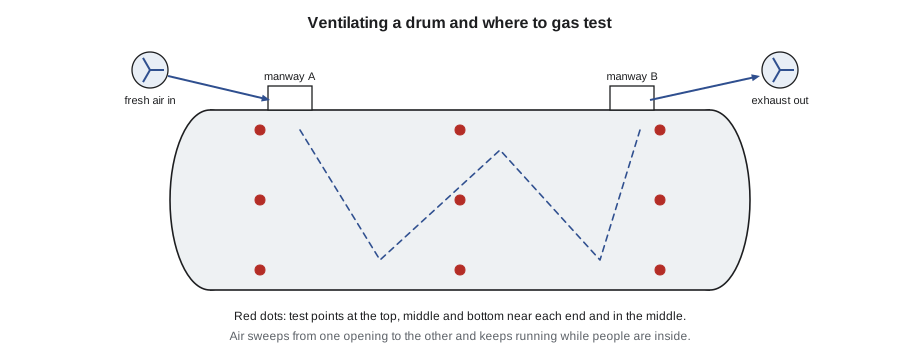
Once the first manway is open, the vessel is ventilated. Most vessels have at least two openings, and the usual arrangement is to blow fresh air in through one and draw it out through the other, so that the air sweeps the whole vessel. The ventilation runs for long enough to give the number of air changes the plant's procedure requires before the first gas test, and it keeps running while people are inside. Air movers that use compressed air or steam must not be used to blow in, because they can carry oil and contaminants; dedicated electric or air-driven fans with clean intakes are used.
Testing the atmosphere
Before anyone enters, the atmosphere is tested for oxygen, flammable gas and the toxic gases that the process could release, such as hydrogen sulfide and carbon monoxide. The tests are done with a calibrated multi-gas detector that has been bump tested before use, by a person trained to use it, and they cover every part of the vessel: top, middle and bottom, near both ends, and in any compartment or behind any baffle. Gases heavier than air collect low; lighter gases collect high; and pockets of gas can hide in dead corners.
The limits for entry are set by law and by the plant. Under OSHA's permit space rule, oxygen must be between 19.5 and 23.5 percent. Flammable gas must be below a fraction of the lower explosive limit; Northgate allows entry below 10 % of the LEL and hot work only at zero. Toxic gases must be below their exposure limits; Northgate's alarm points are 10 ppm for hydrogen sulfide and 25 ppm for carbon monoxide. The atmosphere is retested at set intervals while work continues, and continuously monitored where conditions can change, such as when deposits are being disturbed.
| Gas | Entry limit at Northgate | Why it matters |
|---|---|---|
| Oxygen | 19.5 to 23.5 % | Too little causes collapse without warning; too much raises fire risk |
| Flammable gas | Below 10 % of the LEL; zero for hot work | Ignition can cause a flash fire or explosion |
| Hydrogen sulfide | Below 10 ppm | Toxic; deadens the sense of smell at higher levels |
| Carbon monoxide | Below 25 ppm | Toxic; produced by engines and some processes |
Worked problem
Reading a gas test log
The entry attendant's log for C-410 on the first day of tray work shows six readings. Which readings allow work to continue, where were periodic tests late, and what should have happened at 11:40?
Show solution
- Compare each reading with the limits.
- Check the time since the previous test against the two-hour retest interval.
- Any reading over a limit means everyone leaves the space until the cause is found and fixed.
Answer: The 11:40 reading of 12 % LEL at tray 30 means everyone leaves. Two retests were late. The next test, after ventilation was increased, was back to 3 % LEL.
# Gas test log for a vessel entry: compare each reading with the entry limits
LIMITS = {"O2_low": 19.5, "O2_high": 23.5, "LEL": 10, "H2S": 10, "CO": 25}   # percent, percent, % of LEL, ppm, ppm
RETEST_H = 2   # hours between periodic tests
log = [
    ("06:10", "top manway", 20.8, 0, 0, 0),
    ("06:15", "bottom manway", 20.6, 2, 1, 0),
    ("08:20", "top manway", 20.9, 0, 0, 0),
    ("10:55", "tray 30 area", 20.7, 6, 3, 2),
    ("11:40", "tray 30 area", 20.8, 12, 4, 2),
    ("12:30", "tray 30 area", 20.9, 3, 0, 0),
]   # (time, location, O2 %, LEL %, H2S ppm, CO ppm)

def check(o2, lel, h2s, co):
    bad = []
    if not LIMITS["O2_low"] <= o2 <= LIMITS["O2_high"]: bad.append(f"O2 {o2}")
    if lel >= LIMITS["LEL"]: bad.append(f"LEL {lel}")
    if h2s >= LIMITS["H2S"]: bad.append(f"H2S {h2s}")
    if co >= LIMITS["CO"]: bad.append(f"CO {co}")
    return bad

last = None
for t, where, o2, lel, h2s, co in log:
    h, m = map(int, t.split(":")); now = h + m / 60
    gap = "" if last is None else f" ({now - last:.1f} h since last test)"
    late = last is not None and now - last > RETEST_H
    bad = check(o2, lel, h2s, co)
    verdict = "STOP: " + ", ".join(bad) if bad else "ok"
    print(f"{t} {where:14} O2 {o2:4.1f}  LEL {lel:2}  H2S {h2s:2}  CO {co:2}  {verdict}{gap}{'  RETEST OVERDUE' if late else ''}")
last = now06:10 top manway O2 20.8 LEL 0 H2S 0 CO 0 ok 06:15 bottom manway O2 20.6 LEL 2 H2S 1 CO 0 ok (0.1 h since last test) 08:20 top manway O2 20.9 LEL 0 H2S 0 CO 0 ok (2.1 h since last test) RETEST OVERDUE 10:55 tray 30 area O2 20.7 LEL 6 H2S 3 CO 2 ok (2.6 h since last test) RETEST OVERDUE 11:40 tray 30 area O2 20.8 LEL 12 H2S 4 CO 2 STOP: LEL 12 (0.8 h since last test) 12:30 tray 30 area O2 20.9 LEL 3 H2S 0 CO 0 ok (0.8 h since last test)
The 11:40 reading was not a surprise in hindsight. The crew at tray 30 had started scraping coke from the downcomer, and the coke held hydrocarbon that was released as it was broken up. Under the plant's procedure the attendant called everyone out, the area coordinator was told, ventilation was increased and the crew went back in only after a clean retest. The two late retests were a different problem: the attendant had been covering two entries. Kiera raises it at the next toolbox, and from then on each entry has its own attendant.
Entry and the people outside
Entry into a vessel is entry into a confined space, and the rules from the safety course apply in full: a permit, a trained attendant who stays at the entry point and keeps a count of the people inside, communication with the entrants, a rescue plan with the equipment and people ready to carry it out, and lighting and tools suitable for the atmosphere. On a turnaround the number of entries is large, so plants use entry boards or electronic systems to track who is in which vessel, and rescue teams are stationed in each area.
Lighting inside vessels is low-voltage or explosion-proof, and electrical tools are fed through ground-fault protection. Cords and hoses run through the manway in a way that leaves room for people to get out quickly, and nothing is laid across the manway opening. Kiera's crew uses a manway guard and a tool bag lowered on a line, so that the manway is clear for an emergency exit.
Cleaning for inspection
Inspection needs clean surfaces. Process deposits, scale, coke, sludge and polymer hide corrosion, pitting and cracks, and a thickness gauge needs bare metal to read accurately. Cleaning methods depend on the deposit and the vessel. Loose sludge and scale are removed by hand with shovels and scrapers into containers lowered out of the vessel. Hard deposits are removed by high-pressure water jetting, which is done by specialist crews under their own procedures because the jets can cut through flesh. Abrasive blasting gives the cleanest surface for detailed inspection but produces dust and waste and is used where the inspector asks for it. Chemical cleaning is done before the vessel is opened.
Waste from cleaning is often hazardous. Deposits from sour or hydrocarbon service can contain sulfides, heavy metals or benzene, and some can be pyrophoric. They are kept wet, bagged or drummed, labeled and sent to the plant's waste handling, never left on the ground. Kiera's crew removes about 18 cubic feet of sludge from the bottom of V-2204, wet and in sealed drums, before Teodor starts.
| Method | Good for | Cautions |
|---|---|---|
| Hand cleaning | Loose sludge and scale | Slow; deposits may release gas when disturbed |
| High-pressure water jetting | Hard scale, coke, exchanger tubes | Specialist crews only; serious injection injuries |
| Abrasive blasting | Bare metal for close inspection | Dust, waste, respiratory protection, masking of internals |
| Chemical cleaning | Deposits in closed equipment | Done before opening; neutralize and rinse |
What the inspector does
With the vessel clean, the inspector carries out the internal inspection the inspection plan calls for. It usually begins with a general visual examination of every surface: the shell, heads, nozzles, welds, internals and supports. The inspector looks for general thinning, pitting, grooving at the liquid level, erosion near inlets, cracking at welds and nozzles, blistering, bulging, and damage to linings and internals. Thickness is measured with an ultrasonic gauge at set locations, called condition monitoring locations, so that the readings can be compared with past readings to work out a corrosion rate, which is the subject of lesson 9.
Where cracking is possible, the inspector may call for magnetic particle testing of welds, or more advanced ultrasonic methods. Where a lining is present, it is checked for holidays and disbonding. Internals such as demister pads, baffles, vortex breakers and inlet distributors are checked for damage and for secure fixings. The inspector records the findings, marks areas that need repair, and decides with the engineer whether the vessel can return to service as it is, after repair, or with a lower rating.
In V-2204 Teodor finds a band of grooving along the normal liquid level and scattered pitting in the bottom, typical of the water that collects in an overhead drum. His thickness readings show the shell has thinned faster since the last inspection than in the years before, and he flags it for the engineer. The demister pad is torn at one corner, and two of its clips are missing. These findings become emergent work: a replacement demister section, which is in the warehouse as a contingent spare, and an assessment of the shell, covered in lesson 9.
Closing the vessel
Before the vessel is closed, the crew completes any repairs and replacements, the inspector signs off the hold points, and everything that went into the vessel comes out. A final inspection, often by both the crew and an operator, checks that the vessel is empty of people, tools, rags, lights, scaffold and debris, and that internals are reinstalled and secure. Many plants use a written closing checklist and a tool count, and some require the last person out to sign. Manway gaskets are new, of the specified type and size, and the bolts are tightened in a pattern to the specified torque, as covered in the next lesson.
Kiera does the final walk-through of V-2204 with Colleen. They find a roll of tape and a pair of gloves behind the inlet baffle, which the tool count missed because they were not on the tool list. The tape would probably have ended up in the reflux pump suction. Kiera adds consumables to the crew's tool list for every vessel after that.
Common mistakes
MistakeOpening a manway by removing the bolts nearest you first.
InsteadLoosen the far side first and stand clear, in case of pressure, vacuum or trapped liquid.
MistakeTesting the atmosphere only at the manway.
InsteadTest top, middle and bottom near each end, and behind baffles; gas collects in pockets.
MistakeUsing steam or compressed-air movers to blow air into a vessel.
InsteadUse clean-air fans; steam and air movers can carry oil and contaminants.
MistakeClosing up after a quick look inside.
InsteadDo a written closing inspection and count everything that went in, including consumables.
Summary and key terms
- Vessels are opened only after handover, isolation and a permit, with the far-side bolts loosened first.
- Ventilation sweeps the vessel through two openings and runs while people are inside.
- The atmosphere is tested for oxygen, flammable gas and toxic gases in every part of the vessel, before entry and at intervals.
- Entry needs a permit, an attendant, communication and a ready rescue plan.
- Cleaning must expose bare metal for inspection; cleaning waste is often hazardous.
- The inspector examines every surface, measures thickness at monitoring locations and decides on repairs.
- Closing up needs a written inspection and a count of everything that went in.
- Condition monitoring location
- A marked place where thickness is measured at every inspection.
- LEL
- Lower explosive limit: the lowest concentration of a flammable gas that can ignite.
- Bump test
- A quick check that a gas detector responds to a known gas before use.
- Attendant
- The trained person who stays at the entry point and keeps track of entrants.
- Demister pad
- A mesh pad in a drum that removes liquid droplets from the gas.
- Closing inspection
- The final check that a vessel is empty and complete before it is closed.
Practice problems
Work each problem on paper first, then reveal the answer to check.
A reading inside C-410 shows 12 % of the LEL. What happens?
Show answer
Everyone leaves the space; the cause is found and dealt with, ventilation is improved and entry resumes only after a clean retest.
Why does the inspector want bare metal?
Show answer
Deposits hide pits and cracks, and an ultrasonic gauge needs clean metal for accurate readings.
Why are cleaning deposits kept wet?
Show answer
Some, such as iron sulfide, can heat and ignite as they dry, and wet waste gives off less dust and gas.
What should the closing inspection find?
Show answer
No people, tools, rags, lights, scaffold or debris inside, and internals reinstalled and secure.
Lesson quiz · 5 questions
Score 60% or more to complete this lesson.
Create a free account to save your progress, take quizzes and earn a certificate.