
BLR-330 · Lesson 10 of 12 · 19 min
Working with inspectors and quality hold points
The E-2201A shell nozzle repair is the critical path of Kiera's package, and on its first shift it stops for four hours. Anders has the groove ground and preheated and is ready to weld, but the repair procedure has not yet been accepted by the inspector, and the weld cannot start until it is. Kiera spends the four hours on the radio and in the inspection trailer. When Grant Mahler finally signs the procedure, he tells her something she writes in her notebook. "I'm not here to slow you down," he says. "I'm here so that nobody has to come back and cut this out. If you show me the paperwork before you need me, you'll never wait." This lesson explains the inspectors a boilermaker works with on a turnaround, how inspection and test plans and hold points work, what records the crew must keep and how to work with inspectors so that quality and schedule support each other.
The inspectors on a turnaround
Several kinds of inspector work on a turnaround, each with a different role. The owner's in-service inspectors, such as Teodor, inspect the equipment, decide what repairs are needed and accept the repaired equipment back into service under the owner's inspection program. In the United States, the owner's inspectors are often certified to API 510, API 570 or API 653, and repairs and alterations to code equipment are accepted by an authorized inspector commissioned by the National Board, employed by an inspection agency or by the owner-user.
Contractors have their own quality control staff, who check the crew's work before the owner's inspectors see it. At Ironbridge that is Harjit Gill's group, with a quality control inspector on site for the turnaround. NDE technicians, such as Annika Sorensen's crew from the inspection company, carry out the radiography, ultrasonic, magnetic particle and other tests the plans call for and report the results. Vendors' representatives inspect the installation of their equipment, such as trays and seals. And the jurisdiction's inspectors may visit to inspect equipment under its rules.
| Inspector | Works for | Main role on the turnaround |
|---|---|---|
| Owner's in-service inspector | The plant | Inspects equipment, decides repairs, accepts it back into service |
| Authorized inspector | An inspection agency or owner-user | Accepts repairs and alterations to code equipment |
| Contractor's quality control inspector | Ironbridge | Checks the crew's work before the owner's inspection |
| NDE technician | Inspection company | Carries out and reports the tests the plan calls for |
| Vendor's representative | Equipment maker | Checks installation of the vendor's equipment |
Inspection and test plans
Quality on a turnaround is planned, just like the work. For each job that affects pressure equipment, the work package includes an inspection and test plan, often called an ITP. The ITP lists, in order, every step of the job at which an inspection, test or review is made, who makes it and what kind of point it is. It also names the procedure and acceptance criteria for each check and the record that proves it was done.
There are three main kinds of point. A hold point is a step that work cannot go past until the named inspector has inspected and signed it off: for example, the fit-up of a repair before welding, or a pressure test. A witness point is a step the inspector must be notified of and may attend, but work can continue if the inspector chooses not to come after proper notice. A review point is a check of records, such as material certificates or NDE reports, which can be done afterwards. The ITP shows each inspector's points in its own column.
| Point type | Meaning | Example |
|---|---|---|
| Hold (H) | Work stops until the inspector signs | Repair procedure acceptance; fit-up; pressure test |
| Witness (W) | Inspector notified and may attend; work may continue after proper notice | Welding in progress; bundle reinstalled |
| Review (R) | Records checked, can be after the fact | Material certificates; final paperwork |
Following the plan on the job
The ITP is a working document. A copy goes with the work package, and the lead hand keeps track of which points have been signed and which come next. Before reaching a hold point, the lead hand notifies the inspector with enough notice for the inspector to plan, usually set in the ITP, often a shift or a set number of hours. On a turnaround with hundreds of hold points a day, inspectors are busy, and a crew that calls them only when it is ready waits. A crew that warns them early rarely does.
Worked problem
Where is E-2201A on its ITP?
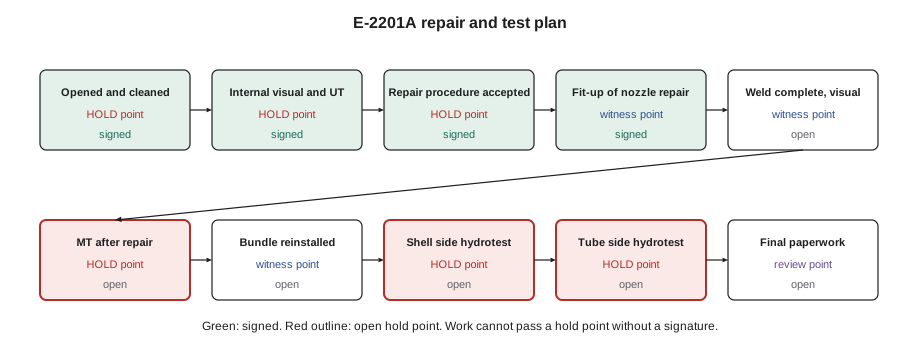
The ITP for the E-2201A nozzle repair and test has ten points. Four are signed. Which is the next point, which is the next hold point, and what should Kiera be doing now?
Show solution
- List the points in order with their type and status.
- The next open point is the next step in the sequence.
- The next open hold point is where work will stop if the inspector is not there.
Answer: The next point is the visual examination of the finished weld, a witness point. The next hold point is the magnetic particle test after the repair, so Kiera should already have notified Annika's crew and Grant.
# Inspection and test plan tracker: hold and witness points for one exchanger
itp = [
    ("Opened and cleaned for inspection", "H", True),
    ("Internal visual and UT by owner", "H", True),
    ("Repair procedure accepted", "H", True),
    ("Fit-up of nozzle repair", "W", True),
    ("Weld complete, visual", "W", False),
    ("MT after repair", "H", False),
    ("Bundle reinstalled, gasket check", "W", False),
    ("Shell side hydrotest", "H", False),
    ("Tube side hydrotest", "H", False),
    ("Final paperwork to owner", "R", False),
]   # (step, point type H/W/R, signed off?)
for step, kind, done in itp:
    mark = {"H": "HOLD", "W": "witness", "R": "review"}[kind]
    print(f"{step:34} {mark:8} {'signed' if done else 'open'}")
open_holds = [s for s, k, d in itp if k == "H" and not d]
first_open = next((s for s, k, d in itp if not d), None)
print(f"Signed {sum(d for _, _, d in itp)} of {len(itp)} points")
if open_holds:
    print(f"Next hold point: {open_holds[0]}. Work past it waits for the inspector.")
print(f"Next open point in sequence: {first_open}")Opened and cleaned for inspection HOLD signed Internal visual and UT by owner HOLD signed Repair procedure accepted HOLD signed Fit-up of nozzle repair witness signed Weld complete, visual witness open MT after repair HOLD open Bundle reinstalled, gasket check witness open Shell side hydrotest HOLD open Tube side hydrotest HOLD open Final paperwork to owner review open Signed 4 of 10 points Next hold point: MT after repair. Work past it waits for the inspector. Next open point in sequence: Weld complete, visual
Kiera uses the tracker every shift. At the morning meeting she lists the hold points her crew will reach in the next 24 hours, with times, and the inspection coordinator schedules the inspectors. When a hold point is signed, the inspector initials the ITP and the record is filed with the job. If an inspection finds a problem, the job goes back to the step where the problem started, and the ITP shows the repeat.
Records the crew keeps
Inspectors accept work on evidence, and much of the evidence comes from the crew. The records a boilermaking crew keeps on a turnaround depend on the job, but usually include material traceability for every pressure part used, with heat numbers matched to certificates; welding records showing which welder made each weld, with which procedure and filler; preheat and interpass temperature records; fit-up and dimensional checks; bolted joint records showing the gasket, lubricant, tool, pattern and final torque for each joint; and pressure test records. Each record must be complete, legible and signed by the person who did the work.
Missing records are one of the commonest reasons for delays at the end of a turnaround. A weld that was made correctly but has no record of who made it, or a gasket fitted without a record of its type, may have to be checked again or even redone. Harjit's quality group checks records each day rather than at the end, so that gaps are found while the people who can fill them are still on site.
| Record | What it shows | Who signs |
|---|---|---|
| Material traceability | Heat numbers of parts match accepted certificates | Crew and quality control |
| Weld record and weld map | Each weld, welder, procedure and filler | Welder and lead hand |
| Preheat and interpass log | Temperatures met the procedure | Welder |
| Fit-up and dimensional check | Joint geometry before welding | Lead hand and inspector at hold point |
| Bolted joint record | Gasket, lubricant, tool, pattern, torque | Bolting technician |
| Pressure test record | Pressure, medium, time, gauges, result | Crew lead and inspector |
When work does not meet the requirement
Sometimes work does not meet the requirement: a weld fails its NDE, a part is the wrong material, a dimension is out of tolerance or a test leaks. When that happens, the work is reported as a nonconformance, through the contractor's quality system, and the owner's inspector is told. The nonconforming item is identified and held so it is not used. The cause is found, the fix is agreed with the inspector and, where needed, the engineer, and the item is repaired, replaced or, rarely, accepted as it is with engineering approval. The nonconformance report records the whole story.
Nonconformances are not a disgrace; hiding them is. A crew that reports a problem early lets it be fixed on its own terms. A crew that covers one up puts the plant and the people at risk, breaks the code and its company's quality system and, when it is found, loses the trust that lets inspectors sign quickly. Kiera has one nonconformance on her package: a bolt set for the E-2201B channel arrives with the wrong material marking. She tags it, reports it and gets a replacement set from stock the same shift.
Working well with inspectors
Inspectors and crews want the same thing: equipment that goes back into service right the first time. Good working relationships make the job faster for everyone. The practices that help are simple. Know the ITP and the next hold points. Notify early. Have the work ready when the inspector arrives: clean, accessible, lit and with scaffolding in place. Have the records ready. Be honest about problems. And when the inspector raises a concern, listen, ask for the reason if it is not clear and fix it rather than arguing.
There will be disagreements. An inspector may reject work that the crew thinks is fine, or ask for more than the package says. The right path is to raise it with the lead hand's foreman and the contractor's quality control, who will resolve it with the owner's inspection group. The crew does not go around the inspector, and does not continue past a hold point without a signature. Grant tells Kiera that in thirty years he has seen more jobs delayed by arguments than by bad welds.
By the end of the first week, Kiera's crew has a routine. Each morning she gives the inspection coordinator the list of hold points for the day. Each evening she checks the ITPs and the records with Harjit's inspector. And when Grant or Teodor arrives at a job, the scaffold is up, the weld is clean and the record is on the clipboard. Her crew does not wait for an inspector again.
Common mistakes
MistakeWorking past a hold point because the inspector is late.
InsteadNever pass a hold point without the signature; notify earlier next time.
MistakeCalling the inspector only when the work is ready.
InsteadGive the notice the ITP requires, ahead of the hold point.
MistakeLeaving records to the end of the turnaround.
InsteadComplete and check records every shift while the people are still on site.
MistakeArguing with the inspector at the job.
InsteadListen, ask for the reason and raise disagreements through the foreman and quality control.
Summary and key terms
- Owner's inspectors, authorized inspectors, contractor quality control, NDE technicians and vendors each have a role.
- An inspection and test plan lists every check, who makes it and what kind of point it is.
- Hold points stop work until signed; witness points need notice; review points check records.
- Lead hands track the ITP, notify inspectors early and have the work and records ready.
- Crews keep traceability, weld, preheat, fit-up, bolting and test records, checked daily.
- Nonconformances are reported, held, fixed and recorded; hiding them breaks trust and the code.
- Inspection and test plan
- The list of every inspection, test and review on a job, with who does it and the type of point.
- Hold point
- A step that work cannot pass until the named inspector signs.
- Witness point
- A step the inspector must be notified of and may attend.
- Review point
- A check of records that can be done after the work.
- Nonconformance
- Work or material that does not meet the requirement, reported and resolved through the quality system.
- Weld map
- A drawing that identifies each weld and who made it.
Practice problems
Work each problem on paper first, then reveal the answer to check.
The fit-up of a repair is a hold point and the inspector is two hours late. What does the crew do?
Show answer
Wait, and use the time on other work; it does not weld until the fit-up is signed. The lead hand reports the delay.
What is the difference between a witness point and a hold point?
Show answer
Work may continue past a witness point after proper notice if the inspector does not attend; it cannot pass a hold point without a signature.
A bolt set arrives with the wrong material marking. What happens?
Show answer
It is tagged and held, reported as a nonconformance and replaced with a correct set.
Why are records checked every day instead of at the end?
Show answer
Gaps are found while the people who can fill them are still on site.
Lesson quiz · 5 questions
Score 60% or more to complete this lesson.
Create a free account to save your progress, take quizzes and earn a certificate.