
BIOL-499 · Lesson 6 of 12 · 19 min
Ethics, permits, animal care and biosafety
▶ Video coming soon A video version of this lesson is on the way.
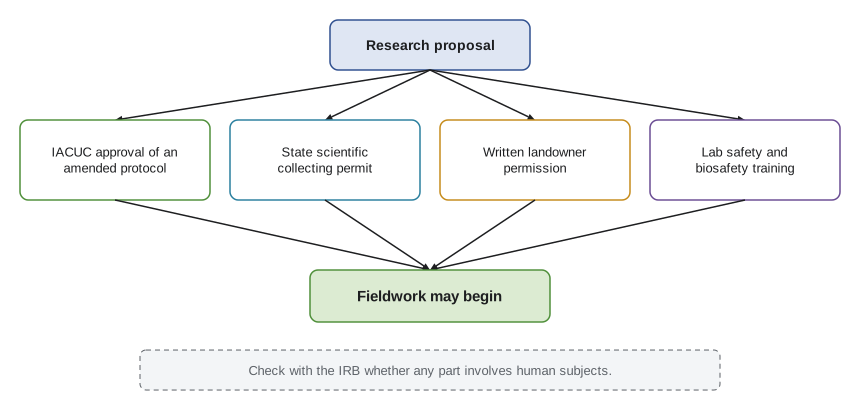
Before Priya could put a dip net in a wetland, she needed permission from several different bodies. Her university had to approve her treatment of animals, a government agency had to permit her to capture and handle wildlife, the landowner had to agree to her presence and methods, and the lab where she would analyze her water samples had to train her in its safety rules. None of this is paperwork for its own sake. Each approval exists because research has, in the past, harmed animals, people, ecosystems or researchers themselves, and each protects something worth protecting.
This lesson covers the approvals and responsibilities that biology honors students most often meet: research integrity, the care and use of animals, wildlife permits and landowner permission, research involving people, work on Indigenous lands or with Indigenous knowledge, and biosafety and lab safety. The rules differ between countries, institutions and provinces or states, so the lesson describes the main frameworks and the questions to ask; always check your own institution's current requirements.
Research integrity
Research integrity means conducting research honestly, accurately and responsibly. In the United States, federal policy defines research misconduct as fabrication, falsification or plagiarism in proposing, performing or reviewing research or in reporting results, and agencies such as the Public Health Service, through its Office of Research Integrity, and the National Science Foundation investigate misconduct in the research they fund. Universities have their own policies, which usually also cover failing to obtain approvals, mishandling data and unfair authorship.
Fabrication is making up data. Falsification is manipulating materials, methods or data, for example dropping inconvenient data points without a stated reason or altering images, so that the record does not accurately represent the research. Plagiarism is using others' ideas, words or data without credit. Most integrity problems in student research are not deliberate fraud but carelessness: undocumented exclusions of outliers, copied text from a source with a light paraphrase, or figures made from a different version of the data than the one analyzed. Good record keeping, covered in lessons 7 and 8, is the best protection.
Authorship is part of integrity. Authors of a paper are people who made substantial contributions to the work and who take responsibility for it; others who helped are acknowledged. Many journals now ask authors to state their contributions using a standard list of roles, such as the CRediT taxonomy, which includes conceptualization, methodology, investigation, formal analysis, writing and supervision. Priya and Dr. Okafor agreed at the start that if the work were published, Priya would be first author, with Dr. Okafor, Dr. Szabo, Mei Chen and the station's data manager as co-authors if they contributed as expected.
Animal care and use
Research with live vertebrate animals requires approval before work begins, including field studies that only observe, capture briefly and release. In the United States, institutions that receive Public Health Service funding must follow the PHS Policy on Humane Care and Use of Laboratory Animals, which covers all live vertebrates, and each institution has an Institutional Animal Care and Use Committee (IACUC) that reviews protocols. The federal Animal Welfare Act regulations cover warm-blooded animals but exclude cold-blooded animals such as amphibians, so for frogs the requirement comes from the PHS Policy and institutional rules, which typically apply IACUC review to every vertebrate. For field work, IACUCs often refer to professional guidelines such as those for the use of live amphibians and reptiles in field and laboratory research.
Animal care committees evaluate protocols using the principle of the Three Rs, first proposed by William Russell and Rex Burch in 1959: replacement (use non-animal methods where possible), reduction (use the minimum number of animals needed for valid results) and refinement (minimize pain, distress and disturbance). Priya's protocol applied all three.
- Replacement: calling was recorded with automated recorders and breeding was detected with eDNA, neither of which required handling frogs.
- Reduction: tadpoles were counted in the net and released immediately at the point of capture; none were collected or kept, and the number of sweeps was the minimum that gave stable estimates in the pilot data.
- Refinement: tadpoles stayed in water at all times, counting took less than a minute per sweep, and Priya stopped sampling if water temperatures exceeded a threshold set in the protocol.
Her protocol was an amendment to Dr. Okafor's existing approved protocol for the station, which saved time, but it still required review because it added a new procedure, dip-netting tadpoles, and a new person. All personnel on an animal protocol must complete training, which for Priya meant an online course and an in-person session on handling amphibians. The IACUC classified the procedures as causing no more than momentary, slight pain or distress.
Wildlife permits and landowner permission
Wild animals are generally managed by governments, and capturing, handling or collecting them for research usually requires a permit, even for common species. In Minnesota, the Department of Natural Resources issues scientific and special permits for collecting or handling wildlife for research, and other states have similar systems. Species listed under the federal Endangered Species Act or state endangered species laws need additional permits. Permit applications typically describe the species, numbers, methods, locations and dates, and the permit holder must report what was done afterward. Permits often take weeks to process, which is why Priya's supervisor applied in February.
Rare species can turn up unexpectedly. Priya's protocol stated that if she caught a northern leopard frog tadpole or another species of conservation concern, she would record it and release it immediately without further handling. She caught two in June, and both were reported in her permit report.
Access to land is separate from permits. The wetlands were on private ranch land, and the station's agreement with the ranch allowed researchers on the land under conditions: gates left as found, vehicles kept to trails, no work during calving season near the calving pasture, and advance notice of visits. Priya signed the station's access agreement and met the ranch manager before the season. Treating landowners well is not only courteous; long-term field research depends on their goodwill.
Research involving people
Research that involves human participants, including surveys, interviews and observations of identifiable people, requires review by a research ethics committee. In the United States, this is the Institutional Review Board (IRB), which applies the federal Common Rule (45 CFR 46) for federally funded research and institutional policy for other research. Core principles include respect for persons through informed consent, concern for welfare and justice in who bears the burdens and benefits of research.
Priya wanted to know when each wetland was fenced and how the cattle were managed. She planned to ask the ranch manager. She checked with her university's research ethics office, which advised that collecting facts about land management, rather than information about the manager's opinions, experiences or behavior, was not research involving human participants and did not need review. Had she planned to survey ranchers about their attitudes to fencing, review would have been required. When in doubt, ask the ethics office; the decision is theirs, not the researcher's.
Indigenous lands, rights and knowledge
Field stations and study sites across North America lie on the lands of Indigenous peoples. The station is in the homelands of Dakota and Anishinaabe peoples. Research on tribal lands requires tribal approval, and many tribes have their own research review processes. The CARE principles for Indigenous data governance, collective benefit, authority to control, responsibility and ethics, complement the FAIR principles for data sharing. Priya's project did not take place on reserve or tribal land or use Indigenous knowledge, but the station shares its results each year with a nearby Indigenous community that has an interest in the wetlands, and Priya presented a short summary of her findings at that meeting.
Biosafety and lab safety
Laboratory work brings its own approvals. Every lab has hazards, chemical, biological, physical and radiological, and every person working in it must be trained before starting. Workplace chemical hazards are communicated under the OSHA Hazard Communication Standard, with labels and safety data sheets for each product. Priya's eDNA work used ethanol, bleach for decontamination and DNA extraction reagents, all low to moderate hazards, and she completed the lab's chemical safety training and a session with Mei Chen on the lab's procedures.
Work with microorganisms, toxins or recombinant DNA requires biosafety review. The Biosafety in Microbiological and Biomedical Laboratories manual, published by the CDC and NIH, describes four biosafety levels, BSL-1 to BSL-4, and research with recombinant DNA at institutions with NIH funding is reviewed by an Institutional Biosafety Committee under the NIH Guidelines. Aisha's project on soil bacteria needed biosafety approval because unknown environmental isolates might include opportunistic pathogens. She worked at the second containment level, in a biosafety cabinet, with procedures her supervisor's lab already had approved. Priya's eDNA work involved only DNA extracted from water, not live organisms, but the lab still required its standard training.
Fieldwork has biosafety issues too. Amphibian pathogens, especially the chytrid fungus Batrachochytrium dendrobatidis and ranaviruses, can be carried between wetlands on boots and nets. Priya's protocol required decontaminating all gear between wetlands, by scrubbing off mud and treating with a disinfectant such as a dilute bleach solution or another approved product, followed by rinsing away from the water. She also visited wetlands in the same order each time where possible and carried separate nets for each pair.
Field safety
Field safety is part of the ethics of research, because supervisors and institutions have a duty of care to students. Priya's department required a field safety plan listing hazards, such as soft wetland margins, cattle and bulls, ticks, heat, lightning and driving on gravel roads, with the precautions for each, and a check-in procedure: she worked with a partner, filed a daily plan with the station, and called in when she left the field each day. If she did not call within an agreed time after her expected return, the station manager followed a written escalation procedure. Working alone in remote areas is the situation most field safety rules exist to prevent.
Approvals have conditions and end dates, and they must be followed after they are granted. Priya kept copies of every approval in her project folder, carried the permit in the field as its conditions required, and recorded each wetland visit so that she could complete the permit report and the animal care committee's annual report accurately. When she later decided to add a second dip-net visit in mid-June, she checked that the approved protocol already allowed two visits before doing it. Had it not, she would have needed an amendment first; changing procedures without approval is itself a breach of the rules, however minor the change seems.
Worked problem
Applying the Three Rs to a design
An earlier student proposed to collect 30 tadpoles from each of 24 wetlands, preserve them and measure their development stage in the lab. Suggest how the Three Rs could change this plan while still answering whether development differs between fenced and grazed wetlands.
Show solution
- Replacement: development stage can be assessed from photographs of live tadpoles in a shallow tray, avoiding the need to preserve animals.
- Reduction: a pilot can show how many tadpoles per wetland give a stable mean stage; perhaps 10 per wetland, not 30.
- Refinement: keep tadpoles in wetland water in shaded trays, photograph quickly and release at the point of capture.
- Together these changes answer the same question with no animals killed and fewer handled.
Answer: Photographing about 10 live tadpoles per wetland and releasing them replaces lethal collection, reduces numbers by two thirds and refines handling, while still allowing a comparison of development stage.
Common mistakes
MistakeObservational field studies do not need animal care approval.
InsteadCapturing or handling vertebrates, even briefly, generally requires approval; check with your committee.
MistakeA government permit replaces landowner permission.
InsteadPermits and land access are separate; you need both.
MistakeIf no one asks, informal conversations with people are never research.
InsteadAsk the ethics office; collecting people's opinions or experiences systematically usually requires review.
MistakeIntegrity problems only involve deliberate fraud.
InsteadCareless record keeping, undocumented data exclusions and weak paraphrasing are the common problems.
Summary and key terms
- Research integrity prohibits fabrication, falsification and plagiarism and requires honest records, fair authorship and proper approvals.
- Vertebrate animal research, including field capture, needs approval from an institutional animal care committee, guided by the Three Rs.
- Wildlife permits, extra permits for species at risk, and landowner permission are separate requirements.
- Research with human participants needs ethics review; the ethics office decides whether review applies.
- Research on Indigenous lands or with Indigenous knowledge requires engagement and respect for data governance principles such as OCAP and CARE.
- Lab safety, biosafety, field biosecurity and field safety plans protect researchers, organisms and ecosystems.
- Research misconduct
- Fabrication, falsification or plagiarism in proposing, performing, reviewing or reporting research.
- Three Rs
- Replacement, reduction and refinement, the guiding principles for the ethical use of animals in research.
- Animal care committee
- An institutional committee that reviews and approves protocols involving animals.
- Research ethics committee
- An institutional board that reviews research involving human participants.
- Containment level
- A set of physical and operational requirements for safely handling biological materials of a given risk.
- Biosecurity
- Measures that prevent the spread of pathogens and invasive species, such as decontaminating field gear.
Practice problems
Work each problem on paper first, then reveal the answer to check.
Name the three parts of research misconduct.
Show answer
Fabrication, falsification and plagiarism.
Give one example each of replacement, reduction and refinement in a field study.
Show answer
Replacement: recorders instead of capture; reduction: fewer sweeps or animals based on a pilot; refinement: keeping animals in water and releasing them quickly.
Why did Priya decontaminate nets between wetlands?
Show answer
To avoid spreading amphibian pathogens such as chytrid fungus and ranaviruses between wetlands.
What should a field safety plan include?
Show answer
Hazards and precautions, working with a partner, a daily plan filed with a contact, and a check-in and escalation procedure.
Lesson quiz · 5 questions
Score 60% or more to complete this lesson.
Create a free account to save your progress, take quizzes and earn a certificate.