
BIOL-499 · Lesson 1 of 12 · 19 min
What an honors project in biology is: from coursework to research
▶ Video coming soon A video version of this lesson is on the way.
Every course in the Biology program so far has asked you to learn what is already known: how cells divide, how genes are regulated, how populations grow and how ecosystems cycle carbon. This course asks you to add something to that knowledge. An honors project is a piece of original research, small in scale but real, that you plan, carry out, analyze, write up and defend under the supervision of a faculty member. It is the closest an undergraduate degree comes to the daily work of a professional biologist, and for many students it is the part of the degree they remember best.
The course follows one student through one project from the first conversation with a supervisor to the oral defense. Priya Nair spent the summer before her final year as a field assistant at the Otter Tail Prairie Field Station near Fergus Falls, Minnesota, the station run by Dr. Amara Okafor that you met in BIOL-430 Field Ecology. The station's long-term study compares prairie pothole wetlands where a cooperating ranch fenced cattle out of the wetland margins with paired wetlands that cattle can still reach. Priya wanted to know whether the fencing mattered for one of the commonest animals in those wetlands, the boreal chorus frog, Pseudacris maculata, a small treefrog whose rasping call, like a thumb running along the teeth of a comb, is one of the first sounds of spring on the prairies.
Her project, carried out at Red River State University in the 2025 to 2026 academic year, is invented, as are all the people and data in this course, but every step she takes is one that real honors students take. The project is used to teach general skills that apply whether your own research is in a field, a molecular lab, a greenhouse, a museum collection or on a computer.
What makes research different from coursework
In a course, the questions are set by the instructor, the answers are known, and the methods have been tested many times. In research, you help choose the question, nobody knows the answer, and the methods may not work the first time. Four differences matter most.
- Uncertainty is normal. Experiments fail, animals do not appear, sequencing runs return poor data and weather destroys field plots. A research project is designed so that useful knowledge comes out even when things go wrong.
- The work is open-ended. There is always another analysis to run or another paper to read. Part of the skill is deciding what is enough for the question and the time available.
- You are responsible for decisions. Your supervisor advises, but you choose sample sizes, write protocols and justify your analysis. Examiners will ask why you made each choice.
- The product is communication. Research that is not written up and shared does not join the body of knowledge. The thesis, poster and defense are not extras; they are how your work becomes science.
These differences explain why the honors project is assessed differently from a course. Most programs weigh the written thesis most heavily, then the oral presentation or defense, and many also give marks for the proposal and for conduct during the project, such as reliability, independence and safe practice. Your program's honors handbook sets out the exact weights and deadlines, and reading it in the first week is the single most useful thing you can do.
Kinds of honors projects
Biology honors projects come in several broad kinds, and many combine more than one. Knowing which kind you are doing helps you plan, because each has different bottlenecks.
| Kind of project | Typical example | Common bottleneck |
|---|---|---|
| Field study | Comparing frog breeding in fenced and grazed wetlands | Seasons and weather: data can only be collected in a short window |
| Laboratory experiment | Testing how temperature affects Daphnia growth | Protocol optimization and contamination |
| Molecular or genomic | Detecting a species from environmental DNA, or sequencing a gene family | Reagent costs, run failures and bioinformatics time |
| Computational or modeling | Simulating population dynamics, or reanalysing public data | Debugging, data access and computing time |
| Collections-based | Measuring museum specimens to track body size over a century | Access to specimens and consistent measurement |
| Literature synthesis or meta-analysis | Combining published effect sizes on a question | Finding enough comparable studies and extracting data |
Priya's project is mainly a field study with a molecular component. She records frog calls with automated recorders, counts tadpoles, measures water turbidity and collects water samples whose environmental DNA, or eDNA, is tested in the lab for chorus frog DNA. Her classmate Tomás Reyes is doing a laboratory experiment on heat tolerance in the water flea Daphnia, and their friend Aisha Rahman is working on antibiotic resistance genes in soil bacteria. The three projects appear throughout the course as contrasts, because what counts as good practice differs between a wetland, a growth chamber and a microbiology lab.
The honors year at a glance
Honors projects usually run over two terms, but the work often starts earlier. A field project is tied to the seasons: chorus frogs breed in April, May and June, so Priya had to plan her project, obtain approvals and be ready in the field before her honors year formally began. Lab and computational projects have more flexible timing but face their own deadlines, such as booking shared equipment or waiting for sequencing results.
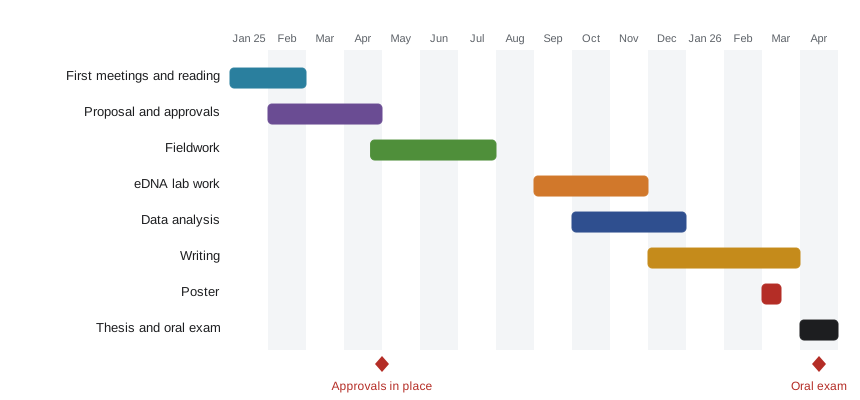
Priya's timeline is typical of a field project. She first met Dr. Okafor in January 2025, read and wrote a proposal over the winter, obtained her approvals in the spring, collected data from late April to July, ran the lab work and analysis in the fall, wrote over the winter and defended her thesis in April 2026. Each stage has its own lesson in this course.
People in an honors project
Research is a team activity, even when one person's name is on the thesis. Knowing who does what avoids misunderstandings.
- The supervisor is the faculty member responsible for your project. Dr. Okafor helped Priya shape the question, gave her access to the station and its long-term data, paid for the eDNA lab work from her research grant, and read drafts. A supervisor is a mentor, not a manager who checks every step, and good supervisors expect you to bring questions and proposals to meetings.
- The second reader or committee member reads the thesis and usually takes part in the defense. Priya's second reader was Dr. Daniel Szabo, a quantitative ecologist, who agreed to help with the statistics.
- The honors coordinator, Dr. Ruth Halvorsen in Priya's department, runs the course, sets deadlines, organizes the poster day and handles problems, such as a breakdown in the relationship between a student and a supervisor.
- Technicians and staff make much research possible. Mei Chen, the manager of the eDNA lab, trained Priya in sterile technique and ran quality checks on her extractions. Field station staff maintained the recorders and the truck.
- Graduate students and postdoctoral researchers in the lab are often the people you will ask most questions of, day to day. Treat their time as you would want yours treated.
Many supervisors ask honors students to agree on expectations in writing at the start: how often you will meet, how quickly drafts will be returned, who owns the data, whether you will be an author on any paper that results, and what happens if a deadline is missed. Some departments supply a template for this agreement. It can feel overly formal, but it prevents most of the problems that arise between students and supervisors, which usually come from expectations that were never discussed.
Skills you will build
The honors project develops skills that employers and graduate programs value, whether or not you go on in research. Priya's list, which she wrote in her first week and reread at the end, included the following.
| Skill | Where it is developed | Lesson |
|---|---|---|
| Turning a topic into an answerable question | Proposal stage | 2, 4 |
| Finding and judging scientific literature | Literature review | 3 |
| Designing studies with adequate replication | Planning | 5 |
| Working ethically and safely, with the right approvals | Approvals and fieldwork | 6, 7 |
| Managing data so that analyses can be repeated | Throughout | 8 |
| Analyzing data and stating uncertainty honestly | Analysis | 9 |
| Writing clear scientific prose and figures | Thesis | 10 |
| Speaking about your work and answering questions | Poster and defense | 11 |
| Planning a long project and recovering from setbacks | Throughout | 12 |
Project management deserves a special mention because it is rarely taught. An honors project is often the first time a student works for eight months toward one goal with no weekly assignments to pace them. Students who succeed usually break the project into stages with dates, keep a running list of tasks, and tell their supervisor early when something is slipping. Students who struggle usually wait, hoping that a problem will solve itself.
A first look at the scientific method in practice
Textbook diagrams show the scientific method as a neat cycle: observe, ask a question, form a hypothesis, make a prediction, test it and draw a conclusion. Real research loops back constantly. Priya's project began with an observation from the summer before: the fenced wetlands looked clearer and greener at the edges, and she seemed to hear more chorus frogs at them. That observation was anecdotal, from a few evenings and a few wetlands. It led to a question, whether excluding cattle increases chorus frog breeding success. Reading the literature then sharpened the question and suggested a mechanism: cattle trampling stirs up sediment and removes the emergent vegetation where chorus frogs attach their eggs, so fencing might help through clearer water and more egg-laying sites.
From that mechanism came hypotheses and predictions: if fencing helps, fenced wetlands should have lower turbidity, more calling and more tadpoles than their paired grazed wetlands. Each prediction could be tested with data. As you will see, the data supported one prediction clearly, gave an uncertain answer for another, and revealed a technical problem that turned into one of the most interesting parts of the thesis. That is a normal outcome. The aim of an honors project is not to confirm what you expected but to find out, honestly and carefully, what is true.
Worked problem
Scoping a project to fit the time available
Tomás proposes to test heat tolerance in five Daphnia genotypes at six temperatures, with ten replicate jars per combination, each monitored daily for 21 days. Each jar takes about 4 minutes to check and feed. Estimate the daily workload and judge whether the design is realistic for one student who also has two courses.
Show solution
- Count the jars: 5 genotypes times 6 temperatures times 10 replicates gives 300 jars.
- Daily checking time is 300 jars times 4 minutes, which is 1,200 minutes, or 20 hours a day.
- That is impossible for one person, so the design must be reduced. Cutting to 3 genotypes, 4 temperatures and 6 replicates gives 72 jars, or 288 minutes, about 4.8 hours a day.
- Even that is heavy alongside courses. Checking every second day for growth, with daily survival checks that take 1 minute per jar, brings the routine load nearer 2 hours a day.
Answer: The original design needs about 20 hours a day. A reduced design of about 72 jars, with lighter routine checks, is feasible. Scoping by arithmetic early prevents an impossible project.
The example shows a habit worth adopting: before committing to a design, multiply out the workload. Field projects have the same arithmetic. Priya's recorders ran themselves, but each wetland visit for dip-netting and water sampling took about 90 minutes including driving between wetlands, and with 24 wetlands visited four times, that was 144 hours of fieldwork before any lab work began.
Common mistakes
MistakeAn honors project is a long assignment with a known answer.
InsteadIt is original research: nobody knows the answer in advance, and a well-designed project produces useful knowledge whatever the result.
MistakeThe supervisor will tell me what to do each week.
InsteadThe supervisor advises and mentors; you are expected to plan, propose and bring questions.
MistakeA project only succeeds if the hypothesis is supported.
InsteadA clear, honest test of a hypothesis is a success even when the data do not support it.
MistakePlanning can wait until the honors year starts.
InsteadField and seasonal projects often need approvals and planning months earlier; check timing with your supervisor early.
Summary and key terms
- An honors project is original research carried out by an undergraduate under supervision, from proposal to defense.
- Research differs from coursework in its uncertainty, open-endedness, personal responsibility for decisions and emphasis on communication.
- Projects may be field, laboratory, molecular, computational, collections-based or synthesis, and each has typical bottlenecks.
- Supervisors, second readers, coordinators, technicians and lab members all contribute; agree on expectations early.
- Real research loops between observation, question, hypothesis and test, and unexpected results are common and valuable.
- Scoping a project by estimating workload early prevents designs that cannot be completed.
- Honors project
- An independent research project completed by an undergraduate student, usually in the final year, and assessed through a thesis and presentation.
- Supervisor
- The faculty member responsible for guiding a student's research project.
- Second reader
- A faculty member who evaluates the thesis and usually takes part in the defense.
- Hypothesis
- A proposed explanation that leads to testable predictions.
- Prediction
- A specific outcome expected if a hypothesis is true.
- Environmental DNA (eDNA)
- DNA shed by organisms into their surroundings, such as water or soil, which can be sampled to detect species.
Practice problems
Work each problem on paper first, then reveal the answer to check.
Name two ways research differs from coursework.
Show answer
Any two of: the answer is unknown, the work is open-ended, the student is responsible for decisions, and the product is communication of new knowledge.
A lab project needs 48 cultures checked daily at 5 minutes each. How many hours a day is that?
Show answer
48 times 5 is 240 minutes, which is 4 hours a day.
Why did Priya's planning start before her honors year began?
Show answer
Chorus frogs breed in spring, so approvals and preparation had to be complete before the field season in late April.
What should a supervisor and student agree on at the start?
Show answer
Meeting frequency, turnaround for drafts, data ownership, authorship on any publication and what happens when deadlines slip.
Lesson quiz · 5 questions
Score 60% or more to complete this lesson.
Create a free account to save your progress, take quizzes and earn a certificate.