
BIOL-499 · Lesson 12 of 12 · 19 min
Capstone: a model honors project from question to defense
▶ Video coming soon A video version of this lesson is on the way.
This final lesson brings the course together by looking back at Priya's project as a whole and then looking forward to yours. It presents her project in the form an examiner sees it, through the abstract and the structure of the finished thesis, identifies the decisions that made the project succeed, and turns those decisions into a plan and a checklist you can use for your own honors year. It ends with what comes after the honors project, whether that is graduate school, a job in biology or something else entirely.
The project at a glance
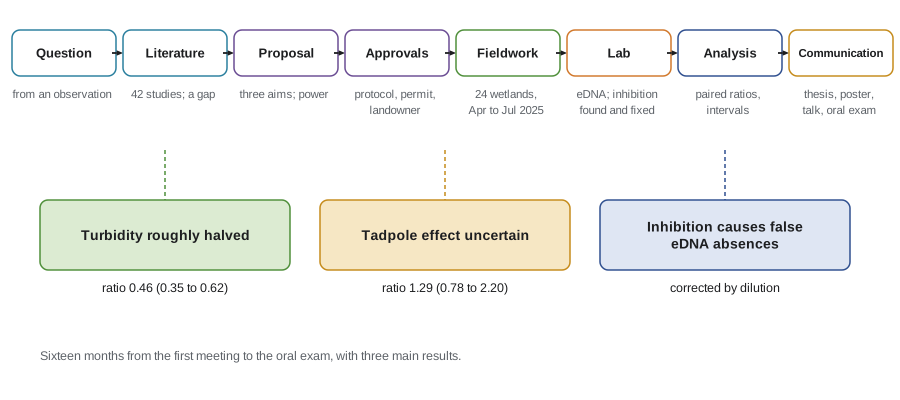
Priya began with a casual observation during a summer job and finished, sixteen months later, with a thesis that answered one question clearly, answered another honestly but uncertainly, and discovered something no one had planned to look for. That combination is typical of good honors projects. Very few produce a dramatic confirmation of a hypothesis. Many produce a careful, well-documented answer that adds a piece to what is known and shows the student can do research.
The finished abstract
Here is the abstract of Priya's thesis, 245 words, written last. It follows the structure described in lesson 10: context and gap, aims, methods, results with numbers and conclusions.
Livestock grazing is widespread around prairie pothole wetlands, which provide breeding habitat for amphibians, but evidence of grazing effects on amphibian breeding is mixed and rarely comes from paired comparisons. I tested whether excluding cattle from wetland margins changed water clarity and boreal chorus frog breeding, and evaluated environmental DNA (eDNA) as a tool for detecting breeding. At a long-term study site in west-central Minnesota, I sampled 12 pairs of wetlands, each pair in one pasture with one wetland fenced and one open to cattle. I measured turbidity on four visits, scored chorus calling from automated recordings on 30 nights, counted tadpoles with standardized dip-netting, and tested water samples for chorus frog eDNA by qPCR with an internal positive control. Turbidity in fenced wetlands was 0.46 times that in grazed wetlands (95 in 100 confidence interval 0.35 to 0.62). Tadpole densities were 1.29 times higher in fenced wetlands (0.78 to 2.20) and calling nights 1.18 times higher (0.86 to 1.61), but neither difference was clear, and tadpole density was not related to within-pair changes in turbidity. Before dilution, eDNA detection appeared much lower in grazed wetlands, but this reflected PCR inhibition associated with turbidity; after dilution, detection was similar in both treatments and matched calling records. Cattle exclusion strongly improves water clarity, but larger or longer studies are needed to determine its effect on chorus frog breeding. eDNA surveys in turbid wetlands must test for and correct inhibition to avoid false absences.
The structure of the thesis
| Section | Length (words) | Main contents |
|---|---|---|
| Abstract | 245 | As above |
| Introduction | 1,520 | Prairie potholes and amphibians; how cattle alter margins; mixed evidence; the gap; three aims and predictions |
| Methods | 1,880 | Site and paired design; turbidity, vegetation, calling, tadpoles and eDNA; approvals; analysis plan and software |
| Results | 1,410 | Five figures and two tables: habitat, calling, tadpoles, the turbidity relationship and eDNA before and after dilution |
| Discussion | 2,640 | Main findings; comparison with other studies; why the mechanism was not supported; inhibition and eDNA practice; limitations; implications; future work |
| Conclusion | 310 | Three conclusions in plain terms |
| References | not counted | 61 sources, Council of Science Editors name-year style |
| Appendices | not counted | Protocols, data dictionary, t-test and mixed model checks, sensitivity analysis, permit and protocol numbers, data and code locations |
What made the project work
Looking back with Dr. Okafor after the defense, Priya identified the decisions that mattered most. They are worth considering for any project, whatever the field.
- A focused question built on an existing system. Using the station's paired wetlands gave her a design she could never have built alone and baseline data that strengthened her conclusions.
- Early planning for a seasonal deadline. Approvals were requested in February, two months before the frogs began calling.
- A power analysis before the field season. It did not change the number of pairs, which was fixed, but it changed how she measured, how she interpreted the results and what she told her examiners.
- Aims that could succeed independently. When the tadpole result was uncertain, the turbidity and eDNA aims still delivered clear findings.
- Controls and quality checks that revealed a hidden problem. The internal positive control turned a misleading result into the most useful finding of the project.
- Records good enough to answer any question. The field notebook entry about the broken fence and the project log entry about dilution both mattered at the defense.
- Scripted, reproducible analysis. Correcting one data entry error and rerunning everything took minutes, not days.
- Honest reporting. Reporting the uncertain tadpole result and the sensitivity analysis earned more credit from the examiners than an overstated claim would have.
Planning your own honors year
Every project has a final deadline, and the most reliable way to plan is backward from it. Start with the submission date, subtract the time needed for each stage, and see when each must begin. If the start dates have already passed, the project is too large and must be scoped down now, not discovered to be too large in March.
# Backward planning from a thesis deadline: when must each stage start?
from datetime import date, timedelta
deadline = date(2027, 4, 9)                 # example submission date
stages = [                                   # (stage, weeks), last stage first
    ("Final revisions after feedback", 2),
    ("Second draft and feedback", 4),
    ("First full draft", 6),
    ("Analysis and figures", 6),
    ("Data collection", 12),
    ("Approvals and pilot", 8),
    ("Proposal", 5),
]
end = deadline
plan = []
for name, weeks in stages:
    start = end - timedelta(weeks=weeks)
    plan.append((start, end, name))
    end = start
for start, finish, name in reversed(plan):
    print(f"{start:%d %b %Y} to {finish:%d %b %Y}  {name}")
print("Total weeks:", sum(w for _, w in stages))12 Jun 2026 to 17 Jul 2026 Proposal 17 Jul 2026 to 11 Sep 2026 Approvals and pilot 11 Sep 2026 to 04 Dec 2026 Data collection 04 Dec 2026 to 15 Jan 2027 Analysis and figures 15 Jan 2027 to 26 Feb 2027 First full draft 26 Feb 2027 to 26 Mar 2027 Second draft and feedback 26 Mar 2027 to 09 Apr 2027 Final revisions after feedback Total weeks: 43
The example, with an April 2027 deadline, shows the proposal starting in mid-June 2026. For a student who has not started by then, the stages must overlap or shrink: a shorter data collection, analysis beginning before collection ends, or writing the methods during data collection. That is exactly what Priya did, and it is why her proposal included a timeline with overlaps. Adapt the stages and durations to your project; lab projects often have longer data collection and shorter approvals, and computational projects longer analysis.
A checklist for your project
| Stage | Check |
|---|---|
| Start | Supervisor agreed; expectations, meetings, budget and authorship discussed and written down; honors handbook read |
| Question | Focused, answerable, feasible, interesting and ethical; hypotheses and predictions written; possible outcomes and their meanings listed |
| Literature | Searches recorded; reference manager set up; literature matrix kept; gap identified |
| Proposal | Aims and measurable objectives; design with experimental units identified; power or precision considered; analysis plan; timeline; budget with contingency; risks and fallbacks |
| Approvals | Animal care, human ethics, permits, land access, biosafety and safety training as needed, all before data collection |
| Data collection | Versioned protocols; pilot done; notebooks and data sheets; calibration; controls; unusual events recorded |
| Data management | Folder structure; read-only raw data; data dictionary and README; scripted cleaning and checks; 3-2-1 backups |
| Analysis | Plots first; planned analyses; estimates with intervals; assumptions checked; sensitivity analyses; exploratory work labeled |
| Writing | IMRaD structure within limits; figures with full captions; limitations discussed; references checked; drafts scheduled with feedback; AI policy followed |
| Communication | Poster and talk practiced; list of likely defense questions; mock defense; revisions completed; data deposited; partners informed |
When things go wrong
Almost every honors project meets a serious problem. Tomás lost three weeks when an incubator failed and killed a round of Daphnia, which he recovered by shortening the experiment and adding a round in January. Aisha found that half her soil isolates had been contaminated during subculturing and had to repeat them, which she could do because she had frozen stocks of every original isolate. Priya's problems, the inhibition and the cattle breach, became parts of her thesis.
Three habits help. First, tell your supervisor early: problems are much easier to solve in October than in March, and supervisors have seen most problems before. Second, keep the question in view and ask what the minimum is that still answers it. Third, look after yourself. Honors years are demanding, and many students also manage courses, jobs and family. Universities provide academic advising, accessibility services, counseling and extensions for illness or emergencies. Using them is not a weakness; finishing a project well while staying healthy is the goal.
After the honors project
An honors project opens several paths. For students considering graduate school, it is the most important evidence of research ability, and supervisors' reference letters are based on it. Many master's and doctoral supervisors recruit students who have shown they can complete a project, and an honors thesis that leads to a conference presentation or a paper strengthens an application. In the United States, graduate students in biology are commonly funded through teaching and research assistantships, university fellowships and national awards such as the National Science Foundation Graduate Research Fellowship Program.
Outside research, the skills from an honors project apply to environmental consulting, government science and management agencies, conservation organizations, biotechnology and pharmaceutical companies, health care, teaching, science policy and science communication. Employers value the ability to design a project, manage data, analyze it honestly, write clearly and present to different audiences, and an honors thesis is concrete evidence of all of these. When you describe your project in an application or interview, describe what you did and decided, not only what you found.
Priya was accepted into a master's program in wetland ecology for the following September, with a project that would extend her study over three breeding seasons and add wetlands from two more ranches, raising the power to detect a 1.6-fold effect from about 0.7 to above 0.9. Her honors question had become the first chapter of a larger one. That, in the end, is what research is: each answer, clear or uncertain, raises the next question.
Worked problem
Scoping down when time runs short
It is November, and a student's plan still needs 14 weeks of lab work, 6 of analysis and 12 of writing and revision before an April 2 deadline, about 20 weeks away. What are the options?
Show solution
- The remaining plan needs 14 plus 6 plus 12, which is 32 weeks, against about 20 available: a shortfall of about 12 weeks.
- Overlapping helps: writing the introduction and methods during lab work could save about 4 weeks.
- Scoping helps more: reducing the lab work to the samples that answer the main question, perhaps 8 weeks instead of 14, saves 6 weeks.
- Starting analysis on early batches while later batches run saves a further 2 to 3 weeks; the student should agree the reduced plan with the supervisor now.
Answer: Combining overlap and a narrower lab plan brings the schedule to roughly 20 weeks. The key is to decide in November, with the supervisor, rather than discover the shortfall in March.
Common mistakes
MistakeA good honors project must confirm its hypothesis.
InsteadGood projects answer questions carefully and honestly, whatever the result; many produce uncertain or unexpected findings.
MistakePlanning forward from today is the best way to schedule a project.
InsteadPlan backward from the deadline to see when each stage must start, and scope down early if needed.
MistakeProblems should be solved alone before telling the supervisor.
InsteadTell your supervisor early; problems are easier to solve with time and experience.
MistakeThe thesis is only useful for the mark.
InsteadIt is evidence of research ability for graduate school and employers, and it can lead to presentations and publications.
Summary and key terms
- Priya's project answered one question clearly, one uncertainly and discovered a methodological problem, a typical and successful outcome.
- Her abstract and thesis show the structure examiners expect: context, gap, aims, methods, numerical results and conclusions.
- Success came from a focused question, early planning, power analysis, independent aims, controls, good records, scripted analysis and honest reporting.
- Plan backward from the deadline, overlap stages where possible and scope down early when time is short.
- Use a checklist to cover every stage, tell your supervisor about problems early and use university support services.
- Honors projects lead to graduate study and to careers that value research, data, writing and communication skills.
- Capstone
- A culminating project that integrates the knowledge and skills of a program.
- Backward planning
- Scheduling a project by working back from the deadline to find when each stage must start.
- Scoping down
- Reducing a project's size or scope so it can be completed in the time available.
- Reference letter
- A supervisor's or instructor's written assessment of a student, used in applications.
- Methods paper
- A publication that describes or evaluates a research technique.
- Research ability
- The capacity to design, carry out, analyze and communicate original research independently.
Practice problems
Work each problem on paper first, then reveal the answer to check.
A deadline is 30 March. Writing needs 10 weeks and analysis 6. When must analysis start?
Show answer
16 weeks before 30 March, which is about 8 December of the previous year.
Name three decisions that made Priya's project succeed.
Show answer
Any three of: a focused question on an existing system, early approvals, a power analysis, independent aims, controls, good records, scripted analysis and honest reporting.
What should you do if your project is behind schedule in November?
Show answer
Tell your supervisor, overlap stages where possible and scope down to what still answers the question.
How should you describe an honors project in a job interview?
Show answer
Describe what you designed, decided, analyzed and communicated, as well as what you found.
Lesson quiz · 5 questions
Score 60% or more to complete this lesson.
Create a free account to save your progress, take quizzes and earn a certificate.