
BIOL-499 · Lesson 2 of 12 · 19 min
Choosing a question, a supervisor and a project
▶ Video coming soon A video version of this lesson is on the way.
The most important decisions in an honors project are made before any data are collected. Who will supervise you, what broad topic you will work on, and how you narrow that topic into a question that can be answered in eight months together determine most of what follows. A good question asked well, with a supportive supervisor and a realistic plan, will carry a student through bad weather and failed experiments. A poor question, or one far too large, can make even a hard-working student's year miserable.
This lesson follows Priya from her first email to Dr. Okafor in January 2025 to the one-sentence research question she wrote at the end of February. Along the way it covers how to approach potential supervisors, how to judge whether a project is feasible, and how to sharpen a topic into a question that data can answer.
Finding a supervisor
Most departments publish a list of faculty who are willing to supervise honors students, often with short project descriptions. Some assign projects; others expect students to find their own supervisor. Either way, the relationship with your supervisor matters as much as the topic. A brilliant project with a supervisor who is rarely available can be harder than a modest project with one who meets weekly and reads drafts quickly.
Priya already knew Dr. Okafor from her summer job, which made the first approach easy. Students who do not know any faculty members can start by reading department research pages, attending research seminars and talking to instructors from courses they enjoyed. When writing to a potential supervisor, a short, specific email works best.
- Say who you are, your program and year, and when you hope to do the project.
- Show that you know something about the person's research: mention a paper, a project or a seminar, and say what interested you.
- Mention relevant experience or courses, briefly.
- Ask whether they are taking honors students and whether you could meet to talk.
Avoid sending the same long message to every faculty member in the department. Supervisors can tell, and a generic message suggests a student who has not thought about what they want to do. If a faculty member says no, it is usually because they already have as many students as they can supervise well, not because of anything about you.
Questions to ask at the first meeting
The first meeting is an interview in both directions. The supervisor wants to know whether you are reliable and interested. You want to know whether the project and the working relationship will suit you. Priya went to her meeting with a list.
| Question | Why it matters |
|---|---|
| How often do you meet with honors students, and how? | Weekly or biweekly meetings keep projects on track; some supervisors delegate day-to-day help to a graduate student |
| How long do you usually take to return a draft? | A two-week turnaround on a chapter changes how you plan the final months |
| Who pays for supplies, travel and lab costs? | Field and molecular projects can cost hundreds or thousands of dollars |
| Are there existing data or methods I can build on? | Starting from an established system saves months |
| What happens if the main approach fails? | Good supervisors plan a fallback |
| Who owns the data, and could the work be published? | Clarifies authorship and data sharing from the start |
| What have past honors students in your lab gone on to do? | Suggests how well students are supported |
Dr. Okafor answered Priya's questions frankly. She met her students every two weeks, more often during fieldwork; she could pay for the eDNA analysis from a grant if the costs stayed under a set budget; and the station's long-term fenced and grazed wetlands, along with their water chemistry records, were available. Her one condition was that Priya's work fit within the existing study's animal care approval and permits, which would need to be amended to cover her methods.
From topic to question
Students usually arrive with a topic, such as frogs and cattle, rather than a question. A topic is an area of interest; a question asks something specific that data can answer. The process of narrowing is called scoping, and it often takes several weeks of reading and discussion.
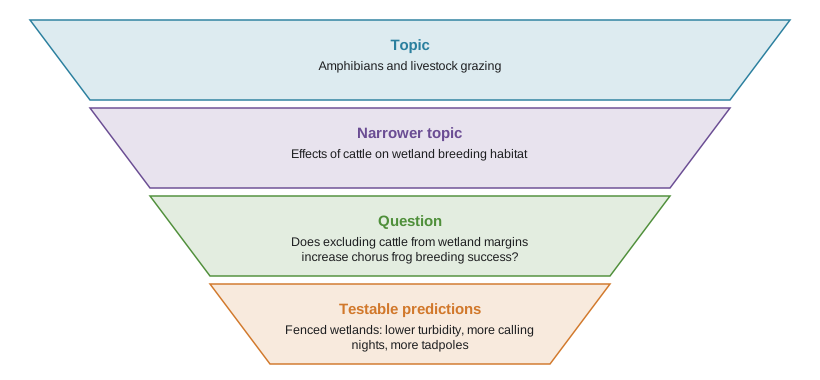
Priya's first draft question was: How does cattle grazing affect amphibians in prairie wetlands? Dr. Okafor pointed out that this question has dozens of possible answers depending on which amphibians, which wetlands, which aspect of the animals' lives and which kind of grazing. Answering it properly would take a team many years. Over several weeks, Priya narrowed it.
- Which amphibians? The boreal chorus frog, because it is common enough at the station to provide data at every wetland.
- Which aspect of grazing? Cattle access to the wetland margin, because the ranch had fenced some margins and not others, providing a natural comparison.
- Which response? Breeding activity and early tadpole numbers, because these can be measured in one spring and are directly linked to population success.
- What mechanism? Water clarity and emergent vegetation, because cattle trample margins and stir up sediment.
The final question, written at the end of February, was: Do wetlands where cattle are excluded from the margins support more chorus frog breeding activity and higher tadpole densities than paired grazed wetlands, and is any difference associated with lower turbidity? It is long, but every part of it can be measured.
What makes a good research question
Researchers use various checklists for judging questions. One useful set of criteria is that a good honors question is focused, answerable, feasible, interesting and ethical.
| Criterion | Test it by asking | Priya's question |
|---|---|---|
| Focused | Could a stranger say exactly what you will measure? | Yes: calling, tadpole density and turbidity at named wetlands |
| Answerable | Is there a result that would answer it either way? | Yes: densities could be higher, lower or similar in fenced wetlands |
| Feasible | Can it be done with the time, money, skills and equipment available? | Yes, with existing wetlands, recorders and a budgeted eDNA analysis |
| Interesting | Would the answer matter to anyone beyond you? | Yes: ranchers, conservation groups and agencies fund fencing programs |
| Ethical | Can it be done without unjustified harm to animals, people or the environment? | Yes, with minimal handling of tadpoles and approved protocols |
Feasibility is where most honors projects need adjustment. It has several parts: time (can data be collected within the season or schedule?), money (are supplies, travel and analyses affordable?), skills (can you learn the methods in time?), access (do you have the sites, organisms or equipment?) and approvals (can permits and ethics reviews be obtained before you need them?). A question that fails any one of these must be changed or narrowed.
Questions, hypotheses and predictions
Biologists distinguish three related statements. A research question asks what is true. A hypothesis proposes an answer, usually with a mechanism. A prediction states what you will observe if the hypothesis is correct. Priya's statements, in the form she used in her proposal, were these.
- Question: Does excluding cattle from wetland margins increase chorus frog breeding success?
- Hypothesis: Cattle access reduces breeding success by increasing turbidity and removing emergent vegetation used for egg attachment.
- Predictions: Compared with paired grazed wetlands, fenced wetlands will have lower turbidity, more nights with chorus calling and higher tadpole densities; across wetlands, tadpole density will decrease as turbidity increases.
The predictions are directional and measurable. They also allow for partial support. If turbidity is lower in fenced wetlands but tadpoles are not more abundant, the mechanism might be wrong, or the effect might be too small to detect with 12 pairs. Thinking through the possible outcomes in advance, and what each would mean, is one of the best habits a researcher can develop. Some researchers make a simple table of outcomes and interpretations before collecting any data.
A related distinction is between a null hypothesis and an alternative hypothesis in statistics. The statistical null hypothesis for Priya's tadpole prediction is that the mean difference in tadpole density between fenced and grazed wetlands in a pair is zero. That is a statement used in a test, not a biological explanation. Lesson 9 returns to how statistical tests relate to biological hypotheses, and why estimating the size of an effect, with its uncertainty, is usually more informative than a yes-or-no test.
Building on what exists
Many of the strongest honors projects add a well-defined piece to an existing study. Priya's project used wetlands that had already been fenced, matched into pairs and monitored for water chemistry for four years. That gave her a design she could never have set up alone and allowed her to compare her turbidity measurements with earlier records. In exchange, her data joined the station's long-term database, with her name attached.
Building on existing work brings obligations. You must use the existing protocols where they apply, so that data are comparable; respect agreements with landowners and partners; and credit the people who created the data. Before starting, Priya read the station's data-use agreement, which stated that her thesis could use station data with acknowledgment and that any publication would include Dr. Okafor and the station's data manager as co-authors.
Worked problem
Testing a question for feasibility
Aisha proposes to sequence the whole genomes of 200 soil bacterial isolates to find antibiotic resistance genes. Sequencing costs about 60 dollars per isolate at her university's core facility, and her supervisor can provide 2,500 dollars. She also has 8 weeks of lab time before the analysis must begin. Is the plan feasible, and how could it be adjusted?
Show solution
- Cost of the full plan: 200 isolates times 60 dollars is 12,000 dollars, far more than the 2,500-dollar budget.
- The budget allows 2,500 divided by 60, or about 41 isolates.
- Isolating, purifying and extracting DNA from 200 isolates in 8 weeks is also very demanding.
- One adjustment is to screen all 200 isolates cheaply for resistance with disk diffusion tests, then sequence the 40 most interesting, such as those resistant to several drugs.
Answer: The original plan costs about five times the budget. Screening widely and sequencing about 40 selected isolates fits the money and time and still answers a focused question.
Aisha's revised question changed from cataloging resistance genes in soil bacteria to asking which resistance genes are found in multidrug-resistant isolates from manured and unmanured fields. It is narrower, cheaper and better, because it compares two conditions and so can test a hypothesis.
When the project changes
Questions often change after a project begins. A pilot study may show that a method does not work, an organism may be scarcer than expected, or early data may reveal something more interesting than the original question. Changing course is not failure, but it should be deliberate and documented. Priya kept a project log in which she recorded each major decision, the date and the reason. When her examiners later asked why she had added a dilution step to her eDNA analysis, the log showed exactly when and why the change was made, which made her answer convincing.
Common mistakes
MistakeA broad question shows ambition and will impress examiners.
InsteadExaminers value a focused question that is answered well over a broad one answered superficially.
MistakeThe topic is the same thing as the research question.
InsteadA topic is an area of interest; a question asks something specific that data can answer.
MistakeFeasibility is mainly about time.
InsteadFeasibility includes time, money, skills, access to sites or organisms, and approvals.
MistakeChanging the question partway through is a sign of failure.
InsteadQuestions often change for good reasons; change deliberately and record why.
Summary and key terms
- Choose a supervisor as carefully as a topic: availability, support and resources matter.
- Approach potential supervisors with a short, specific message and a list of questions for the first meeting.
- Scoping narrows a topic into a focused, answerable, feasible, interesting and ethical question.
- A hypothesis proposes an explanation; predictions state measurable outcomes if it is true.
- Building on an existing study can provide sites, data and methods, with obligations to credit and comparability.
- Estimate cost and workload early, and record any change of direction with the reason.
- Scoping
- Narrowing a broad topic into a research question that can be answered with the time and resources available.
- Feasibility
- Whether a project can be completed with the available time, money, skills, access and approvals.
- Null hypothesis
- In statistics, the hypothesis of no effect or no difference that a test evaluates.
- Pilot study
- A small preliminary study to test methods and estimate variability before the main study.
- Project log
- A dated record of major decisions in a project and the reasons for them.
- Data-use agreement
- A written agreement on how existing data may be used, credited and shared.
Practice problems
Work each problem on paper first, then reveal the answer to check.
Rewrite the topic 'bees and pesticides' as a focused question.
Show answer
For example: Do bumble bee colonies placed beside fields treated with a named insecticide produce fewer new queens than colonies beside untreated fields?
A project needs 30 sequencing runs at 150 dollars each and the budget is 3,000 dollars. Is it affordable?
Show answer
No. 30 times 150 is 4,500 dollars, 1,500 dollars over budget; reduce to 20 runs or find more funding.
What is the difference between a hypothesis and a prediction?
Show answer
A hypothesis is a proposed explanation; a prediction is the specific measurable outcome expected if the hypothesis is true.
Give two questions to ask a potential supervisor.
Show answer
For example: How often do you meet with students? Who pays for supplies? What happens if the main method fails?
Lesson quiz · 5 questions
Score 60% or more to complete this lesson.
Create a free account to save your progress, take quizzes and earn a certificate.