
BIOL-499 · Lesson 10 of 12 · 19 min
Scientific writing: the thesis, figures and references
▶ Video coming soon A video version of this lesson is on the way.
The thesis is the main product of an honors project, and for most programs it carries the largest share of the mark. It is also the only part of the project that lasts: data are archived, posters are taken down, and the defense is over in an hour, but the thesis is read by examiners, by future students in the lab and sometimes by other researchers. Writing it well requires a different skill from doing the research. This lesson follows Priya through the writing of her thesis from December 2025 to March 2026: its structure, the content of each section, figures and tables, style, references and the drafting process.
The structure of a biology thesis
Most biology theses and research papers follow the IMRaD structure: Introduction, Methods, Results and Discussion, framed by a title and abstract at the start and references at the end. Many theses add acknowledgments, a table of contents, lists of figures and tables, and appendices for supplementary material. Your department's honors handbook will specify the required sections, page or word limits, formatting and citation style. Priya's limit was 8,000 words for the main text, excluding the abstract, references, captions and appendices.
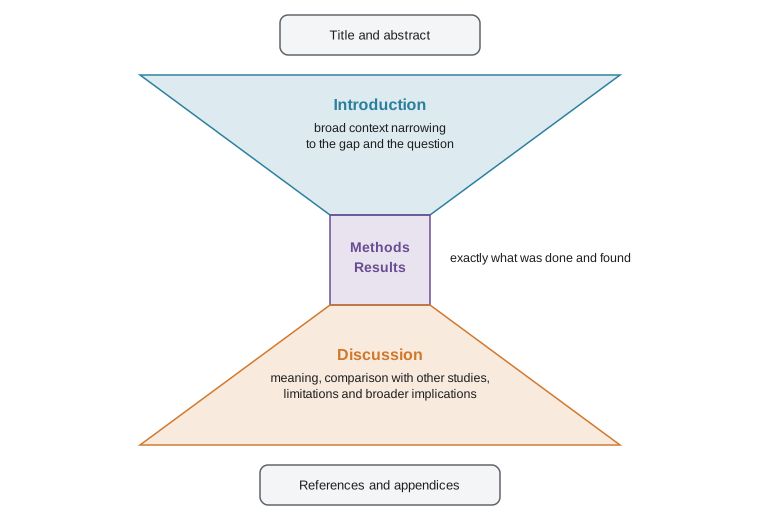
The hourglass shape is a useful image. The introduction begins broadly, with why the topic matters, and narrows to the specific gap and question. The methods and results are narrow and precise: exactly what was done and exactly what was found. The discussion widens again, from what the results mean for the question to what they mean for the field and for practice.
Writing order
The thesis is not usually written in the order it is read. Priya followed a common sequence: methods first, because they were already largely written in her proposal and could be drafted during the lab work; then results, built around her figures and tables; then the discussion; then the introduction, revised from the proposal's background to lead precisely to the questions her results answered; and finally the abstract and title. Writing the introduction late prevents a common problem, an introduction that promises things the results never deliver.
Methods
The methods section should allow a competent reader to repeat the study. It describes the study site, the design, each measurement and its timing, the laboratory procedures, the approvals obtained and the statistical analysis, including the software and version. It is written in the past tense, because it describes what was done. Methods that follow a standard protocol can cite it rather than repeat it, but any modification must be stated, such as Priya's one-in-five dilution of inhibited extracts. Approvals are reported briefly: the animal care protocol number, the permit number and the landowner's permission.
Results
The results section reports what was found, without interpretation. It is organized around the figures and tables, which carry most of the information, and the text guides the reader through them, giving the key numbers. Every claim should be supported by an estimate with its uncertainty and, if used, the test statistic or p-value. Report results for all planned analyses, including those that did not show clear effects.
A common weakness is text that merely points at figures: Figure 3 shows the tadpole results. Better text states the finding and cites the figure: Tadpole densities were higher in fenced than grazed wetlands in 9 of 12 pairs, with a geometric mean ratio of 1.29 (95 in 100 confidence interval 0.78 to 2.20; Fig. 3). The reader learns the result from the sentence and can check the figure for detail.
Worked problem
Rewriting a results sentence
Priya's first draft read: "Fencing had a significant effect on turbidity (p = 0.001), which proves that cattle make wetlands muddy." Rewrite it as a results sentence.
Show solution
- Remove interpretation: "proves that cattle make wetlands muddy" belongs in the discussion, and "proves" overstates any single study.
- State the direction and size of the effect, not just significance.
- Give the uncertainty and the test, and refer to the figure.
- Include how consistent the pattern was across pairs.
Answer: Turbidity in fenced wetlands was lower than in the paired grazed wetland in 11 of 12 pairs, with a geometric mean ratio of 0.46 (95 in 100 confidence interval 0.35 to 0.62; paired permutation test, p = 0.001; Fig. 2).
Discussion
The discussion interprets the results. A useful structure has five parts. Open with a short statement of the main findings and what they mean for the question. Then interpret each finding in turn, comparing it with other studies and explaining agreements and disagreements. Next, discuss limitations honestly and say how they affect the conclusions. Then state the implications for theory, management or methods. Finish with what future research should do and a brief concluding paragraph.
Priya's discussion opened with three sentences: fencing roughly halved turbidity, tadpole and calling estimates favored fenced wetlands but were too uncertain to show a clear effect, and PCR inhibition in turbid grazed wetlands caused false eDNA absences that would have created a spurious treatment difference. She then compared the turbidity result with studies of cattle in farm ponds and the uncertain amphibian results with the mixed literature, discussed why the mechanism prediction was not supported, and spent a full section on the inhibition finding, because it had the clearest practical implications for agencies using eDNA surveys.
Limitations are not a confession of failure but a demonstration of judgment. Priya's included the non-random assignment of fencing, the low power of 12 pairs, a single breeding season, the cattle breach at wetland F9 and the fact that tadpole density is not the same as the number of young frogs that survive to metamorphosis. For each, she stated how it might affect the conclusions. Examiners are far more impressed by a student who identifies the weaknesses of their study than by one who claims it has none.
Introduction, abstract and title
The introduction, revised from the proposal, establishes the importance of the topic, reviews what is known, identifies the gap and ends with the aims, questions and hypotheses. It should cite the literature that frames the question but need not include everything from the full literature review. Priya's introduction was about 1,500 words and ended with her three aims, stated exactly as in the methods and results, so that a reader could follow each aim through the thesis.
The abstract summarizes the whole thesis, usually in 200 to 300 words: one or two sentences of context and the gap, the aims, the key methods, the main results with numbers and the main conclusion. Many readers will read only the abstract, so it must stand alone and must not contain anything not in the thesis. The title should state the main subject and, ideally, the main finding. Priya's final title was: Cattle exclusion halves turbidity in prairie pothole wetlands, but effects on chorus frog breeding are uncertain and PCR inhibition biases eDNA detection.
Figures and tables
Figures are often the first thing examiners look at, and good figures make a thesis easier to understand. Each figure should make one main point, which the caption states. Show the data where possible, not just means: Priya's paired dot plots showed every pair, which let readers see both the consistent turbidity reduction and the scattered tadpole differences. Label axes with the variable and its units, use a font large enough to read when printed, avoid unnecessary decoration such as three-dimensional effects or heavy grid lines, and choose colors that remain distinguishable for readers with color vision deficiency and in grayscale.
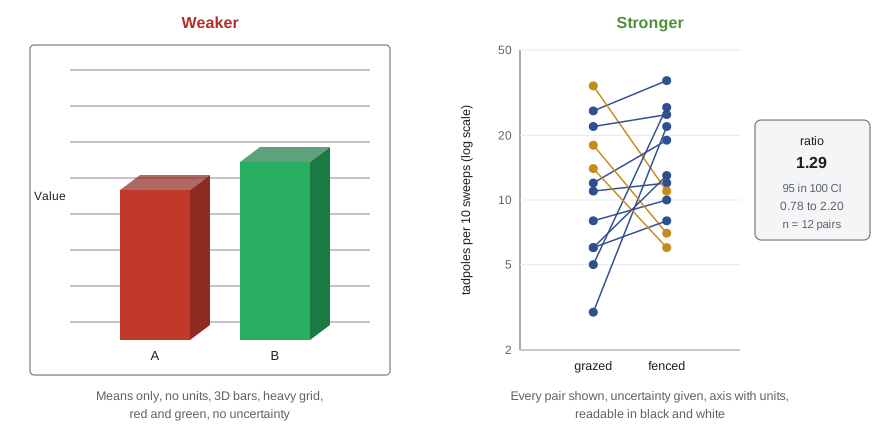
Captions should allow the figure to be understood without reading the text: state what is shown, what each symbol and color means, the sample size, what error bars or intervals represent, and any statistical result. Tables are better than figures for exact values and for many variables; they should have clear column headings with units and a caption above them. Number figures and tables in the order they are first cited, and cite every one in the text.
Image integrity matters as much as data integrity. Photographs of gels, microscope images and the like may be adjusted for brightness or contrast only if the adjustment is applied to the whole image and does not obscure, remove or introduce any feature; splicing lanes or panels must be clearly marked. Journals screen submitted images for manipulation, and inappropriate changes are treated as falsification.
Style
Scientific writing aims for clarity and precision, not elegance. A few habits help. Put the main point of each paragraph in its first sentence. Use the past tense for what you did and found, and the present for established knowledge and for what your figures show. Prefer the active voice when it is clearer, such as We measured turbidity at each visit; the passive is acceptable when the actor is unimportant. Use the same term for the same thing throughout: if you call them grazed wetlands in the methods, do not switch to unfenced or control wetlands in the discussion. Cut words that add nothing: in order to becomes to, due to the fact that becomes because. Define abbreviations at first use and keep them few.
Hedging should match the evidence. Fencing reduced turbidity is justified by a large, consistent effect. Fencing may increase tadpole density, but the estimate was uncertain is justified by Priya's tadpole result. Fencing increases frog populations would not be justified by her data at all. Examiners notice both overclaiming and excessive hedging that refuses to state any conclusion.
References
Every source cited in the text must appear in the reference list, and every item in the list must be cited. Biology departments commonly use a name-year style, such as that of the Council of Science Editors, in which the text cites (Author Year) and the list is alphabetical. A reference manager inserts citations and formats the list automatically, which prevents most errors, but check the output, especially for books, reports and web pages, which managers often format incompletely. Cite primary sources for specific findings, and cite data sets, software and important R or Python packages as well as papers.
Drafting, feedback and revision
No one writes a good thesis in one draft. Priya's schedule allowed three rounds: a full draft to Dr. Okafor by mid-February, a revised draft to both Dr. Okafor and Dr. Szabo by mid-March, and final revisions before the April deadline. She also exchanged chapters with Tomás for comments on clarity, since a reader outside the topic finds unclear passages that experts miss. When she received comments, she addressed each one, either by revising or by noting why she disagreed, and kept a list to show her supervisor what had changed.
Many universities allow students to use AI tools for limited purposes, such as checking grammar or getting feedback on clarity, while prohibiting their use to generate thesis content and requiring disclosure of any use. Policies differ and change, so check your institution's and your department's current rules, and ask your supervisor. Whatever tools are used, you are responsible for every word, number and citation in the thesis.
Common mistakes
MistakeThe results section should explain why the results occurred.
InsteadResults report findings; interpretation belongs in the discussion.
MistakeAdmitting limitations weakens a thesis.
InsteadHonest limitations show judgment and help readers weigh the conclusions.
MistakeBar charts of means are the best way to show any comparison.
InsteadShowing individual data points, paired lines and intervals usually reveals more.
MistakeWrite the introduction first, exactly as in the proposal.
InsteadRevise the introduction late so it leads precisely to the questions the results answer.
Summary and key terms
- Biology theses usually follow the IMRaD structure, framed by an abstract and references, within the department's limits.
- Writing methods and results first, then the discussion, introduction and abstract, keeps the thesis focused.
- Methods allow replication; results report estimates with uncertainty for all planned analyses, guided by figures and tables.
- Discussions interpret, compare, admit limitations, state implications and suggest future work.
- Good figures show the data, make one point, have clear labels and complete captions; images must not be manipulated.
- Write clearly, hedge to match the evidence, cite carefully, revise with feedback and follow AI-use policies.
- IMRaD
- The Introduction, Methods, Results and Discussion structure of scientific papers and theses.
- Abstract
- A short summary of a whole study, including its aims, methods, main results and conclusion.
- Caption
- Text accompanying a figure or table that explains what is shown so it can be understood on its own.
- Limitation
- A weakness of a study that affects how far its conclusions can be trusted or generalized.
- Hedging
- Language that signals the strength of evidence for a claim, such as may or suggests.
- Image manipulation
- Altering a scientific image in ways that misrepresent the data, treated as research misconduct.
Practice problems
Work each problem on paper first, then reveal the answer to check.
Which section of a thesis should contain the sentence: 'Turbidity may limit tadpole feeding by reducing algal growth'?
Show answer
The discussion, because it interprets the results with a possible explanation.
Name four things a figure caption should state.
Show answer
What is shown, what symbols and colors mean, the sample size and what error bars or intervals represent; also any statistical result.
Shorten: 'Due to the fact that the wetlands were turbid, it was necessary in order to obtain results to dilute the extracts.'
Show answer
Because the wetlands were turbid, extracts had to be diluted.
Why should the abstract be written last?
Show answer
Because it summarizes the whole thesis, including results and conclusions that are only final at the end.
Lesson quiz · 5 questions
Score 60% or more to complete this lesson.
Create a free account to save your progress, take quizzes and earn a certificate.