
BIOL-460 · Lesson 5 of 12 · 16 min
Phytoplankton, algae and aquatic plants
▶ Video coming soon A video version of this lesson is on the way.
Lena Fournier's laboratory at the station is mostly microscopes. Every two weeks she preserves a liter of water from each lake with a few drops of iodine solution, lets the cells settle in a counting chamber overnight, and identifies and counts them under an inverted microscope. A sample from Kestrel Lake in May is a lacework of diatoms: star-shaped colonies of Asterionella and long chains of Aulacoseira. A sample from Mallard Lake in August is dominated by a single kind of organism, round colonies of Microcystis embedded in mucilage, packed so densely that the counting takes hours. This lesson is about who the primary producers of fresh water are, how they live suspended in water or rooted in sediment, and why some of them become a public health problem.
The main groups of phytoplankton
Phytoplankton are the photosynthetic organisms that drift in open water. They are not a single lineage but a collection of distantly related groups that share a way of life. The most important in fresh water are:
- Cyanobacteria, the blue-green algae, which are bacteria rather than eukaryotic algae. They include colonial forms such as Microcystis and filamentous forms such as Dolichospermum, Aphanizomenon and Planktothrix. Many can regulate their buoyancy with gas vesicles, some fix nitrogen, and some produce toxins.
- Diatoms, single cells or colonies enclosed in glass-like walls of silica called frustules. They dominate in cool, mixed, nutrient-rich water, especially in spring and fall, and their heavy walls make them sink quickly in calm water.
- Green algae, a diverse group including tiny single cells, colonies such as Pediastrum and the ornate desmids, which are common in soft-water lakes.
- Golden algae, or chrysophytes, such as Dinobryon and Synura, often abundant in nutrient-poor, slightly acid lakes; some can also eat bacteria.
- Cryptophytes and dinoflagellates, motile cells with flagella that swim toward light and nutrients; dinoflagellates such as Ceratium have armor-like plates.
Phytoplankton are also grouped by size, because size controls how fast cells sink, take up nutrients and are eaten. Picoplankton, below 2 micrometers across, are mostly tiny cyanobacteria and are abundant in clear oligotrophic lakes; nanoplankton are 2 to 20 micrometers; and microplankton, larger than 20 micrometers, include most colonial diatoms and cyanobacteria. Small cells have a large surface relative to their volume, so they take up scarce nutrients efficiently, which is one reason they do well in nutrient-poor water.
Counting and identifying phytoplankton
Lena's microscope counts are the classic method, and they remain the only way to identify most species reliably. She counts cells or colonies in a known volume, measures their dimensions and converts counts to biovolume by treating each cell as a simple shape such as a sphere or cylinder. Biovolume, multiplied by an assumed density, estimates biomass, and it is a far better measure than cell numbers alone, because a single large diatom may hold as much carbon as a thousand picocyanobacteria. Counting is slow, though, so it is supplemented by faster methods. Chlorophyll a extracted from filtered water estimates total algal biomass. Other pigments are diagnostic of particular groups, such as phycocyanin for cyanobacteria, and sondes and buoys can measure both pigments by their fluorescence every few minutes. Flow cytometers count and size thousands of cells a second, and DNA sequencing of water samples can detect species, including toxin-producing strains, that are rare or hard to tell apart by eye. Each method sees part of the community, which is why long-term programs keep using several together.
Staying afloat
Phytoplankton are slightly denser than water, so they sink. Sinking carries them out of the light and into the hypolimnion, where they die or rest, so much of their biology is about slowing or reversing it. For a small sphere, the sinking speed is given by Stokes' law:
where \(r\) is the cell's radius, \(\rho_c\) and \(\rho_w\) the densities of the cell and the water, \(g\) the acceleration of gravity and \(\mu\) the viscosity of the water. Sinking speed rises with the square of size, so a cell ten times wider sinks a hundred times faster. Colder water is more viscous, so cells sink more slowly in spring than in summer.
g = 9.81                 # m per second squared
rho_w = 998.0            # density of water, kg per m3
mu = {5: 1.52e-3, 20: 1.00e-3}   # viscosity of water, Pa s, at 5 and 20 C
# A diatom-like cell with a silica wall is denser than a green algal cell.
for name, diam_um, rho_c in (('picocyanobacterium', 1, 1050), ('small green cell', 5, 1030), ('diatom cell', 30, 1100)):
    r = diam_um / 2 * 1e-6
    for t in (5, 20):
        v = 2 / 9 * g * r**2 * (rho_c - rho_w) / mu[t]
print(f"{name:20s} {t:2d} C sinks {v * 86400:7.3f} m per day")picocyanobacterium 5 C sinks 0.002 m per day picocyanobacterium 20 C sinks 0.002 m per day small green cell 5 C sinks 0.025 m per day small green cell 20 C sinks 0.038 m per day diatom cell 5 C sinks 2.844 m per day diatom cell 20 C sinks 4.323 m per day
The numbers explain a great deal of seasonal ecology. A diatom cell with a heavy silica wall can sink several meters a day in calm summer water, and chains and colonies sink faster still, which is why diatoms dominate when turbulence keeps them suspended, in spring and fall, and fade when the lake stratifies. Phytoplankton resist sinking in several ways: staying small, forming spines or flat shapes that increase drag, storing light oils, producing mucilage, swimming with flagella, or, in cyanobacteria, building gas vesicles that make the cells buoyant. Buoyant cyanobacteria can rise to the surface on calm days and form the green scums typical of Mallard Lake in August, shading every other alga beneath them.
Seasonal succession
The phytoplankton of a temperate lake change through the year in a broadly repeatable sequence. A group of plankton ecologists summarized it in the 1980s as the PEG model, named for the Plankton Ecology Group that drew it up. In spring, light increases, the lake is mixed and nutrients are high, and fast-growing diatoms and small flagellates bloom. Zooplankton, especially Daphnia, then multiply and graze the algae down, producing a clear-water phase in late spring when the lake is at its most transparent. Grazing, nutrient depletion and sinking as the lake stratifies shift the community toward large, inedible or colonial forms and, in productive lakes, toward cyanobacteria in late summer. A smaller diatom peak often follows fall turnover.
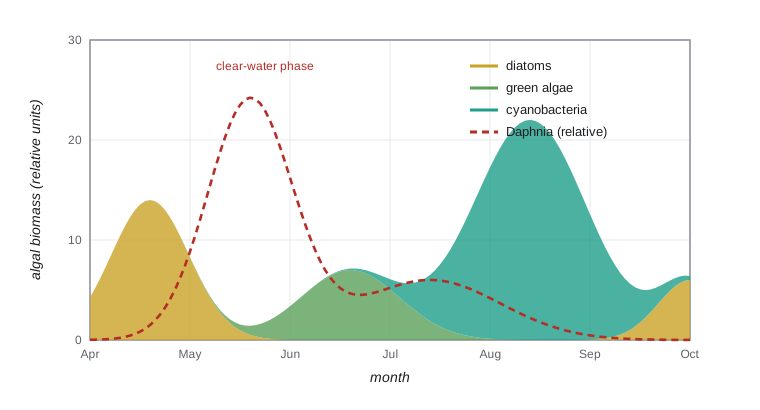
Behind the succession is competition for resources. The ecologist David Tilman showed in laboratory chemostats that two diatoms, Asterionella and Cyclotella, could coexist only within a certain range of silica-to-phosphorus ratios, with Asterionella winning when phosphorus was scarce relative to silica and Cyclotella winning when silica was scarce. In lakes, shifting ratios of nutrients, light and temperature through the season favor different species at different times.
That raises a famous puzzle. Competition theory predicts that in a uniform environment the number of species cannot exceed the number of limiting resources, yet a single liter of lake water can hold dozens of phytoplankton species competing for a handful of nutrients. G. Evelyn Hutchinson called this the paradox of the plankton in 1961. Most explanations rely on the fact that lakes are never at equilibrium: conditions change faster than competitive exclusion can play out, grazers and parasites suppress whichever species becomes common, and patches of different water persist side by side.
Harmful algal blooms
A bloom is simply a high density of algae, but blooms of cyanobacteria can be harmful. Some strains of Microcystis, Dolichospermum, Planktothrix and other genera produce toxins: microcystins, which damage the liver; anatoxins and saxitoxins, which attack the nervous system; and cylindrospermopsin, which damages the liver and kidneys. Whether a bloom is toxic cannot be judged by eye, because toxic and non-toxic strains look the same, so agencies test water and issue advisories. Dogs that swim in or drink from scummy water are especially at risk, and deaths are reported almost every summer.
In the United States, the Environmental Protection Agency's drinking water health advisories for microcystins, issued in 2015, are 0.3 micrograms per liter for bottle-fed infants and young children and 1.6 for older children and adults over ten days of exposure. Its 2019 recommended recreational criteria are 8 micrograms per liter for microcystins and 15 for cylindrospermopsin. States issue local advisories.
The most dramatic example in North America came in August 2014, when a bloom in western Lake Erie put microcystins into the intake of the Toledo, Ohio, water treatment plant. About half a million people were told not to drink or cook with tap water for nearly three days. The episode transformed bloom monitoring around the Great Lakes and was one reason for the phosphorus targets described in Lesson 4. Mallard Lake's own blooms are tested weekly in August, and the township posts advisories on the beach.
Periphyton and aquatic plants
Not all aquatic primary producers float. Periphyton, the film of algae, bacteria and fungi on rocks, wood and plants, is often the main food for grazing snails and insect larvae in streams and the littoral zone of lakes. In clear, nutrient-poor lakes, periphyton on the bottom can rival phytoplankton in production. When nutrients rise, filamentous green algae such as Cladophora can smother rocky shores, as they did in the lower Great Lakes in the 1960s and again in recent decades.
Macrophytes, the larger aquatic plants, are grouped by growth form:
- Emergent plants, such as cattails, bulrushes and wild rice, are rooted in shallow water with leaves and stems held above it.
- Floating-leaved plants, such as water lilies, are rooted on the bottom with leaves lying on the surface.
- Free-floating plants, such as duckweeds, are not rooted and drift on the surface.
- Submersed plants, such as pondweeds, coontail and the large alga Chara, grow entirely underwater and need enough light reaching the bottom.
Macrophytes stabilize sediments, take up nutrients, provide shelter and spawning habitat for fish and invertebrates, and support the periphyton that grows on them. Wild rice, manoomin in Anishinaabemowin, deserves special mention. It is an annual grass that grows in shallow, slowly flowing water and is a central food and cultural relationship for Anishinaabe and other peoples across Minnesota, Wisconsin and Michigan. It is sensitive to changes in water level, to competition from invasive plants and to sulfate, which bacteria in the sediment convert to sulfide that is toxic to its roots. Sam Whitehorse's water program monitors the rice beds at the head of Kestrel Lake each August.
Clear and turbid shallow lakes
Shallow lakes like Mallard Lake can exist in two contrasting conditions. In the clear state, submersed plants cover much of the bottom. They stabilize sediments, take up nutrients, shelter zooplankton that graze algae and support predatory fish, and all of these keep the water clear, which in turn lets the plants grow. In the turbid state, phytoplankton dominate, shading out the plants; without plants, wind and bottom-feeding fish stir up sediment, nutrients are released and zooplankton have nowhere to hide, so the water stays turbid. The Dutch ecologist Marten Scheffer and colleagues described these as alternative stable states in the 1990s.
Each state reinforces itself, so a lake can switch abruptly between them when a threshold of nutrients is crossed, and switching back requires reducing nutrients far below the level at which the lake first became turbid. That lag is called hysteresis. Reports from older residents and the station's earliest notes suggest Mallard Lake had extensive plant beds and clear water in the 1970s. It is now firmly in the turbid state, and Lesson 12 asks what it would take to push it back.
Lakeshore residents often see macrophytes as weeds and want them removed. Cutting, raking and herbicides can open swimming areas, but large-scale removal in a shallow lake can tip it toward the turbid state, releasing nutrients and removing the habitat of young fish. Most provinces and states require permits for removing plants beyond a small area in front of a property, and lake management plans usually aim to control invasive species such as Eurasian watermilfoil while protecting native plant beds.
Common mistakes
MistakeAll green scum on a lake is toxic.
InsteadSome blooms are harmless; toxicity depends on the strain and must be tested. Treat all scums with caution until results are known.
MistakePhytoplankton are all algae.
InsteadCyanobacteria are bacteria, though they photosynthesize like algae and are counted with the phytoplankton.
MistakeRemoving nutrients will restore a turbid shallow lake at the same level at which it became turbid.
InsteadBecause of hysteresis, nutrients usually need to fall much further, often with extra measures such as fish removal or replanting.
Summary and key terms
- Freshwater phytoplankton include cyanobacteria, diatoms, green algae, golden algae, cryptophytes and dinoflagellates.
- Sinking speed rises with the square of cell size; phytoplankton have many adaptations that slow sinking.
- Seasonal succession runs from spring diatoms through a clear-water phase to summer cyanobacteria in productive lakes.
- Cyanobacterial toxins are a public health concern, with drinking water and recreational guidelines in both countries.
- Shallow lakes can switch between clear, plant-dominated and turbid, algae-dominated states, with hysteresis.
- Phytoplankton
- Photosynthetic organisms that drift in open water.
- Periphyton
- Algae, bacteria and fungi growing attached to submerged surfaces.
- Macrophyte
- A large aquatic plant or alga visible to the naked eye.
- Clear-water phase
- A period of high water clarity in late spring when zooplankton graze down algae.
- Microcystin
- A liver toxin produced by some cyanobacteria.
- Hysteresis
- Dependence of a system's state on its history, so that recovery requires going past the point of change.
Practice problems
Work each problem on paper first, then reveal the answer to check.
A cell three times wider than another, of the same density, sinks how many times faster?
Show answer
Nine times, because speed rises with the square of the radius.
Why do diatoms decline when a lake stratifies in summer?
Show answer
Without turbulence their heavy silica walls make them sink out of the light, and silica may be depleted.
Name two ways submersed plants keep a shallow lake clear.
Show answer
They stabilize sediments and shelter algae-grazing zooplankton; they also take up nutrients.
Lesson quiz · 5 questions
Score 60% or more to complete this lesson.
Create a free account to save your progress, take quizzes and earn a certificate.