
BIOL-460 · Lesson 11 of 12 · 18 min
Water quality: eutrophication, contaminants and invasive species
▶ Video coming soon A video version of this lesson is on the way.
Late in the summer the township council that includes Mallard Lake invites Dr. Solberg to a public meeting. The beach has been posted with a blue-green algae advisory for three weeks, a cottager's dog became ill after swimming, and a resident has asked whether the walleye are safe to eat. Another resident reports finding zebra mussels on a dock that was brought in from a lake in the south. Dr. Solberg brings the class's data. The questions at the meeting, about nutrients, toxins, contaminants in fish and invasive species, are the four most common water quality problems in North American lakes, and this lesson takes them in turn.
Managing eutrophication
Lesson 4 established that phosphorus drives the productivity of most lakes, and that Mallard Lake's phosphorus comes both from its watershed and from its own sediments. Controlling eutrophication therefore means reducing external loads and, where necessary, internal loading. External loads are reduced by measures in the watershed. For point sources, sewage treatment plants can remove most phosphorus by chemical precipitation and biological processes. For nonpoint sources, the options include managing fertilizer and manure by the principle of applying the right source at the right rate, at the right time and in the right place; keeping soil on fields with cover crops, conservation tillage and grassed waterways; fencing livestock from streams; restoring riparian buffers and wetlands; upgrading or replacing failing septic systems near shorelines; and managing urban stormwater with ponds, rain gardens and permeable surfaces.
In the United States, the Clean Water Act requires states to list waters that do not meet their water quality standards and to develop a total maximum daily load, or TMDL, for each pollutant: a calculation of the maximum load a water body can receive and still meet standards, divided among point and nonpoint sources. Phosphorus TMDLs have been written for thousands of lakes, including Lake Champlain, and for Lake Erie the states and federal agencies issued domestic action plans in 2018 to meet the binational targets of Lesson 4. Progress is slow, because nonpoint controls depend on voluntary action by many landowners and because phosphorus stored in soils, called legacy phosphorus, continues to leak for years.
When internal loading dominates, as it does in Mallard Lake, in-lake treatments may be needed as well. The most widely used is aluminum sulfate, called alum, spread over the lake. It forms a floc of aluminum hydroxide that settles on the sediment and binds phosphate even when the bottom water is anoxic. Well-dosed alum treatments have cut internal loading for a decade or more in many lakes, though they are less effective in shallow lakes stirred by wind or carp, and they must follow, not replace, watershed controls. Other options include oxygenating or aerating the hypolimnion, dredging nutrient-rich sediment, and the biomanipulation described in Lesson 6.
Contaminants: mercury
Mercury is the contaminant behind most fish consumption advisories in North America. Most of it reaching remote lakes arrives through the air, from coal combustion, metal smelting, artisanal gold mining and other sources, often far away. In wetlands and anoxic sediments, sulfate-reducing and other bacteria convert inorganic mercury into methylmercury, a form that is readily absorbed by organisms and retained in their tissues. Methylmercury then biomagnifies: because each predator eats many prey and retains most of their methylmercury, its concentration rises roughly fivefold to tenfold at each step in the food chain, so that large predatory fish can carry concentrations millions of times higher than the water around them.
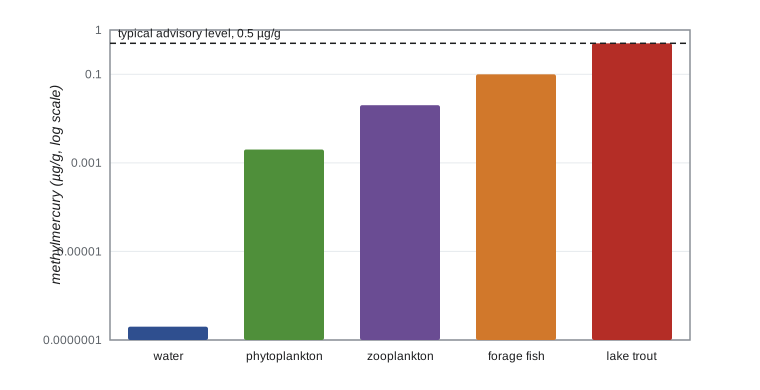
Whole-ecosystem experiments at the Experimental Lakes Area clarified how mercury moves. When a wetland and later a forested area were flooded to mimic hydroelectric reservoirs, methylmercury production rose sharply as flooded vegetation decomposed, and fish mercury increased several-fold, explaining the high mercury of fish in new reservoirs. In another experiment, researchers added mercury labeled with distinct stable isotopes to a lake and its watershed. The mercury deposited directly onto the lake appeared in fish within months, while that deposited on the watershed moved in very slowly; after additions stopped, mercury in the fish fell measurably within a decade. The finding gave strong support to controls on mercury emissions, such as the international Minamata Convention, which entered into force in 2017.
Local industrial releases have caused the most severe harm. Onondaga Lake in central New York received tens of metric tons of mercury from a chlor-alkali plant over much of the twentieth century and became one of the most contaminated lakes in the country. A cleanup under the federal Superfund program dredged and capped its sediments, and work was largely completed by 2017. States issue fish consumption advisories for thousands of lakes and rivers, and the Environmental Protection Agency and Food and Drug Administration publish national advice on choosing fish low in mercury.
Persistent and emerging contaminants
Persistent organic pollutants, such as the insecticide DDT and the industrial chemicals called PCBs, also biomagnify, because they dissolve in fat and resist breakdown. In the Great Lakes in the 1960s and 1970s they caused eggshell thinning and deformities in fish-eating birds such as herring gulls, cormorants and bald eagles, and wildlife agencies have monitored contaminants in herring gull eggs ever since. Bans and cleanups have reduced their concentrations greatly, and bird populations recovered, but these chemicals persist in sediments and still drive fish advisories in some areas. Under the Great Lakes Water Quality Agreement, the two countries designated more than forty Areas of Concern, harbors and river mouths with severe legacy contamination, and have been cleaning them up one by one.
Newer concerns include per- and polyfluoroalkyl substances, called PFAS, which are extremely persistent; microplastics; pesticides; and pharmaceuticals and personal care products that pass through sewage treatment. A landmark experiment at the Experimental Lakes Area tested one of them. From 2001 to 2003, Karen Kidd and colleagues added the synthetic estrogen used in birth control pills to Lake 260 at a concentration of only about 5 to 6 nanograms per liter, similar to levels measured in some sewage effluents. Male fathead minnows began producing egg proteins and abnormal reproductive tissue, and the minnow population collapsed almost to extinction. After additions stopped, the population recovered within a few years. The experiment showed that a chemical at concentrations once considered negligible could eliminate a fish population from a lake.
Salt
A growing problem in cold regions is chloride from road de-icing salt. Salt applied to roads and parking lots washes into streams and groundwater, and because chloride is not removed by treatment or taken up by organisms, it accumulates. Long-term records from hundreds of lakes in northern North America show chloride rising, especially where road density is high, and some urban streams exceed toxic levels for weeks after each snowmelt. Chloride harms sensitive zooplankton such as Daphnia, can strengthen the density stratification of small lakes and interfere with spring mixing, and mobilizes metals from soils. The Environmental Protection Agency's recommended aquatic life criteria for chloride are 230 milligrams per liter for chronic exposure and 860 for acute exposure, and several states have adopted salt reduction programs and certification for private snow-removal contractors.
# Chloride in Kestrel Lake and in a small lake beside the highway (synthetic data, mg per L, late summer).
years = list(range(2006, 2026, 2))
kestrel = [1.1, 1.2, 1.1, 1.3, 1.3, 1.4, 1.4, 1.5, 1.5, 1.6]
roadside = [38, 44, 49, 57, 61, 70, 74, 83, 88, 96]
def slope(x, y):
    n = len(x); mx, my = sum(x) / n, sum(y) / n
    return sum((a - mx) * (b - my) for a, b in zip(x, y)) / sum((a - mx) ** 2 for a in x)
for name, y in (('Kestrel Lake', kestrel), ('roadside lake', roadside)):
    s = slope(years, y)
    print(f"{name:13s} trend {s:5.2f} mg/L per year; latest {y[-1]} mg/L")
s = slope(years, roadside)
print(f"years until the roadside lake reaches 120 mg/L at the current trend: {(120 - roadside[-1]) / s:.0f}")Kestrel Lake trend 0.03 mg/L per year; latest 1.6 mg/L roadside lake trend 3.21 mg/L per year; latest 96 mg/L years until the roadside lake reaches 120 mg/L at the current trend: 7
Invasive species
Invasive species are non-native species that spread and cause ecological or economic harm. The Great Lakes are one of the most invaded freshwater systems on Earth, with more than 180 established non-native species. Their main pathways have been ballast water from ocean ships, canals connecting previously separate basins, the aquarium, water garden and live bait trades, and recreational boats and equipment moved between lakes. Some of the most damaging invaders in the region are:
- Zebra and quagga mussels, which reengineer lakes, as described in Lesson 7. They also tend to reject the toxic cyanobacterium Microcystis while eating other algae, which may help explain why Microcystis blooms have increased in some mussel-invaded lakes.
- Round goby, a bottom fish that eats mussels and fish eggs and is now a major prey of other fish, which has linked it to outbreaks of botulism in Great Lakes birds.
- Sea lamprey, which parasitizes large fish, and the spiny water flea, which eats native zooplankton, both described earlier.
- Eurasian watermilfoil and the common reed Phragmites, which form dense stands that crowd out native plants in lakes and wetlands.
- Rusty crayfish, spread as bait, which eats plants, snails and fish eggs and has transformed the littoral zones of many northern lakes.
Once established in a large lake, most aquatic invaders cannot be eradicated, so prevention is the most effective strategy. Ballast water rules now require ships entering the Great Lakes to exchange or treat ballast, and few new ship-borne invaders have been reported since the late 2000s. For inland lakes, the main message to boaters and anglers is to clean, drain and dry boats, trailers and gear before moving between water bodies, and never to release bait or aquarium animals and plants. Federal law lists injurious species, such as bighead, silver and black carp, under the Lacey Act, making their import and interstate transport illegal, and the Vessel Incidental Discharge Act of 2018 governs ballast water. States run boat inspection and decontamination programs, and many prohibit transporting boats with plants or water aboard. The zebra mussels on the Mallard Lake dock, Dr. Solberg tells the meeting, are dead and dried, but the episode shows how easily a lake can be invaded.
Worked problem
How much mercury reaches the lake trout?
Suppose methylmercury in Kestrel Lake's zooplankton is 0.02 micrograms per gram (synthetic data), and concentrations rise by a factor of 5 from zooplankton to forage fish and by a further factor of 5 from forage fish to lake trout. What is the expected concentration in lake trout, and how does it compare with an advisory threshold of 0.5 micrograms per gram?
Show solution
- Forage fish: 0.02 times 5 is 0.10 micrograms per gram.
- Lake trout: 0.10 times 5 is 0.50 micrograms per gram.
- The predicted concentration is at the threshold, so advice would likely recommend limiting meals of large trout, especially for children and people who are or may become pregnant.
- If smallmouth bass invasion lengthened the chain by adding another step at the same factor, trout mercury would rise to about 2.5 micrograms per gram, which shows why food chain length matters.
Answer: About 0.5 micrograms per gram, at the advisory threshold.
At the meeting, the class's data let Dr. Solberg give clear answers. The algae advisory reflects internal loading and summer warmth and will recur until both watershed and sediment phosphorus are reduced. Mallard Lake's walleye grow quickly in its rich food web, which dilutes the mercury they accumulate, and the state advisory permits regular meals of smaller walleye, though fewer of the largest fish. And the dock should never have been launched without cleaning and drying. Lesson 12 turns those answers into a plan.
Common mistakes
MistakeCutting watershed phosphorus will fix a lake with heavy internal loading within a year.
InsteadSediment phosphorus can sustain blooms for years; in-lake treatment may be needed after external loads are controlled.
MistakeMercury in remote lakes must come from a local polluter.
InsteadMost mercury in remote lakes arrives through the atmosphere from distant sources and is methylated in wetlands and sediments.
MistakeMoving a boat between nearby lakes is harmless if it looks clean.
InsteadLarvae, eggs and plant fragments can survive in bilge water and wet gear; clean, drain and dry every time.
Summary and key terms
- Eutrophication is managed by reducing watershed loads and, where needed, internal loading with treatments such as alum.
- Methylmercury forms in anoxic environments and biomagnifies; experiments showed fish respond to changes in deposition.
- Persistent organic pollutants and emerging contaminants such as synthetic estrogens can harm fish at very low concentrations.
- Road salt is raising chloride in many northern lakes and streams, with guidelines and criteria in both countries.
- Invasive species arrive by ballast, canals, trade and boats; prevention is far more effective than control.
- Internal loading
- Release of phosphorus from lake sediments, especially under anoxic conditions.
- Alum treatment
- Application of aluminum sulfate to bind phosphate in lake sediments.
- Methylmercury
- An organic form of mercury produced by bacteria that is readily absorbed and biomagnified.
- Biomagnification
- Increase in the concentration of a contaminant at each higher trophic level.
- Legacy phosphorus
- Phosphorus accumulated in soils and sediments that continues to be released after inputs fall.
- Invasive species
- A non-native species that spreads and causes ecological or economic harm.
Practice problems
Work each problem on paper first, then reveal the answer to check.
If methylmercury increases fourfold at each of three trophic steps, by what factor does it rise overall?
Show answer
64, since 4 times 4 times 4 is 64.
Why does alum work even when bottom water is anoxic?
Show answer
Aluminum hydroxide binds phosphate without depending on oxygen, unlike iron.
What three actions should boaters take between lakes?
Show answer
Clean, drain and dry boats, trailers and gear.
Lesson quiz · 5 questions
Score 60% or more to complete this lesson.
Create a free account to save your progress, take quizzes and earn a certificate.