
BIOL-460 · Lesson 3 of 12 · 18 min
Water chemistry: dissolved oxygen, carbon and pH
▶ Video coming soon A video version of this lesson is on the way.
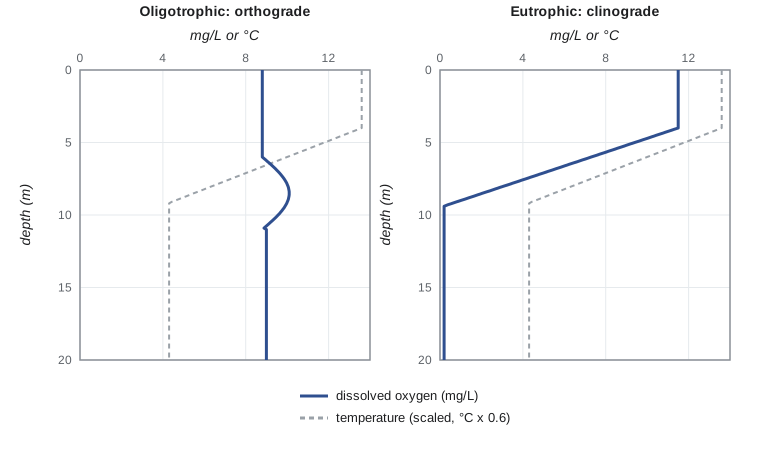
In late July the class repeats the profiles of Lesson 2, this time watching the oxygen sensor. In Kestrel Lake the readings are about 8.8 milligrams per liter at the warm surface, rise slightly to about 10 in the cold metalimnion, and stay near 9 all the way to the bottom. In Mallard Lake, which was briefly stratified after a calm, hot week, the surface reads 12 milligrams per liter at four in the afternoon, more than the water should hold, and the bottom meter reads almost zero and smells of rotten eggs when the sample bottle is opened. Same weather, same week, very different chemistry. This lesson explains why, and introduces the carbon chemistry and pH that tie lakes to their watersheds and to the atmosphere.
Water as a solvent
Natural waters are dilute solutions. Rain is nearly pure, but as water passes over and through soil and rock it dissolves minerals. The major ions in most fresh waters are the cations calcium, magnesium, sodium and potassium and the anions bicarbonate, sulfate and chloride. Their total is measured quickly as specific conductance, the ability of water to carry an electric current, corrected to 25 degrees. Kestrel Lake, on granite, has a conductance of about 25 microsiemens per centimeter; Mallard Lake, on calcareous till with farm runoff, about 320. Hard water is water rich in calcium and magnesium. Conductance is also a sensitive tracer of pollution: road salt, for example, raises chloride and conductance in urban streams for months after each winter, a problem that returns in Lesson 11.
Dissolved oxygen
Oxygen is the gas that matters most to aquatic animals, and it is in short supply. Air is about one fifth oxygen, but water in equilibrium with air at 20 degrees holds only about 9 milligrams of oxygen per liter, roughly a thirtieth of the oxygen in the same volume of air. Gas solubility falls as temperature rises, so cold water holds more: about 14.6 milligrams per liter at 0 degrees, 11.3 at 10 degrees and 8.3 at 25 degrees at sea level. Solubility also falls with altitude, because air pressure is lower, and with salinity.
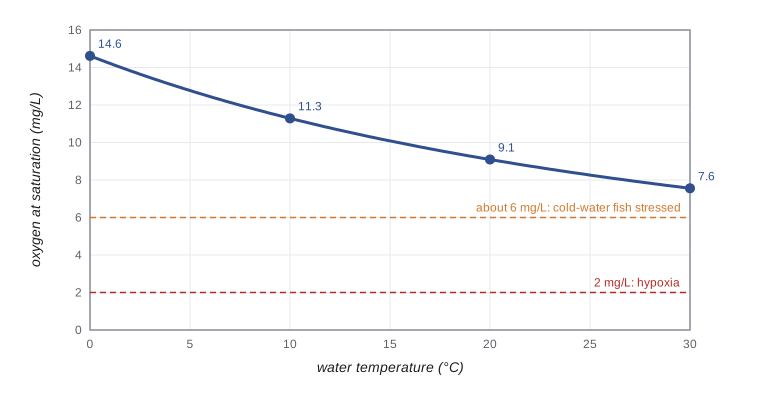
Because solubility changes with temperature, a concentration alone does not say whether water is oxygen-rich. Limnologists also report saturation: the measured concentration divided by the equilibrium concentration at that temperature and pressure. Water at saturation is in balance with the air. Supersaturated water, above saturation, usually means photosynthesis is adding oxygen faster than it can escape; undersaturated water means respiration and decomposition are using it faster than it is replaced.
The class computes saturation with a standard equation for the solubility of oxygen in fresh water at sea level, the Benson–Krause equation used in water quality manuals. It is written with temperature in kelvins.
import math
def o2_sat(t_c):
    """Oxygen solubility in fresh water at 1 atmosphere, mg per L (Benson and Krause equation)."""
    T = t_c + 273.15
    ln_c = (-139.34411 + 1.575701e5 / T - 6.642308e7 / T**2
            + 1.243800e10 / T**3 - 8.621949e11 / T**4)
    return math.exp(ln_c)
for t in (0, 4, 10, 20, 25, 30):
    print(f"{t:2d} C  saturation {o2_sat(t):5.2f} mg/L")
# Mallard Lake surface at 4 pm, and bottom water, July (synthetic)
for label, t, do in (('surface', 24.5, 12.0), ('bottom', 20.0, 0.3)):
print(f"{label:7s} {do:4.1f} mg/L at {t} C is {do / o2_sat(t):.2f} of saturation")0 C saturation 14.62 mg/L 4 C saturation 13.11 mg/L 10 C saturation 11.29 mg/L 20 C saturation 9.09 mg/L 25 C saturation 8.26 mg/L 30 C saturation 7.56 mg/L surface 12.0 mg/L at 24.5 C is 1.44 of saturation bottom 0.3 mg/L at 20.0 C is 0.03 of saturation
Mallard Lake's surface water was about one and a half times saturated: algae were producing oxygen faster than the air could absorb it. At night the same algae respire, and by dawn the surface can fall well below saturation. Large daily swings in oxygen and pH are a signature of a productive lake.
Where oxygen comes from and where it goes
Oxygen enters water by diffusion from the air, which is slow except where wind, waves or turbulence mix the surface, and from photosynthesis by algae and plants in the lit zone. It is consumed by the respiration of every organism and, above all, by bacteria decomposing organic matter. In the epilimnion, exchange with the air keeps oxygen near saturation. In the hypolimnion of a stratified lake there is no exchange with the air and, below the euphotic zone, no photosynthesis, so the oxygen present at spring turnover is a fixed budget that decomposition draws down all summer.
How fast that budget is spent depends on how much organic matter sinks into the hypolimnion, and so on how productive the lake is, and on how large the hypolimnion is. In an oligotrophic lake such as Kestrel Lake, little organic matter sinks and the hypolimnion is large and cold, so oxygen stays high through the summer. The profile is called orthograde, and because cold water holds more oxygen, concentrations may even be higher in the depths than at the surface. In a eutrophic lake, the rain of dead algae is heavy and oxygen falls steadily in the hypolimnion, sometimes to zero by late summer. That shape is called clinograde. Some lakes also develop a metalimnetic oxygen minimum, where sinking algae pause and decompose in the density gradient.
Limnologists summarize the rate of depletion as the areal hypolimnetic oxygen deficit: the rate at which oxygen is lost from the hypolimnion beneath each square meter of its upper surface, usually in milligrams per square meter per day. It is one of the most useful indicators of trophic state and of whether a lake can support cold-water fish.
Worked problem
An areal hypolimnetic oxygen deficit
A small lake (synthetic data) has a hypolimnion with a volume of 1.8 million cubic meters and an upper surface area of 0.40 square kilometers. Mean hypolimnetic oxygen falls from 10.5 milligrams per liter on 1 June to 4.5 milligrams per liter on 31 August, 91 days later. Find the areal deficit.
Show solution
- The concentration fell by 6.0 milligrams per liter, which is 6.0 grams per cubic meter.
- Total oxygen lost is 6.0 grams per cubic meter times 1.8 million cubic meters, or 10.8 million grams.
- \[\text{AHOD} = \frac{10.8 \times 10^{6}\ \text{g}}{0.40 \times 10^{6}\ \text{m}^2 \times 91\ \text{d}} \approx 0.30\ \text{g m}^{-2}\,\text{d}^{-1}\]
- That is about 300 milligrams per square meter per day, a value typical of a mesotrophic to eutrophic lake.
Answer: About 0.30 grams, or 300 milligrams, per square meter per day.
What happens without oxygen
When the bottom water loses its oxygen, decomposition does not stop; bacteria switch to other electron acceptors in a predictable sequence. First they use nitrate, converting it to nitrogen gas in denitrification. Then they reduce manganese and iron oxides, dissolving those metals. Then sulfate is reduced to hydrogen sulfide, the rotten-egg smell in the Mallard Lake sample, and finally methane is produced from organic matter. Each step yields less energy than the one before, and each changes the chemistry of the water.
The most important consequence for lake management is internal phosphorus loading. In oxygenated sediments, phosphate binds tightly to iron oxides. When the sediment surface becomes anoxic, the iron is reduced and dissolves, and the phosphate is released into the bottom water. At fall turnover, or during a windy spell in a shallow lake, that phosphorus mixes into the surface water and can fuel a late-season algal bloom. A lake that has received phosphorus for decades may therefore keep blooming for years after external inputs are cut, an issue that returns in Lessons 4 and 11. Anoxic water also accumulates ammonium, dissolved iron and manganese, which cause taste and odor problems when lakes are used for drinking water, and its hydrogen sulfide is toxic to most animals.
Carbon dioxide, bicarbonate and alkalinity
Carbon dioxide dissolves in water and reacts with it to form carbonic acid, which dissociates into bicarbonate and carbonate ions:
Which form dominates depends on pH. Below about pH 6.3, most inorganic carbon is dissolved carbon dioxide; between about 6.3 and 10.3, bicarbonate dominates; above about 10.3, carbonate. Those two pH values are the dissociation constants of the system at 25 degrees, expressed as pK values, and at each the two forms on either side are present in equal amounts. Acidified lakes, below about pH 5.5, hold almost all of their inorganic carbon as dissolved carbon dioxide; most lakes, between 6.5 and 8.5, hold it mainly as bicarbonate; and only in productive lakes on sunny afternoons, when pH climbs above 9, does carbonate become important.
Alkalinity, also called acid-neutralizing capacity, is the water's capacity to absorb acid without a large change in pH. In most fresh waters it is made up mainly of bicarbonate and carbonate, and it is reported in microequivalents per liter or in milligrams per liter as calcium carbonate. Waters on limestone and calcareous till, such as Mallard Lake, have high alkalinity and are well buffered. Shield waters such as Kestrel Lake have low alkalinity, often below 100 microequivalents per liter, and their pH can change readily.
Photosynthesis removes carbon dioxide from the water and respiration adds it, so pH rises during the day and falls at night. In Mallard Lake on a sunny afternoon the surface pH can exceed 9.5, which means carbon dioxide is almost exhausted and algae that can use bicarbonate directly, including many blue-green species, gain an advantage. At the bottom, where decomposition releases carbon dioxide, pH falls.
Lakes are also part of the global carbon cycle. Many lakes, especially in forested landscapes, are supersaturated with carbon dioxide and release it to the air, because they receive and decompose large amounts of organic carbon from their watersheds. Productive lakes can take up carbon dioxide in summer, and lake sediments bury organic carbon, so per unit area lakes are disproportionately important in regional carbon budgets. Anoxic sediments and wetlands also release methane, a potent greenhouse gas.
Acid rain and recovery
Low alkalinity made Shield lakes vulnerable when sulfur and nitrogen emissions from smelters and power plants fell as acid rain in the twentieth century. Around the smelters at Sudbury, Ontario, many lakes lost some or all of their fish. At the Experimental Lakes Area in northwestern Ontario, David Schindler and colleagues deliberately acidified Lake 223 in steps from 1976, from a pH of about 6.8 to about 5.0. Opossum shrimp, crayfish and fathead minnows declined or disappeared at pH values near 5.8 to 5.6, well before the water was acid enough to kill adult fish directly, and lake trout stopped reproducing because the food web beneath them had collapsed. The experiment showed that acid damage begins at modest pH changes and works through the food web, and it informed regulation in both countries.
Under the Clean Air Act Amendments of 1990, the acid rain program capped sulfur dioxide emissions from power plants, and the 1991 Air Quality Agreement with Canada coordinated controls across the border. Lakes in the Adirondack Mountains of New York, among the most acidified in the country, have since recovered partly, with rising pH and the return of some fish, though recovery is slow and incomplete. A newer problem in soft-water lakes is falling calcium, as decades of acid deposition and logging have leached it from soils, and the decline is now low enough to threaten calcium-rich zooplankton such as Daphnia.
Measuring oxygen in the field
For most of the twentieth century, dissolved oxygen was measured by the Winkler titration, in which chemicals added to a sealed sample fix the oxygen as a precipitate that is then titrated in the laboratory. It is accurate and is still used to check instruments. Most field measurements today use optical sensors, in which a dye on the sensor's tip glows less brightly in the presence of oxygen. Optical sensors need little maintenance and can be left on buoys for months, recording oxygen every few minutes. Their records have revealed how much oxygen changes over hours: in Mallard Lake, the station's buoy shows the surface swinging from about 7 milligrams per liter at dawn to 12 in the afternoon on sunny days, a range that a single daytime visit would never capture. Calibrating each sensor against air-saturated water or a Winkler sample before deployment is part of every sampling plan.
Common mistakes
MistakeA dissolved oxygen reading of 9 milligrams per liter always means healthy water.
InsteadIt depends on temperature; 9 milligrams per liter is saturated at 20 degrees but undersaturated at 5 degrees. Report saturation as well.
MistakeDeep water in a lake is always low in oxygen.
InsteadIn oligotrophic lakes the cold hypolimnion often stays well oxygenated all summer; depletion is a sign of high productivity.
MistakeCutting phosphorus inputs cleans up a lake within a year.
InsteadPhosphorus stored in sediments can be released for years when bottom waters go anoxic.
Summary and key terms
- Conductivity and major ions reflect watershed geology and pollution.
- Oxygen solubility falls with temperature; saturation compares a reading with the equilibrium value.
- Productive lakes develop clinograde oxygen profiles and large daily swings in oxygen and pH.
- Anoxic sediments release phosphorus, iron, manganese, hydrogen sulfide and methane.
- The carbonate system and alkalinity set how well a lake resists acidification; Shield lakes are poorly buffered.
- Saturation
- The measured concentration of a dissolved gas divided by its equilibrium concentration with the air.
- Clinograde profile
- An oxygen profile that falls with depth through the hypolimnion, typical of productive lakes.
- Orthograde profile
- An oxygen profile that stays high to the bottom, typical of unproductive lakes.
- Internal loading
- The release of nutrients, especially phosphorus, from lake sediments into the water.
- Alkalinity
- The capacity of water to neutralize acid, mainly from bicarbonate and carbonate.
- Denitrification
- Bacterial conversion of nitrate to nitrogen gas in the absence of oxygen.
Practice problems
Work each problem on paper first, then reveal the answer to check.
Water at 10 degrees contains 9.0 milligrams per liter of oxygen. Is it saturated?
Show answer
No; saturation at 10 degrees is about 11.3 milligrams per liter, so it is about 0.8 of saturation.
Why does pH rise in the afternoon in a productive lake?
Show answer
Photosynthesis removes carbon dioxide from the water.
Why can a lake keep blooming after its phosphorus inputs are cut?
Show answer
Phosphorus stored in sediments is released when bottom water loses its oxygen.
Lesson quiz · 5 questions
Score 60% or more to complete this lesson.
Create a free account to save your progress, take quizzes and earn a certificate.