
BIOL-450 · Lesson 12 of 12 · 27 min
Tumor immunology and immunotherapy
For most of the twentieth century, attempts to treat cancer by stimulating the immune system produced occasional dramatic responses and many disappointments. That changed in the 2010s. Antibodies that release brakes on T cells, engineered T cells and other immunotherapies now produce lasting remissions in cancers that were previously fatal, including metastatic melanoma, some lung cancers and relapsed leukemias. This final lesson explains how the immune system recognizes tumors, how tumors escape it, how immunotherapies work and why they help some patients profoundly and others not at all. It ends by following Maya and Daniel through the whole course.
Does the immune system recognize cancer?
In the late nineteenth century the New York surgeon William Coley injected bacterial preparations, later called Coley's toxins, into patients with sarcomas and reported some regressions, the first deliberate cancer immunotherapy. In the 1950s Frank Macfarlane Burnet and Lewis Thomas proposed immunosurveillance, the idea that the immune system routinely destroys nascent cancers. Strong evidence came only decades later. Mice lacking interferon-gamma signaling or lymphocytes developed more chemically induced and spontaneous tumors, and tumors arising in immunodeficient mice were often rejected when transplanted into normal mice, showing they had not been shaped by immune pressure. In humans, people taking immunosuppressive drugs after organ transplantation have markedly higher rates of virus-associated cancers and of skin cancers, and the density of T cells in colorectal tumors, scored as the Immunoscore by Jérôme Galon and colleagues, predicts survival better than some features of conventional staging.
Robert Schreiber and colleagues summarized the relationship as cancer immunoediting, with three phases. In elimination, innate and adaptive immunity destroy developing tumor cells. In equilibrium, surviving tumor cells persist in a dormant state, held in check but not eliminated, which may explain some of the dormancy of lesson 8. In escape, tumor cell variants that resist immune attack grow out. Immunoediting is natural selection again: the immune system is one of the selective pressures that shape a tumor's evolution.
How T cells see tumors
Cytotoxic CD8 T cells recognize peptides presented on MHC class I molecules, called HLA in humans, which every nucleated cell uses to display fragments of its own proteins. Tumor cells can present three kinds of foreign-looking peptides. Neoantigens come from mutated proteins: a missense mutation, or more potently a frameshift from mismatch repair deficiency, creates a peptide sequence absent from normal cells, so T cells are not tolerant to it. Viral antigens come from oncogenic viruses such as HPV, whose E6 and E7 proteins are entirely foreign. Tumor-associated antigens are normal proteins expressed abnormally, such as cancer–testis antigens like NY-ESO-1, normally made only in germ cells, or lineage antigens such as melanocyte proteins.
Daniel Chen and Ira Mellman described the steps needed for an effective response as the cancer–immunity cycle. Dying tumor cells release antigens, which dendritic cells take up and carry to lymph nodes. There they present the antigens to naive T cells and activate them, a step that requires a second, costimulatory signal through CD28. Activated T cells travel through the blood, infiltrate the tumor, recognize their target peptides on tumor cells and kill them by releasing perforin and granzymes, releasing more antigen. Each step can fail, and each failure suggests a therapy.
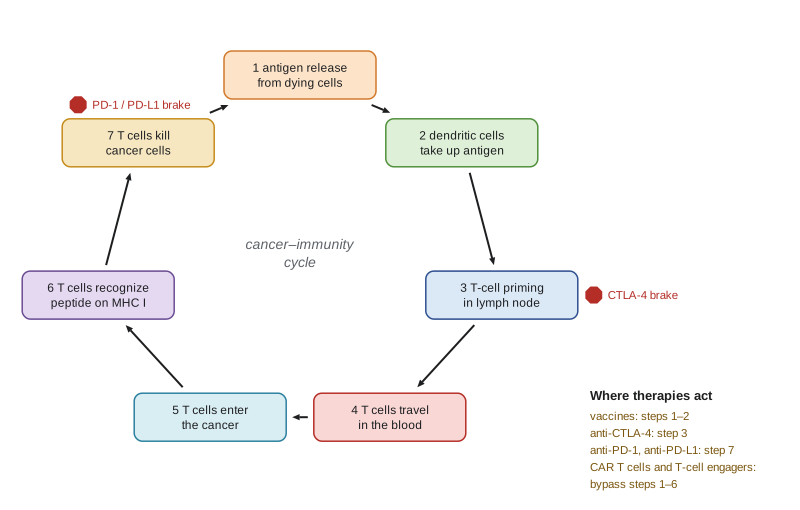
How tumors escape
Tumors that grow have found ways around this cycle. They can lose antigen presentation, through mutations in the B2M gene that encodes beta-2 microglobulin, an essential part of MHC class I, or through loss of the HLA alleles that present their neoantigens, which TRACERx found to be common in lung cancer. They can express ligands for inhibitory receptors on T cells, most importantly PD-L1, often induced by the interferon-gamma that attacking T cells release, an adaptive resistance that shows the immune system was active. They can recruit suppressive cells, regulatory T cells and myeloid-derived suppressor cells, and secrete immunosuppressive factors such as TGF-beta, adenosine and the tryptophan-depleting enzyme IDO. They can exclude T cells altogether, keeping them in the surrounding stroma, partly through TGF-beta and abnormal vasculature, a link to lesson 7. And some oncogenic pathways actively suppress immunity: WNT–beta-catenin activation in melanoma excludes dendritic cells, and loss of STK11 in KRAS-mutant lung cancer produces cold tumors that respond poorly to PD-1 blockade.
Pathologists and immunologists often describe tumors as hot, with abundant T cells inside the tumor and frequent PD-L1 expression; excluded, with T cells held at the margins; or cold, with few T cells anywhere. Hot tumors are the most likely to respond to checkpoint inhibitors, and much current research aims to turn cold tumors hot, using radiation, chemotherapy, vaccines or drugs that target suppressive myeloid cells.
Immune checkpoint inhibitors
T cells carry inhibitory receptors, called immune checkpoints, that prevent excessive or self-directed responses. CTLA-4 competes with CD28 for its ligands on antigen-presenting cells and so dampens T-cell priming in lymph nodes. PD-1, expressed on activated and exhausted T cells, binds PD-L1 and PD-L2 on tumor and other cells in tissues and switches off T-cell signaling at the site of attack. In the 1990s James Allison showed that blocking CTLA-4 caused tumor rejection in mice, and Tasuku Honjo discovered PD-1; they shared the 2018 Nobel Prize in Physiology or Medicine.
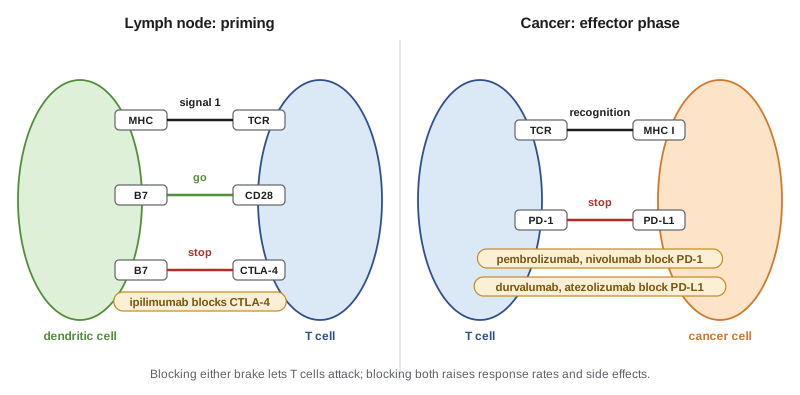
Ipilimumab, a CTLA-4 antibody, was approved for metastatic melanoma in 2011, after a trial showing improved survival in a disease that had no effective systemic therapy; about a fifth of patients were alive several years later. The PD-1 antibodies pembrolizumab and nivolumab followed in 2014 and are now approved for more than a dozen cancer types, alongside PD-L1 antibodies such as atezolizumab, durvalumab and avelumab, and the LAG-3 antibody relatlimab, combined with nivolumab in melanoma since 2022. Combining ipilimumab and nivolumab in melanoma produced response rates around 58 percent, and in the CheckMate 067 trial more than 40 percent of patients given the combination were alive ten years after starting treatment, a result unimaginable twenty years earlier. Checkpoint inhibitors are now used in the adjuvant and neoadjuvant settings as well as in metastatic disease.
Responses to checkpoint inhibitors have a distinctive shape. Many patients do not respond at all, but those who do often stay in remission for years, even after treatment stops. Survival curves therefore separate late and flatten into a tail, quite unlike the curves of chemotherapy, which delay progression for most patients but plateau rarely. The simulation below shows why median survival can understate the value of immunotherapy.
# Mixture-cure model: a fraction of patients has a durable response; others follow an exponential survival curve.
import numpy as np
def survival(t, cure, median_rest):
    lam = np.log(2) / median_rest
    return cure + (1 - cure) * np.exp(-lam * t)
months = np.array([0, 6, 12, 24, 36, 60, 120])
arms = {'chemotherapy': (0.05, 11.0), 'checkpoint inhibitor': (0.25, 7.5)}
print(f"{'month':22s}" + "".join(f"{m:7d}" for m in months[1:]))
for name, (cure, med) in arms.items():
    s = survival(months, cure, med)
    tgrid = np.linspace(0, 240, 24001)
    median = tgrid[np.argmax(survival(tgrid, cure, med) <= 0.5)]
    print(f"{name:22s}" + "".join(f"{x:7.0%}" for x in s[1:]) + f"   median {median:4.1f} mo")
cross = np.linspace(0, 60, 6001)
d = survival(cross, *arms['checkpoint inhibitor']) - survival(cross, *arms['chemotherapy'])
print(f"curves cross at about {cross[np.argmax((cross > 1) & (d > 0))]:.0f} months")month 6 12 24 36 60 120 chemotherapy 70% 50% 26% 15% 7% 5% median 11.9 mo checkpoint inhibitor 68% 50% 33% 28% 25% 25% median 11.9 mo curves cross at about 12 months
The numbers are illustrative: the two arms have the same median survival, yet more than three times as many patients are alive at five years with immunotherapy. Real trials of checkpoint inhibitors have shown curves that overlap or even cross early and then separate, which has prompted trial designers to report survival at fixed times such as two and five years, or restricted mean survival, rather than relying only on hazard ratios and medians.
Who responds?
Predicting response remains imperfect. PD-L1 expression on tumor cells, scored by immunohistochemistry as the tumor proportion score, enriches for benefit: in lung cancer with a score of 50 percent or more, pembrolizumab alone outperformed chemotherapy in the KEYNOTE-024 trial, and Maya's score of 60 percent places her in that group. But some PD-L1-negative tumors respond, and many positive ones do not. Tumor mutational burden helps because more mutations mean more potential neoantigens; carcinogen-driven cancers such as melanoma and smoking-related lung cancer, and mismatch repair-deficient tumors like Daniel's, have the highest burdens and the highest response rates. MSI-H/dMMR is the strongest single predictor: in metastatic MSI-H colorectal cancer, pembrolizumab replaced chemotherapy as first-line treatment after the KEYNOTE-177 trial. Other factors include T-cell infiltration, interferon-gamma gene signatures, loss of B2M or HLA, STK11 and KEAP1 mutations in lung cancer, and, intriguingly, the composition of the gut microbiome, which in several studies differed between responders and non-responders and, in small trials, faecal microbiota transplants from responders restored responses in some melanoma patients.
Side effects of releasing the brakes
Because checkpoint inhibitors remove restraints on the whole immune system, they can cause autoimmune inflammation in almost any organ, called immune-related adverse events. The skin, gut, liver, lungs and endocrine glands are affected most often. Colitis, hepatitis and pneumonitis are usually treated by stopping the drug and giving corticosteroids; endocrine damage, such as destruction of the thyroid, pituitary or adrenal glands, or of the insulin-producing cells of the pancreas causing type 1 diabetes, is often permanent and needs lifelong hormone replacement. Rare complications such as myocarditis can be fatal. Severe events are more common with combinations than with single agents. For Maya, pneumonitis is a particular concern, because her lungs have also received radiation; in PACIFIC, pneumonitis of any severity, mostly mild, occurred in about a third of patients given durvalumab and about a quarter of those given placebo.
Cell therapies and engagers
Chimeric antigen receptor (CAR) T cells are the patient's own T cells, collected by apheresis and genetically engineered, usually with a viral vector, to express a synthetic receptor. The CAR combines an antibody fragment that binds a surface antigen with the signaling domain of the T-cell receptor and a costimulatory domain such as CD28 or 4-1BB, so the engineered cells recognize tumor cells without needing MHC presentation. CD19-directed CAR T cells, first approved in 2017 for children and young adults with relapsed B-cell acute lymphoblastic leukemia, produce complete remissions in most such patients, and products targeting CD19 in lymphoma and BCMA in multiple myeloma followed. The main toxicities are cytokine release syndrome, a systemic inflammatory reaction treated with the IL-6 receptor antibody tocilizumab, and a neurological syndrome called ICANS. CAR T cells have so far worked much less well in solid tumors, where target antigens are rarely uniform, T cells must travel into the tumor and the microenvironment is suppressive.
Other approaches extend the idea. Tumor-infiltrating lymphocyte (TIL) therapy, pioneered by Steven Rosenberg at the US National Cancer Institute, expands T cells taken from a patient's own tumor and reinfuses them; lifileucel became the first approved TIL therapy, for advanced melanoma, in 2024. Engineered T-cell receptor therapies, which recognize peptides presented on specific HLA types, reached approval for synovial sarcoma in 2024. Bispecific T-cell engagers are off-the-shelf antibodies that bind CD3 on any T cell and a tumor antigen on the cancer cell, physically linking them: blinatumomab targets CD19 in leukemia, tebentafusp targets a melanoma peptide on HLA-A*02:01 in uveal melanoma, and tarlatamab targets DLL3 in small cell lung cancer. Cancer vaccines have a longer and less successful history, but personalized vaccines encoding a patient's own neoantigens, made from messenger RNA in a few weeks after sequencing the tumor, reduced recurrence when combined with pembrolizumab in a randomized phase 2 trial in resected melanoma, and phase 3 trials are under way. Older immune approaches remain in use: BCG instilled into the bladder for early bladder cancer, and an oncolytic herpes virus, talimogene laherparepvec, injected into melanoma deposits.
| Therapy | Example | Target or mechanism | Main uses |
|---|---|---|---|
| Anti-CTLA-4 antibody | Ipilimumab | Releases priming brake | Melanoma, kidney cancer, in combination with anti-PD-1 |
| Anti-PD-1 antibody | Pembrolizumab, nivolumab | Releases effector brake | Many solid tumors, Hodgkin lymphoma, MSI-H tumors |
| Anti-PD-L1 antibody | Durvalumab, atezolizumab | Blocks PD-L1 on tumor and immune cells | Lung, bladder, liver cancers |
| CAR T cells | CD19- and BCMA-directed products | Engineered receptor recognizes surface antigen | B-cell leukemias and lymphomas, myeloma |
| TIL therapy | Lifileucel | Expanded tumor-infiltrating T cells | Advanced melanoma |
| Bispecific T-cell engager | Blinatumomab, tebentafusp, tarlatamab | Links T cells to tumor cells | Leukemia, uveal melanoma, small cell lung cancer |
| Cancer vaccine | BCG; personalized neoantigen mRNA vaccines (in trials) | Stimulates local or antigen-specific immunity | Early bladder cancer; melanoma trials |
Bringing the course together
Maya completed chemoradiation with oesophagitis that settled within weeks, and began durvalumab. Her story touches almost every lesson. Tobacco carcinogens supplied mutations (lesson 1), including an activating KRAS G12C mutation (lesson 2) and loss of TP53 and p16 (lessons 3 and 5). Her tumor's high glucose uptake made it visible on PET (lesson 6), its hypoxic regions threatened her radiation response (lesson 7), and spread to a mediastinal node defined her stage (lessons 8 and 10). Its heterogeneity and the subclonal PIK3CA mutation found on sequencing hint at how it may resist treatment (lessons 9 and 11), and its high mutational burden and PD-L1 expression explain why immunotherapy is part of her plan. If her cancer recurs, a liquid biopsy may show how it escaped, and a KRAS G12C inhibitor is available.
Daniel's story ran through inheritance and DNA repair. A germline MSH2 variant (lessons 3 and 4) left one functional copy in every cell; a second hit in a colonic crypt removed mismatch repair, mutations accumulated, and the resulting cancer was detected through universal tumor screening (lesson 10). His family members who carry the variant now have colonoscopy every one to two years from their twenties and can consider risk-reducing surgery and aspirin, which reduced cancer incidence in Lynch syndrome carriers in the CAPP2 trial. If his own cancer returns, its mismatch repair deficiency makes him one of the patients most likely to benefit from PD-1 blockade.
Together the two cases show the main lesson of modern cancer biology: cancers are many different diseases, defined by their cell of origin, their mutations, their epigenetic state and their environment, and the most effective treatments come from matching therapy to that biology. Prevention, especially of smoking, and early detection still save more lives than any new drug. Yet survival has improved steadily. In both Canada and the United States, age-standardized cancer death rates have fallen by about a third from their peaks around 1990, through reductions in smoking, screening and better treatment, even as the number of cancer cases rises with an aging population.
Worked problem
Interpreting an immunotherapy biomarker panel
Two patients have metastatic non-small cell lung cancer. Patient A: PD-L1 tumor proportion score 80 percent, TMB 14 mutations per megabase, no driver mutation, STK11 wild-type. Patient B: PD-L1 score 5 percent, TMB 3 mutations per megabase, an EGFR exon 19 deletion. Which patient is more likely to benefit from first-line PD-1 blockade alone?
Show solution
- Patient A has high PD-L1 expression, which predicted benefit from pembrolizumab alone in KEYNOTE-024.
- A TMB of 14 suggests many neoantigens; STK11 wild-type avoids a known cold-tumor pattern.
- Patient B has low PD-L1 and low TMB, and EGFR-mutant lung cancers, usually arising in people who never smoked, respond poorly to checkpoint inhibitors.
- Patient B should receive an EGFR inhibitor such as osimertinib first; checkpoint inhibitors are generally avoided early in EGFR-mutant disease, partly because of toxicity when combined with osimertinib.
Answer: Patient A; Patient B should be treated with a targeted EGFR inhibitor instead.
Common mistakes
MistakeThinking checkpoint inhibitors kill cancer cells directly.
InsteadThey release brakes on T cells, which do the killing.
MistakeAssuming PD-L1-negative tumors never respond.
InsteadPD-L1 is an imperfect biomarker; some negative tumors respond and many positive ones do not.
MistakeJudging immunotherapy only by median survival.
InsteadDurable responses produce a tail on the survival curve that medians miss.
MistakeTreating immune side effects as minor.
InsteadImmune-related adverse events can be permanent or, rarely, fatal, and need prompt recognition.
MistakeExpecting CAR T-cell success in leukemia to transfer directly to solid tumors.
InsteadAntigen heterogeneity, trafficking and the suppressive microenvironment limit CAR T cells in solid tumors.
Summary and key terms
- The immune system recognizes and edits tumors through elimination, equilibrium and escape.
- T cells recognize neoantigens, viral antigens and tumor-associated antigens presented on MHC class I.
- Tumors escape by losing antigen presentation, expressing PD-L1, recruiting suppressive cells and excluding T cells.
- CTLA-4 and PD-1 antibodies release T-cell brakes and produce durable responses in a subset of patients, shown by survival curve tails.
- PD-L1, TMB and MSI-H/dMMR help predict response; MSI-H/dMMR is the strongest single predictor.
- Immune-related adverse events can affect any organ, and endocrine damage is often permanent.
- CAR T cells, TIL therapy, engineered TCRs, bispecific engagers and neoantigen vaccines extend immunotherapy beyond checkpoint blockade.
- immunosurveillance
- The idea that the immune system detects and destroys developing cancers.
- cancer immunoediting
- The shaping of tumors by immune pressure through elimination, equilibrium and escape.
- neoantigen
- A peptide created by a tumor mutation that the immune system can recognize as foreign.
- immune checkpoint
- An inhibitory receptor, such as PD-1 or CTLA-4, that limits T-cell activity.
- checkpoint inhibitor
- An antibody that blocks an immune checkpoint to restore T-cell responses.
- tumor proportion score
- The percentage of tumor cells staining for PD-L1.
- immune-related adverse event
- Autoimmune inflammation caused by immunotherapy.
- CAR T cell
- A T cell engineered to express a chimeric antigen receptor that recognizes a surface antigen.
- cytokine release syndrome
- A systemic inflammatory reaction caused by activated immune cells.
- bispecific T-cell engager
- An antibody that binds both a T cell and a tumor cell to trigger killing.
- hot tumor
- A tumor with abundant infiltrating T cells, more likely to respond to checkpoint inhibitors.
Practice problems
Work each problem on paper first, then reveal the answer to check.
Name the three phases of cancer immunoediting.
Show answer
Elimination, equilibrium and escape.
Why are frameshift mutations especially immunogenic?
Show answer
They create long stretches of new peptide sequence absent from normal proteins.
Where do CTLA-4 and PD-1 mainly act?
Show answer
CTLA-4 in lymph nodes during T-cell priming; PD-1 in tissues and tumors during the effector phase.
Give two ways tumors lose antigen presentation.
Show answer
B2M mutation and loss of HLA alleles.
Why does PD-L1 expression sometimes indicate an active immune response?
Show answer
Interferon-gamma released by attacking T cells induces PD-L1.
What is the main treatment for severe immune-related colitis?
Show answer
Stopping the drug and giving corticosteroids.
How does a CAR differ from a natural T-cell receptor?
Show answer
It recognizes a surface antigen directly via an antibody fragment, without MHC presentation, and includes costimulatory signaling.
Why might immunotherapy survival curves cross chemotherapy curves?
Show answer
Non-responders may do worse early, but durable responders create a long-term tail.
Lesson quiz · 5 questions
Score 60% or more to complete this lesson.
Create a free account to save your progress, take quizzes and earn a certificate.