
BIOL-450 · Lesson 1 of 12 · 24 min
What cancer is: hallmarks, epidemiology and evolution
Cancer is not one disease but a large family of diseases that share a logic. In every cancer, a lineage of cells escapes the controls that normally keep cell number, position and identity in balance, and its descendants expand at the expense of the organism. That escape is driven by changes in DNA and in the way DNA is read, accumulated over years, filtered by selection inside the body, and shaped by the tissue in which the cells live. This course follows that logic from molecules to patients. It builds on the cell biology of BIOL-214 (signaling, the cell cycle and cell death), the molecular biology of BIOL-207 and the genetics of BIOL-201, and it leaves tumor immunology and immunotherapy to BIOL-380, which already treats them in depth.
This first lesson sets out the framework used in the rest of the course: what defines a cancer, how common cancers are and why, the hallmarks that organize the biology, and the idea that a tumor is an evolving population. The running example, used in later lessons too, is an invented patient, Maya, a 58-year-old diagnosed with lung adenocarcinoma, together with an invented colorectal cancer family that illustrates inherited risk.
Defining cancer
A neoplasm, literally new growth, is an abnormal mass of cells whose growth exceeds and is uncoordinated with that of normal tissue. Benign neoplasms grow locally and remain encapsulated; they can still cause harm by pressure or by secreting hormones, but they do not invade or spread. Malignant neoplasms, cancers, invade surrounding tissue and can metastasize, establishing secondary tumors at distant sites. Metastasis, not the primary tumor, causes most cancer deaths.
Cancers are classified by the tissue of origin. Carcinomas arise from epithelia and account for most adult cancers: adenocarcinomas from glandular epithelium (much of breast, prostate, colon and lung cancer) and squamous cell carcinomas from protective epithelia (skin, esophagus, cervix, some lung). Sarcomas arise from mesenchymal tissues such as bone, muscle and fat. Hematopoietic cancers, the leukemias and lymphomas, arise from blood-forming cells and lymphocytes, and neuroectodermal tumors include gliomas and neuroblastoma. Pathologists also grade tumors by how abnormal the cells look and stage them by how far they have spread, usually with the TNM system: size and extent of the primary tumor (T), regional lymph node involvement (N) and distant metastasis (M). Stage is the strongest single predictor of outcome for most solid tumors, which is why so much of cancer control aims to find tumors at an earlier stage.
How common is cancer?
Cancer is the second leading cause of death in the United States, after heart disease. The American Cancer Society's Cancer Statistics, 2026 report projected about 2,114,850 new cancer cases and 626,140 cancer deaths in the United States in 2026. Five-year relative survival for all cancers combined reached about 70 percent for diagnoses in 2015 to 2021, up from 63 percent in the mid-1990s, and the report estimates that falling death rates since 1991 have averted about 4.8 million deaths (figures as of January 2026; check the current release). Lung cancer still causes more deaths than colorectal and pancreatic cancer combined.
Two measures are easily confused. Incidence is the rate of new diagnoses, usually expressed per 100,000 people per year and age-standardized so that populations with different age structures can be compared. Mortality is the rate of deaths from the disease. Survival, usually five-year net or relative survival, compares the survival of people with cancer with that expected in similar people without it. Incidence can rise because of real change in risk or because screening finds more tumors, some of which would never have caused harm. Mortality is less affected by such artifacts, which is why it is the most trusted measure of progress for a population. In both Canada and the United States, age-standardized cancer mortality has fallen steadily for three decades, driven mostly by reduced smoking, earlier detection and better treatment, while the number of cases keeps rising because populations are growing and aging.
Why age matters
The single strongest risk factor for most cancers is age. Incidence of common carcinomas climbs steeply from middle age, roughly with the fourth to sixth power of age. In the 1950s, Peter Armitage and Richard Doll showed that such a power law is what you would expect if a cell must pass through several rare, independent, rate-limiting steps before it becomes malignant. If each of \(k\) steps occurs at a small constant rate, the probability that one cell has completed all of them by age \(t\) grows approximately as \(t^{k}\), and the incidence, the rate of completing the last step, grows as \(t^{k-1}\). A log-log plot of incidence against age then gives a straight line with slope \(k-1\).
The multistage model is a simplification. It ignores clonal expansion between steps, which speeds the process, and it treats steps as mutations although some are epigenetic or microenvironmental. But its central insight has been confirmed by sequencing: most solid tumors carry a handful of driver mutations, typically between one and ten depending on tumor type, among many more passenger mutations that do not contribute to growth. Childhood cancers and some leukemias need fewer steps, consistent with their flatter age curves.
# Armitage-Doll: incidence rising as a power of age implies several rate-limiting steps.
import numpy as np
ages = np.array([30, 35, 40, 45, 50, 55, 60, 65, 70, 75, 80])
rng = np.random.default_rng(1)
k = 6                                             # steps in the invented model
true = 1.0e-12 * ages ** (k - 1)                   # rate per person-year
cases = rng.poisson(true * 500_000)                # cases in 500,000 person-years per age group
rate = cases / 500_000 * 1e5                      # per 100,000 per year
slope, intercept = np.polyfit(np.log(ages), np.log(rate), 1)
for a, r in zip(ages[::2], rate[::2]):
    print(f"age {a}: {r:7.1f} per 100,000")
print(f"log-log slope = {slope:.2f}, so about {slope + 1:.1f} rate-limiting steps")age 30: 2.0 per 100,000 age 40: 10.4 per 100,000 age 50: 30.0 per 100,000 age 60: 72.8 per 100,000 age 70: 172.4 per 100,000 age 80: 328.6 per 100,000 log-log slope = 5.00, so about 6.0 rate-limiting steps
Real age curves bend at older ages, partly because of competing causes of death and less complete diagnosis in the very old, and the slope differs among cancers. The lesson is not that every cancer needs exactly six mutations but that cancer is a multistep process, and that the time needed to accumulate steps explains why cancer is mostly a disease of later life.
Causes and risk factors
Risk factors act by increasing the rate of mutation, by increasing the number of cell divisions, or by providing an environment in which mutant cells grow. Tobacco smoke remains the largest single preventable cause of cancer, linked not only to lung cancer but to cancers of the mouth, throat, esophagus, bladder, pancreas and more. Infections cause a substantial share of cancers worldwide: human papillomavirus (HPV) causes almost all cervical cancers, hepatitis B and C viruses cause liver cancer, and Helicobacter pylori causes most stomach cancers; lesson 9 returns to these. Alcohol, excess body weight, physical inactivity, ultraviolet radiation, ionizing radiation including indoor radon, and occupational exposures such as asbestos and diesel exhaust add further risk. Inherited variants in genes such as BRCA1, BRCA2 and the mismatch repair genes cause perhaps 5 to 10 percent of cancers, although they matter enormously for the families who carry them.
In 2015, Cristian Tomasetti and Bert Vogelstein reported that the lifetime risk of cancer in different tissues correlated strongly with the total number of stem cell divisions in those tissues, and argued that much of the variation in risk among tissues reflected random replication errors, so-called bad luck. The paper provoked intense debate. Critics pointed out that a correlation across tissues says nothing about how much of the risk in any one tissue could be prevented, and that environmental and lifestyle factors still account for a large and preventable share of cancers. The useful synthesis is that mutations arise from three sources, replication errors, environmental exposures and inherited variants, and that all three combine; reducing exposures prevents many cancers even if some cannot be prevented.
The hallmarks of cancer
In 2000, Douglas Hanahan and Robert Weinberg proposed that the bewildering diversity of cancers could be organized around a small number of acquired capabilities, the hallmarks of cancer. Their 2011 update added two more and two enabling characteristics, and in 2022 Hanahan proposed further emerging hallmarks and enabling characteristics. The hallmarks are capabilities, not genes: many different molecular routes lead to each one, and a given mutation may contribute to several.
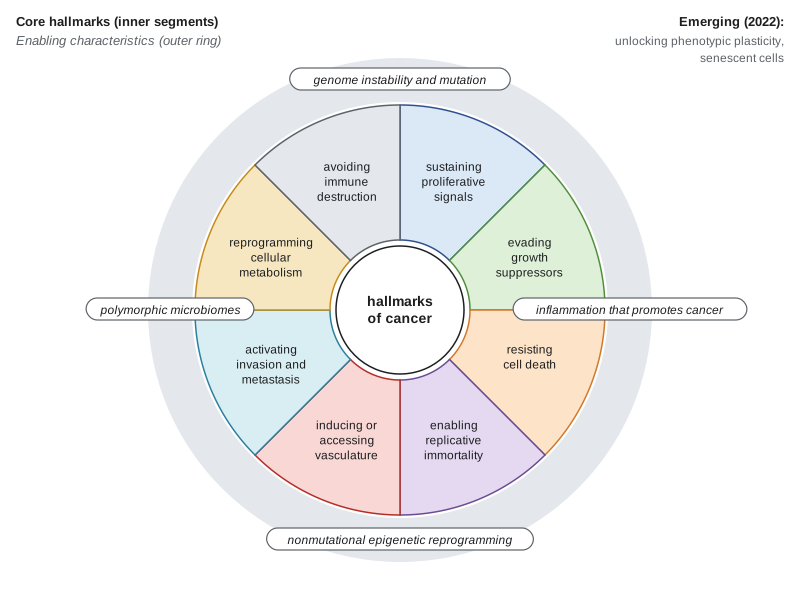
| Hallmark | Example mechanisms | Lesson |
|---|---|---|
| Sustaining proliferative signaling | Mutant RAS, amplified HER2, EGFR mutation | 2 |
| Evading growth suppressors | Loss of RB, loss of APC | 3 |
| Resisting cell death | p53 loss, BCL-2 overexpression | 3, 5 |
| Enabling replicative immortality | Telomerase reactivation, ALT | 4 |
| Inducing or accessing vasculature | VEGF secretion, vessel co-option | 7 |
| Activating invasion and metastasis | EMT, loss of E-cadherin | 8 |
| Reprogramming cellular metabolism | Warburg effect, IDH mutation | 6 |
| Avoiding immune destruction | PD-L1 expression, loss of MHC class I | BIOL-380 |
| Genome instability (enabling) | Mismatch repair loss, BRCA loss | 4 |
| Phenotypic plasticity, epigenetic reprogramming (2022) | Dedifferentiation, EZH2, DNA methylation | 9 |
Cancer as evolution
Peter Nowell's 1976 paper The clonal evolution of tumor cell populations gave cancer biology its central organizing idea. A tumor begins with a single cell that acquires an advantage. Its descendants form a clone. Further mutations arise at random within the clone; most are neutral or harmful, but occasionally one confers a further advantage and a subclone expands. Natural selection, acting within the body over years, assembles the combination of changes that makes a lethal cancer. The process is darwinian in the strict sense: heritable variation, differential reproduction and inheritance, the same principles taught in BIOL-321.
Two consequences follow. First, tumors are heterogeneous. Different regions of one tumor, and different metastases, can carry different mutations, and a biopsy samples only part of that diversity. Second, treatment is a selective pressure. A drug that kills most cells but spares a resistant minority selects for resistance, exactly as antibiotics select for resistant bacteria. Lessons 10 and 11 return to tumor heterogeneity and resistance quantitatively.
Maya's lung adenocarcinoma illustrates the framework. She smoked for 20 years and quit 15 years before diagnosis. Her tumor carries an activating KRAS mutation, a TP53 mutation and the characteristic mutational signature of tobacco smoke, a pattern of C to A changes on one DNA strand. Each change can be mapped onto a hallmark: KRAS sustains proliferative signaling, TP53 loss allows cells to resist death and tolerate damage, and the tobacco signature records the exposure that supplied the mutations.
Worked problem
Estimating the number of steps from two points
For an invented carcinoma, age-specific incidence is 20 per 100,000 at age 40 and 640 per 100,000 at age 80. If incidence follows a power law in age, estimate the exponent and the implied number of rate-limiting steps.
Show solution
- Ratio of incidences = 640 / 20 = 32; ratio of ages = 80 / 40 = 2.
- For I proportional to t to the power (k minus 1): 2 to the power (k minus 1) = 32.
- Since 2 to the fifth = 32, k minus 1 = 5.
- So k is about 6 rate-limiting steps, under the simple multistage model.
Answer: An exponent of 5, implying about six rate-limiting steps.
Common mistakes
MistakeTreating rising incidence as proof that cancer risk is rising.
InsteadCheck age standardization, changes in screening and diagnosis, and mortality trends before concluding risk has changed.
MistakeCalling every neoplasm a cancer.
InsteadOnly malignant neoplasms, which invade and can metastasize, are cancers; benign tumors stay local.
MistakeReading the multistage model as exactly k mutations for every cancer.
InsteadIt shows cancer is multistep; real tumors vary in driver number and include epigenetic and microenvironmental steps.
MistakeConcluding from the bad luck debate that cancer cannot be prevented.
InsteadReplication errors, exposures and inheritance all contribute; many cancers remain preventable by reducing exposures.
MistakeAssuming a single biopsy captures the whole tumor.
InsteadTumors are heterogeneous; different regions and metastases can differ genetically.
Summary and key terms
- Cancers are malignant neoplasms that invade and can metastasize; metastasis causes most cancer deaths.
- Carcinomas, sarcomas, hematopoietic and neuroectodermal cancers are classified by tissue of origin; stage (TNM) predicts outcome.
- Cancer is common and its number of cases is rising with population aging, while age-standardized mortality has fallen for decades.
- The steep rise of incidence with age reflects a multistep process; the Armitage–Doll model links the log-log slope to the number of steps.
- Mutations arise from replication errors, environmental exposures and inheritance; tobacco, infections, alcohol, obesity and radiation are major risk factors.
- The hallmarks of cancer organize the acquired capabilities of tumor cells and their enabling characteristics.
- Tumors evolve by mutation and selection, producing heterogeneity and the capacity to become resistant to treatment.
- neoplasm
- An abnormal mass of tissue whose growth exceeds and is uncoordinated with that of normal tissue.
- metastasis
- The spread of cancer cells from the primary tumor to form secondary tumors at distant sites.
- carcinoma
- A cancer arising from epithelial cells.
- TNM staging
- Classification of a tumor by primary tumor extent, regional lymph nodes and distant metastasis.
- incidence
- The rate of new diagnoses in a population over a period.
- age standardization
- Adjusting rates to a standard population age structure so that populations can be compared.
- multistage model
- A model in which a cell must pass through several rare steps to become malignant, predicting incidence rising as a power of age.
- driver mutation
- A mutation that gives a cell a growth advantage and contributes to cancer.
- passenger mutation
- A mutation carried in a tumor that does not contribute to its growth.
- hallmarks of cancer
- The acquired capabilities common to cancers, as proposed by Hanahan and Weinberg.
- clonal evolution
- The process by which tumor cells acquire mutations and selected subclones expand over time.
Practice problems
Work each problem on paper first, then reveal the answer to check.
Why is mortality a more trusted measure of progress against cancer than incidence?
Show answer
Incidence can rise with screening and overdiagnosis; mortality is less affected by such artifacts.
A cancer type has a log-log slope of incidence against age of 3. How many steps does the simple model imply?
Show answer
About 4.
Give two reasons the Armitage–Doll power law bends at very old ages.
Show answer
Competing causes of death and less complete diagnosis; also changing cell dynamics in old age.
Name three infectious agents that cause cancer.
Show answer
HPV, hepatitis B or C virus, and Helicobacter pylori (also EBV).
What is the difference between a hallmark and an enabling characteristic?
Show answer
A hallmark is an acquired capability; an enabling characteristic, such as genome instability, makes acquiring hallmarks more likely.
Why does treatment act as a selective pressure on a tumor?
Show answer
It kills sensitive cells and spares resistant ones, which then expand.
Map Maya's KRAS and TP53 mutations onto hallmarks.
Show answer
KRAS: sustaining proliferative signaling; TP53: resisting cell death and tolerating genome damage.
What does TNM stand for?
Show answer
Tumor, lymph Nodes, Metastasis.
Lesson quiz · 5 questions
Score 60% or more to complete this lesson.
Create a free account to save your progress, take quizzes and earn a certificate.