
BIOL-367 · Lesson 1 of 12 · 30 min
What conservation biology is and why it matters
Conservation biology is the science of understanding and protecting the diversity of life. It draws on ecology, evolution, genetics and physiology, which earlier courses in this program have built up, and it adds something those fields do not require: a commitment to an outcome. Ecologists study how populations grow and how communities assemble; conservation biologists study the same processes in order to slow the loss of species, populations and ecosystems. This first lesson asks what kind of science that makes conservation biology, why people value biodiversity, how different knowledge systems contribute, and how the rest of the course is organized.
A crisis discipline
In 1985 the American biologist Michael Soulé published an essay titled 'What is conservation biology?', which has shaped the field ever since. He described conservation biology as a crisis discipline, comparable to cancer biology or emergency medicine. In a crisis discipline, practitioners must often act before the science is complete, because waiting for certainty would mean losing the very thing they hope to protect. A physician treating a trauma patient cannot wait for a randomized trial; a biologist faced with a population of a few dozen animals cannot wait decades for a full demographic study. Decisions are made under uncertainty, and the costs of being wrong are asymmetric: an unnecessary precaution is usually reversible, but extinction is not.
Soulé also argued that conservation biology is value-laden, and he set out four functional postulates and a normative one. The functional postulates were that the diversity of organisms is good, that the untimely extinction of populations and species is bad, that ecological complexity is good, and that evolution is good. The normative postulate was that biotic diversity has intrinsic value, irrespective of its usefulness to people. Critics then and now have pointed out that these statements are not scientific hypotheses that can be tested; they are commitments. Supporters respond that every applied science has goals of this kind. Public health assumes that human health is worth protecting, and engineering assumes that bridges should stay up. The science within conservation biology must still be rigorous and honest, even when the results are unwelcome.
Roots of the field
Conservation biology as a named field dates from the late 1970s and 1980s. The first International Conference on Conservation Biology was held in San Diego in 1978, and the Society for Conservation Biology was founded in 1985. Its roots are much older. In North America, two traditions of the late nineteenth and early twentieth centuries are often contrasted. The preservationist tradition, associated with John Muir, argued that wild places should be protected for their own sake and for the spiritual benefit they give people. The resource conservation tradition, associated with Gifford Pinchot, the first chief of the US Forest Service, argued that forests, water and wildlife should be managed scientifically to provide the greatest good for the greatest number over the long run. Both traditions shaped the national parks and forest reserves created in Canada and the United States, from Yellowstone in 1872 and Banff in 1885 onward.
The ecologist Aldo Leopold bridged the two traditions. His essay 'The Land Ethic', published in 1949 in A Sand County Almanac, proposed that people should see themselves as members of a biotic community rather than as conquerors of it. Leopold's famous principle was that a thing is right when it tends to preserve the integrity, stability and beauty of the biotic community. Rachel Carson's Silent Spring (1962) then showed the public how pesticides moved through food webs, and helped launch modern environmental law in both countries. The science of island biogeography developed by Robert MacArthur and E. O. Wilson in the 1960s, discussed in BIOL-208, gave conservation biology some of its first quantitative tools, and population genetics, covered in BIOL-322, supplied others.
These historical roots also carry a less comfortable legacy. Many protected areas in North America were created by removing Indigenous peoples from lands they had lived on and cared for over thousands of years, and by banning hunting, fishing and burning practices that had shaped those landscapes. Lesson 11 returns to this history and to the growing role of Indigenous-led conservation today.
Levels of biodiversity
Biodiversity is usually described at three nested levels. Genetic diversity is the variation in genes within and among populations of a species; it is the raw material for adaptation and is lost when populations shrink or disappear, as BIOL-322 showed. Species diversity is the variety of species in a place or on Earth as a whole; it is the level most people think of first and the level at which most laws operate. Ecosystem diversity is the variety of communities and the processes, such as nutrient cycling and disturbance regimes, that connect them. Some authors add functional diversity, the range of ecological roles that species play, and phylogenetic diversity, the amount of evolutionary history represented by a set of species. Lesson 2 shows how each level can be measured.
Conservation can fail at any level. A species can persist while losing most of its genetic diversity, as the northern elephant seal did after being hunted to perhaps a few dozen animals in the 1890s. A species can survive in zoos while its ecological role disappears from the wild. And an ecosystem can lose its character without losing a single species, if the abundances of key species collapse. For this reason conservation biologists increasingly talk about protecting abundance and ecological function, not only the presence of species.
Why biodiversity matters: values
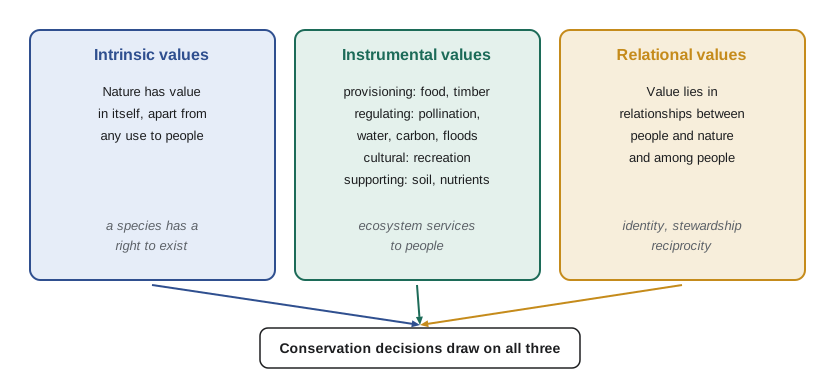
People value nature for many reasons, and conservation biologists find it useful to distinguish three broad families of values. Intrinsic values are the values that nature has in and of itself, independent of any use to people. When someone says that a species has a right to exist, they are appealing to intrinsic value. Intrinsic value cannot be measured in money, and it does not depend on whether a species is useful, beautiful or even known to science.
Instrumental values are the values that nature has as a means to human ends. The most familiar instrumental values are the goods and services that ecosystems provide. The Millennium Ecosystem Assessment, published in 2005, sorted these ecosystem services into four groups. Provisioning services are products such as food, timber, fiber, fresh water and medicines; about half of modern pharmaceuticals were derived from or inspired by natural compounds. Regulating services include pollination, the purification of water by wetlands, the control of floods, the storage of carbon in forests and peatlands, and the control of crop pests by predators. Cultural services include recreation, tourism, inspiration and spiritual experience. Supporting services, such as soil formation and nutrient cycling, underpin all the others.
Relational values are a third category, emphasized in recent work by the Intergovernmental Science-Policy Platform on Biodiversity and Ecosystem Services (IPBES) and by researchers such as Kai Chan and colleagues in 2016. Relational values are neither purely intrinsic nor purely instrumental; they reside in relationships between people and nature and among people through nature. A family that has fished the same river for generations, a community whose identity is bound to a mountain, or a nation whose laws and ceremonies are tied to the return of salmon all hold relational values. IPBES now uses the broader term 'nature's contributions to people' to make room for values that do not fit easily into the language of services.
Putting numbers on nature
Because many decisions are made in economic terms, ecologists and economists have tried to estimate the monetary value of ecosystem services. A widely cited study by Robert Costanza and colleagues in 1997 estimated the annual value of global ecosystem services at about 33 trillion US dollars, more than the global economic output of the time, and an updated study in 2014 raised the estimate to well over 100 trillion dollars a year. These numbers are rough, and critics point out that summing the value of services that cannot be substituted for one another has little meaning; without pollination or fresh water there would be no economy to compare them with. Valuation is more useful at local scales, where it can show, for example, that protecting a watershed is cheaper than building a water treatment plant. New York City made this argument in the 1990s when it chose to protect the Catskill and Delaware watersheds rather than build a filtration plant estimated to cost several billion dollars.
Valuation also raises the problem of time. Many benefits of conservation, such as a stable climate or the continued existence of a species, accrue far into the future, while the costs, such as forgone timber harvest, fall now. Economists convert future benefits to present values by discounting, and the choice of discount rate can decide the outcome of an analysis, as the next example shows.
# Present value of a wetland's services compared with a one-time payment for converting it.
# All numbers are invented for illustration.
annual_services = 120_000       # dollars per year of flood control, water filtration and recreation
conversion_value = 2_500_000    # one-time value of draining the wetland for development
years = 100
for rate in (0.01, 0.03, 0.05, 0.07):
    pv = sum(annual_services / (1 + rate) ** t for t in range(1, years + 1))
    choice = "protect" if pv > conversion_value else "convert"
    print(f"discount rate {rate:4.0%}: present value of services = {pv:12,.0f}  -> {choice}")
# value of services 100 years from now, seen from today
for rate in (0.01, 0.07):
print(f"at {rate:.0%}, one year of services in year 100 is worth {annual_services / (1 + rate) ** 100:9,.0f} today")discount rate 1%: present value of services = 7,563,465 -> protect discount rate 3%: present value of services = 3,791,869 -> protect discount rate 5%: present value of services = 2,381,749 -> convert discount rate 7%: present value of services = 1,712,310 -> convert at 1%, one year of services in year 100 is worth 44,365 today at 7%, one year of services in year 100 is worth 138 today
At low discount rates the stream of services over a century is worth more than the one-time conversion payment, so protection wins; at high rates the same stream is worth less, and conversion wins. The last two lines show why: at 7 percent a year, a benefit received a century from now is worth about one thousandth of its face value today. Some economists argue that discounting the welfare of future generations at market rates is ethically unjustified, and that irreversible losses such as extinction should be treated differently from ordinary costs. This debate is not one that biology can settle, but conservation biologists need to understand it because it shapes real decisions.
Knowledge systems and Two-Eyed Seeing
Western science is one way of knowing about nature. Indigenous knowledge systems, sometimes called traditional ecological knowledge or Indigenous knowledge, are others. They are cumulative bodies of knowledge, practice and belief, passed down through generations and adapted as conditions change, about the relationships of living beings with one another and with their environment. They are often place-based and intergenerational, and they are embedded in law, language and ceremony. Indigenous knowledge has contributed directly to conservation science: for example, Inuit knowledge of polar bear and beluga movements, Cree and Dene knowledge of caribou and the long fire-management traditions of many nations.
In Canada, an influential framework for bringing knowledge systems together is Etuaptmumk, or Two-Eyed Seeing, articulated by Mi'kmaw Elder Albert Marshall. Two-Eyed Seeing means learning to see from one eye with the strengths of Indigenous knowledges and from the other eye with the strengths of Western knowledges, and using both eyes together for the benefit of all. It does not mean absorbing Indigenous knowledge into Western science or treating it as a source of data points; it means respecting each system on its own terms and creating space where both can inform decisions. BIOL-208 introduced Two-Eyed Seeing in an ecological context; in conservation, it appears in species assessments, in co-management boards and in Indigenous-led monitoring.
In the United States, tribal nations are sovereign governments with treaty-reserved rights to hunt, fish and gather on and beyond their reservations, and they manage millions of acres of land and many fisheries. Co-management arrangements between tribes and federal or state agencies are increasingly common: for example, treaty tribes in Washington have co-managed salmon fisheries with the state since the 1974 Boldt decision, and the InterTribal Buffalo Council supports dozens of tribes in restoring bison herds. Tribal wildlife departments run monitoring and recovery programs for species such as the black-footed ferret, Pacific lamprey and Columbia River salmon.
Bringing knowledge systems together raises real questions of power and control. Who owns knowledge shared in an assessment? How is it protected from misuse? Indigenous data sovereignty principles, such as the CARE principles (collective benefit, authority to control, responsibility and ethics), are designed to keep communities in control of data about their lands and peoples, and BIOL-322 discussed similar principles for genomic data. Good practice is to involve communities from the design of a project, not only at the end.
Science, values and advocacy
Because conservation biology has goals, its practitioners face a recurring question: how far should scientists advocate for particular policies? One view holds that scientists should present evidence and let others decide, because advocacy may undermine public trust. Another holds that scientists have a responsibility to speak up when their expertise shows that a course of action will cause irreversible harm. Most conservation biologists take a middle position: they distinguish clearly between what the evidence shows and what they recommend, they disclose their values, and they avoid overstating certainty. Honest reporting of uncertainty, including evidence that a favored intervention does not work, is part of what makes the field credible. Lesson 12 discusses evidence-based conservation in more detail.
Conservation decisions also involve trade-offs among values held by different people. A dam may provide clean electricity and flood control while blocking salmon migration; a mine may provide jobs and minerals needed for batteries while destroying caribou habitat. Conservation biology can describe the biological consequences of each option clearly, estimate the risks to species and ecosystems, and design ways to reduce harm. It cannot by itself decide which values should prevail. That is a matter for democratic processes, Indigenous governance and law, which lesson 9 examines.
Conservation in two countries
The United States spans arctic, temperate, desert and tropical ecosystems, from Alaska to Hawaii and Puerto Rico, and it contains several global centers of species richness and endemism, including the California Floristic Province, the freshwater systems of the southeastern states, which hold more species of freshwater mussels, crayfish and fishes than anywhere else in the temperate world, and the islands of Hawaii, where a large share of the nation's documented extinctions have occurred. Roughly 1,700 species found in the United States are listed as endangered or threatened under the Endangered Species Act. Many wide-ranging species, from caribou to monarch butterflies and migratory birds, are shared with Canada and Mexico.
Throughout the course, examples are drawn from both countries, and legal and policy material is presented for the country whose site you are reading, with comparisons where they help. The science is the same on both sides of the border; what differs is the institutions through which societies act on it.
How the course is organized
Lessons 2 and 3 cover measurement and status: how biodiversity is quantified and what the best global and national data say about its state. Lessons 4 and 5 examine the threats that drive declines, grouped under the acronym HIPPO: habitat loss, invasive species, pollution, human population and consumption, and overexploitation, with climate change and disease as growing and interacting pressures. Lessons 6 and 7 turn to the population and landscape processes that determine whether species persist: small-population dynamics, population viability analysis, metapopulations and connectivity. Lessons 8 to 10 cover responses: protected areas and conservation planning, law and policy, and the recovery of species through captive breeding, reintroduction and restoration. Lesson 11 considers people, from Indigenous-led conservation to working landscapes and environmental justice. Lesson 12 is a capstone on monitoring, evidence and recovery planning, in which you will apply the course's tools to an invented species at risk.
| Lesson | Main question | Key tools |
|---|---|---|
| 2. Measuring biodiversity | How much diversity is there and how do we count it? | Hill numbers, rarefaction, species estimators, species–area curves |
| 3. Global status | How fast is biodiversity declining? | Living Planet Index, IUCN Red List criteria |
| 4–5. Threats | What drives declines? | Species–area extinction estimates, harvest models |
| 6–7. Persistence | Will a population or metapopulation survive? | Population viability analysis, metapopulation models, least-cost paths |
| 8–10. Responses | What can be done? | Reserve selection, legal tools, reintroduction models |
| 11–12. People and evidence | How do societies decide and learn? | Land sparing and sharing models, occupancy estimation, adaptive management |
Worked problem
Classifying values in a real dispute
A proposed highway would cross a valley used by elk, wolves and grizzly bears. Ranchers want the road for access to markets; a nearby First Nation or tribe opposes it because the valley contains ceremonial sites and hunting grounds used for generations; tourism operators worry about loss of wildlife viewing; and a conservation group argues that grizzly bears have a right to the valley. Classify the values in play.
Show solution
- The conservation group appeals to intrinsic value: the bears matter in themselves.
- Tourism operators appeal to instrumental value, specifically cultural ecosystem services such as recreation and wildlife viewing, which also have market value.
- The ranchers appeal to instrumental economic values of access, which are not ecosystem services but compete with them.
- The Indigenous community appeals to relational values tied to identity, ceremony and stewardship, and also to legal rights under treaties or Aboriginal title.
- A conservation biologist could contribute evidence on wildlife movement, road mortality and the effectiveness of crossing structures, without deciding whose values prevail.
Answer: All three families of values are present, along with legal rights. Clear classification helps a decision process see why people disagree and which kinds of evidence each group will find relevant.
Common mistakes
MistakeThinking conservation biology is the same as ecology.
InsteadIt uses ecology but adds an explicit goal of protecting biodiversity and must often act under uncertainty.
MistakeAssuming biodiversity means only the number of species.
InsteadIt includes genetic, species and ecosystem diversity, and often functional and phylogenetic diversity and abundance.
MistakeBelieving that putting a dollar value on nature settles conservation decisions.
InsteadValuation is useful at local scales but cannot capture intrinsic or relational values and depends heavily on discounting assumptions.
MistakeTreating Indigenous knowledge as data to be extracted for Western science.
InsteadTwo-Eyed Seeing and data sovereignty principles call for respecting each knowledge system and keeping communities in control.
MistakeAssuming that scientists must stay silent on policy to remain objective.
InsteadScientists can recommend actions if they separate evidence from values, disclose uncertainty and avoid overstating results.
Summary and key terms
- Conservation biology is a crisis discipline that applies ecology, evolution and genetics to protect biodiversity, often before the science is complete.
- Soulé's postulates state that diversity, ecological complexity and evolution are good, untimely extinction is bad and biodiversity has intrinsic value.
- The field grew from preservationist and resource conservation traditions, Leopold's land ethic and the environmental movement.
- Biodiversity is measured at genetic, species and ecosystem levels, and increasingly in terms of abundance and function.
- Nature has intrinsic, instrumental and relational values; ecosystem services are provisioning, regulating, cultural and supporting.
- Discounting can make long-term benefits of conservation look small; the choice of rate is partly ethical.
- Two-Eyed Seeing, Guardians programs and co-management bring Indigenous and Western knowledge systems together.
- conservation biology
- The applied science of understanding and protecting biological diversity.
- crisis discipline
- A field in which action must often be taken before full knowledge is available.
- biodiversity
- The variety of life at genetic, species and ecosystem levels.
- intrinsic value
- Value that something has in itself, independent of its usefulness.
- instrumental value
- Value that something has as a means to an end, such as human welfare.
- relational value
- Value arising from relationships between people and nature or among people through nature.
- ecosystem services
- Benefits people obtain from ecosystems: provisioning, regulating, cultural and supporting services.
- discounting
- Reducing the present value of future costs and benefits by a rate per year.
- Two-Eyed Seeing
- Etuaptmumk: using the strengths of Indigenous and Western knowledges together.
- Indigenous knowledge
- Cumulative, place-based knowledge, practice and belief held by Indigenous peoples.
- land ethic
- Leopold's idea that people are members of a biotic community and should act to preserve its integrity.
Practice problems
Work each problem on paper first, then reveal the answer to check.
Why did Soulé call conservation biology a crisis discipline?
Show answer
Because practitioners must often act before data are complete, as delay can mean irreversible loss.
Name the three main levels of biodiversity.
Show answer
Genetic, species and ecosystem diversity.
Give one example of each type of ecosystem service.
Show answer
Provisioning: timber; regulating: pollination; cultural: recreation; supporting: soil formation.
What is a relational value? Give an example.
Show answer
A value residing in a relationship, such as a community's identity tied to the return of salmon.
Why can a high discount rate favor converting habitat?
Show answer
It reduces the present value of long-term service flows below the immediate gain from conversion.
What does Two-Eyed Seeing ask of researchers?
Show answer
To use Indigenous and Western knowledges together while respecting each on its own terms.
Contrast the Muir and Pinchot traditions.
Show answer
Muir: protect wild places for their own sake; Pinchot: manage resources wisely for long-term human use.
Why can a species persist yet still be a conservation concern?
Show answer
It may have lost genetic diversity, abundance or its ecological role.
Lesson quiz · 5 questions
Score 60% or more to complete this lesson.
Create a free account to save your progress, take quizzes and earn a certificate.