
BAS-410 · Lesson 8 of 12 · 21 min
Issues logs and resolving deficiencies
▶ Video coming soon A video version of this lesson is on the way.
The most-used document in the Marlow Lane binder was not a test. It was a spreadsheet printout, eight pages long, headed Issues Log, with 58 rows. Every finding from Philippa's first design review comment in April to the last burn-in trend in November was on it: who found it, when, what it was, who had to fix it, what they did, and who checked that it was fixed. Ivo said the log was the commissioning process in one document. "If something is not in the log, as far as the commissioning record is concerned it never happened," he said. "That cuts both ways. A fix you never logged does not count either."
What an issues log is
An issues log is the single list of every deficiency, question and concern found during commissioning, kept by the commissioning provider and shared with the whole team. It is the tool that makes sure findings are not forgotten, that each one has an owner, and that nothing is closed until someone has checked the fix. It is also, at the end, the evidence of what commissioning found and achieved.
The log sits alongside, not instead of, the contract's other lists. On the construction side, a contractor's work that is incomplete or wrong is listed on the punch list at substantial completion. Commissioning issues can end up on that list too, but the issues log covers more: design questions, owner decisions, performance findings and recommendations that are nobody's deficiency.
| Field | What it holds | Marlow Lane example |
|---|---|---|
| Number | A unique number, never reused | I-37 |
| Date found and by | When and by whom | October 22, Philippa Quaid |
| Source | Design review, submittal, checklist, checkout, TAB, functional test, trends | Functional test FPT-VAV, step 3 |
| System and equipment | Where | VAV-3-04 (and all third-floor boxes) |
| Description | What was found, in facts | Discharge air temperature rose above its maximum in heating; limit block input linked to a constant |
| Requirement | The OPR line, specification clause or sequence section it breaks | Sequence 4.4; OPR lines 3 and 7 |
| Priority | How serious (see below) | B |
| Responsible | Who must act | Quillon |
| Action | What was done, by whom | Template corrected (S. Aubertin); loaded to 12 boxes (I. Bartek) |
| Status | Open, in progress, ready for verification, closed, deferred | Closed |
| Verified | Who checked the fix, how and when | Philippa, retest of step 3 on 12 boxes, October 23 |
Writing a good issue
Most issue logs are only as good as their descriptions. An entry that says "VAV-3-04 not working" sends someone to site without knowing what to look for, and it cannot be verified because nobody knows what working would look like. A good entry states the facts that were observed, the requirement they fail, and enough detail to reproduce the problem.
| Weak entry | Better entry |
|---|---|
| VAV-3-04 heating wrong | VAV-3-04 in FPT-VAV step 3: discharge air temperature rose to 106 °F and kept rising; sequence 4.4 limits it to the discharge air maximum |
| AHU-1 freeze stat bad | AHU-1 checklist line C-11: freeze protection capillary does not cross the bottom quarter of the heating coil face; manufacturer requires full face coverage |
| Alarms | Burn-in week: 131 zone temperature alarms during morning warm-up, before occupancy; OPR line 6 asks for no nuisance alarms |
| Check sensor | VAV-2-09 zone sensor 1.3 °F above reference at checkout; back box open to wall cavity on an outside wall |
The second column is not much longer than the first. It names what was observed, where, and against what requirement, and it avoids guessing at the cause unless the cause is known. On VAV-3-04, the first entry Philippa made in the field read "DAT exceeds max in heating; cause unknown", and Ivo added the cause to the action field when he found it.
Priorities
Not every issue matters equally. A missing label and a freeze protection device that cannot protect the coil are both deficiencies, but one has to be fixed before the unit runs in winter and the other before the binder is closed. Philippa's plan used four priorities, which is a common pattern.
| Priority | Meaning | Must be closed | Marlow Lane example |
|---|---|---|---|
| A | Safety, equipment protection or life safety interface | Before the equipment is operated | Freeze protection capillary (C-11); AHU-1 auto-restart after fire alarm reset (October 28) |
| B | Prevents a function the OPR or sequence requires, or prevents testing | Before the affected test, and before handover | VAV-3-04 template; swapped boiler enables |
| C | Performance, efficiency or comfort below the requirement | Before handover, or deferred with a date | VAV-2-07 and VAV-2-08 reheat hunting; VAV-1-02 corner office |
| D | Documents, labels, minor items | Before closeout | Plant panel engraved labels; graphics room numbers |
The fire alarm restart finding from BAS-340, where AHU-1 restarted on its own after the fire alarm reset instead of waiting for an operator, was priority A and was closed the same morning: Sophie added a latch cleared only by an operator command, and the row of the cause-and-effect matrix was retested and passed. The second finding from that test, that the monitoring window was too short, was not a deficiency of anyone's work. It went into the log as a recommendation (book three hours for future tests) and was closed by including it in the systems manual.
The issue lifecycle
Every issue moves through the same stages, and only the commissioning provider closes one.
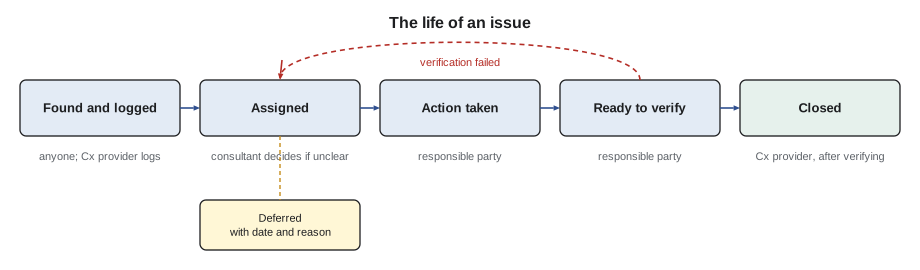
- Found and logged. Whoever finds an issue reports it; the commissioning provider writes it into the log with a number.
- Assigned. The responsible party is named. If it is unclear whose issue it is, the consultant decides, because responsibility can mean cost.
- Action taken. The responsible party fixes it, or answers it if it is a question, and records what was done.
- Ready for verification. The responsible party says it is ready to be checked.
- Closed. The commissioning provider checks the fix, by a retest, a site look, a trend or a document review, and closes the issue. If the check fails, the issue goes back to assigned.
The step that most often goes wrong is the last one. A contractor fixes something on site and moves on, and the log still says open, or the log says fixed and nobody has checked. Ivo's habit was to send Philippa a short note every evening listing the issues he had acted on that day, with the evidence: a photograph, a trend, a recheck on the checkout sheet. She closed most of them from the evidence and came to see the rest.
Resolving deficiencies well
Fixing a deficiency is not always the same as resolving it. The difference is whether the cause is understood.
- Find the cause before fixing the symptom. VAV-2-09's sensor was 0.7 K high because of a draft in the back box; an offset would have fixed the reading on that day and hidden a problem that changes with the weather.
- Ask whether the cause is shared. VAV-3-04 was one box failing a test; the cause was a template on twelve boxes. Whenever a deficiency comes from a template, a standard detail, a habit or a shared setting, look for it everywhere.
- Fix it in the source as well as in the field. Sophie corrected Quillon's master VAV template, not just the third-floor copy, so the next job would not repeat the error.
- Record what was changed. A setting changed during a fix must reach the as-built documents.
- Say when you caused it. Two of the Marlow Lane issues were Quillon's own mistakes found by Quillon. Logging them cost nothing and built trust.
Worked problem
How fast were issues closed?
Three Marlow Lane issues: I-37 (VAV-3-04) found October 22, fixed that afternoon, verified October 23; I-12 (freeze protection capillary) found October 5, fixed October 8, verified October 9; I-44 (VAV-2-07 and 2-08 hunting) found October 30, retuned November 2, verified from the November 3 trend. How many days did each take from finding to closing, and what is the average?
Show solution
- I-37: October 22 to 23 = 1 day.
- I-12: October 5 to 9 = 4 days.
- I-44: October 30 to November 3 = 4 days (1 day left in October after the 30th, plus 3 in November).
- Average: (1 + 4 + 4) ÷ 3 = 3 days.
Answer: 1, 4 and 4 days, averaging 3 days. Quick closing during the testing weeks was possible because the contractor and the commissioning provider were on site together; issues found by design review were closed in days too, but on paper.
Marlow Lane's log at handover
At handover on November 5, the log had 58 issues. The chart in Philippa's handover report showed where they came from.
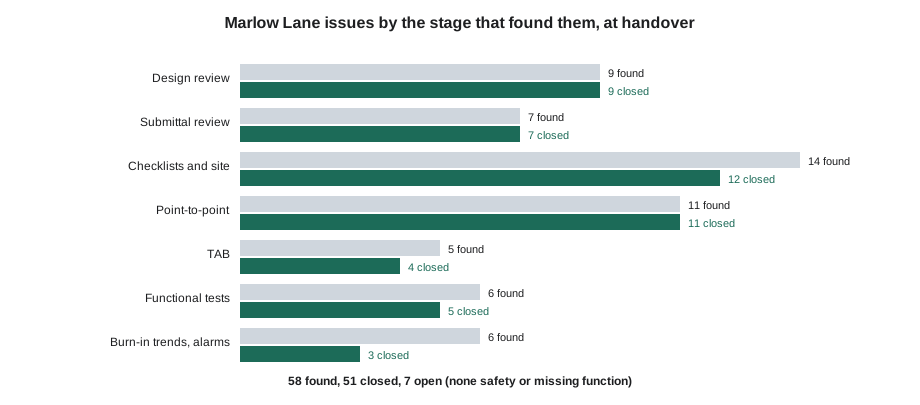
| Stage that found it | Issues |
|---|---|
| Design review | 9 |
| Submittal review | 7 |
| Pre-functional checklists and site observation | 14 |
| Point-to-point checkout | 11 |
| TAB | 5 |
| Functional tests, including the fire alarm interface test | 6 |
| Burn-in trends and alarms | 6 |
| Total | 58 |
Sixteen of the 58 were found on paper, in design and submittal review, before anything was installed. Those were the cheapest to fix and some of the most important, such as the discharge air sensors and the fire alarm restart sequence. Thirty were found during installation, checkout and balancing, by Quillon, Stelmark and Philippa, and the remaining twelve during testing and burn-in.
Worked problem
How much was closed at handover?
51 of the 58 issues were closed at handover. What share was that, and how many were open?
Show solution
- Share closed: 51 ÷ 58 = 0.879, about 88 in 100.
- Open: 58 − 51 = 7.
Answer: About 88 in 100 closed, 7 open. Halvern accepted the handover with the 7 open issues listed in the handover certificate, each with a responsible party and a target date.
| Issue | Priority | Responsible | Target |
|---|---|---|---|
| VAV-1-02 corner office below setpoint on cold mornings | C | Design engineer to decide; Quillon to implement | December 2026 (plan) |
| AHU-1 cooling at high outdoor temperature and economizer high limit not yet tested | C | Philippa and Quillon | June 2027 (plan) |
| AHU-1 morning transition after warm-up: supply air outside band for up to 25 minutes | C | Quillon | Warranty review, September 2027 (plan) |
| Missing test port on the hot water supply main | D | Mechanical contractor | December 2026 (plan) |
| Plant panel engraved labels | D | Quillon | December 2026 (plan) |
| Graphics: room numbers on the third-floor plan to match the tenant's new numbering | D | Quillon | December 2026 (plan) |
| AHU-1 filter section access door gasket torn | D | Mechanical contractor | December 2026 (plan) |
None of the open issues was priority A or B. That was the real handover test: a building can be handed over with open items, but not with open safety items or missing functions. Every open item has a date, and the log stays open until the last one is closed, which on Marlow Lane will be after the June 2027 cooling tests. The record documents and the systems manual are not on the list because they are closeout deliverables with their own due dates (lesson 10).
Tools and habits
Issues logs are kept in many ways: a shared spreadsheet, a commissioning software platform, or a module of a construction management system. The tool matters less than a few rules: one log per project, kept by one person; every party able to read it; numbers never reused; nothing deleted, only closed; and the log reviewed at every site meeting. On Marlow Lane, Philippa used a shared spreadsheet, reviewed at the weekly meeting during construction and daily during the testing weeks.
For Callie's December rooftop units at Ninefield, where there is no commissioning provider, Ivo suggested she keep a simple issues log anyway, with the same fields, and hand it to Ilona's operator with the checkout sheets. A log is not only for commissioned jobs; it is how a job shows what was found and fixed.
When responsibility is disputed
Some issues have no obvious owner. VAV-1-02, the corner office, could be a design question (is the heating airflow enough for two outside walls?), a balancing question (is the box delivering its design heating airflow?) or a controls question (is warm-up starting early enough?). The log records it with the responsible party as to be decided, and the consultant decides, after the facts are collected. On Marlow Lane, Brenna confirmed the airflow and Ivo confirmed the warm-up timing, which left the design question for the engineer. Collecting facts first stops the log from becoming an argument, and it means the decision, when it comes, is about the right thing.
Common mistakes
MistakeFixing problems on site without logging them.
InsteadLog every finding, including your own, with what was done. A fix that is not in the log does not appear in the commissioning record.
MistakeWriting vague issue descriptions.
InsteadState what was observed, where, and against what requirement, so the issue can be found, fixed and verified.
MistakeClosing an issue when the contractor says it is fixed.
InsteadOnly the commissioning provider closes an issue, after verifying the fix.
MistakeFixing one instance of a shared fault.
InsteadLook for the same cause on every unit that shares the template, detail or setting, and fix it at the source.
Summary and key terms
- The issues log is the single list of every commissioning finding, with an owner and a status for each.
- Good entries state facts, location and the requirement broken, without guessing the cause.
- Priorities separate safety and missing functions, which must be closed before handover, from performance and document items.
- Issues move from logged to assigned, action, verification and closed; only the commissioning provider closes them.
- Resolving a deficiency means finding the cause, checking whether it is shared, and fixing it at the source.
- Issues log
- The commissioning provider's list of every deficiency, question and concern, with owners, actions and status.
- Deficiency
- Work that does not meet the contract documents, the sequence or the owner's requirements.
- Verification
- The commissioning provider's check that a fix works, by retest, inspection, trend or document review.
- Priority
- The seriousness of an issue, which sets when it must be closed.
- Handover certificate
- The document recording the owner's acceptance of the work, with any open items listed.
Practice problems
Work each problem on paper first, then reveal the answer to check.
Why was the monitoring window finding logged even though it was nobody's deficiency?
Show answer
It was a useful recommendation for future tests. Logging it meant it was recorded, decided on and closed, by putting it in the systems manual.
What makes an issue ready to close?
Show answer
The responsible party has acted and said it is ready, and the commissioning provider has verified the fix.
Why could Marlow Lane be handed over with seven open issues?
Show answer
None was a safety item or a missing function, and each had a responsible party and a target date in the handover certificate.
Lesson quiz · 5 questions
Score 60% or more to complete this lesson.
Create a free account to save your progress, take quizzes and earn a certificate.