
BAS-410 · Lesson 5 of 12 · 21 min
Functional performance testing
▶ Video coming soon A video version of this lesson is on the way.
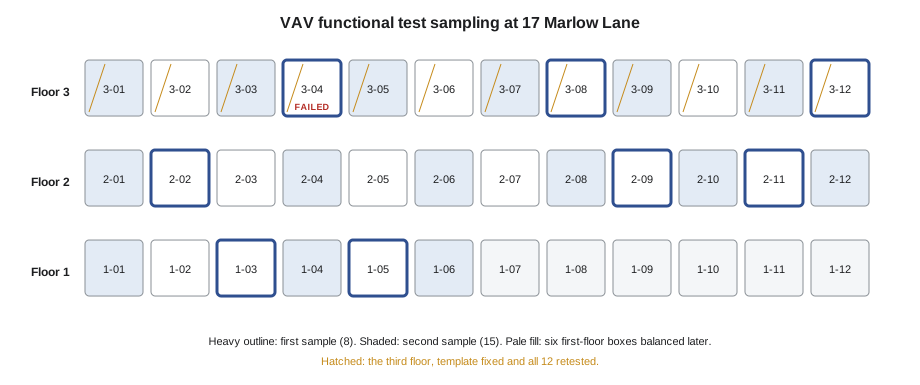
On Thursday, October 22, with the balancing finished on all but six first-floor boxes and the checkout sheets accepted, Philippa came to Marlow Lane with a folder of test scripts and a list of eight box numbers she had chosen the night before. Ivo sat at the front end on the second floor; Philippa walked the floors with a tablet and a radio. By the end of the morning seven boxes had passed every step and one, VAV-3-04 on the third floor, had failed in heating. That one failure turned an eight-box test into a fifteen-box test and found a problem in the program of every box on the third floor. Ivo said it was the best morning of the whole commissioning process.
What a functional performance test is
A functional performance test (FPT) operates a system through its modes and conditions and checks that it responds as the sequence of operation and the owner's requirements say it should. Point-to-point checkout asks whether each point works. A functional test asks whether the system works: whether the box goes to maximum cooling airflow when the room is warm, whether the reheat valve opens and the discharge air warms when the room is cold, whether the box does the right thing when its sensor fails.
The contractors perform functional tests, because they know the equipment and the controls and they are responsible for fixing what fails. The commissioning provider writes the test scripts, directs the tests, witnesses them, and decides whether each step passed. Operators often join, which is good training.
Functional testing is part of every commissioning standard. In the US, the IECC's commissioning section requires functional testing of HVAC equipment, HVAC controls and economizers in buildings it covers, and ASHRAE 90.1 has similar verification and testing requirements. The project's specification sets what is tested and how much is sampled.
The test script
A functional test is written as a script before the test, so that everyone knows what will happen, what result is expected, and what counts as passing. Writing the script is also a review of the sequence: Philippa found two ambiguities in the VAV sequence while writing the VAV scripts, and the consulting engineer clarified both before testing.
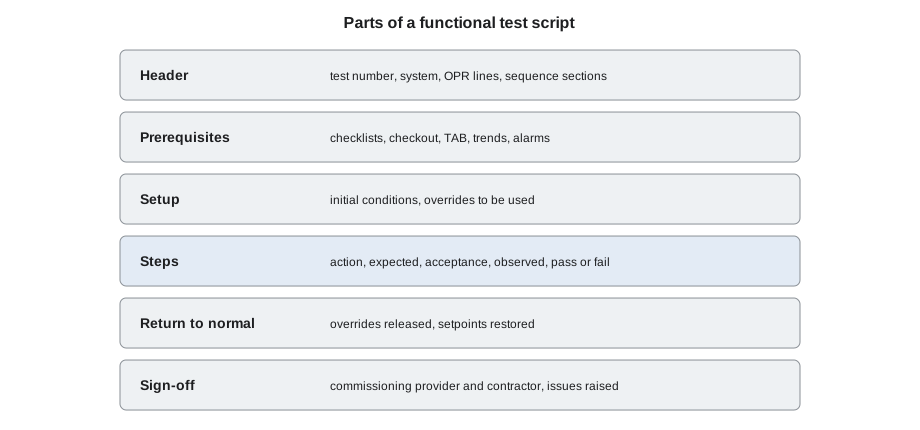
| Section | Purpose |
|---|---|
| Header | Test number, system, OPR lines and sequence sections it tests, date, names |
| Prerequisites | What must be done first: checklists complete, checkout accepted, TAB done, alarms set up, trends running |
| Setup | Initial conditions and how they are created; any overrides used |
| Steps | Each action, the expected response, the acceptance criterion, the observed result and pass or fail |
| Return to normal | Every override released, setpoints restored, system back in automatic |
| Sign-off | Commissioning provider and contractor signatures, and any issues raised |
Acceptance criteria are what make a test a test. "Box goes to maximum airflow" is not enough: to what airflow, how close, and how fast? Marlow Lane's VAV scripts used criteria like these.
FPT-VAV  VAV box with hot water reheat (applies to all 36 boxes)
OPR lines 3, 4, 7   Sequence sections 4.1 to 4.6
Prerequisites: box checklist complete, checkout accepted, TAB done, trends at 1 min
Step  Action                                  Expected                          Accept
1     Occupied. Lower cooling setpoint         Airflow setpoint to cooling max   Flow within 10 in 100 of
      5 F below zone temp                      Reheat valve closed               setpoint within 3 min
2     Restore cooling setpoint                 Airflow to minimum when           Flow within 10 in 100 of
                                               zone is satisfied                 minimum within 5 min
3     Raise heating setpoint 5 F above zone    Airflow to heating airflow;       DA temp rises at least
                                               valve opens; DA temp rises        20 F above supply within
                                               DA temp limited to its maximum    10 min; not above DA max
4     Restore heating setpoint                 Valve closes, DA temp falls       Valve 0 within 2 min
5     Command unoccupied                       Box to unoccupied mode,           Mode correct on front end
                                               setpoints to setback values
6     Disconnect zone sensor at controller     Sensor fail alarm; box holds      Alarm within 60 s; box to
                                               failure airflow                   failure position
7     Return to normal                         All overrides released            Override report empty
Each step has one action and an expected response that someone can observe. The steps are short and in an order where each one starts from a known state. Step 6 is a failure test, which many scripts forget: the sequence says what the box should do if its sensor fails, so that behavior must be tested too.
Worked problem
Is the airflow within its criterion?
In step 1 on VAV-2-11, the airflow setpoint went to the box's cooling maximum of 425 cfm, and after 3 minutes the box read 395 cfm. The criterion is within 10 in 100 of setpoint. Pass or fail?
Show solution
- Allowed band: 425 × 0.10 = 42.5 cfm, so 382.5 to 467.5 cfm.
- 395 cfm is inside the band; the error is (395 − 425) ÷ 425 = −0.071, or about 7 in 100 low.
Answer: Pass. Philippa recorded the actual number, not just the tick, because a box sitting 7 in 100 low at maximum may show up again in trends or complaints. The box reading itself had been calibrated against a flow hood during balancing (lesson 7), which is what makes the comparison meaningful.
How conditions are created
A functional test needs the conditions that trigger each mode: a warm room, a cold room, an outdoor temperature that calls for the economizer, a sensor failure. Some happen naturally; most have to be created. There are three ways to do it, and each has rules.
| Method | How | Care needed |
|---|---|---|
| Real conditions | Test when the weather or the load gives the condition: a cold morning for warm-up, a mild afternoon for the economizer | Most convincing, but may need waiting or seasonal testing |
| Setpoint changes | Move the setpoint so the existing condition triggers the mode, as in steps 1 and 3 | Restore every setpoint; record each change |
| Overriding an input | Override a sensor value in the controller to simulate a condition, such as a low outdoor temperature | Never override a safety; release every override; the override tests the program, not the sensor |
Overriding an input is the most powerful method and the easiest to misuse. Overriding the outdoor temperature to 41 °F on a 59 °F day tests what the program does at that temperature, which is useful. It does not test the coil's ability to heat air that cold, and if the override is forgotten, the building runs all night as if it were cold. Safety devices are never overridden in software to make a test pass. Freeze protection, high static limits and fire alarm shutdowns are tested by operating the device itself, with the right people present, as BAS-340 described.
A simpler rule from Ivo: change setpoints before overriding inputs, and override inputs only when there is no other way to create the condition in the time available.
Sampling
Testing every box in a large building takes a long time, and boxes of the same type with the same program usually behave the same way. Specifications therefore often allow sampling of repeated equipment such as VAV boxes, fan coils and terminal heat pumps, while major equipment (air handlers, boilers, chillers, main pumps) is tested in full. A common arrangement, typical rather than universal, is to test 10 to 20 in 100 of the repeated units at random and to expand the sample if more than a set share of the sample fails.
| Marlow Lane rule (from the commissioning plan) | Value |
|---|---|
| Major equipment (AHU-1, boilers, exhaust fans) | Tested in full |
| VAV boxes, first sample | 20 in 100, rounded up, chosen at random by the commissioning provider from the balanced boxes, at least two per floor |
| Failure threshold | If more than 10 in 100 of the sampled boxes fail, test a second sample of 40 in 100 |
| Systemic failure | If a failure is caused by something shared (a program template, a wiring standard), fix it on every affected box and retest those boxes |
| Retests | The first retest of a failed step at no charge; further retests charged to the contractor at the commissioning provider's rate |
Worked problem
How many boxes?
Marlow Lane has 36 VAV boxes. How many boxes are in the first sample, how many failures trigger the second sample, and how large is the second sample?
Show solution
- First sample: 36 × 0.20 = 7.2, rounded up to 8 boxes.
- Failure threshold: more than 10 in 100 of 8 is more than 0.8, so one failure is enough (1 ÷ 8 = 12.5 in 100).
- Second sample: 36 × 0.40 = 14.4, rounded up to 15 boxes.
Answer: 8 boxes first; a single failure triggers a second sample of 15 boxes. Small samples are strict: on 8 boxes, there is no room for even one failure.
The failure on VAV-3-04
In step 3, VAV-3-04's reheat valve opened and its discharge air temperature rose, but it kept rising past the discharge air maximum. The box was heating the room with air hotter than the sequence allowed, which wastes energy and, with ceiling diffusers, leaves warm air near the ceiling while the floor stays cool. Ivo opened the program and found that the discharge air limit block was present but its input was linked to a constant, not to the discharge air sensor. The third-floor boxes had been loaded from an earlier version of the template, saved before the discharge air sensors were added by design review comment D-5. The first and second floors used the corrected version.
Because the cause was shared, the commissioning plan's systemic failure rule applied. Sophie corrected the third-floor template, Ivo loaded it to all 12 third-floor boxes that afternoon, and the next morning Philippa and Ivo retested step 3 on all 12 and then ran the full script on the second sample of 15 boxes. Everything passed. The issues log records the failure, the cause, the fix and the retests, with the template version numbers.
Without sampling and the expansion rule, the fault might have been found in a single box and fixed there, leaving 11 others with the same error. Without functional testing at all, the third floor would have overheated its air every winter morning, and nobody would have seen it except in the gas bill. The point-to-point checkout could not have found it: every point on VAV-3-04 had read and moved correctly.
Witnessing, failing and retesting
A test step passes only when its acceptance criterion is met while the commissioning provider is watching, or, for trend-based steps, when the commissioning provider has reviewed the trend. If a step fails, the test team decides whether the cause can be fixed on the spot. A wrong setpoint or a reversed output can often be corrected and the step rerun; the sheet then records both the failure and the retest. A program error or a hardware problem usually means stopping that test, logging the issue, and retesting later.
Ivo had three rules for the controls technician during a witnessed test.
- Say what you are about to change before you change it, and record it.
- Never adjust anything quietly to make a step pass. If a step passes only after an adjustment, the adjustment is part of the result and must be in the record.
- When a step fails, find the cause before guessing a fix. The VAV-3-04 failure looked like a tuning problem for about a minute; it was a missing link in the program.
Seasonal and deferred tests
Some modes can be tested only in the right season. A November handover can test heating and warm-up under real load, but not cooling at design conditions or the economizer's high limit on a hot day. Those steps are tested at part load before handover, with setpoint changes or overrides where safe, and then deferred tests are scheduled for the right season. Marlow Lane's deferred list includes AHU-1 cooling at high outdoor temperature and the economizer high limit, planned for June 2027 (lesson 12).
Who pays for retests
Retests cost the commissioning provider's time, and the Marlow Lane plan made the arrangement clear before testing began: the first retest of a failed step was included, and further retests were charged to the contractor at the commissioning provider's rate. Rules like this are common. They are not meant to punish failures, which are expected, but to discourage contractors from presenting equipment for testing before it is ready. Ivo's view was simple: the cheapest test is the one that passes first time because the checkout was done properly, and the most expensive is the third attempt at a step that failed because nobody looked at the program before the commissioning provider arrived.
Common mistakes
MistakeWriting a test step without an acceptance criterion.
InsteadEvery step needs a measurable criterion: how much, how close, how fast. Otherwise pass and fail become opinions.
MistakeOverriding a safety device in software so a test can continue.
InsteadSafeties are tested by operating the device with the right people present, and are never bypassed to make a test pass.
MistakeFixing one failed box when the cause is shared.
InsteadIf the cause is a template, a standard or a shared setting, every affected unit must be fixed and retested.
MistakeMaking a quiet adjustment during a witnessed step.
InsteadAnnounce and record every change; an adjustment that makes a step pass is part of the result.
Summary and key terms
- A functional performance test operates a system through its modes and checks its responses against the sequence and the OPR.
- Test scripts list prerequisites, setup, steps with expected responses and acceptance criteria, return to normal, and sign-off.
- Conditions are created by real weather, setpoint changes or input overrides; safeties are never overridden in software.
- Repeated equipment can be sampled, with the sample expanded when failures exceed the threshold and shared faults fixed everywhere.
- Seasonal tests are deferred to the season that provides the conditions.
- Functional performance test (FPT)
- A test that operates a system through its modes and checks its responses against acceptance criteria.
- Test script
- The written procedure for a functional test, with steps, expected responses and acceptance criteria.
- Acceptance criterion
- The measurable condition that decides whether a test step passes.
- Sampling
- Testing a random share of repeated units, with rules for expanding the sample when failures occur.
- Systemic failure
- A failure caused by something shared by many units, such as a program template, which must be fixed on all of them.
Practice problems
Work each problem on paper first, then reveal the answer to check.
Why could the point-to-point checkout not find the VAV-3-04 fault?
Show answer
Every point read and moved correctly. The fault was in the program's logic, which only shows when the sequence is operated through its heating mode.
A sample of 8 boxes has 1 failure. Does the second sample apply under Marlow Lane's rules?
Show answer
Yes. 1 ÷ 8 = 12.5 in 100, which is more than 10 in 100.
What is wrong with overriding the outdoor temperature input and leaving it?
Show answer
The program will act on the false value after the test, for example heating as if it were cold, until someone notices.
Lesson quiz · 5 questions
Score 60% or more to complete this lesson.
Create a free account to save your progress, take quizzes and earn a certificate.