
BAS-410 · Lesson 10 of 12 · 23 min
As-built documentation and closeout
▶ Video coming soon A video version of this lesson is on the way.
The last tab of the Marlow Lane binder was mostly empty pages with headings: As-built drawings, Points list, Sequences as built, Programs and backups, Graphics, Operation and maintenance manuals, Warranty, Training record, Systems manual, Final commissioning report. Each page had a due date and a name. "This is the part of the job nobody wants to do," Ivo said, "and the part the next technician will thank you for. In five years, nobody will remember what we did in October. They will only have what we leave in this tab."
What closeout is
Closeout is the set of tasks that turns a working installation into a documented one the owner can operate, maintain, modify and service with any qualified contractor. For a controls contractor it means delivering record documents that match what is installed, backups of everything that was configured, the manuals and warranties, and evidence that training was done. For the commissioning provider it means compiling the systems manual and the final commissioning report.
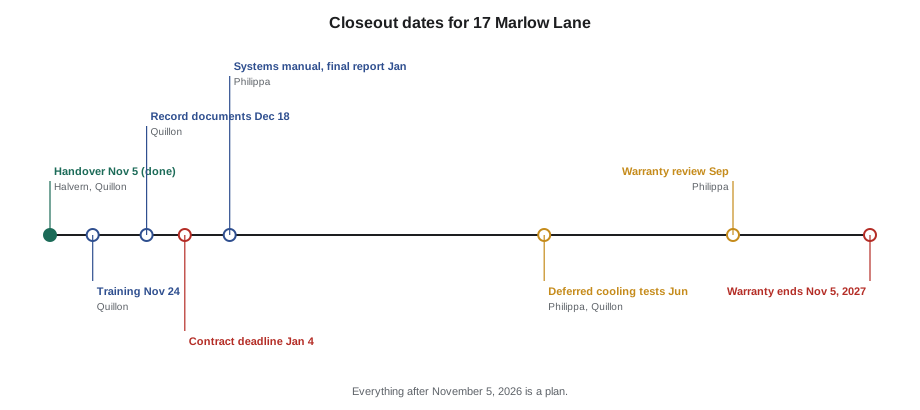
Halvern's contract made closeout concrete: Quillon's record documents within 60 days of handover, which lesson 2 worked out as Monday, January 4, 2027. Quillon plans to deliver them on Friday, December 18 (a plan), before the holidays. Philippa's systems manual and final commissioning report follow in January 2027 (plans), using Quillon's documents.
In the US, closeout requirements come from the contract and specification, and where the IECC's commissioning section applies, the owner must receive the record documents, manuals and training report within 90 days of the certificate of occupancy. Many specifications follow a standard division for closeout submittals, operation and maintenance data and record documents.
As-built drawings and the points list
As-built (or record) drawings show what was actually installed, not what was designed or submitted. Every change made during construction must reach them: a sensor moved, a cable rerouted, a controller added, a terminal reassigned. The controls as-builts usually include the network riser, panel layouts, wiring diagrams for each controller, device schedules and the points list.
The points list is the most-used controls document after the graphics. Marlow Lane's as-built points list has all 445 points, each with its name, controller, terminal or object, type, units, range, alarm limits and trend settings. Ivo built it by exporting the configuration from the controllers and comparing it, line by line, with the submittal points list.
Worked problem
Reconciling the points list
The approved submittal points list had 445 points. During construction, 3 points were renamed to match Halvern's naming standard, 2 points were moved to different terminals during checkout to use spare channels in the plant panel, and 1 spare input was used for the AHU-1 filter section's new door switch while 1 unused point was removed. How many points does the as-built list have, and how many lines changed?
Show solution
- Added: 1 (door switch). Removed: 1 (unused point). Net: 445 + 1 − 1 = 445.
- Changed lines: 3 renamed + 2 terminal reassignments + 1 added + 1 removed = 7.
Answer: Still 445 points, but 7 lines differ from the submittal. A points list that has the right count can still be wrong in detail, which is why the as-built list is exported from the controllers rather than copied from the submittal.
Ivo's rule for as-builts was that they are produced from the installation, not from the design: export the configuration, walk the panels with the drawings, photograph every panel with its door open, and mark up the drawings in the field. The markups are then drafted into the record set.
Sequences as built and the settings that matter
Sequences change during commissioning. Marlow Lane's changed in at least three ways: the fire alarm restart latch (design review comment D-3 and the October 28 test), the discharge air limit on every box (D-5 and the VAV-3-04 failure), and the settings found by balancing. A sequence as built records the sequence as it now runs, with every adjustable value at its final setting.
| Setting | Design value | As-built value | Source |
|---|---|---|---|
| Duct static pressure reset maximum | 1.00 in. w.c. | 0.85 in. w.c. | TAB (lesson 7) |
| Duct static pressure reset minimum | 0.40 in. w.c. | 0.40 in. w.c. | Unchanged |
| VAV airflow factors | Maker's values | Corrected for each of the 36 boxes | TAB report |
| Outdoor airflow station correction | None | Small correction to match the traverse | TAB (lesson 7) |
| Zone temperature alarm enable | At occupancy | 30 min after the occupied period starts | Burn-in alarm review (lesson 6) |
| Hot water temperature alarm delay | 2 min | 15 min | Burn-in alarm review |
| Reheat loops on VAV-2-07 and VAV-2-08 | Template tuning | Retuned | Burn-in trends |
| AHU-1 restart after fire alarm reset | Not stated | Operator restart only, latch cleared at priority 8 | Design review D-3; October 28 test |
This table goes into the sequences as built and the systems manual. It answers the question that every service technician asks sooner or later: is this value deliberate? A static pressure maximum lower than the design is not a mistake to be corrected; it was measured. Without the record, the next technician may put it back.
Programs, databases and backups
Every program, configuration and database must be handed over in a form the owner keeps. BAS-320 described Quillon's backup practice; at closeout it becomes a deliverable.
| Item | Handed over |
|---|---|
| Controller programs and configurations | A final backup of all 40 devices, taken after the last setting change, named with the site, device and date |
| Front-end database and graphics | A full export of the front end, with the graphics source files |
| Software and licenses | The license certificate for 50 devices in Halvern's name, with the support agreement details |
| Tools | The name and version of the programming tool needed to open the programs; whether Halvern owns a copy |
| Credentials | Administrator accounts for Halvern, delivered separately and securely, not in the binder; Quillon's installer accounts removed or handed over as the contract says |
| Restore test | One controller restored from the handed-over backup on Quillon's bench, to prove the backup works |
The restore test is the one most often skipped, and the one that matters most. A backup that has never been restored is a hope, not a backup. Quillon's monthly bench restore tests, described in BAS-320, made it routine: Ivo restored the AHU-1 backup to a spare controller on the bench and compared the program with the one on site before signing the closeout list.
Credentials need care. The binder is a document that many people will read and copy. Passwords do not belong in it. Halvern receives administrator credentials through the method its IT provider set up for the VPN, and the systems manual says who holds them, not what they are.
Operation and maintenance manuals
Operation and maintenance (O&M) manuals collect the product data and maintenance information for everything installed: controllers, sensors, actuators, valves, airflow stations, drives where the controls contractor supplied them, and the front end. For controls, the useful parts are the device data sheets, wiring and installation instructions, calibration and replacement procedures, recommended spare parts, and a maintenance schedule.
| Task | Typical interval | Who |
|---|---|---|
| Review alarms and overrides | Daily | Operators |
| Check trends of key systems | Weekly | Operators |
| Back up the front end and controllers | As BAS-320 described; at least after every change | Quillon or operators |
| Check sensor readings against a reference, sample of sensors | Annually | Service contractor |
| Stroke-test economizer and major valve actuators | Annually, before each season | Service contractor |
| Check the outdoor airflow station | Annually | Service contractor |
| Test the BAS side of the fire alarm interfaces | With the fire alarm system's annual test | Fire alarm contractor with the BAS contractor |
Ivo had a strong view about O&M manuals: a pile of every data sheet the supplier publishes is not a manual. The Marlow Lane manual has a contents page by system, the data sheet for each model actually installed (not the whole product family), and a page at the front of each section saying where the equipment is and what it does.
The systems manual
Guideline 0 and Standard 202 call for a systems manual: a document, compiled by the commissioning provider from everyone's contributions, that explains how the building's systems are meant to work and how to keep them working. It is different from the O&M manuals, which describe products. The systems manual describes the building.
| Systems manual section | Marlow Lane content |
|---|---|
| Owner's project requirements and basis of design | The March 2026 OPR and the consultant's BOD, with later changes noted |
| System descriptions | One section each for AHU-1, the VAV system, the heating plant, exhaust, metering and the BAS itself |
| Sequences as built | From Quillon, with the table of changed settings |
| Operating procedures | Seasonal changeover, start-up after a shutdown, restart after a fire alarm, response to common alarms |
| Maintenance and recommissioning | Maintenance schedules from the O&M manuals; recommended retesting intervals |
| Training | The training plan, records, plain-language summaries and video |
| Commissioning record | The final commissioning report, the issues log, test scripts and results |
| Interfaces | The fire alarm interfaces and the recommendation to book three hours for future integrated tests |
The controls contractor supplies much of the material, and the commissioning provider makes it into one document. Callie asked why it mattered when everything was already in other documents. Ivo's answer was that the systems manual is the only place where the owner's requirements, the design intent, the final settings and the test results sit side by side. When someone wants to change a sequence in 2030, it tells them what the sequence was meant to achieve and how it was proven.
The final commissioning report
The commissioning provider's final report summarizes the whole process: what was commissioned, how, what was found, what was fixed, what remains open, and what is recommended. A preliminary report is often issued at handover, as Philippa did on November 5, with the final report after the deferred tests or at a set date. Philippa's final report is planned for January 2027, with an addendum after the June 2027 cooling tests.
- Executive summary: the systems meet the OPR, with listed exceptions.
- Scope and process: what was commissioned and how, including the sampling rules.
- Findings: the issues log, summarized by source and priority, with the open items.
- Test results: each functional test and the trend verification, with the acceptance criteria.
- Training: what was delivered and whether the objectives were met.
- Deferred tests and recommendations: the June 2027 cooling tests, the warranty review, the integrated test window, and future recommissioning.
Warranty and the warranty review
The controls warranty on Marlow Lane runs for one year from handover, to November 5, 2027. Guideline 0 recommends a review before the warranty ends, so that problems can be fixed while the contractor is still responsible. Philippa's plan puts the review about ten months after handover.
Worked problem
When is the warranty review?
Handover was November 5, 2026. When is ten months after handover, and how much warranty time is left then?
Show solution
- Ten months after November 5, 2026 is September 5, 2027.
- The warranty ends November 5, 2027, two months later.
Answer: Early September 2027 (a plan), leaving two months to fix anything found under warranty. The review will compare that summer's trends with the burn-in week, check the issues log is closed, interview the operators, and look at the alarm history.
Worked problem
How much margin before the deadline?
Quillon plans to deliver the record documents on Friday, December 18, 2026. The contract deadline is Monday, January 4, 2027. How many days of margin is that?
Show solution
- Days from December 18 to December 31: 31 − 18 = 13.
- Days from December 31 to January 4: 4.
- Total: 13 + 4 = 17 days.
Answer: 17 days of margin, most of it the holiday period, when Philippa would not be reviewing documents anyway. Delivering early gives her time to comment before the systems manual is compiled.
Closing out a small job
For the Ninefield rooftop units in December there will be no systems manual or commissioning report, but the same habits apply on a smaller scale: an as-built points list exported from the controller, the final checkout sheet, a backup named the way RTU-1's was (NF_RTU1_2026-11-11_a), the settings that changed, the device data sheets, and a one-page training sign-off. Callie's job file for each unit should let the next technician understand it without calling her.
Closeout also has a quieter deliverable: a clean job file at Quillon. The service department will answer Marlow Lane's calls for years, and its technicians will open the same as-builts, backups and sequence notes that Halvern receives. Ivo keeps the office copy identical to the owner's, with one addition, a short note of anything learned on the job that should change Quillon's templates or checklists.
Common mistakes
MistakeDrawing as-builts from the design or the submittal.
InsteadProduce them from the installation: export configurations, walk the panels, mark up drawings in the field.
MistakeHanding over backups that have never been restored.
InsteadRestore at least one backup on the bench and compare it with the site before closeout.
MistakePutting passwords in the binder or the manuals.
InsteadDeliver credentials separately and securely; record who holds them, not what they are.
MistakeLeaving changed settings unexplained.
InsteadRecord each changed setting with its source, so later technicians know it was deliberate.
Summary and key terms
- Closeout turns a working installation into a documented one the owner can operate and have serviced by anyone qualified.
- As-built drawings, the points list and the sequences as built are produced from the installation, with every changed setting recorded.
- Programs, databases and licenses are handed over with a tested backup; credentials go separately and securely.
- O&M manuals describe products; the systems manual, compiled by the commissioning provider, describes the building and how it was proven.
- The final report, deferred tests and the warranty review complete the process.
- As-built (record) drawings
- Drawings that show what was actually installed, including every change made during construction.
- Sequence as built
- The sequence of operation as it now runs, with all adjustable values at their final settings.
- Systems manual
- The commissioning provider's compiled document explaining how the building's systems are meant to work and how to keep them working.
- Operation and maintenance (O&M) manual
- The collected product data and maintenance information for installed equipment.
- Final commissioning report
- The commissioning provider's summary of the process, findings, results, open items and recommendations.
Practice problems
Work each problem on paper first, then reveal the answer to check.
Why is the as-built points list exported from the controllers?
Show answer
Because the installed configuration is the truth; changes made during construction may not have reached the submittal documents.
What is the difference between the O&M manuals and the systems manual?
Show answer
O&M manuals describe the products installed; the systems manual describes how the building's systems are meant to work, how they were proven and how to keep them working.
Why record that the static pressure maximum was set lower than the design value?
Show answer
So that later technicians know it was measured by the balancer and deliberate, and do not change it back.
Lesson quiz · 5 questions
Score 60% or more to complete this lesson.
Create a free account to save your progress, take quizzes and earn a certificate.