
BAS-410 · Lesson 2 of 12 · 21 min
The commissioning process from design to occupancy
▶ Video coming soon A video version of this lesson is on the way.
The first tab of the Marlow Lane commissioning binder was not a test. It was four pages written in March 2026, months before Quillon had the job, titled Owner's Project Requirements. Ivo turned to it before anything else. "Every test Philippa wrote traces back to a line on these four pages," he said. "If you want to know why a test exists, look here. If a test has no line here, ask why it is being done."
The binder was arranged in the order the work happened, and that order is the commissioning process. This lesson walks through it from the owner's first decision to the end of the warranty year, using Marlow Lane's dates, and shows where the controls contractor joins in.
The phases
Guideline 0 and Standard 202 divide commissioning into phases that follow the project: pre-design, design, construction, occupancy and operations. Different documents name them slightly differently, and CSA Z320 groups the work in a similar way, but the sequence is the same everywhere.
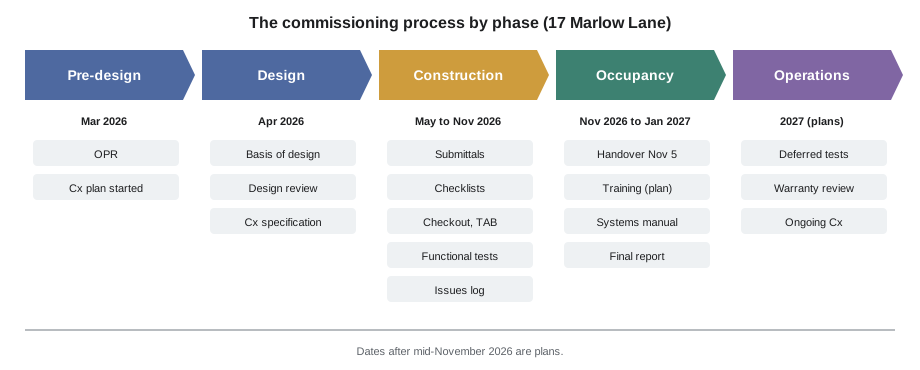
| Phase | Main commissioning tasks | Marlow Lane |
|---|---|---|
| Pre-design | Owner's project requirements; commissioning provider appointed; commissioning plan started | OPR workshop and document, March 2026; Philippa appointed |
| Design | Basis of design; design reviews against the OPR; commissioning requirements written into the specification | Basis of design and specification, April; Philippa's design review, 9 comments |
| Construction | Submittal reviews; site observation; pre-functional checklists; point-to-point checkout; TAB; functional tests; issues log | Quillon awarded late May; submittals June (7 comments); installation July to October; tests late October |
| Occupancy | Handover; training; systems manual; final commissioning report | Handover Thursday, November 5; training Tuesday, November 24 (plan); final report January 2027 (plan) |
| Operations | Warranty period review; deferred and seasonal tests; ongoing commissioning | Cooling tests June 2027 and warranty review September 2027 (plans) |
Pre-design: the owner's project requirements
The owner's project requirements (OPR) describe what the owner needs the finished project to do, in the owner's words, before anyone decides how. A good OPR is short, specific and measurable where it can be. It covers the purpose of the project, the people who will use and run the building, the conditions they need, the budget and schedule limits, and how success will be judged.
Rowena Strand wrote Marlow Lane's OPR with Philippa in a two-hour workshop with the consulting engineer and Halvern's two building operators. Ivo had copied out the lines that mattered most to the controls.
17 Marlow Lane - Owner's Project Requirements (extract), March 2026
1  Replace the building controls with an open-protocol (BACnet) system that
   more than one contractor can service.
2  No loss of heating or cooling to occupied floors during the work; cutovers
   outside occupied hours.
3  Space conditions in occupied hours: heating setpoint 70 F,
   cooling setpoint 75 F, held within 2 F in normal weather.
4  Ventilation at the design outdoor air rates whenever spaces are occupied.
5  Operators able to see, change and trend every point from the front end,
   from the office and remotely.
6  Alarms for equipment failures sent to the on-call phone; no nuisance alarms.
7  Lower energy use than the old controls: schedules, setbacks, and resets of
   supply air temperature and duct static pressure.
8  Fire alarm interfaces unchanged in function and tested with the fire
   alarm contractor.
9  Complete as-built documents, a systems manual, and training for the
   operators before the warranty starts.
Ivo pointed at line 3. It gives setpoints and a tolerance, so a test can check it. Line 6 says no nuisance alarms, which is harder to test but still useful: it is why the burn-in week's alarm count was reviewed (lesson 6). Line 2 shaped the whole installation schedule, because every cutover had to happen at night or on a weekend.
An OPR does not specify equipment or sequences. If Rowena had written "use trim and respond reset on the static pressure", that would have been a design decision made by the owner. Line 7 asks for resets and leaves the method to the designer.
Design: the basis of design and design reviews
The design team answers the OPR with a basis of design (BOD): a document explaining how the design meets each requirement and what assumptions it rests on. For Marlow Lane, the consulting engineer's BOD described the controller architecture (BACnet MS/TP controllers on the VAV boxes, BACnet/IP for AHU-1 and the plant controller), the sequences to be used, the outdoor design temperatures, the occupancy schedule, and the alarm priorities. The sequences of operation and the controls specification followed from it.
The commissioning provider then reviews the design documents against the OPR. Philippa's review of the drawings, specification and sequences produced nine comments. Three of them changed what Quillon later built.
| Comment | Finding | Result |
|---|---|---|
| D-3 | The sequences did not say what AHU-1 should do after a fire alarm reset; OPR line 8 requires unchanged function, and the old system required an operator restart. | Sequence revised: AHU-1 held off until an operator restarts it (tested on October 28) |
| D-5 | No sensor on the air leaving each reheat coil, so a stuck reheat valve could not be detected. | Discharge air sensors added to all 36 VAV boxes |
| D-8 | The specification asked for trends but did not say which points, at what interval, or for how long before handover. | A trend list and a seven-day burn-in period written into the specification |
Comment D-5 cost money, which is why it needed Rowena's approval. Each box gained one sensor and one input, which pushed the VAV point count from 8 to 9 per box and the building to 445 points. The design review also produced the commissioning section of the specification: what the controls contractor must provide for commissioning, including checklists, test participation, trend setup and documents. That section is the contractual reason Quillon spent 93 hours on commissioning work.
Worked problem
Tracing a test back to the OPR
Philippa's functional test for VAV boxes includes a step that commands a box to full heating and checks that the discharge air temperature rises at least 20 °F above the supply air within 10 minutes. Which documents does this step trace back to?
Show solution
- The step checks that the reheat valve opens and the coil heats, which the discharge air sensor added by comment D-5 makes visible.
- The sequence and BOD say how the box heats, which is design.
- The OPR line it serves is line 3: space conditions held in occupied hours. Heating that does not work would fail line 3 in winter.
Answer: The test step traces to OPR line 3 through the BOD and sequences, and it is only possible because of design review comment D-5.
The commissioning plan
The commissioning plan is the commissioning provider's plan for the whole process. It starts in pre-design and is updated as the project goes on. It is the first document a controls contractor should ask for on a commissioned job.
| Section | What Marlow Lane's plan said |
|---|---|
| Scope | The new controls and every system they control: AHU-1, VAV boxes, heating plant, exhaust fans, meters; the fire alarm interfaces |
| Team and responsibilities | Names and duties for each party, as in lesson 1 |
| Communication | Weekly site meeting during construction; issues log shared online; who may direct the contractors (the consultant, not the commissioning provider) |
| Schedule | Each commissioning activity tied to the construction schedule |
| Documents | Checklists, test scripts, issues log, reports, and who writes and signs each |
| Testing | The list of tests, sampling rules, acceptance criteria, deferred and seasonal tests |
| Training and closeout | Training plan, systems manual, as-built documents and their due dates |
One line in the communication section surprised Callie: the commissioning provider does not direct the contractors. Philippa recorded issues and reported them to Halvern and the consulting engineer. If something had to change in Quillon's work, the instruction came through the contract, from the consultant. That keeps the contract chain clear. In practice, on a job this size, Philippa and Ivo talked every day, but a change that cost money or time still went through the consultant.
Construction: where most of the work happens
Construction is where the controls technician's commissioning work happens, and the remaining lessons cover each part. In outline:
- Submittal review. The commissioning provider reviews the controls submittal (points list, sequences, controller and device data, wiring diagrams, graphics) against the OPR and design. Quillon's June submittal drew seven comments, including a points list that had missed the new discharge air sensors on 12 boxes.
- Site observation. The commissioning provider visits during installation to catch problems before they are covered up: sensor locations, cable routes, panel labeling.
- Pre-functional checklists (lesson 3). Each piece of equipment is checked as installed and ready before it is started and tested.
- Point-to-point checkout (lesson 4). The controls contractor proves every point.
- TAB (lesson 7). Flows are set, and airflow readings are calibrated with the controls.
- Functional performance tests (lesson 5 and lesson 12). The commissioning provider directs tests of every sequence and mode.
- Trend verification (lesson 6). Trends show how the systems behave over days, not minutes.
- Issues log (lesson 8). Every deficiency is recorded until it is fixed and verified.
On Marlow Lane, the construction phase had an extra constraint from OPR line 2: the building stayed occupied. Ivo replaced controllers floor by floor, with cutovers on weeknights and weekends. Each floor's VAV boxes were checked out and put back under control the same night, and the full functional tests waited until all floors and AHU-1 were on the new system in late October.
Worked problem
Working out the closeout dates
Halvern's contract required Quillon's record documents within 60 days of handover, and the warranty runs for one year from handover. Handover was Thursday, November 5, 2026. When are the record documents due, and when does the warranty end?
Show solution
- Days left in November after the 5th: 30 − 5 = 25, reaching November 30.
- December adds 31 days: 25 + 31 = 56, reaching December 31.
- Four more days are needed: 60 − 56 = 4, reaching January 4, 2027.
- The warranty runs one year from handover, ending November 5, 2027.
Answer: Record documents are due by Monday, January 4, 2027, and the warranty ends on November 5, 2027. Quillon planned to deliver the documents before the holidays rather than run to the deadline.
Occupancy and operations
Handover is when the owner accepts the systems as substantially complete and takes over their operation. It is not the end of commissioning. After handover come the training of the operators (lesson 9), the systems manual and as-built documents (lesson 10), the final commissioning report, and tests that could not be done before handover.
Some tests cannot be done in the season when construction finishes. Marlow Lane was handed over in November, so the heating sequences were tested under real heating load, but the cooling sequences could only be tested at part load, on mild afternoons and with simulated loads. Philippa's plan lists deferred cooling tests in June 2027 (a plan), when AHU-1's cooling can be seen under real conditions. The plan also includes a warranty period review about ten months after handover, in September 2027 (a plan), to look at trends, alarms and operator feedback and to record anything that should be fixed while the warranty still applies.
Guideline 0 treats the operations phase as continuing for the life of the building. After the warranty year, commissioning becomes the owner's ongoing commissioning or monitoring-based commissioning, using the trends and analytics covered in BAS-330, or a re-commissioning some years later.
Where Callie fits next
Callie's next two jobs will both use this process, scaled differently. The Ninefield podium rooftop units RTU-2 to RTU-4 are planned for the first two weeks of December, the same scope as RTU-1: Quillon's own checkout, witnessed by Ilona's operator, with no separate commissioning provider. The Tilden Hall AHU-2 replacement in the summer of 2027 is a larger job, and Declan's proposal to Gus in early December is expected to include a commissioning process with an OPR, design review, functional tests and a seasonal follow-up. Ivo told Callie to read the Tilden proposal's commissioning section when it is written and to check that every test has an OPR line behind it.
The process is the same on a small job, only lighter. For a single rooftop unit, the OPR might be a paragraph in an email, the design review a check of the sequence, and the commissioning plan a page; but the order (requirements, design, checks, tests, training, documents) still holds, and skipping a step still costs more later than doing it.
Common mistakes
MistakeStarting commissioning when construction starts.
InsteadCommissioning starts in pre-design with the owner's requirements. By construction, the most useful design reviews have already happened or been missed.
MistakeWriting design decisions into the OPR.
InsteadThe OPR says what the owner needs, such as lower energy use with resets. The basis of design and the sequences say how.
MistakeTaking instructions from the commissioning provider as contract changes.
InsteadThe commissioning provider records and reports issues; changes to the work come through the contract, normally from the consultant.
MistakeTreating handover as the end of commissioning.
InsteadTraining, the systems manual, the final report, deferred seasonal tests and the warranty review all come after handover.
Summary and key terms
- Commissioning follows the project through pre-design, design, construction, occupancy and operations.
- The owner's project requirements state what the project must achieve; the basis of design explains how the design meets them.
- Design and submittal reviews catch problems on paper, when they are cheapest to fix.
- The commissioning plan sets the scope, team, schedule, documents, tests and closeout requirements.
- Seasonal tests and the warranty period review continue after handover.
- Basis of design (BOD)
- The design team's explanation of how the design meets the owner's requirements and the assumptions behind it.
- Commissioning plan
- The commissioning provider's document setting out the scope, team, schedule, documents and tests for the process.
- Design review
- The commissioning provider's review of design documents against the owner's requirements.
- Deferred test
- A functional test postponed to a later date, often because the season does not allow it before handover.
- Warranty period review
- A review of system performance before the warranty ends, so that problems can be fixed under warranty.
Practice problems
Work each problem on paper first, then reveal the answer to check.
Which phase did Philippa's comment about missing discharge air sensors come from, and why did it matter?
Show answer
The design phase. Without the sensors, a stuck reheat valve could not be detected, and later functional tests on reheat would have had nothing to measure.
Why were Marlow Lane's cooling tests deferred to June 2027?
Show answer
The building was handed over in November, so cooling could only be tested at part load. Real cooling conditions will not exist until summer.
Who gives Quillon an instruction that changes its scope of work?
Show answer
The consultant, through the contract. The commissioning provider records and reports issues but does not direct the contractors.
Lesson quiz · 5 questions
Score 60% or more to complete this lesson.
Create a free account to save your progress, take quizzes and earn a certificate.