
BAS-330 · Lesson 6 of 12 · 27 min
Demand limiting and load shedding
▶ Video coming soon A video version of this lesson is on the way.
On Thursday, November 5, Declan had spent the day on the drawings and schedules for Tilden's AHU-2 replacement. In the evening he pulled up Ninefield's January 2026 meter data instead of a bill. The billing demand for January had been 760 kW, not far below July's 820 kW, even though the chillers were off all month. "Guess what set it," he said. Callie guessed the morning start again, and she was right, but not for the reason she expected.
Why winter mornings peak at Ninefield
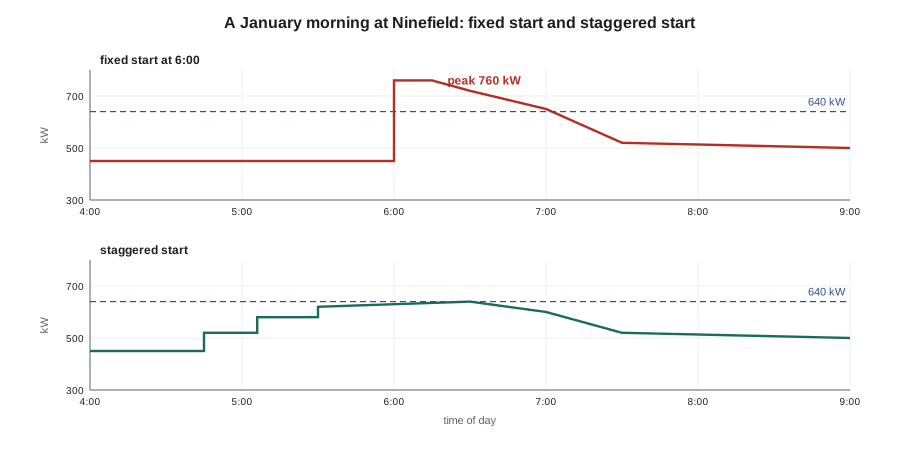
Ninefield's tower floors have about 60 parallel fan-powered boxes on the perimeter, each with an electric heater of about 5 kW. Overnight, with the setback at its unoccupied heating setpoint, most of the perimeter zones drift down to it. At the fixed 6:00 start, every zone's setpoint jumps to the occupied value at the same moment, every perimeter box finds itself cold, and every heater comes on at once.
Worked problem
The coincident perimeter heat
About 60 perimeter boxes each have a 5 kW heater. What is the heating load if all come on at once, and what does it add to the demand?
Show solution
- 60 × 5 kW = 300 kW of electric heat.
- Added to the base load and the air handlers starting at the same time, the building reached 760 kW in the 6:00 to 6:15 interval.
Answer: Up to 300 kW appears in a single interval. Once the zones recover, after about an hour, most heaters cycle off and the building settles near 500 kW, but the meter has already recorded the 760 kW peak for the month.
The cure is not to stop heating but to stop heating everything at once. Two strategies do it: staggering the start, and limiting demand while the building recovers.
Staggered starts
A staggered start brings loads on in groups, a few minutes apart, so that the largest loads never coincide. At Ninefield, Declan's draft started the penthouse air handlers first, then let the perimeter heat recover floor by floor, two floors every 10 minutes, beginning earlier on the coldest mornings so that every floor still reached setpoint by 7:00. Optimal start, covered in lesson 4, already calculates how early each zone group must start; staggering adds a rule that no more than a set amount of heating may be enabled in each interval.
Worked problem
What staggering is worth in January
With staggering, Declan expected January's billing demand to fall from 760 kW to about 640 kW. At a sample demand rate of 9.80 dollars per kW, what is the monthly saving?
Show solution
- Reduction: 760 − 640 = 120 kW.
- Saving: 120 × 9.80 = 1,176 dollars a month.
Answer: About 1,176 dollars a month in the four coldest months, or about 4,700 dollars a winter, with no change in comfort and very little change in energy.
Staggering saves money on demand without saving much energy, because the same heat is still delivered. That is one reason demand savings and energy savings are always calculated separately.
How demand limiting works
Demand limiting watches the building's demand in real time and sheds loads when it is about to exceed a target. The simplest version compares instantaneous kW with a limit and sheds when the limit is crossed. That works poorly, because billing demand is an average over 15 minutes: a short spike above the limit may not matter at all, and a long period just below it may still produce a high average.
Better controllers predict the interval's average. They track the energy already used in the current interval, then work out how much power the building may draw for the rest of the interval without the average exceeding the target.
Worked problem
A predictive demand limit
The target is 700 kW for a 15-minute interval. Ten minutes into the interval, the meter shows 125 kWh used. The building is drawing 690 kW. How much must be shed?
Show solution
- Energy allowed in the interval: 700 kW × 0.25 h = 175 kWh.
- Energy left: 175 − 125 = 50 kWh, over the remaining 5 minutes (0.0833 h).
- Power allowed for the rest of the interval: 50 ÷ 0.0833 = 600 kW.
- Shed: 690 − 600 = 90 kW.
Answer: About 90 kW must be shed for the last five minutes, even though the building is drawing less than 700 kW right now, because the first ten minutes averaged 750 kW.
The interval the controller uses must match the utility meter's interval, including where each interval starts. A controller that thinks intervals start on the hour when the meter's start at 7 and 22 minutes past will shed at the wrong times. Many meters provide an end-of-interval pulse or a synchronized clock for exactly this reason.
Choosing what to shed
A shed list ranks loads by how little their reduction disturbs the building. Loads that store energy, or that can be delayed briefly without anyone noticing, go first.
| Order | Load | How it is shed | Limits |
|---|---|---|---|
| 1 | Electric reheat and perimeter heat | Lower setpoints 1 to 2 °F or limit stages per floor | Restore within 15 to 30 minutes |
| 2 | Chiller demand | Limit chiller current or capacity, or raise chilled water temperature | Respect the chiller's minimum load and the plant sequence |
| 3 | Zone cooling setpoints | Raise by 2 to 4 °F | Occupant comfort; limit duration |
| 4 | Water heaters and snow melt | Delay | Hot water supply and safety |
| 5 | Fans | Reduce speed within ventilation limits | Minimum outdoor air must be maintained |
| Never | Life safety, smoke control, refrigeration of food or medicine, critical process loads | Not shed |
Every shed needs limits: a maximum shed time, a minimum time before the same load can be shed again, and a minimum off and on time for equipment that should not short-cycle, such as compressors. The control system writes shed commands at a priority that sits above normal program control but below safety and operator commands. In Quillon's priority scheme from BAS-310, demand limiting writes at priority 10, below equipment protection at 5 and operator commands at 8, so a technician can always override a shed and a safety can always override everything.
Demand limit (Ninefield draft)
  Target ..................... 640 kW (November to March), 760 kW (April to October)
  Interval ................... 15 min, synchronized to the meter's end-of-interval signal
  Every 30 s:
    P_allowed = (Target x 0.25 h - E_used) / t_remaining
    if P_now > P_allowed and t_remaining < 10 min:
        shed next load on the list, written at priority 10
    if P_now < P_allowed - 40 kW for 2 min:
        restore the last load shed (last shed, first restored)
  Limits: each load shed no longer than 20 min, then locked out of shedding for 30 min
          compressors: minimum off 5 min, minimum on 5 min
          perimeter heat setpoint lowered no more than 2 °F
Rebound
Shed loads come back. When a heater or chiller is released after a shed, it has to make up the heat or cooling it did not supply, so its demand jumps above its normal value for a while: the rebound. If several loads are released at once, the rebound can set a new peak in the next interval. Restoring loads one at a time, last shed first, and only when there is room under the target, prevents that. The draft's 40 kW margin and two-minute wait served that purpose.
Demand response and the PJM peaks
Demand response is load reduction at the request of the grid operator or a utility, usually in return for a payment. In the PJM region, commercial buildings usually take part through a curtailment service provider that combines many sites and bids their reduction into PJM's markets. When an event is called, typically on a hot summer afternoon, the provider sends the building a signal, and the building reduces load for a few hours.
Every commercial customer in the PJM region has a second reason to shed on the hottest afternoons: the capacity tag for the following year depends on the building's demand in the five PJM system peak hours, and the transmission tag on the single zonal peak. Suppliers and providers send peak alerts on likely days, and a building that sheds on those days lowers its charges for a full year.
A demand response event uses the same shed list as demand limiting, but with deeper reductions for longer: raising cooling setpoints by 4 °F for two to four hours, limiting chillers, dimming lights through the lighting interface. Precooling the building in the morning before an afternoon event lets the structure absorb heat during the event and makes deeper setpoint changes tolerable. The BAS receives the event signal through a contact closure, a network point, or an open protocol such as OpenADR.
Checking demand control
Demand control fails quietly. A shed that never restores leaves a floor warm; a target set too low sheds constantly and annoys tenants; a controller whose interval is out of step with the meter saves nothing. Declan's checks were:
- Compare the BAS's interval kW with the utility interval data for the same days.
- Count sheds per day and per load; more than a few a day means the target is too low or the shed list too short.
- Trend each shed load's command and the zone conditions it affects.
- Look for rebound peaks in the interval after a restore.
- Check that operator overrides at priority 8 still win over sheds at priority 10.
Setting the demand target
A demand limit is only as good as its target. Set too high, it never acts; set too low, it sheds all day and the tenants notice. Declan set Ninefield's draft targets from the interval data rather than from the bills: he looked at the 15-minute demand for every weekday of the past year, excluding the start-up peaks that staggering would remove, and set the target just above the demand the building normally reached on its highest ordinary days.
Worked problem
Choosing a winter target
On the 20 coldest weekdays of last winter, after removing the 6:00 start-up intervals, Ninefield's highest 15-minute demand ranged from 560 to 630 kW. The staggered start is expected to hold the morning to about 640 kW. What target should demand limiting use, and how often would it act?
Show solution
- The ordinary daily highs reach 630 kW, so a target below that would shed on many days.
- A target of 640 kW sits just above both the ordinary highs and the staggered morning.
- It would act only on unusual days, such as a very cold Monday after a long weekend.
Answer: A target of about 640 kW, acting a few times a winter. Demand limiting is a backstop for unusual days; staggering and good schedules do the everyday work.
Where a tariff has a ratchet, the target matters more, because one bad interval can be billed for many months. A ratchet also changes the value of a demand saving: if billed demand is held up by last summer's peak, a winter reduction may not lower the bill at all until the ratchet period ends. Reading the tariff before promising a demand saving avoids an awkward conversation later.
Demand and the chiller plant
In summer, the chiller plant is usually the largest controllable electrical load. Chillers have a demand limit setting, often adjustable over the network, that caps their current or capacity. Lowering it for an hour on a peak day trims demand quickly, but it also lets the chilled water temperature rise, so it must be coordinated with the zones: a small rise in chilled water temperature is tolerable for an hour, a large one is not. Starting the second chiller only when the first is near full load, rather than on a timer, also avoids paying for two chillers' start-up demand when one would do.
At Ninefield, the plant's 7:00 summer start had added a chiller's start-up current to the fans' at the same moment. Declan's draft enabled the chillers only once the air handlers had run for 20 minutes and the cooling coil valves showed real demand. On many spring and autumn mornings, the economizer would carry the building for the first hour and the chillers would not start until later, which saves both demand and energy.
Tenants and demand control
Occupants rarely notice a well-designed shed, but they notice a badly designed one: a floor that stays warm all afternoon because a shed never restored, or fans that slow down every few minutes. Telling tenants in advance that demand control is in place, keeping the setpoint changes small and short, and putting comfort on the monthly report, as lesson 8 describes, keep demand control from becoming the reason a tenant leaves.
Common mistakes
MistakeLimiting instantaneous kW instead of the interval average.
InsteadPredict the interval average and shed only what keeps it under the target.
MistakeRunning the demand controller's intervals out of step with the meter.
InsteadSynchronize to the meter's end-of-interval signal or clock.
MistakeRestoring all shed loads at once.
InsteadRestore one at a time, last shed first, when there is room under the target.
MistakeShedding without limits on time and cycling.
InsteadSet maximum shed times, lockouts and minimum on and off times.
MistakeCounting a demand saving as an energy saving.
InsteadStaggering and shedding move energy in time; calculate the two separately.
Summary and key terms
- One 15-minute interval sets the billing demand, so coincident starts are expensive.
- Staggered starts bring loads on in groups and remove peaks without reducing comfort.
- Predictive demand limiting works out the power allowed for the rest of the interval.
- A shed list ranks loads by how little their reduction disturbs the building, with limits on each.
- Shed commands sit below safety and operator priorities.
- Restore loads one at a time to avoid rebound peaks.
- Demand response and the PJM peak hours reward shedding at the grid's peak times.
- Demand limiting
- Controlling loads to keep interval demand below a target.
- Staggered start
- Starting loads in groups a few minutes apart.
- Shed list
- A ranked list of loads that may be reduced, with limits for each.
- Rebound
- The rise in demand when shed loads are restored.
- Demand response
- Load reduction at the request of a grid operator or utility.
- Aggregator
- A company that combines many buildings' load reductions for the grid.
- Precooling
- Cooling a building early so its structure absorbs heat later.
- OpenADR
- An open protocol for sending demand response signals to buildings.
Practice problems
Work each problem on paper first, then reveal the answer to check.
Target 500 kW; after 5 minutes, 50 kWh used. What power is allowed for the remaining 10 minutes?
Show answer
(125 − 50) ÷ 0.1667 = 450 kW.
40 heaters of 4 kW each start together. What is the coincident load?
Show answer
160 kW.
A 100 kW reduction at 12 dollars per kW for 4 months saves how much?
Show answer
100 × 12 × 4 = 4,800 dollars.
Why should a demand shed write below the operator priority?
Show answer
So a technician can always override it.
What causes rebound?
Show answer
Shed loads making up the heating or cooling they did not supply.
Lesson quiz · 5 questions
Score 60% or more to complete this lesson.
Create a free account to save your progress, take quizzes and earn a certificate.