
BAS-330 · Lesson 5 of 12 · 25 min
Reset strategies that save energy
▶ Video coming soon A video version of this lesson is on the way.
There was no session the following Thursday, so Declan gave Callie the resets section of his Ninefield draft to read over the weekend, with a note on the first page: "A setpoint that never changes is a guess about the worst day of the year. A reset is the building telling you what it actually needs." Sophie had written the reset sequences in BAS-230's sessions; Declan's notes were about what they were worth.
What a reset is
A reset changes a setpoint automatically in response to something else: the outdoor temperature, the load, or requests from the zones the system serves. A fixed setpoint must be chosen for the most demanding conditions, so for most of the year it asks the equipment to do more than necessary: colder supply air, higher duct pressure, higher pump pressure, hotter heating water. A reset gives the equipment the easiest setpoint that still satisfies the most demanding zone.
| Reset | Usually reset from | What it saves |
|---|---|---|
| Supply air temperature | Zone cooling requests and outdoor temperature | Reheat, chiller energy; may add fan energy |
| Duct static pressure | Zone damper positions or airflow requests | Fan energy |
| Chilled water supply temperature | Cooling coil valve positions or requests | Chiller energy |
| Chilled water differential pressure | Coil valve positions or requests | Pump energy |
| Heating water supply temperature | Outdoor temperature, then zone requests | Distribution losses; boiler efficiency when condensing |
| Condenser water temperature | Outdoor wet-bulb and chiller limits | Chiller energy, balanced against tower fan energy |
| Outdoor air (ventilation) | CO₂ or occupancy; zone ventilation needs | Heating and cooling of outdoor air |
Trim and respond
Many modern resets use the trim and respond logic described in ASHRAE Guideline 36. Each zone sends requests when it is not being satisfied, for example a cooling request when its damper is nearly fully open and the zone is still warm. The supervisory logic counts the requests at a fixed interval. If there are fewer requests than a set number to ignore, it trims the setpoint a small step toward the energy-saving direction. If there are more, it responds by moving the setpoint the other way, by an amount in proportion to the number of requests, up to a limit.
Duct static pressure trim and respond (Ninefield draft, penthouse air handlers)
  Initial setpoint SP0 ................. 1.2 in. w.c.
  Minimum setpoint SPmin ................ 0.4 in. w.c.
  Maximum setpoint SPmax ................ 2.0 in. w.c.
  Delay after fan start Td .............. 10 min
  Time step T ........................... 2 min
  Requests ignored I .................... 2
  Trim amount SPtrim .................... -0.05 in. w.c.
  Respond amount SPres .................. +0.06 in. w.c. per request above I
  Maximum response SPres-max ............ +0.13 in. w.c.

Every T, after Td:
  R = number of zone pressure requests
  if R <= I then  SP = SP + SPtrim
  else            SP = SP + min(SPres x (R - I), SPres-max)
  limit SP between SPmin and SPmax
The ignored requests matter. In any building, one or two zones are always unhappy for reasons that have nothing to do with the air handler: an undersized box, a stuck damper, a thermostat behind a photocopier. Without ignores, those rogue zones hold the setpoint at maximum all year and the reset saves nothing. With ignores, the reset serves the building, and the rogue zones show up in a report as zones that request constantly, which makes them maintenance items rather than energy losses. BAS-230's hydronic DP draft for Ninefield used one ignored request for the same reason.
Duct static pressure reset
In a VAV system the supply fan's speed is controlled to hold a static pressure setpoint in the duct. A fixed setpoint must be high enough for design airflow to reach the farthest box, but at part load most boxes throttle their dampers to cut that pressure back down. The fan is making pressure only for the dampers to waste.
Fan power is proportional to airflow times the total pressure the fan develops, divided by the combined efficiency of fan, motor and drive.
Worked problem
Static pressure reset on a Ninefield penthouse air handler
At an average occupied airflow of 22,250 cfm, a penthouse air handler develops a total pressure of 5.0 in. w.c. with a fixed duct static setpoint. Trim and respond lowers the average total to 4.2 in. w.c. at the same airflow. The combined efficiency is 0.60. Estimate the fan power saved and the annual saving over 3,120 occupied hours.
Show solution
- Before: 22,250 × 5.0 ÷ (6356 × 0.60) = 29.2 hp, × 0.746 = 21.8 kW.
- After: 22,250 × 4.2 ÷ (6356 × 0.60) = 24.5 hp, × 0.746 = 18.3 kW.
- Saving: 3.5 kW × 3,120 h = 10,900 kWh a year.
Answer: About 3.5 kW and about 10,900 kWh a year per air handler, or about 21,800 kWh for both. The actual saving will be measured from the drive kW readings before and after, as lesson 9 explains.
Reset also helps at the boxes: with less pressure behind them, dampers open wider, run quieter and control better. The usual reason a static pressure reset fails is not the logic but one box with a bad flow sensor or a damper stuck shut that requests constantly. Fix the box, and the reset works.
Fan and pump affinity laws
When a fan or pump slows down and the system it serves stays the same, flow falls in proportion to speed, pressure with the square of speed, and power with the cube of speed. These are the affinity laws.
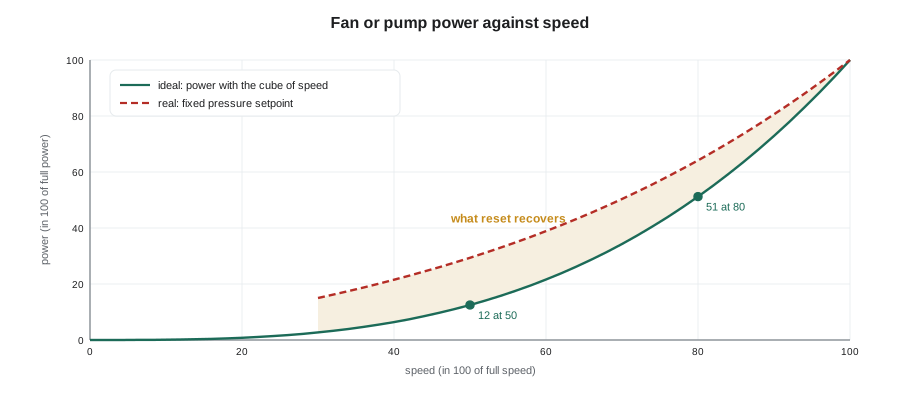
The cube law is the reason drives save so much: at 80 in 100 of full speed, ideal power is 0.8³ = 0.512 of full power, about half. But the cube law applies only if the whole system curve passes through zero pressure at zero flow. A VAV fan or a variable-flow pump controlled to a fixed setpoint never gets there: the controlled pressure stays constant as flow falls, so power falls much more slowly. That is exactly what reset changes. Lowering the setpoint as the load falls moves the operating point toward the ideal curve.
Worked problem
Ninefield's secondary chilled water pumps
Ninefield's secondary pumps run at about 52 Hz all day to hold a fixed header differential pressure, drawing about 15 kW. With two-way valves and DP reset, Declan expects the average speed to fall to about 42 Hz. What would the cube law predict, and why did Declan use a smaller saving?
Show solution
- Cube law: (42 ÷ 52)³ = 0.527, so 15 × 0.527 = 7.9 kW, a saving of 7.1 kW.
- Because the reset has a minimum setpoint and the system never reaches zero pressure at zero flow, Declan used 9 kW after the change: a saving of 6 kW.
- Over about 2,600 cooling hours: 6 kW × 2,600 h = 15,600 kWh a year.
Answer: The cube law predicts about 7 kW; Declan used 6 kW, about 15,600 kWh a year, because a real system with a minimum pressure does not follow the ideal curve. A conservative estimate that is then beaten is better than an optimistic one that is not.
The three-way valves on Ninefield's coils matter here. A three-way valve bypasses water around the coil when the coil does not need it, so the system flow stays nearly constant whatever the load, and no pressure reset can slow the pumps. Converting to two-way valves, which the valve schedule Declan and Sophie drew up on October 28 provides for, is what makes the pump savings possible, and it also helps with the low delta-T problem.
Supply air temperature reset
A VAV air handler typically supplies air at about 55 °F in cooling. When the weather is mild or the building's load is low, that air is colder than most zones need, and the zones reheat it. Raising the supply air temperature reduces reheat and, when the economizer can supply it with outdoor air alone, saves chiller energy too. Guideline 36 resets supply air temperature between a minimum, around 53 to 55 °F, and a maximum around 60 to 65 °F, using cooling requests from the zones, with the range limited by outdoor temperature.
There is a trade-off. Warmer supply air means more airflow for the same cooling, so fan energy rises. In mild weather, with the economizer open, reheat savings are usually larger than the extra fan energy; in hot, humid weather, the supply air must stay cold enough to dehumidify. The reset logic handles this by allowing warmer supply air only when the outdoor temperature is low enough.
At Ninefield, one penthouse air handler's supply air setpoint had been lowered to 50 °F some years earlier, probably to deal with a hot zone, and never raised. Every zone it served that was not calling for full cooling was being overcooled and then heated by its fan-powered box's electric heater.
Worked problem
What the lowered setpoint costs in reheat
About 40 perimeter boxes on that air handler sit at their minimum primary airflow of about 125 cfm each in heating, and their electric heaters warm that air. Restoring the setpoint from 50 °F to 55 °F raises the primary air 5 °F. How much reheat does that avoid while the boxes are heating?
Show solution
- Total minimum airflow: 40 × 125 = 5,000 cfm.
- Reheat avoided: 1.08 × 5,000 × 5 = 27,000 Btu/h, about 7.9 kW.
Answer: About 7.9 kW of electric heat whenever those boxes are reheating, plus the chiller energy for the extra cooling. Declan's draft estimated about 30,000 kWh a year for restoring the setpoint and adding the reset, before anyone checked the hot zone the old change was meant to fix.
Chilled water and condenser water resets
A chiller works harder the larger the temperature lift between the chilled water it produces and the condenser water it rejects heat to. Raising the chilled water supply temperature when coils do not need the coldest water reduces the lift. A figure often quoted is that each 1 °F of chilled water reset saves about 1 to 1.5 in 100 of chiller energy, though it depends heavily on the chiller. The catch is the same as for supply air: warmer chilled water means more flow for the same cooling, so pump energy rises, and coils dehumidify less. In a plant with variable-speed pumps, Guideline 36 resets differential pressure first and chilled water temperature second, because pump energy is cheaper to save at low load.
Condenser water reset lowers the tower water temperature as far as the chiller allows and the weather permits, which also lowers the lift. Colder condenser water costs tower fan energy, so the best setpoint balances chiller and tower. BAS-230 had drafted an approach-based reset for Ninefield's tower, with a minimum set by the chiller manufacturer.
Heating water reset
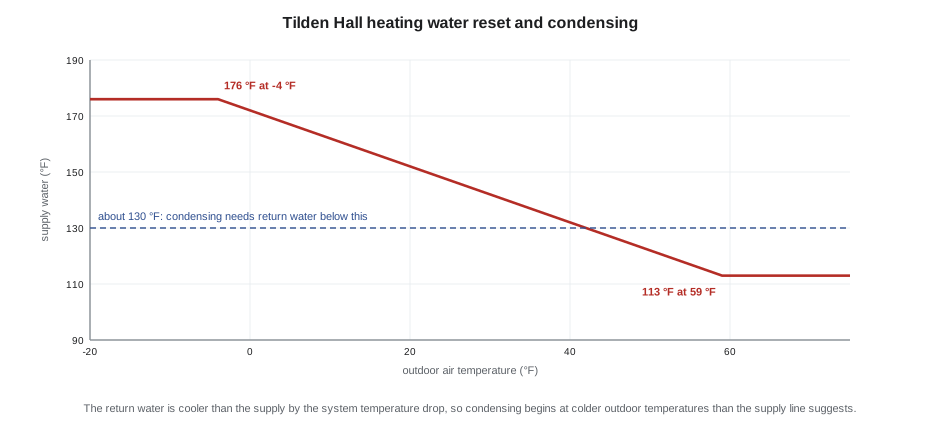
Tilden's heating water reset runs from 176 °F at an outdoor temperature of −4 °F to 113 °F at 59 °F. Prakash and Nell had added a demand override for the north reheat coils in October. Lower water temperatures reduce heat lost from the piping and, for condensing boilers like Morrow House's, they make condensing possible.
A condensing boiler condenses water vapor out of its flue gas, recovering its latent heat, only when the return water is below the flue gas dew point, about 130 °F for natural gas. Above that, it works like a good non-condensing boiler. Every degree of return temperature below that point adds efficiency, which is why reset matters more for a condensing plant than for any other.
Ventilation resets
Outdoor air is often the largest single heating load in a cold climate, so ventilation resets are powerful. Demand-controlled ventilation, set up for T-120 in BAS-230, reduces outdoor air in densely occupied rooms by measuring CO₂. In multi-zone systems, the minimum outdoor air at the air handler can be recalculated continuously from the ventilation needs of the zones actually occupied, as ASHRAE 62.1 and Guideline 36 describe, rather than fixed for the worst case.
Common mistakes
MistakeAdding a reset with no ignored requests.
InsteadIgnore one or two requests so rogue zones cannot hold the setpoint at maximum.
MistakeExpecting cube-law savings from a fan or pump with a fixed pressure setpoint.
InsteadSavings follow the cube law only as the setpoint is reset toward zero.
MistakeRaising supply air temperature in humid weather.
InsteadLimit the reset by outdoor temperature or dew point so the coil still dehumidifies.
MistakeResetting chilled water temperature before pump pressure in a variable-flow plant.
InsteadReset pump pressure first; chilled water temperature second.
MistakeLeaving a setpoint lowered to fix one hot zone.
InsteadFix the zone; restore the setpoint and let the reset do its job.
Summary and key terms
- A reset gives the equipment the easiest setpoint that still satisfies the most demanding zone.
- Trim and respond counts zone requests, trims when there are few, responds when there are many, and ignores a set number.
- Fan power is proportional to airflow times total pressure divided by efficiency.
- The affinity laws give power falling with the cube of speed only when the pressure setpoint falls too.
- Supply air reset saves reheat and chiller energy but adds fan energy; limit it in humid weather.
- Chilled water and condenser water resets reduce chiller lift.
- Heating water reset reduces losses and lets condensing boilers condense.
- Reset
- Automatic adjustment of a setpoint in response to load, outdoor conditions or zone requests.
- Trim and respond
- A reset that trims the setpoint when few zones request and responds when many do.
- Request
- A signal from a zone that it is not being satisfied.
- Ignored requests
- The number of requests below which the setpoint keeps trimming.
- Affinity laws
- Relations between speed, flow, pressure and power for fans and pumps.
- Lift
- The temperature difference a chiller works across, between chilled and condenser water.
- Condensing
- Recovering latent heat from flue gas by cooling it below its dew point.
- Rogue zone
- A zone that requests constantly for reasons the central system cannot fix.
Practice problems
Work each problem on paper first, then reveal the answer to check.
A fan moves 17,000 cfm at 4.0 in. w.c. total with efficiency 0.62. What is its brake horsepower?
Show answer
17,000 × 4.0 ÷ (6356 × 0.62) = 17.3 hp.
A pump slows to 70 in 100 of full speed on an ideal system. What fraction of full power does it use?
Show answer
0.7³ = 0.343.
A reset has I = 2. Four zones request; SPres is 0.06 in., SPres-max 0.13 in. How much does the setpoint rise?
Show answer
min(0.06 × 2, 0.13) = 0.12 in. w.c.
Raising supply air 4 °F on 6,000 cfm of minimum airflow avoids how much reheat?
Show answer
1.08 × 6,000 × 4 = 25,920 Btu/h.
Why do three-way valves prevent pump savings?
Show answer
They bypass water so system flow stays nearly constant.
Lesson quiz · 5 questions
Score 60% or more to complete this lesson.
Create a free account to save your progress, take quizzes and earn a certificate.