
BAS-330 · Lesson 3 of 12 · 27 min
Metering and submetering
▶ Video coming soon A video version of this lesson is on the way.
On Thursday, October 22, Callie had installed a second carbon dioxide sensor in lecture hall T-120 and checked it against a portable meter. In the evening Declan asked her what she had checked the portable meter against. She had no good answer. "That is the whole of metering," he said. "Every number traces back to something you trust, or it means nothing. Tonight we talk about the meters an energy manager relies on, and how to know when to stop relying on them."
Revenue meters and submeters
A revenue meter is the utility's meter, the one the bill is based on. It belongs to the utility, it is sealed, and nobody else touches it. A submeter is any meter the owner installs downstream of it to measure part of the building: a floor, a tenant, a chiller plant, a lighting panel, a rooftop unit.
| Revenue meter | Submeter | |
|---|---|---|
| Owner | The utility | The building owner |
| Purpose | Billing the building | Allocating costs, finding waste, proving savings |
| Accuracy | Approved and verified for billing | From billing grade to rough estimate, depending on the meter and installation |
| Data access | Through the utility, often a day late | Live, through the BAS or a metering system |
| Typical interval | 15 minutes, sometimes 5 or 60 | Seconds to 15 minutes, as configured |
Utility interval data is often available to the customer through a web portal or a download, and in many places through a standard format called Green Button. It is the authoritative record, but it arrives late and only for the whole building. Submeters fill in the detail.
If a submeter is used to bill a tenant for electricity, state and local rules on resale of electricity and on submeter accuracy may apply, and the meter is normally expected to meet ANSI C12.20 billing accuracy. A submeter used only for the owner's own analysis has no such requirement. The 7th-floor tenant dispute at Ninefield, about after-hours HVAC charges, was a reminder of the difference: once a number appears on someone else's invoice, it has to stand up.
How an electrical meter measures
A meter measures power by measuring voltage and current on each phase and multiplying them, sample by sample, many times per cycle. That captures power factor and harmonics correctly. Voltages up to 600 V are usually connected directly through fused leads; higher voltages use potential transformers. Currents are almost always measured through current transformers (CTs), because the conductors in a switchboard carry hundreds or thousands of amps.
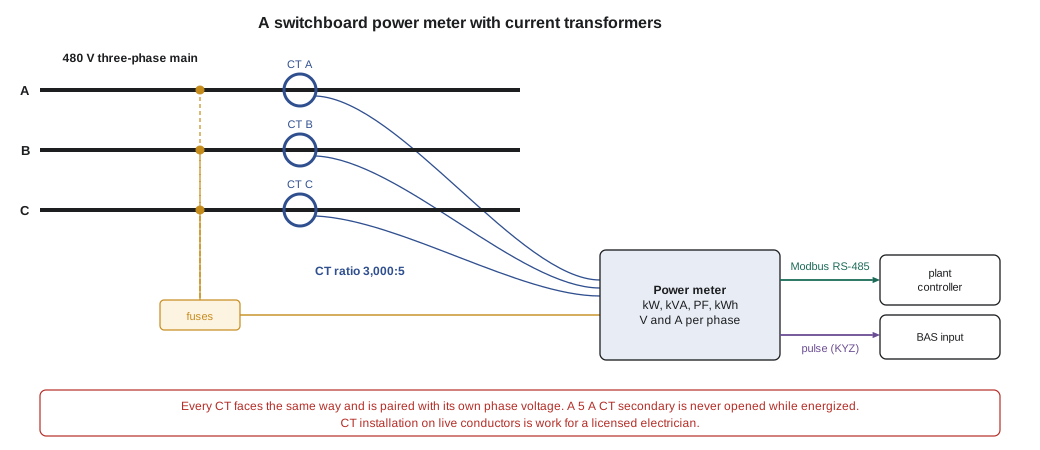
A CT produces a small secondary current in proportion to the primary current. The ratio is printed on it: a 3,000:5 CT produces 5 A at its secondary when 3,000 A flows in the primary. The meter must be programmed with the same ratio, or every reading will be wrong by the same factor. Newer meters often use CTs with a low-voltage output, such as 333 mV at full scale, which are safer to install because an open secondary does not produce dangerous voltage. With 5 A CTs, the secondary must never be opened while the primary is energized; a shorting block is used. Installing and removing CTs on live conductors is a job for a licensed electrician.
Worked problem
Checking a meter reading from the CT ratio
PM-1 at Ninefield uses 3,000:5 CTs on the 480 V main. A clamp meter on a CT secondary reads 1.36 A. The meter shows a power factor of 0.92. What should the meter read for current and three-phase power?
Show solution
- Primary current = 1.36 A × (3,000 ÷ 5) = 1.36 × 600 = 816 A.
- Three-phase power = √3 × V × I × PF = 1.732 × 480 × 816 × 0.92 = 624,000 W.
- The meter should read about 816 A per phase and about 624 kW total, if the load is balanced.
Answer: About 624 kW. A large difference would point to a wrong CT ratio, a CT on the wrong phase, or a CT facing backward.
The three most common metering errors are all installation errors. A CT installed backward makes its phase read negative, so the total is about a third of the truth. A CT on phase A paired with the voltage of phase B makes the power factor of that phase nonsense. A CT ratio entered wrongly makes everything wrong by the same factor, which is the hardest to spot because the readings look plausible. Checking every new meter against a clamp meter reading, phase by phase, catches all three.
Accuracy classes
Electrical meters are sold by accuracy class. ANSI C12.20, used in North America for revenue-grade meters, defines class 0.2 and class 0.5, meaning errors within about 0.2 and 0.5 in 100 of reading under the test conditions. IEC standards use similar class numbers. Building submeters are often class 0.5 or class 1. The CTs have their own accuracy class, and the total error is roughly the meter's plus the CT's.
Worked problem
What an accuracy class means in a year
Ninefield uses 2,800,000 kWh a year. How large is a 0.5 in 100 error over a year?
Show solution
- Error = 2,800,000 × 0.005 = 14,000 kWh.
Answer: A class 0.5 meter could be off by about 14,000 kWh a year at the limit of its class, which is small beside a savings target of 200,000 kWh, but not small beside a single 10,000 kWh measure. The accuracy of a meter should be judged against the size of the change it is meant to detect.
Accuracy also falls off at the bottom of a CT's range. A CT sized for 3,000 A that normally sees 150 A at night is working at 5 in 100 of its rating, where its error may be several times its rated class. Sizing CTs to the actual load, rather than to the breaker, matters for any meter used to measure base loads.
Getting meter data into the BAS
There are three common ways to bring a meter into the building automation system, and Ninefield used all of them at one time or another.
| Method | How it works | Strengths and limits |
|---|---|---|
| Pulse output | The meter closes a dry contact (often called KYZ) once per fixed amount of energy; the BAS counts pulses | Simple and robust; gives energy only, and demand must be worked out from pulse rate; a missed pulse is lost energy |
| Modbus | The BAS reads the meter's registers over RS-485 or Ethernet | Many values: kW, kVA, PF, voltage, current, kWh; needs correct register map, word order and scaling |
| BACnet | The meter is a BACnet device with standard objects | Easiest to integrate; fewer meters offer it |
| Analog output | A 4 to 20 mA signal proportional to kW | Instantaneous power only; energy must be totalized in the controller, and errors accumulate |
Worked problem
Pulse rate and demand
A pulse output is set to 10 kWh per pulse. The building draws 620 kW steadily. How many pulses per hour does the BAS see, and what happens to the reading if the input misses short pulses?
Show solution
- Energy per hour = 620 kWh, so pulses per hour = 620 ÷ 10 = 62, about one every 58 seconds.
- Each missed pulse loses 10 kWh from the total.
Answer: 62 pulses an hour. A pulse input must be fast enough to catch the meter's pulse width, and the pulse value must be small enough to give useful resolution at 15-minute intervals: at 10 kWh per pulse, a 15-minute interval at 620 kW has only 15 or 16 pulses, so demand calculated from pulses jumps in steps of 40 kW.
Ninefield's PM-1 was brought in over Modbus in August, after Prakash and Sophie had worked through a word-order fault that made the first reading of kW come back as a huge negative number, and a one-register offset on the energy reading. BAS-310 told that story. The lesson for energy work is that a meter value in the BAS is only as good as its integration, and the first job with any meter is to compare it with the utility bill, as Callie had done with July.
Thermal energy meters
Heating and cooling energy can be metered too. A thermal energy meter, often called a BTU meter, measures the water flow and the supply and return temperatures, and multiplies.
Worked problem
Ninefield's chilled water at design
Ninefield's chilled water design is 475 gpm at 10 °F temperature difference. What is the cooling rate?
Show solution
- Q = 500 × 475 × 10 = 2,375,000 Btu/h.
- In tons: 2,375,000 ÷ 12,000 = 198 tons, close to one chiller's 200-ton rating.
Answer: About 198 tons, which matches one 200-ton chiller at full load.
Thermal meters are only as good as their sensors. Because the temperature difference is small, an error of 0.4 °F in one sensor is an error of nearly 4 in 100 at a 10 °F difference. Good thermal meters use matched pairs of temperature sensors, calibrated together, in wells close to each other. Flow meters need straight pipe upstream and downstream to read correctly.
Ninefield's chilled water meter was a 1998 insertion turbine meter. During the flow checks in September, Callie and Prakash had found it reading about 28 in 100 low against a portable ultrasonic meter, and a magnetic flow meter had gone into the retro-commissioning quote. Declan showed what a low meter does: if the old meter shows 342 gpm, the true flow is 342 ÷ 0.72 = 475 gpm. Any energy calculation based on the old meter would understate the cooling the plant was delivering, and would make the chillers look about 40 in 100 less efficient than they were, because the same kilowatts would seem to buy less cooling.
Gas, water and virtual meters
Gas is metered by volume. Many utility gas meters have a pulse output that the utility can allow the owner to connect, through an isolating device, to the BAS; a separate owner's meter can also be installed on a boiler's supply. Gas volume must be corrected for pressure and temperature to give energy, and the energy content of the gas, around 1,000 to 1,050 Btu per cubic foot, varies slightly from month to month.
Water meters on the domestic supply and on cooling tower makeup are worth having too: tower makeup water is often billed, and a sudden rise in makeup is a sign of a leak or a stuck fill valve.
A virtual meter is a calculated value: the sum or difference of real meters, or an estimate from equipment data. The penthouse air handler fan power can be estimated from the drive's own kW reading, which most VFDs provide over the network. A virtual meter for tenant after-hours HVAC can be calculated from run hours and a measured kW. Virtual meters are useful for allocating costs and spotting trends, but they should be labeled as calculated, so that nobody mistakes them for measurements.
Planning a submetering system
Declan's approach for Ninefield's retro-commissioning was to meter where a decision would be made. That meant a meter on the chiller plant (to judge efficiency), the drive kW readings for the fans and pumps (to prove the resets), the existing lighting panel data from the 2019 lighting controls, and the new magnetic flow meter with matched temperature sensors on chilled water. He did not propose metering every panel, because a meter nobody looks at saves nothing.
| Question to answer | Meter needed | Interval |
|---|---|---|
| How efficient is the chiller plant? | Chiller and pump kW, chilled water flow and temperatures | 5 to 15 minutes |
| Did the static pressure reset reduce fan energy? | Fan drive kW | 15 minutes |
| What makes up the night base load? | Main meter plus large feeders | 15 minutes |
| How much does each tenant use after hours? | HVAC run hours and measured kW by zone | Run hours by day |
| Is the tower losing water? | Makeup water meter | Hourly or daily |
Checking meter data
Meter data goes wrong in predictable ways, and an energy manager checks for them before using it.
- Gaps: missing intervals from a network outage. Fill them only from a buffered source, or mark them missing.
- Flatlines: the same value for hours, often a stale value held by a gateway after the meter stopped responding.
- Spikes and negative values: scaling and word-order faults, or a register rollover on an energy counter.
- Wrong totals: compare monthly totals with the utility bill; differences of more than 1 or 2 in 100 need explaining.
- Time errors: a meter or controller clock off by an hour shifts every interval, which matters for demand and time-of-use analysis.
Common mistakes
MistakeUsing a submeter to bill a tenant without considering the rules for billing meters.
InsteadCheck state and local rules, and use billing-grade meters.
MistakeProgramming a meter with the wrong CT ratio.
InsteadCheck every new meter against a clamp meter reading, phase by phase.
MistakeOpening the secondary of a 5 A CT with the primary energized.
InsteadUse a shorting block; CT work on live conductors is for a licensed electrician.
MistakeTrusting a thermal meter without checking its temperature sensors.
InsteadA small sensor error is a large share of a small temperature difference.
MistakeInstalling meters nobody will use.
InsteadMeter where a decision will be made, and set up a report for each meter.
Summary and key terms
- Revenue meters bill the building; submeters measure parts of it for the owner.
- Electrical meters measure voltage and current through CTs; the CT ratio must be programmed correctly.
- Accuracy classes such as 0.2 and 0.5 describe error limits; accuracy falls at the bottom of a CT's range.
- Pulse, Modbus, BACnet and analog connections each have strengths and limits.
- Thermal meters multiply flow by temperature difference and depend on matched sensors.
- Virtual meters are calculated and should be labeled as such.
- Check meter data for gaps, flatlines, spikes, wrong totals and clock errors.
- Revenue meter
- The utility's meter on which the bill is based.
- Submeter
- An owner's meter measuring part of a building.
- Current transformer (CT)
- A device that produces a small current in proportion to the current in a conductor.
- CT ratio
- The ratio of primary to secondary current of a CT, such as 3,000:5.
- Pulse output
- A meter contact that closes once per fixed quantity of energy.
- Thermal energy meter
- A meter that calculates heating or cooling energy from flow and temperature difference.
- Virtual meter
- A calculated value treated as a meter, such as a sum of other meters.
- Green Button
- A standard format for customers to download utility interval data.
Practice problems
Work each problem on paper first, then reveal the answer to check.
A 2,000:5 CT secondary reads 2.0 A. What is the primary current?
Show answer
2.0 × 400 = 800 A.
Three-phase 480 V, 400 A, PF 0.90. What is the power?
Show answer
1.732 × 480 × 400 × 0.90 = 299 kW.
A pulse output is 5 kWh per pulse at 300 kW. How many pulses per 15 minutes?
Show answer
75 kWh ÷ 5 = 15 pulses.
Chilled water: 320 gpm at 11 °F. What is the cooling rate?
Show answer
500 × 320 × 11 = 1,760,000 Btu/h, about 147 tons.
A thermal meter's sensors have a 0.5 °F error at a 9 °F difference. What is the error in energy?
Show answer
0.5 ÷ 9 = about 6 in 100.
Lesson quiz · 5 questions
Score 60% or more to complete this lesson.
Create a free account to save your progress, take quizzes and earn a certificate.