
BAS-330 · Lesson 10 of 12 · 21 min
Energy codes and benchmarking: ASHRAE 90.1 and ENERGY STAR Portfolio Manager
▶ Video coming soon A video version of this lesson is on the way.
Ilona had submitted Ninefield's 2025 energy data to the City of Columbus before the June 1 deadline, as she did every year, and the report Portfolio Manager produced was in Declan's folder: an ENERGY STAR score of 52 for the office portion of the building. "Middle of the pack," Declan said. "Ilona's owners would like it above 75, which is where certification starts. The codes tell you the minimum a new building must do. Benchmarking tells you where an existing one stands. Controls technicians meet both."
What energy codes do
An energy code sets the minimum energy performance for new buildings, additions and major alterations. Like other building codes, it is adopted into law by a government, usually with amendments, and enforced through permits and inspections. Most of an energy code deals with the building envelope, lighting and equipment efficiency, but a substantial part deals with controls, and controls requirements are where a technician's work meets the code most directly.
In the United States, commercial energy codes are adopted by states and sometimes by cities. Most are based on one of two documents: the International Energy Conservation Code (IECC), published by the International Code Council, or ANSI/ASHRAE/IES Standard 90.1, Energy Standard for Sites and Buildings Except Low-Rise Residential Buildings. The IECC's commercial chapter allows ASHRAE 90.1 as an alternative path. ASHRAE updates 90.1 on a three-year cycle; the 2025 edition is the latest, and federal law requires states to review their commercial codes against new editions.
Ohio's current commercial energy code, effective March 1, 2024 as part of the Ohio Building Code, is based on the 2021 IECC, with ASHRAE 90.1-2019 as the alternative. A building in Columbus is designed to that code. Some cities and states go further with stretch codes or building performance standards for existing buildings.
| United States | Ohio | |
|---|---|---|
| Model code or standard | IECC (2021, 2024) and ASHRAE 90.1 (2019, 2022, 2025) | 2021 IECC or ASHRAE 90.1-2019 |
| Who adopts | States and some cities | State of Ohio |
| Applies to | New buildings, additions, alterations | New buildings, additions, alterations |
| Existing building benchmarking | Separate city or state rules | Columbus benchmarking ordinance |
Controls requirements in energy codes
The details and numbers differ between ASHRAE 90.1 and the IECC, and between editions, but current energy codes share a recognizable set of controls requirements. Each one corresponds to something already covered in this course or in earlier courses.
| Typical requirement | What it means | Covered in |
|---|---|---|
| Automatic shutoff and setback | Equipment turns off or sets back when the building is unoccupied, by schedule or occupancy sensing | Lesson 4 |
| Optimum start | Larger systems start at a calculated time instead of a fixed one | Lesson 4 |
| Deadband between heating and cooling | Heating and cooling setpoints cannot overlap; there must be a gap where neither runs | BAS-230 |
| Limits on simultaneous heating and cooling | Reheat and recooling are restricted, with minimum airflows kept low | Lessons 1 and 5 |
| Air and water economizers | Free cooling must be used when available, with fault detection on the economizer in some editions | BAS-230 |
| Static pressure and supply air resets | VAV systems with DDC to the zone must reset static pressure from zone demand; supply air temperature reset is required in many cases | Lesson 5 |
| Hydronic resets and variable flow | Larger pumping systems must vary flow and reset pressure or temperature | Lesson 5 |
| Demand-controlled ventilation | High-occupancy spaces adjust outdoor air to occupancy | BAS-230 |
| Energy monitoring | Larger buildings must meter major end uses separately and record the data | Lesson 3 |
| Functional testing of controls | Controls must be tested to show they work as specified before handover | BAS-410 |
For a technician, the practical point is that many of these sequences are not optional on a new building. A static pressure reset that is disabled at handover because it seemed to cause a complaint is not just a lost saving; on a new building it may be a code requirement that the commissioning agent will check. When a code-required sequence causes a problem, the fix is to find out why, not to switch it off.
Codes also apply to alterations. Replacing Tilden AHU-2 in 2027 will bring the new unit and its controls under the energy code in force when the permit is issued, so the new unit's sequence will have to meet the code's economizer, reset and ventilation requirements, whatever the old unit did. Declan's proposal to Gus would list the code path the engineer of record had chosen.
Performance paths and energy models
Energy codes usually offer two kinds of compliance. A prescriptive path sets requirements item by item: insulation levels, window performance, equipment efficiencies, controls. A performance path lets the designer trade one item against another, provided an energy model of the proposed building uses no more energy, or costs no more to run, than a reference building that just meets the prescriptive requirements. Performance paths are popular because they give flexibility, but they rely on the controls being built and operated as the model assumed. A model that assumes static pressure reset and occupied standby saves those kilowatt-hours only if the building actually runs them.
Benchmarking
Benchmarking compares a building's energy use with its own past and with similar buildings. It is done once a year, usually from utility bills, and it answers the question an owner asks first: is this building doing well or badly? The standard tool is ENERGY STAR Portfolio Manager, a free online tool run by the US Environmental Protection Agency.
A Portfolio Manager account holds each property's details (floor area, use types, operating hours, occupancy, number of computers) and its monthly energy and water use for every meter. From those it calculates site and source EUI, greenhouse gas emissions, and, for eligible building types, an ENERGY STAR score.
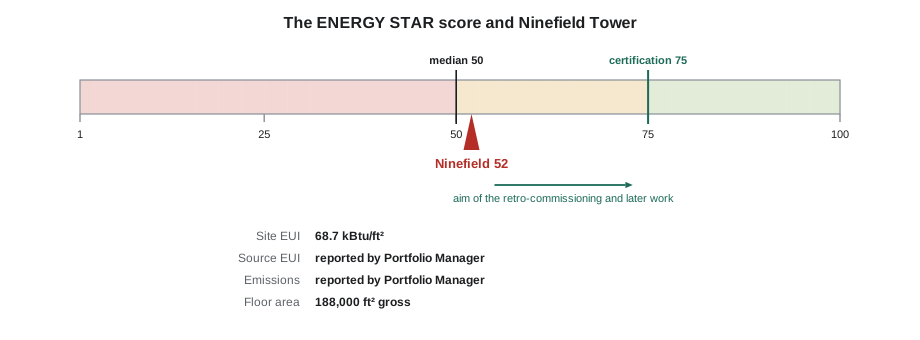
The ENERGY STAR score, from 1 to 100, compares a building's source energy with that of similar buildings nationally, after adjusting for climate, size, hours and occupancy. A score of 50 means the building performs at the median; 75 means it performs better than three in four similar buildings and may qualify for ENERGY STAR certification, which requires the data to be verified by a licensed professional. The score uses source energy so that a building that buys mostly electricity and one that burns mostly gas are compared fairly.
Source energy factors in Portfolio Manager reflect the national generation mix. In the US, grid electricity has a source factor between about 2.7 and 2.8, meaning that each unit of site electricity takes nearly three units of primary energy to generate and deliver, while natural gas is about 1.05. EPA reviews these periodically; check the current factors in Portfolio Manager's technical references rather than using remembered values.
Worked problem
What moving from 52 toward 75 would take
Suppose Portfolio Manager shows that Ninefield would reach a score of about 75 with roughly 18 in 100 less source energy. The retro-commissioning is expected to save about 9 in 100 of the electricity and some gas. Would it reach 75 on its own?
Show solution
- Ninefield's source energy is mostly electricity, so a 9 in 100 electricity saving gives very roughly a 7 to 9 in 100 source energy saving, depending on the source factors.
- That is about half of the 18 in 100 needed.
Answer: No. It would move the score up meaningfully, perhaps into the low 60s, but reaching 75 would need further measures, such as the chiller and lighting work in Ilona's longer-term plan. Portfolio Manager has a target-setting feature that estimates the score for a given reduction, which is the right way to answer this question for a real building.
Benchmarking rules: the Columbus ordinance
Columbus adopted an energy and water benchmarking ordinance in 2020. Commercial and multifamily buildings of 50,000 square feet or more must report their annual energy and water use through Portfolio Manager; the report for 2025 data was due June 1, 2026. Ninefield, at about 188,000 square feet, is covered. The city publishes summary data, so a building's performance becomes visible to tenants, buyers and lenders.
Benchmarking only requires reporting; it does not require a building to improve. Columbus has proposed going further with a building performance standard that would set targets existing buildings must meet over time. Drafts have been published for comment but, at the time of writing, nothing has been adopted, so the details may change. Owners like Ilona's expect the rules on existing buildings to tighten over time.
Data quality in benchmarking
A benchmark is only as good as the property data and meter data behind it. Common errors include:
- Wrong floor area, often the rentable area instead of the gross floor area Portfolio Manager asks for.
- Missing meters: a gas meter for a podium tenant, or electricity bought by a tenant directly from the utility but serving the building's HVAC.
- Gaps or overlaps in monthly bills, especially when bills are entered by hand.
- Wrong property use details: operating hours or number of workers that are years out of date.
- Units entered wrongly: therms instead of cubic meters, or kWh instead of MWh.
Many utilities can upload a building's meter data to Portfolio Manager automatically, which removes most of the data-entry errors. The BAS's main meter data is a useful cross-check on whatever the utility uploads, as Callie had found with the July bill.
What the technician brings
Benchmarking and codes may seem like the property manager's and the engineer's business, but both depend on what the technician does in the building. A technician who sets up a new air handler's resets and leaves them working helps it meet the code. A technician who finds why Ninefield's night base load is 150 kW instead of 110 helps its score more than any report. And a technician who understands why the score matters can explain to an owner why a fault worth fixing is worth paying for.
What a commissioning agent checks
On a new building or a major alteration, a commissioning agent or the engineer of record checks that the code-required controls were installed and work. BAS-410 covers commissioning in full; for energy, the checks usually include:
- Schedules and setback are programmed, and outdoor air dampers close when unoccupied.
- Optimum start is enabled where required, with reasonable limits.
- Heating and cooling setpoints have the required deadband and cannot be set to overlap.
- Economizers enable, modulate and lock out correctly, with any required fault detection working.
- Static pressure, supply air and hydronic resets respond to zone demand as specified.
- Demand-controlled ventilation responds to CO₂ or occupancy within its limits.
- Energy meters read correctly and record data at the required interval.
Each check is a functional test with a result recorded. A building that passes at handover can still lose its savings within a year, which is why benchmarking and monthly tracking matter after the code has done its job.
Setting up a building in Portfolio Manager
Callie set up a practice property for 17 Marlow Lane, the office building from BAS-320, to see what the process involved.
| Step | What to enter |
|---|---|
| Property | Address, year built, gross floor area, primary use |
| Use details | Weekly operating hours, number of workers on the main shift, number of computers, and the share of the floor area that is heated and cooled |
| Meters | One meter entry for each utility meter: type, units, and whether it serves the whole property |
| Meter data | Monthly use and cost for each meter, entered by hand, uploaded from a spreadsheet, or received automatically from the utility |
| Sharing | Share the property with the owner, the consultant or the government reporting account |
| Review | Check the data quality checker, then the metrics: EUI, score, emissions |
The data quality checker flags gaps, overlaps and unusually high or low months. Running it before submitting a report catches most errors. Once a property is set up, keeping it current is a few minutes a month, and automatic uploads from the utility reduce it further.
Marlow Lane was too new to have a full year of data, so its score would not be meaningful until after its first winter. Callie noted that in the practice file, along with the reminder that a building's first benchmark is a starting point, not a verdict: what matters is the direction it moves in afterward, and the control system has more influence on that direction than almost anything else in the building.
Common mistakes
MistakeAssuming the latest model code applies to a building.
InsteadCheck which code and edition the province, state or city has adopted, and when the permit was issued.
MistakeDisabling a code-required sequence because it causes a complaint.
InsteadFind and fix the cause; the sequence may be required.
MistakeUsing rentable area in Portfolio Manager.
InsteadUse gross floor area as Portfolio Manager defines it.
MistakeComparing buildings by site EUI when their fuels differ.
InsteadUse source EUI or the ENERGY STAR score.
MistakeTreating benchmarking as a requirement to improve.
InsteadBenchmarking requires reporting; performance standards, where they exist, require improvement.
Summary and key terms
- The IECC and ASHRAE 90.1 are the bases of most US commercial energy codes; Ohio uses the 2021 IECC with ASHRAE 90.1-2019 as an alternative.
- Energy codes include controls requirements for shutoff, optimum start, deadbands, economizers, resets, ventilation, metering and testing.
- Code requirements apply to alterations such as replacing an air handler.
- Performance paths depend on controls being built and run as modeled.
- Portfolio Manager calculates EUI, emissions and the ENERGY STAR score from property and meter data.
- A score of 50 is the median; 75 is the certification threshold.
- Columbus requires annual reporting for buildings of 50,000 square feet or more, due June 1.
- Energy code
- A law setting minimum energy performance for new and altered buildings.
- IECC
- The International Energy Conservation Code.
- ASHRAE 90.1
- The energy standard for buildings except low-rise residential, used directly or through the IECC.
- Stretch code
- An optional code more demanding than the base energy code.
- Prescriptive path
- Code compliance by meeting each requirement item by item.
- Performance path
- Code compliance by showing a model uses no more energy than a reference building.
- Benchmarking
- Comparing a building's energy use with its past and with similar buildings.
- ENERGY STAR score
- A 1 to 100 rating of a building's source energy against similar buildings.
Practice problems
Work each problem on paper first, then reveal the answer to check.
A building scores 75 in Portfolio Manager. What does that mean?
Show answer
It performs better than about three in four similar buildings and may qualify for certification.
Why does the ENERGY STAR score use source energy?
Show answer
So buildings with different fuel mixes are compared fairly.
A new air handler's static pressure reset causes noise in one zone. What should be done?
Show answer
Find and fix the cause; do not disable a possibly code-required reset.
Name two errors common in benchmarking data.
Show answer
Wrong floor area, missing meters, billing gaps, out-of-date use details, unit errors.
What is the difference between benchmarking and a building performance standard?
Show answer
Benchmarking requires reporting; a performance standard requires meeting targets.
Lesson quiz · 5 questions
Score 60% or more to complete this lesson.
Create a free account to save your progress, take quizzes and earn a certificate.