
BAS-110 · Lesson 6 of 12 · 25 min
Chillers, cooling towers and chilled water
▶ Video coming soon A video version of this lesson is on the way.
On Tuesday, October 6, Prakash and Callie went back to Ninefield Tower, this time to the basement chiller plant that cooled the ten office floors. Two water-cooled centrifugal chillers, each rated at 200 tons, sat side by side on concrete pads, with a tangle of insulated piping overhead and a pair of primary pumps beside each one. A cooling tower on the penthouse roof rejected the heat. Ilona Vescovi had a complaint and a question. The complaint was that on hot afternoons the north side of the upper floors ran warm. The question was why the plant ran both chillers on days when the building's cooling load, by her energy bills, should need only one.
This lesson explains how central cooling plants make and distribute chilled water: how chillers work from the controls point of view, how cooling towers reject heat, how primary and secondary pumping arrangements work, and why the temperature difference across the chilled water loop matters so much. RAC-310 and RAC-320 cover chillers and towers from the refrigeration side; here the focus is on what the BAS sees and controls.
What a chiller does
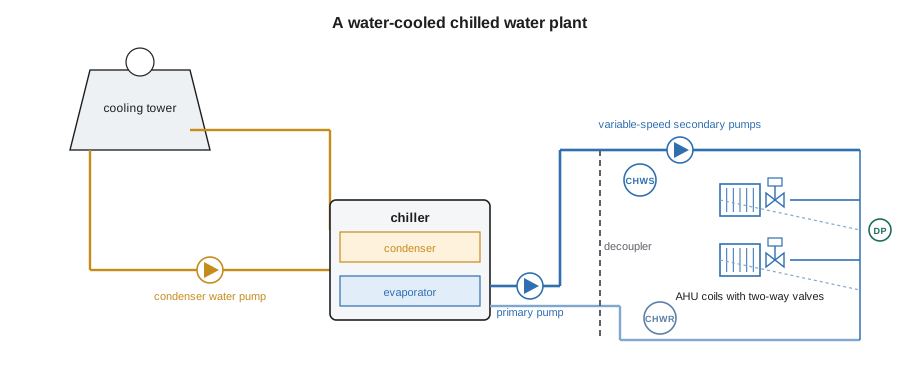
A chiller is a refrigeration machine that cools water instead of air. Its evaporator is a heat exchanger in which refrigerant boils and takes heat from the building's chilled water; its condenser is another heat exchanger in which the refrigerant condenses and gives that heat, plus the energy from the compressor, to condenser water or to outdoor air. The chilled water, typically supplied at about 42 to 45 °F, is pumped to the cooling coils in the air handlers and fan coils, picks up heat from the air and returns several degrees warmer.
Chillers are classified by how they reject heat and by their compressor. Air-cooled chillers have condenser coils and fans and sit outdoors, often on a roof or a pad beside the building; they are simpler and need no cooling tower, but use more energy in hot weather. Water-cooled chillers reject heat to a condenser water loop connected to a cooling tower; they are more efficient and suit large buildings. Compressors may be scroll, screw or centrifugal, and many modern machines have variable-speed drives or magnetic-bearing centrifugal compressors that run very efficiently at part load. Some plants also use absorption chillers driven by steam or hot water, and some buildings store cooling as ice made at night.
How much cooling: flow and temperature difference
The cooling a chilled water loop delivers depends on two things: the flow rate and the temperature difference between the supply and return water, called the delta-T. It is the same relationship as for hot water in lesson 5, run in the other direction. A chiller's nameplate gives a design flow and a design delta-T, and a well-run plant delivers close to the design delta-T at every load.
Worked problem
Cooling delivered by a chilled water loop
Ninefield's chilled water loop is designed for 475 gpm with supply at 44 °F and return at 54 °F. How much cooling is that, in tons and in kilowatts?
Show solution
- Delta-T: 54 − 44 = 10 °F.
- Tons = gpm × ΔT ÷ 24 = 475 × 10 ÷ 24 = 198 tons.
- In kilowatts: 198 × 3.517 = 696 kW.
Answer: About 198 tons, or about 696 kW: one chiller at full load. The factor 24 comes from 12,000 Btu/h per ton ÷ 500.
Low delta-T syndrome
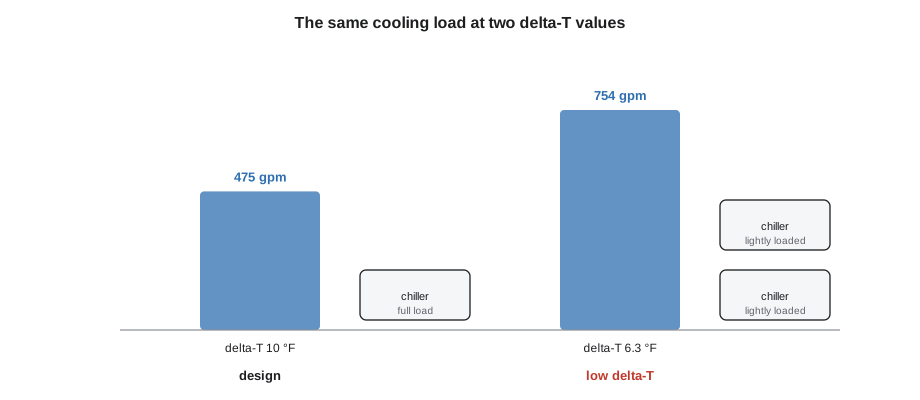
When Callie and Prakash looked at the trends, the chilled water supply was right at setpoint, but the return was only about 6.3 °F warmer instead of 10 °F. The building's cooling load on a typical afternoon was well within one chiller's capacity, but because each unit of water was carrying less heat, the loop needed far more water to deliver it. The plant control sequence started the second chiller and its primary pump whenever the secondary flow exceeded what one primary pump could supply. So the second chiller ran, lightly loaded and inefficient, for no reason except that the water was coming back too cold.
Worked problem
How much extra flow does low delta-T cause?
If the same 198-ton load is delivered with only a 6.3 °F delta-T, how much chilled water must flow?
Show solution
- Flow = tons × 24 ÷ ΔT = 198 × 24 ÷ 6.3 = 754 gpm.
- That is about 59 in 100 more than the 475 gpm design flow.
Answer: About 754 gpm. The secondary pumps work harder, the second chiller starts early, and the chillers run at low load where they are least efficient.
This problem is common enough to have a name: low delta-T syndrome. Its causes are mostly on the load side, which is why controls technicians are often the ones who find it. Three-way valves on coils let chilled water bypass straight to the return. Control valves that leak, or are oversized and hunt, let too much water through. Coils with dirty fins, or air handlers with supply air setpoints set too low, pass water through without loading it. Coils piped backwards, with water flowing the same way as the air instead of against it, transfer less heat. And a decoupler pipe in a primary-secondary plant can let supply water flow straight back to the return when the primary flow exceeds the secondary.
At Ninefield, Callie and Prakash found two of the causes. The two oldest air handlers in the penthouse had three-way valves that had never been converted when the plant went to variable-speed secondary pumps in 2008, and the supply air setpoint on one of them had been lowered to 50 °F by someone trying to fix the warm north offices. The lower setpoint made the coil valve run wide open all afternoon, sending a great deal of water through the coil without much rise in its temperature, and it did not cure the warm offices either, as lesson 7 explains. Declan Kilbride quoted converting the two three-way valves to two-way valves as part of a retro-commissioning project planned for the spring of 2027.
Primary, secondary and variable primary pumping
Chilled water plants pump water in one of a few common arrangements. In a constant primary system, the pumps run at a fixed speed and three-way valves at the coils keep the flow constant. In a primary-secondary system, constant-speed primary pumps circulate a fixed flow through each chiller, while variable-speed secondary pumps send only the flow the coils need out to the building; a decoupler, or common pipe, between the two loops carries the difference. In a variable primary flow system, the chillers themselves can accept a varying flow within limits, and one set of variable-speed pumps does the whole job, with a bypass valve to protect the chillers at low flow. Ninefield's plant was primary-secondary.
Each arrangement has its own control points. The secondary pumps are usually controlled to hold a differential pressure setpoint, measured near the most remote coil, so that every coil has enough pressure to get the flow it needs. Better sequences reset that setpoint downward when no coil valve is near fully open, saving pump energy. The direction and amount of flow in the decoupler tells the controls whether the primary flow is enough: water flowing from the return side to the supply side means the secondary is drawing more than the primary supplies, and warm return water is mixing into the supply. That is a sign to start another chiller, but only if the load really needs it, which is why low delta-T confuses this logic.
Chiller staging and protection
The BAS, or a dedicated plant controller, decides how many chillers to run and in what order, starts the pumps and tower fans each chiller needs, and sends each chiller its enable and setpoint. Like a boiler, a chiller has its own controls and safeties: low refrigerant pressure, low evaporator temperature to prevent freezing, high condenser pressure, oil pressure, motor protection, and flow switches on the evaporator and condenser that stop the chiller if water is not moving. The chiller will not run without proven flow on both sides, and the BAS must never bypass those flow switches.
A typical start sequence opens the chiller's isolation valves, starts its condenser water pump and chilled water pump, waits for flow to be proven, enables the cooling tower controls and then enables the chiller, which runs its own start-up routine. Shut-down runs in reverse, with the pumps kept running for a few minutes after the chiller stops. Staging logic adds a chiller when the running ones are near full load for some time and the supply temperature is rising above setpoint, and removes one when the load would fit comfortably on fewer machines. Minimum run times and time delays prevent short cycling, which is hard on large compressors and motors.
Chilled water supply temperature can be reset upward when the load is light and humidity is low, which improves chiller efficiency, but it must be done carefully, because warmer chilled water also means the air handler coils remove less moisture. In humid summer weather, a reset that saves chiller energy can leave the building clammy. Many sequences reset chilled water temperature on the basis of how far open the coil valves are, so that the warmest water that still meets every coil's load is supplied.
Cooling towers and condenser water
A cooling tower rejects the heat from a water-cooled chiller's condenser to the outdoor air, mostly by evaporating a small part of the condenser water. Warm condenser water is sprayed or spread over fill material inside the tower, a fan draws outdoor air through it, and the cooled water collects in a basin and returns to the condenser. Because the cooling comes mostly from evaporation, a tower can cool water to within a few degrees of the outdoor wet-bulb temperature, which is lower than the dry-bulb temperature whenever the air is not saturated. The heat a tower rejects is the building's cooling load plus the compressor's energy, roughly 1.25 times the cooling load for a typical chiller.
Tower controls hold the condenser water supply temperature to the chiller at a setpoint by cycling or varying the speed of the tower fans, and in cold weather by bypassing water around the tower so that it does not get too cold for the chiller to run. Makeup water replaces what evaporates and what is bled off; blowdown, or bleed, removes water with its concentrated minerals to keep scale down. Water treatment controls the minerals, corrosion and biological growth. In cold climates, towers that run in winter need basin heaters and careful control to stop ice forming.
Cooling towers can grow Legionella bacteria, which cause Legionnaires' disease when people breathe in contaminated droplets. ASHRAE Standard 188 sets out how building owners should manage Legionella risk in their water systems, and many states, cities and owners require a written water management plan for cooling towers. Water treatment, regular cleaning and a written plan are the defenses. For a controls technician, the most important rules are not to leave a tower basin stagnant and warm, and to report drift, slime or failed treatment equipment at once.
Worked problem
Heat the cooling tower must reject
When one Ninefield chiller delivers 198 tons of cooling, about how much heat must the cooling tower reject?
Show solution
- Tower heat ≈ 1.25 × cooling load.
- 1.25 × 198 = 248 tons of heat rejection, or about 2,970,000 Btu/h.
Answer: About 248 tons, or about 3 million Btu/h. The extra quarter is the energy the compressor adds; a more efficient chiller adds less.
Free cooling and waterside economizers
In cold weather, some water-cooled plants can make chilled water without running the chillers at all. A waterside economizer uses a plate heat exchanger between the condenser water and the chilled water loops: when the cooling tower can make condenser water colder than the chilled water return, it cools the chilled water directly. Buildings with large interior zones that need cooling all year, such as Ninefield, benefit most. Ninefield had no waterside economizer, which was one more item for the retro-commissioning study.
Common mistakes
MistakeStarting an extra chiller because flow is high, without checking delta-T.
InsteadLook for low delta-T and its causes on the load side before adding chillers.
MistakeLowering an air handler's supply setpoint to fix a warm room.
InsteadFind out why the room is warm; a lower setpoint can cause low delta-T and overcooling elsewhere.
MistakeBypassing a chiller's flow switch.
InsteadNever bypass it; a chiller without water flow can freeze its evaporator.
MistakeResetting chilled water warmer in humid weather without watching humidity.
InsteadReset on coil valve demand and check that the air is still being dehumidified.
MistakeIgnoring a tower that runs in winter.
InsteadCheck basin heaters, bypass control and ice formation.
MistakeTreating cooling tower water quality as someone else's problem.
InsteadReport treatment failures and stagnant or slimy towers at once.
Summary and key terms
- A chiller cools water in its evaporator and rejects heat through its condenser to condenser water or outdoor air.
- Cooling delivered depends on flow and delta-T; tons ≈ gpm × ΔT ÷ 24.
- Low delta-T syndrome makes the plant pump more water and run more chillers than the load needs.
- Its causes are mostly at the coils: three-way valves, leaking or hunting valves, low setpoints and dirty coils.
- Primary-secondary plants have a decoupler; secondary pumps hold a differential pressure setpoint.
- The BAS stages chillers and their pumps and towers; the chiller's own controls and flow switches protect it.
- Cooling towers reject about 1.25 times the cooling load by evaporation; they need water treatment and Legionella control.
- Waterside economizers make chilled water from the tower in cold weather.
- Chiller
- A refrigeration machine that cools water for use in cooling coils.
- Delta-T
- The temperature difference between supply and return water in a loop.
- Low delta-T syndrome
- A chilled water loop returning water too cold, so that more flow and more chillers are needed.
- Decoupler
- A pipe joining the primary and secondary loops in a primary-secondary plant.
- Cooling tower
- Equipment that cools condenser water mainly by evaporating part of it into outdoor air.
- Wet-bulb temperature
- The lowest temperature evaporation can cool water to in given air; it is below the dry-bulb temperature unless the air is saturated.
- Blowdown
- Water bled from a cooling tower to remove concentrated minerals.
- Waterside economizer
- A heat exchanger that lets cooling tower water cool the chilled water loop without running chillers.
Practice problems
Work each problem on paper first, then reveal the answer to check.
A loop flows 300 gpm with a 10 °F delta-T. How much cooling does it deliver?
Show answer
300 × 10 ÷ 24 = 125 tons.
Name two load-side causes of low delta-T.
Show answer
Three-way valves at coils, and supply air setpoints set too low; also leaking valves and dirty coils.
What does water flowing from the return side to the supply side in a decoupler mean?
Show answer
The secondary loop is drawing more flow than the primary pumps supply.
Why must a chiller's flow switches never be bypassed?
Show answer
Without flow, the evaporator can freeze and the condenser can overpressure.
Why can a cooling tower cool water below the outdoor dry-bulb temperature?
Show answer
It cools mainly by evaporation, so it approaches the wet-bulb temperature.
Lesson quiz · 5 questions
Score 60% or more to complete this lesson.
Create a free account to save your progress, take quizzes and earn a certificate.