
BAS-110 · Lesson 5 of 12 · 24 min
Boilers, hot water and steam heating plants
▶ Video coming soon A video version of this lesson is on the way.
On Tuesday, September 29, Prakash took Callie to the Harcastle College central heating plant, a brick building at the edge of the campus with a tall stack. Nell Nakagawa, the college's chief building operator, met them at the door. Nell was a licensed stationary engineer and ran the plant's two low-pressure steam boilers, installed in 1988, which supplied steam through underground pipes to most of the campus buildings, Tilden Hall among them. "Your controls tell my boilers when the buildings need heat," she told Callie. "My job is to make the steam safely. Yours is to use it well. We have to understand each other's half."
This lesson describes heating plants from the controls technician's point of view: the kinds of boilers found in commercial buildings, how hot water and steam systems distribute heat, how heat exchangers and converters connect the two, and what a BAS controls, monitors and must never interfere with. BLR-110 to BLR-130 and the stationary engineering courses cover boilers in far more depth; here the aim is to know enough to control a heating system well and to work safely beside the people who run the plant.
Hot water and steam
Commercial buildings are heated mostly by hot water, by steam, or by both. Hot water systems, called hydronic systems, pump water heated in a boiler or heat exchanger around a closed loop to coils, radiators and terminal units, and back. They are easy to control, quiet and efficient, and almost all new commercial heating systems use them. Steam systems carry heat as steam, which gives up a large amount of latent heat when it condenses back to water in a coil or radiator. Steam needs no pumps to reach the far end of a system, because it flows from high pressure to low, and it can carry a great deal of heat in a small pipe, which is why older campuses, hospitals and downtown districts often distribute heat by steam.
Many older buildings use both. Harcastle's central plant made low-pressure steam and sent it across the campus. In Tilden Hall's basement, the steam passed through a converter, a shell-and-tube heat exchanger in which steam condensing on the outside of a bundle of tubes heated building water flowing through them. The building's own hot water pumps then circulated that water to the AHU coils, the VAV reheat coils, the fan coils and the perimeter radiation. The condensate from the converter drained through a steam trap to a condensate receiver and was pumped back to the plant.
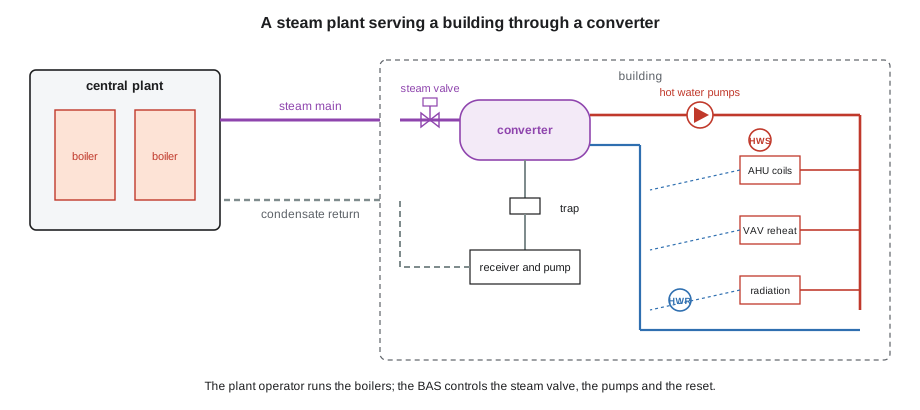
Boilers
A boiler transfers heat from burning fuel, or from electric elements, to water or steam. Commercial boilers come in a few main types. Fire-tube boilers pass hot combustion gases through tubes surrounded by water; they are robust and hold a large volume of water. Water-tube boilers pass water through tubes surrounded by hot gases; they suit high pressures and large plants. Cast-iron sectional boilers are built from sections bolted together and are common in older schools and churches. Modern condensing boilers, usually small fire-tube or coil designs of stainless steel or aluminum, cool their flue gases enough to condense the water vapor in them and recover its latent heat, reaching efficiencies over 90 in 100 when the return water is cool enough.
That last condition matters to controls. A condensing boiler only condenses, and only reaches its high efficiency, when the water returning to it is below the dew point of its flue gases, roughly 130 °F for natural gas. A system designed for supply water at 180 °F and return at 160 °F, like many older systems, keeps a condensing boiler from condensing much of the time. Lower supply temperatures and resetting the supply temperature with the outdoor temperature both help, and those are controls decisions.
Boilers are rated by their output in kilowatts or Btu per hour, and steam boilers also by their pressure. Low-pressure steam boilers operate at up to about 15 psi of steam pressure, and low-pressure hot water boilers at up to about 160 psi and 250 °F. Above those limits, boilers are high-pressure and their operation is more strictly regulated. The exact thresholds come from the pressure vessel regulations, and they decide what certificates the operators need.
Who controls the boiler
Every boiler has its own operating controls and safety controls, which come from the manufacturer and are installed and maintained under the boiler rules. In Ohio, boilers are regulated by the state's Division of Industrial Compliance under the Ohio boiler laws and rules, which adopt the ASME codes, and many boilers must be inspected and carry a certificate of operation; Columbus and some other cities also license stationary engineers. Many boilers also follow ASME CSD-1 for controls and safety devices. The safety controls, such as the low-water cutoff, the high-limit pressure or temperature control, the flame safeguard and the safety relief valve, are never part of the BAS and must never be bypassed or overridden by it. The BAS may enable a boiler, send it a setpoint and read its status and alarms. It does not run the burner.
That division of responsibility is the most important idea in this lesson. A controls technician might write a sequence that enables boiler 1 when the outdoor temperature falls below a set point, rotates the lead boiler weekly and raises an alarm if a boiler fails to fire within ten minutes of a call. But the boiler's own controls decide whether it is safe to fire. Prakash told Callie about a technician at another company who had once jumpered out a boiler's flow switch to stop a nuisance alarm. The boiler fired with no water moving through it and cracked its heat exchanger within the hour. No one was hurt, but it could have been far worse.
| Control | Belongs to | What the BAS does with it |
|---|---|---|
| Flame safeguard and burner sequence | Boiler manufacturer and gas technician | Reads status and lockout alarm only |
| Low-water cutoff | Boiler (safety) | Reads alarm; never bypasses |
| High-limit pressure or temperature | Boiler (safety) | Reads alarm; never bypasses |
| Safety relief valve | Boiler (mechanical safety) | Nothing |
| Operating control (setpoint) | Boiler controller | May send a setpoint or reset signal |
| Enable, lead-lag and staging | Plant control sequence | Often runs it |
| Pumps, valves and building loops | Building system | Controls them |
Hot water distribution
In a hot water system, pumps circulate water from the boiler or converter through supply piping to the terminal units and back through return piping. The heat delivered depends on the flow rate and the temperature drop across the loads. Controls vary one, the other, or both. A system with three-way valves at its coils keeps the flow through the pumps nearly constant and bypasses water around coils that need less heat. A system with two-way valves throttles the flow to each coil, so the total flow falls at part load, and variable-speed pumps, controlled to hold a differential pressure, save a great deal of pump energy. Lesson 9 covers pumps and their control.
Worked problem
Heat delivered by a hot water loop
Tilden Hall's hot water pumps circulate 47.5 gpm, with supply at 180 °F and return at 160 °F. How much heat is the loop delivering? Use the approximation that heat in Btu/h is 500 × gpm × ΔT for water.
Show solution
- Temperature drop: 180 − 160 = 20 °F.
- Q = 500 × 47.5 × 20 = 475,000 Btu/h.
Answer: About 475,000 Btu/h. The factor 500 comes from 8.33 lb per gallon × 60 minutes per hour × 1 Btu per lb·°F; glycol mixtures need a smaller factor.
The hot water supply temperature is usually reset with the outdoor temperature. On the coldest days the system needs its full design temperature, but on a mild day the same coils and radiators can heat the building with much cooler water. A reset schedule might call for 180 °F supply at −4 °F outdoors and 120 °F at 60 °F outdoors, with a straight line between. Reset saves energy, reduces pipe heat losses, makes control valves work over more of their range and, with condensing boilers, keeps return water cool enough to condense. BAS-130 shows how reset schedules are built.
Hot water systems also need an expansion tank to absorb the change in water volume as it heats, an air separator and vents to remove air, a fill valve with backflow prevention to keep the system pressurized, and water treatment to prevent corrosion and scale. The BAS may monitor system pressure, and a low-pressure alarm is often the first sign of a leak. In buildings with cooling coils or air handlers exposed to outdoor air, the loop may be filled with a glycol mixture to protect against freezing, which reduces its heat-carrying capacity a little and must be allowed for in calculations.
Steam systems
Steam behaves very differently. When water boils at atmospheric pressure, every kilogram absorbs about 2,260 kJ of latent heat, and it gives that heat back when it condenses. That is about five times the heat a kilogram of water gives up by cooling from 212 °F to 32 °F. A steam coil therefore delivers a lot of heat from a small flow, and as long as there is steam at the coil, its surface stays near the steam temperature. Steam heating is controlled by modulating a steam valve, which lets more or less steam into the coil or converter.
Worked problem
Steam needed by the Tilden converter
The Tilden converter delivers 475,000 Btu/h to the hot water loop. About how much steam does it condense per hour? At low pressure each pound of condensing steam gives up about 960 Btu.
Show solution
- Steam: 475,000 ÷ 960 = 495 lb/h.
Answer: About 495 lb of steam an hour, returned to the plant as the same mass of hot condensate.
The parts of a steam system that a controls technician meets most often are the control valves, the steam traps and the condensate return. A steam trap is an automatic valve that lets condensate and air pass but holds steam back. When a trap fails open, live steam blows through to the condensate return, wasting energy and overheating the receiver; when it fails closed, condensate backs up in the coil, which then delivers little heat and can freeze or suffer water hammer, the violent banging of slugs of water driven by steam. A coil that will not heat even though its valve is wide open is often a failed trap, not a controls fault. Steam valves, coils and traps are hot enough to burn badly, and steam lines are always treated as live.
What the BAS watches
Even where the plant operators run the boilers, a BAS usually monitors a heating plant: boiler status and alarms, steam pressure or hot water supply and return temperatures, flue gas temperature, makeup water flow, outdoor temperature, pump status and system pressure. Trends of these points show how the plant responds to the weather and to the buildings' demands. At Harcastle, Nell's plant had its own control system, and Quillon's BAS received a few signals from it through a BACnet gateway. In each building, the BAS controlled the steam valve on the converter, the hot water pumps and the reset schedule.
Callie and Prakash looked at a week of trends for the Tilden converter. The hot water supply temperature followed the reset schedule closely except on two mornings, when it fell well below setpoint for about an hour after the system started. Nell looked at the same mornings in her plant log and found that both coincided with the second boiler being brought on line, when steam pressure in the campus main dipped. Prakash suggested a small change: start Tilden's warm-up fifteen minutes later than the buildings closest to the plant, so that the campus load did not arrive all at once. Nell agreed to try it in October. It was a small example of the two halves working together.
Safety around heating plants
Boiler rooms and mechanical rooms hold some of the most dangerous energy in a building: steam and hot water at high temperature and pressure, fuel gas, combustion products, rotating pumps and fans, and line-voltage power. A controls technician working in a plant follows the plant's rules, signs in with the operator, never opens a valve or changes a setting on a boiler without the operator's agreement, and never works on a pressurized steam or hot water line. Carbon monoxide detectors in boiler rooms are a reminder that combustion can kill. If a technician smells gas, hears a safety valve lifting or sees a boiler in lockout, they tell the operator at once.
Common mistakes
MistakeBypassing a boiler safety to stop a nuisance alarm.
InsteadNever bypass a safety; find out why it is tripping and tell the operator.
MistakeAssuming the BAS runs the burner.
InsteadThe boiler's own controls run the burner; the BAS enables, sets and monitors.
MistakeRunning condensing boilers with high return water temperatures.
InsteadLower supply temperatures and use outdoor reset so the return water stays cool.
MistakeBlaming the controls for a steam coil that will not heat.
InsteadCheck the steam trap and condensate drainage before the valve and the program.
MistakeForgetting that glycol reduces heat-carrying capacity.
InsteadUse the correct factor for the fluid in heat calculations.
MistakeWorking on a live steam or hot water line.
InsteadIsolate, depressurize, cool and lock out with the plant operator's agreement.
Summary and key terms
- Commercial buildings are heated by hot water, steam or both, often joined by a converter.
- Boilers include fire-tube, water-tube, cast-iron sectional and condensing types; condensing boilers need cool return water.
- The boiler's own safety controls are never part of the BAS and must never be bypassed.
- The BAS may enable boilers, send setpoints, stage and rotate them, and control pumps, valves and reset.
- Hot water heat delivered depends on flow and temperature drop; outdoor reset lowers supply temperature in mild weather.
- Steam delivers large amounts of latent heat; traps hold steam back and pass condensate.
- A failed trap, not the controls, is a common cause of steam coils that will not heat.
- Heating plants are dangerous; work with the operator and follow the plant's rules.
- Hydronic system
- A heating or cooling system that circulates water through a closed loop.
- Condensing boiler
- A boiler that cools its flue gases enough to condense their water vapor and recover its heat.
- Converter
- A heat exchanger that uses steam to heat building hot water.
- Low-water cutoff
- A boiler safety that shuts the burner off if the water level falls too low.
- Outdoor reset
- Lowering the hot water supply temperature as the outdoor temperature rises.
- Steam trap
- An automatic valve that passes condensate and air but holds back steam.
- Condensate
- The water formed when steam gives up its latent heat.
- Water hammer
- Violent banging caused by slugs of water driven through steam or water piping.
Practice problems
Work each problem on paper first, then reveal the answer to check.
A loop circulates 40 gpm with a 20 °F temperature drop. About how much heat does it deliver?
Show answer
500 × 40 × 20 = 400,000 Btu/h.
Which boiler controls must the BAS never bypass?
Show answer
The safeties: low-water cutoff, high limits, flame safeguard and relief valve.
Why does outdoor reset help a condensing boiler?
Show answer
Lower supply temperatures bring cooler return water, so the boiler condenses and is more efficient.
A steam coil stays cold with its valve wide open. What should be checked first?
Show answer
The steam trap and the condensate drainage.
What does a falling hot water system pressure often indicate?
Show answer
A leak, or a problem with the fill valve or expansion tank.
Lesson quiz · 5 questions
Score 60% or more to complete this lesson.
Create a free account to save your progress, take quizzes and earn a certificate.