
BAS-110 · Lesson 1 of 12 · 26 min
What a building automation system does
▶ Video coming soon A video version of this lesson is on the way.
Callie Rintoul started at Quillon Building Controls on Tuesday, September 8, 2026. By nine o'clock she had a laptop, a hard hat, a set of keys she was not allowed to lose and a seat in Prakash Deshmukh's van. Prakash had been a controls technician for twenty-two years. He had started on pneumatic controls, when a thermostat was a brass box full of air, and he had watched three generations of digital controls arrive. Their first stop was Tilden Hall, a four-story science and teaching building at Harcastle College built in 1988. Quillon held the service contract for the college's building automation system. Prakash logged in to the college's front end on a workstation in the basement mechanical room, turned the screen toward Callie and said, "Everything in this building is on here: the air handlers, the pumps, the heating, every room. Before you learn the controls, you have to learn what they control. That is what this first course is about."
This lesson explains what a building automation system is, what it does for a building's owners and occupants, and how it is put together, from the sensors in a room to the screen in an operator's office. It introduces the vocabulary used for the rest of the program and shows where the controls technician fits among the trades who work on a building's mechanical and electrical systems. Lessons 2 to 10 then walk through the systems the BAS controls, and lessons 11 and 12 show how to read the drawings for those systems and trace them through a real building.
A definition
A building automation system, or BAS, is a network of controllers, sensors, actuators and software that monitors and controls a building's mechanical and electrical equipment. It is also called a building management system (BMS), an energy management system (EMS) or, in a hospital or campus, an energy management and control system (EMCS). The names overlap, and contractors use them loosely; the job is the same. A BAS turns equipment on and off on a schedule, holds temperatures, pressures and humidities at setpoints, protects equipment from damage, raises alarms when something goes wrong and records what happened so that people can see trends and find problems.
Most commercial buildings built or renovated in the last thirty years have a direct digital control (DDC) system. In a DDC system, sensors send their readings to small computers called controllers, which run programs that decide what the equipment should do and send commands to actuators, relays and drives. Older buildings may still have pneumatic controls, in which compressed air signals at low pressure position dampers and valves, or electric controls, in which thermostats switch equipment directly. Many buildings have a mix: a DDC system at the main equipment and pneumatic actuators still working on valves and dampers in the rooms. A controls technician needs to recognize all three.
What a BAS does
It helps to think of a BAS as doing five jobs. Each job will come up again and again in this program.
- Scheduling. Equipment runs only when the building needs it. Air handlers start before the first classes and stop after the last; heating and cooling setpoints move to unoccupied values at night and on weekends; lights in corridors switch off after hours. Scheduling is the cheapest energy saving there is, and a BAS that has lost its schedules is wasting money every hour.
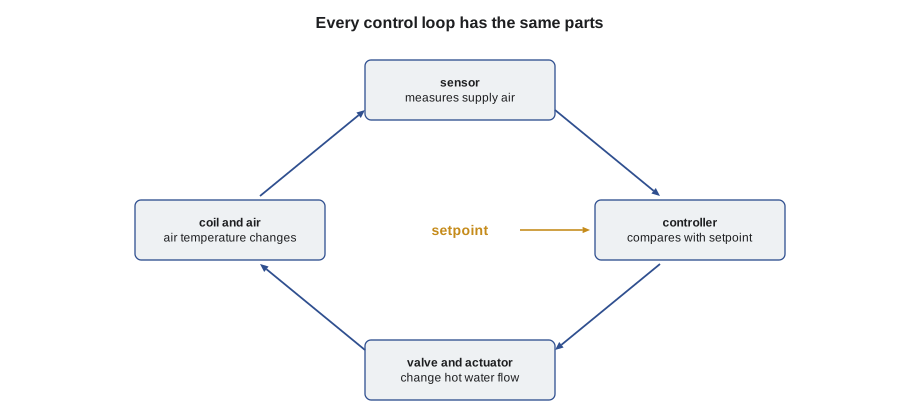
- Control. The BAS holds conditions at setpoints. It modulates a heating valve to keep supply air at a temperature, varies a fan's speed to hold a duct pressure, opens an outdoor air damper to keep carbon dioxide down in a lecture hall and stages chillers to meet the cooling load. The control loops that do this work are the subject of BAS-130.
- Protection. The BAS protects people and equipment. A freeze protection thermostat stops a fan before frozen air can split a coil; a high-pressure limit stops a fan before it bursts a duct; a smoke detector in the return air shuts an air handler down so that it cannot spread smoke. Many of these safeties are hard-wired so that they work even if a controller fails, and BAS-120 covers them in detail.
- Alarming. When a temperature drifts out of range, a pump fails to start or a filter clogs, the BAS raises an alarm so that someone can respond before occupants complain or equipment is damaged. Good alarming is selective: an operator who receives three hundred alarms a day soon ignores all of them.
- Recording. The BAS stores trend logs of temperatures, valve positions, fan speeds and energy use. Trends are the controls technician's most powerful diagnostic tool, because they show what happened at three in the morning when no one was there to see it.
Behind all five jobs are two goals that sometimes pull against each other: comfort and health for the people in the building, and low energy use and long life for the equipment. A large part of a controls technician's skill is finding settings that serve both. A building that is comfortable but wastes energy is not well controlled, and neither is one that saves energy by making people miserable.
Points: the language of a BAS
Every piece of information a BAS reads or writes is called a point. A sensor reading such as a room temperature is an input; a command such as a valve position is an output. Points are usually sorted into four kinds, and Callie heard all four names within her first hour.
| Point type | Abbreviation | What it is | Example at Tilden Hall |
|---|---|---|---|
| Analog input | AI | A measured value that varies continuously | Supply air temperature, duct static pressure |
| Analog output | AO | A command that varies continuously | Heating valve position, fan speed command |
| Binary input | BI | A two-state status read from the field | Fan proving (on or off), filter switch |
| Binary output | BO | A two-state command sent to the field | Fan start/stop, pump enable |
Besides the physical points wired to a controller, every system has software points, also called virtual or internal points: setpoints, schedules, calculated values such as an average of several room temperatures, and flags that one program sets for another. A typical air handler has twenty to forty physical points and many more software points. A large building can have several thousand points in all, and a college campus tens of thousands. Each point has a name, and Prakash explained that a good naming convention, such as TH-AHU1-SAT for Tilden Hall, air handling unit 1, supply air temperature, is worth more than any piece of hardware, because it lets anyone find a point years later.
The words used for point types differ a little from one manufacturer to another. Some call binary points digital inputs and outputs (DI and DO), and some controllers have universal inputs that can be configured as either analog or binary. BACnet, the open communication standard used by most systems today, uses the analog and binary names, along with multi-state points for things with more than two states, such as a fan with low, medium and high speeds. BAS-210 and BAS-310 cover controller hardware and BACnet in depth.
The architecture of a system
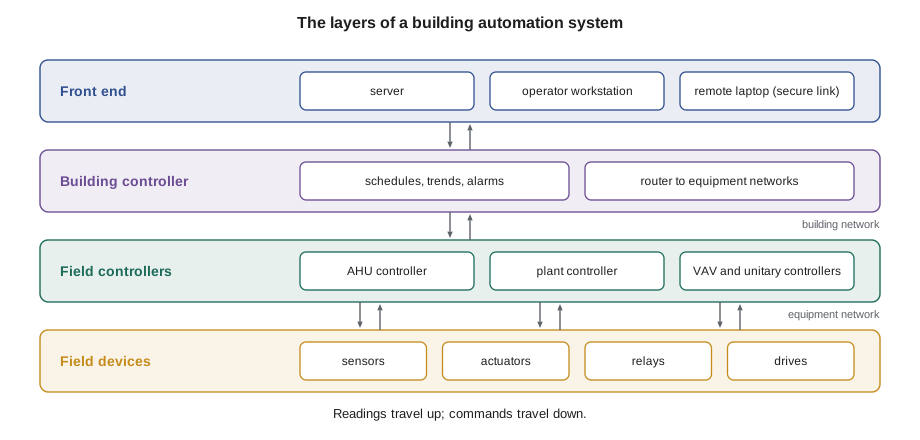
A BAS is built in layers. At the bottom are the field devices: the sensors that measure temperature, humidity, pressure, flow and carbon dioxide, and the actuators, relays and drives that move dampers and valves and start motors. Field devices are wired to field controllers, which are mounted near the equipment they control, in a panel on the side of an air handler or above a ceiling next to a VAV box. Unitary controllers serve one piece of equipment, such as a single VAV box or a rooftop unit; larger programmable controllers serve an air handler or a plant.
Field controllers talk to one another and to a building controller over an equipment network, usually a twisted-pair BACnet MS/TP trunk or, increasingly, Ethernet. The building controller, which some manufacturers call a supervisory controller, router or engine, gathers data from the field controllers, stores trends and alarms, runs schedules and passes information up to the building network. At the top is the front end: server software and operator workstations, usually with a graphical interface showing each system as a drawing with live values. Operators and technicians can log in from a laptop in the building or, through a secure connection, from anywhere.
The layers matter to a technician because a problem shows up differently depending on where it is. A failed sensor makes one reading wrong. A failed field controller makes every point on that controller go offline at once. A broken trunk cable takes out every controller beyond the break. A network or server problem leaves the controllers running their programs perfectly well while the front end shows nothing. Knowing the architecture tells you where to look.
Because a BAS sits on a network, it is a computer system as well as a control system, and it can be attacked like one. A BAS that is reachable from the internet with a default password is a risk to the building and to the owner's other systems. The program closes with a course on control system cybersecurity, BAS-440. For now, Prakash's rule for Callie was simple: never share a login, never leave a laptop logged in and unattended, and never connect anything to a customer's network without the customer's permission.
What the BAS controls
A BAS in a commercial building can control almost anything with a motor, a valve or a switch, but most of its work falls into a few systems. Heating plants make hot water or steam. Cooling plants make chilled water, or the cooling is done by packaged units on the roof. Air handling units mix outdoor and return air, filter it, heat or cool it and push it through ducts to the rooms. Terminal units, such as VAV boxes, fan coils and radiators, fine-tune the conditions in each room or zone. Pumps and fans move water and air, often at variable speed. Lighting, and sometimes other electrical loads, can be scheduled and metered too. Lessons 3 to 10 take these systems one at a time.
Some systems connect to the BAS without being controlled by it. Fire alarm systems, for example, are separate life safety systems designed and maintained under their own codes; the BAS may receive a signal from the fire alarm panel to shut down a fan, but it does not control the fire alarm. Elevators, security and access control usually run on their own systems as well, though modern buildings may share information among them. A controls technician needs to know where the BAS stops and another trade's system begins.
Who works on building systems
A controls technician works alongside many other trades. HVAC and refrigeration technicians, sheet metal workers, pipefitters and plumbers install and service the mechanical equipment, often through union or open-shop apprenticeships. Electricians wire the line-voltage power to motors, drives and panels, and that work falls under the state and local electrical licensing rules and the National Electrical Code. Ohio has no state license for controls technicians themselves. Most come from a technical college program in building automation, HVAC controls or electronics, and many later earn manufacturer or industry certifications. They install and service the controllers and the low-voltage control wiring, which the National Electrical Code treats as Class 2 circuits with their own wiring rules. Lesson 10 and BAS-210 return to where that line falls. Large buildings such as hospitals, colleges and plants may also have stationary engineers who operate the boilers and chillers.
On a new building, the controls contractor is usually a subcontractor to the mechanical contractor, working from drawings and a written sequence of operations prepared by the mechanical engineer. On an existing building, the controls contractor often works directly for the owner under a service contract, as Quillon did at Harcastle College. In both cases the controls technician spends a lot of time with people who do not work on controls: operators, facility managers, other trades and the occupants who call because they are too hot or too cold. Explaining clearly what the system is doing, and why, is part of the job.
What a controls technician does
Callie asked Prakash what a typical week looked like. He said there was no such thing, but most of the work fell into five kinds. Installation means mounting controllers and field devices, pulling and terminating low-voltage wiring and checking every point. Programming means writing or editing the control sequences and building the graphics, which is Sophie Aubertin's specialty at Quillon. Commissioning means proving that each system does what the sequence of operations says, point by point and mode by mode. Service means answering calls and alarms and finding out why something is not working. And optimization means finding ways to make a building use less energy without making anyone less comfortable. A technician who understands the mechanical systems does all five better.
The first thing Prakash asked Callie to do was to read the active alarm list on the Tilden Hall front end and write down, for each alarm, which piece of equipment it came from and what she thought it meant. There were eleven alarms. Three were for rooms slightly too warm on the fourth floor, one was a filter differential pressure high on AHU-1, one was a hot water pump that had failed to prove when commanded on and then cleared, and six were for a fume hood exhaust fan that Harcastle had decommissioned the previous spring but no one had removed from the system. "That last one is a lesson," Prakash said. "Six alarms that mean nothing train people to ignore the five that mean something."
Worked problem
Savings from a lost schedule
Tilden Hall's AHU-1 supply fan draws about 11 kW at full speed. Its schedule should run it about 70 hours a week, but after a controller replacement the schedule was never reloaded, and the fan has been running all 168 hours. Assuming the fan runs at full speed whenever it is on, how much electrical energy does the missing schedule waste in a week and in a year?
Show solution
- Extra hours per week: 168 − 70 = 98 h.
- Extra energy per week: 11 kW × 98 h = 1,078 kWh.
- Extra energy per year: 1,078 × 52 = 56,056 kWh, or about 56,000 kWh.
- This counts only the fan. Heating and cooling the outdoor air brought in during those extra hours usually costs more than the fan itself.
Answer: About 1,080 kWh a week and 56,000 kWh a year for the fan alone. Checking that every schedule is loaded and correct is one of the first things to do on any service visit.
Sequences of operation
Every system a BAS controls should have a written sequence of operations: a plain-language description of what the equipment does in every mode, such as occupied, unoccupied, warm-up, economizer and alarm. The sequence is the link between the engineer's design and the controls program. A good sequence says, for example, that the supply fan starts when the schedule calls for occupancy, that the outdoor air damper opens to its minimum position when the fan is proven, that the supply air temperature setpoint resets between two values as the outdoor temperature changes, and that the fan stops and an alarm is raised if the freeze stat trips. A technician who has to fix a system should read the sequence first.
Many older buildings have lost their sequences, or the program no longer matches what is written. ASHRAE Guideline 36 sets out standardized, tested sequences for common systems such as VAV air handlers and terminal units, and many engineers now base their designs on it. The program returns to sequences in BAS-230. For now it is enough to know that the sequence is the first document to ask for on any job, and that the drawings and schedules covered in lesson 11 are the second.
Safety on the job
Controls work looks clean and safe, and much of it is: low-voltage wiring, laptops and quiet offices. But controls technicians spend their days around rotating fans, belt drives, hot water and steam at high temperature, chemicals in water treatment and line-voltage power in starters and drives. A fan that the BAS has commanded off can start again without warning when the schedule changes or another technician overrides it. Before touching any equipment, a controls technician follows the site's lockout procedure, which TRD-101 covered, and confirms that the equipment cannot start. Prakash showed Callie the lockout station in Tilden's mechanical room and told her that no one at Quillon ever put a hand inside a fan section without their own lock on the disconnect.
Overriding equipment from the front end is a hazard of its own. A technician who commands a pump off to change a sensor, then forgets to release the override, may leave a building without heat on a cold night. Quillon's rule is to log every override with a note saying who set it and why, and to release it before leaving site. OSHA's lockout/tagout rule and the site's own procedures apply to controls technicians just as they do to mechanics and electricians.
Common mistakes
MistakeTreating every alarm as equally important.
InsteadFind out which alarms mean real problems, and work with the owner to remove or fix nuisance alarms.
MistakeChanging a program before reading the sequence of operations.
InsteadRead the sequence first, then compare the program with it.
MistakeLeaving an override in place after a service call.
InsteadLog every override and release it before leaving site.
MistakeAssuming a fan the BAS has commanded off cannot start.
InsteadLock out the equipment at its disconnect before working on it.
MistakeNaming points however you like.
InsteadFollow the site's naming convention so others can find every point.
MistakeConnecting a laptop to a customer's network without asking.
InsteadGet permission and follow the owner's network rules.
Summary and key terms
- A BAS is a network of controllers, sensors, actuators and software that monitors and controls building equipment.
- It schedules equipment, holds setpoints, protects people and equipment, raises alarms and records trends.
- Points are analog or binary inputs and outputs, plus software points such as setpoints and schedules.
- Field devices connect to field controllers, which connect over networks to building controllers and the front end.
- Knowing the architecture tells you where to look when points go wrong or offline.
- A written sequence of operations describes what each system should do in every mode.
- Controls technicians work beside mechanical trades, electricians and operators, and must know where each system's boundaries are.
- Lockout, override discipline and network security are part of every job.
- Building automation system (BAS)
- A network of controllers, sensors, actuators and software that monitors and controls building equipment.
- Direct digital control (DDC)
- Control in which digital controllers read sensors, run programs and command outputs.
- Point
- Any single piece of information a BAS reads or writes, such as a temperature or a fan command.
- Analog input (AI)
- A measured value that varies continuously, such as a temperature.
- Binary output (BO)
- A two-state command, such as start or stop.
- Field controller
- A controller mounted near the equipment it controls, wired to its sensors and actuators.
- Front end
- The server software and workstations operators use to see and command the system.
- Sequence of operations
- A written description of what a system should do in every mode.
- Trend log
- A stored record of a point value over time.
Practice problems
Work each problem on paper first, then reveal the answer to check.
Name the five jobs a BAS does.
Show answer
Scheduling, control, protection, alarming and recording.
Every point on one field controller goes offline at once. Where is the problem likely to be?
Show answer
At that controller, its power or its network connection, not at the individual sensors.
Is a fan start/stop command an AI, AO, BI or BO?
Show answer
A binary output (BO).
Why is a nuisance alarm harmful?
Show answer
It trains operators to ignore alarms, including real ones.
What document should you read before changing a control program?
Show answer
The sequence of operations.
Lesson quiz · 5 questions
Score 60% or more to complete this lesson.
Create a free account to save your progress, take quizzes and earn a certificate.