
BAS-110 · Lesson 3 of 12 · 26 min
Air handling units and their components
▶ Video coming soon A video version of this lesson is on the way.
On Tuesday, September 15, Prakash took Callie into the fourth-floor fan room at Tilden Hall, where AHU-1 filled most of the space: a sheet metal box about 40 feet long with access doors along one side, ducts rising out of its top and a control panel mounted on its end. AHU-1 served the classrooms and offices on the north side of the building. Prakash locked out the supply fan, opened the doors one at a time and walked Callie from the outdoor air intake at one end to the supply duct at the other. "Every air handler is built from the same pieces in roughly the same order," he said. "Learn this one and you can read any of them."
This lesson walks through a typical air handling unit, or AHU, section by section, and explains what each component does and what the controls do with it. It covers the mixing box and dampers, filters, heating and cooling coils, humidifiers, fans and the economizer. Lesson 4 covers packaged rooftop units, which do many of the same jobs in one box; lesson 7 covers the terminal units at the other end of the ducts.
What an air handler does
An air handler conditions air and moves it. It takes in a mixture of outdoor air and air returning from the rooms, filters it, heats or cools it, sometimes humidifies or dehumidifies it, and blows it through supply ducts to the spaces it serves. Most of the air returns to the AHU through return ducts or a ceiling plenum and is used again; some is exhausted to make room for the outdoor air brought in. The proportions change through the year and through the day, and managing them is one of the main jobs of the AHU controls.
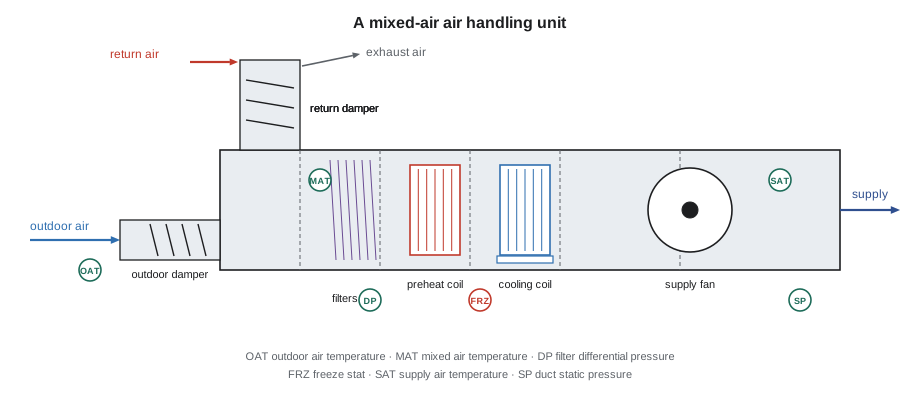
Air handlers come in many sizes and arrangements. A small one might serve a few rooms; AHU-1 at Tilden Hall moves about 10,600 cfm; the central AHUs in a large office tower may move ten times that. Some are constant volume, moving the same amount of air all the time and varying its temperature to meet the load. Most modern ones are variable air volume (VAV), supplying air at a roughly constant temperature and varying the amount of air as the VAV boxes in the rooms open and close. Some, such as those serving laboratories and some hospital areas, use 100 in 100 outdoor air and no return at all. AHU-1 was a VAV unit with a mixing box, which is the most common arrangement in offices and schools.
Dampers and the mixing box
At the inlet end, three sets of dampers control the air paths. The outdoor air damper lets in fresh air. The return air damper lets in air coming back from the rooms. The exhaust or relief air damper, upstream on the return duct, lets some return air leave the building. Dampers are made of parallel or opposed blades on shafts, linked together and moved by an actuator. The outdoor and return dampers are usually linked or controlled so that as one opens the other closes, keeping the total airflow steady. The space where outdoor and return air meet is called the mixing box or mixing plenum.
The minimum outdoor air setting is the least outdoor air the AHU may bring in while the building is occupied, set by the ventilation design covered in lesson 8. On AHU-1 it was about 3,180 cfm, 30 in 100 of the full supply airflow. Many older AHUs set the minimum by a fixed damper position; better ones measure the outdoor airflow with an airflow measuring station and control it directly, because a fixed damper position lets in different amounts of air as the fan speed and the pressure in the mixing box change.
The mixed air temperature, measured just after the mixing box, tells the controls what is going into the coils. Poor mixing is common: cold outdoor air and warm return air can travel side by side as separate layers, called stratification, so that one part of the coil sees air far colder than the average. A single-point sensor in the wrong place can read several degrees off. That is why mixed air sensors are usually averaging elements, long capillaries or strings of sensors stretched across the whole duct, and why stratification is a common cause of freeze stat trips in winter.
Worked problem
Mixed air temperature
On a cold morning, AHU-1 brings in 30 in 100 outdoor air at 14 °F, with return air at 72 °F. Assuming good mixing, what is the mixed air temperature?
Show solution
- Mixed air temperature = (fraction outdoor × outdoor temperature) + (fraction return × return temperature).
- MAT = 0.30 × 14 + 0.70 × 72 = 4.2 + 50.4 = 54.6 °F.
Answer: About 54.6 °F. Run backwards, the same relationship lets a technician estimate the outdoor air fraction from three temperatures: fraction = (return − mixed) ÷ (return − outdoor).
That backward calculation is one of the most useful checks a controls technician has. If the return air is at 72 °F, the outdoor air at 14 °F and the mixed air reads 54.6 °F, the outdoor fraction is (72 − 54.6) ÷ (72 − 14) = 0.30, which matches the design. If the mixed air read much colder, the AHU would be bringing in more outdoor air than designed, or the sensor would be stratified. The check only works when the outdoor and return temperatures are well apart, so it is a winter and summer test, not a spring one.
Filters
After the mixing box come the filters, which clean the air of dust, pollen, smoke particles and some microorganisms. Filters are rated by their efficiency. In North America the common scale is the Minimum Efficiency Reporting Value, or MERV, from ASHRAE Standard 52.2, which runs from 1 to 16; higher numbers catch more and smaller particles. Many commercial buildings use MERV 8 prefilters followed by MERV 13 final filters, and ASHRAE recommendations since 2020 have pushed many owners to MERV 13 or better for better protection against airborne infection. The international standard ISO 16890 uses a different system, and some European-made filters are labeled that way.
As a filter loads with dirt, the pressure drop across it rises. A differential pressure sensor or switch across the filter bank tells the controls when it is time to change filters, usually by alarming at a set pressure drop or a set rise above the clean value. A filter that has been left too long reduces airflow, makes the fan work harder and can collapse or blow out of its rack, letting dirty air through to the coils. A sudden drop in filter pressure is as important as a slow rise: it often means a filter has blown out or a door has been left open.
Heating coils
Most AHUs have a heating coil, made of copper tubes with aluminum fins, through which hot water or steam flows. A control valve on the coil modulates the flow to hold the leaving air temperature at its setpoint. In cold climates, a coil that heats outdoor air from far below freezing is called a preheat coil, and it usually sits ahead of the cooling coil to protect it. Some AHUs also have a reheat coil after the cooling coil for dehumidification control. Electric heating coils, with resistance elements staged by contactors or controlled by silicon-controlled rectifiers, are common in smaller units and in buildings with no boiler plant.
Freezing is the great danger to a water coil in a northern winter. Water expands as it freezes, and a coil that freezes splits its tubes, which then leak when the coil thaws. A freeze stat, a long capillary thermostat stretched across the face of the coil or just after it, opens when any part of its length senses air below about 35 to 40 °F and stops the fan and closes the outdoor air damper. Freeze stats are hard-wired safeties, and many must be reset by hand. A good preheat control sequence keeps the valve open enough to keep water moving whenever the outdoor air is cold, because still water in a coil freezes far faster than moving water. Lesson 5 covers the hot water and steam that feed these coils.
Cooling coils
The cooling coil, usually supplied with chilled water from a central plant or with refrigerant in a direct-expansion (DX) unit, cools the air and removes moisture. Air leaving a cooling coil in summer is close to saturated, and the moisture it gave up condenses on the fins and runs into a drain pan under the coil, which drains through a trap to the building drain. A clogged drain pan or a dry trap leads to water overflowing into the AHU or being drawn into the fan, and a pan that stays wet grows biological slime. Checking drain pans is part of every summer maintenance visit.
The supply air temperature setpoint for a VAV system is commonly about 55 °F in summer. That temperature is low enough to dehumidify the air and to cool the rooms with a reasonable amount of air. In cooler weather, many sequences reset the supply air temperature upward to save cooling energy and reduce the reheat needed in the rooms, a trade-off that BAS-230 explores. A chilled water coil is controlled by a modulating valve, in the same way as a hot water coil. A DX coil is controlled by staging or modulating the compressors, as lesson 4 explains.
Worked problem
Preheat coil capacity
AHU-1 moves 10,600 cfm. How much heat must the preheat coil add to raise the mixed air from 54.6 °F to 61 °F? Use the common approximation that sensible heat in Btu/h is 1.08 × cfm × ΔT.
Show solution
- Temperature rise: 61 − 54.6 = 6.4 °F.
- Q = 1.08 × 10,600 × 6.4 = 73,267 Btu/h, or about 73,000 Btu/h.
Answer: About 73,000 Btu/h. The factor 1.08 comes from the density and specific heat of air at normal conditions; it changes a little with altitude and temperature.
Humidifiers
In cold climates, outdoor air in winter holds very little moisture, and when it is heated to room temperature its relative humidity falls to 10 or 20 in 100. Some buildings, such as hospitals, museums, laboratories and data centers, must keep humidity higher, and many offices choose to. Humidifiers add moisture to the supply air. The most common type in commercial AHUs injects steam, either from the building's steam plant or from a self-contained electric steam generator, through a dispersion manifold across the duct. Others spray fine water mist or pass air over wetted media.
Humidifier controls use a humidity sensor in the return or space to modulate the humidifier, and a high-limit humidity sensor in the supply duct downstream to stop it before the air becomes so saturated that water condenses in the duct. Wet ducts and wet insulation downstream of a humidifier are a serious problem, so the high limit is a safety. Humidifiers must also be interlocked so that they cannot run when the fan is off or there is no airflow.
Fans
The supply fan moves air through the whole system: the dampers, filters, coils, ducts, VAV boxes and diffusers. Most commercial AHU fans are centrifugal fans, in which a wheel spins inside a scroll housing or, increasingly, as a plenum fan with no housing at all. Fan arrays, several small direct-drive fans side by side, are now common in new and replacement AHUs because they save space and keep working if one fan fails. Older fans are belt-driven from a motor; newer ones are direct-drive, with the wheel on the motor shaft. Lesson 9 covers fans, drives and the fan laws in detail.
Many AHUs also have a return fan or a relief fan to move air back from the spaces and push some of it out of the building. Controlling the supply and return fans so that the building stays slightly positive, neither sucking in outdoor air through every crack nor blowing doors open, is one of the trickier AHU sequences. On a VAV system, the supply fan speed is controlled to hold a static pressure setpoint in the supply duct, measured by a sensor about two-thirds of the way down the longest duct run or, in better systems, reset according to how far open the VAV box dampers are.
Every fan should have a proof of operation, a binary input that tells the controller the fan is really running, not just that it was commanded to run. A current switch on the motor lead, a differential pressure switch across the fan, or a status signal from the variable frequency drive are all common. Proof matters because a broken belt leaves a motor running with a fan wheel standing still, and only an airflow or pressure proof catches that. The duct high-pressure limit, another hard-wired safety, stops the fan if dampers close and the pressure rises high enough to damage ducts.
The economizer
When the outdoor air is cool enough, it can cool the building for free. An airside economizer opens the outdoor air damper beyond its minimum, and closes the return damper, to use outdoor air instead of mechanical cooling. In spring and fall, and in many buildings even in winter, an economizer can meet much of the cooling load with no chiller running at all. Energy codes require economizers on most larger air systems in the climate of central Ohio.
Economizer control has three ranges. When the outdoor air is too warm or too humid to help, the dampers stay at minimum and mechanical cooling does the work. When the outdoor air is cooler than the return air but warmer than the supply setpoint, the economizer opens fully and mechanical cooling makes up the rest; this is called integrated economizer operation. When the outdoor air is colder than the supply setpoint, the dampers modulate to mix outdoor and return air to the right mixed air temperature, and mechanical cooling stays off. The changeover between ranges is decided by a high limit, which may be a fixed outdoor temperature, a comparison of outdoor and return temperatures, or a comparison of enthalpy, which also counts humidity.
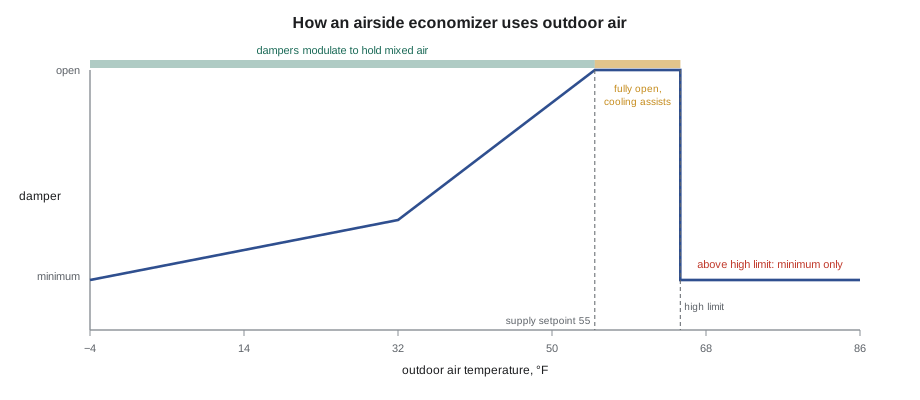
Economizers save a great deal of energy when they work and waste a great deal when they do not. Studies of rooftop units have repeatedly found that a large share of economizers are broken: stuck dampers, failed actuators, disconnected linkages, failed sensors or wrong settings. A damper stuck open in winter wastes heating and can freeze coils; one stuck closed in spring wastes cooling. Checking economizer operation is a basic part of commissioning and service, and BAS-120 shows how to test the dampers and sensors.
Common mistakes
MistakeTrusting a single-point mixed air sensor in a stratified mixing box.
InsteadUse an averaging sensor and check the outdoor air fraction from three temperatures.
MistakeTreating a freeze stat trip as a nuisance and raising its setting.
InsteadFind out why the air was cold: stratification, a closed preheat valve or too much outdoor air.
MistakeAssuming a running motor means a running fan.
InsteadProve airflow with a pressure switch or a current switch set to catch a broken belt.
MistakeIgnoring a sudden drop in filter pressure.
InsteadCheck for a blown-out filter or an open door.
MistakeLeaving a humidifier able to run without airflow.
InsteadInterlock it with fan proof and a duct high-limit humidity sensor.
MistakeAssuming the economizer works because it is in the program.
InsteadWatch the dampers move and check the sensors and changeover logic.
Summary and key terms
- An AHU mixes outdoor and return air, filters it, heats or cools it, may humidify it and fans it to the spaces.
- Outdoor, return and exhaust dampers control the air paths; the minimum outdoor air is set by ventilation needs.
- Mixed air temperature reveals the outdoor air fraction: (return − mixed) ÷ (return − outdoor).
- Filters are rated by MERV; a differential pressure sensor shows when they need changing.
- Freeze stats protect water coils and are hard-wired safeties.
- Cooling coils dehumidify; their drain pans and traps need regular checking.
- Supply fan speed on a VAV system holds a duct static pressure setpoint; every fan needs a proof of operation.
- An economizer uses cool outdoor air for free cooling and must be checked, because many fail.
- Air handling unit (AHU)
- A unit that mixes, filters, heats, cools and moves air through ducts to the spaces it serves.
- Mixing box
- The section of an AHU where outdoor air and return air meet.
- Minimum outdoor air
- The least outdoor air an AHU may bring in while the building is occupied.
- Stratification
- Layers of air at different temperatures traveling without mixing.
- MERV
- Minimum Efficiency Reporting Value, a filter efficiency rating from 1 to 16.
- Freeze stat
- A low-temperature safety that stops the fan before air cold enough to freeze a water coil passes through it.
- Duct static pressure
- The pressure in a supply duct, used to control a VAV supply fan.
- Economizer
- Controls and dampers that use cool outdoor air for cooling instead of mechanical refrigeration.
- Enthalpy
- The total heat content of air, counting both temperature and moisture.
Practice problems
Work each problem on paper first, then reveal the answer to check.
Return air is 72 °F, outdoor air is 32 °F and mixed air is 60 °F. What is the outdoor air fraction?
Show answer
(72 − 60) ÷ (72 − 32) = 0.30, or 30 in 100.
Why are mixed air sensors usually averaging elements?
Show answer
Outdoor and return air often stratify, so a single point can read far from the average.
What does a rising filter differential pressure mean?
Show answer
The filter is loading with dirt and will soon need changing.
Why is a current switch on a fan motor not always enough proof?
Show answer
It may not catch a broken belt, so the switch must be set to detect the lower current of an unloaded motor, or airflow must be proved.
In what outdoor conditions does an economizer modulate the dampers to hold mixed air temperature?
Show answer
When the outdoor air is colder than the supply air setpoint.
Lesson quiz · 5 questions
Score 60% or more to complete this lesson.
Create a free account to save your progress, take quizzes and earn a certificate.