
BAR-251 · Lesson 7 of 12 · 21 min
Wyoming courts and civil procedure
▶ Video coming soon A video version of this lesson is on the way.
The first file Kenna's supervising partner, Ardith Duvall, handed her was a small one: a rancher near Kaycee wanted to sue a trucking company for 38,000 dollars in fence and livestock losses after a jackknifed trailer went through his pasture. 'Which court?' Ardith asked. Kenna started to say district court, then stopped. 'It is under fifty thousand,' she said. 'Circuit court.' Ardith nodded. 'Now tell me where an appeal goes.'
This lesson describes the Wyoming court system, how judges are selected, the Wyoming Rules of Civil Procedure and their relationship to the federal rules, limitations periods and appeals, the federal court in Wyoming and the place of tribal courts on the Wind River Reservation. The bar exam tests federal procedure; this lesson is for practice.
The structure of the courts
Wyoming has a simple court structure with no intermediate appellate court. At the top is the Supreme Court of Wyoming, which sits in Cheyenne with five justices. Because there is no court of appeals between it and the trial courts, the Supreme Court hears appeals as of right from the district courts, and it decides a large share of the state's appeals itself. It also regulates the practice of law, adopts procedural rules and supervises the lower courts.
The district courts are Wyoming's trial courts of general jurisdiction. There are 23 of them, one in each county, grouped into nine judicial districts. They hear civil cases above the circuit court limit, felony criminal cases, family cases including divorce and custody, probate, juvenile and adoption matters, and appeals from the circuit courts and from administrative agencies.
The circuit courts are trial courts of limited jurisdiction. There are also 23 of them, with the same county boundaries and grouped in the same nine districts. They hear civil claims under 50,000 dollars, small claims, misdemeanors, traffic citations and DWUI cases, and they handle preliminary matters in felony cases, such as initial appearances and preliminary hearings, before the case moves to district court. The rancher's 38,000-dollar claim belongs in circuit court, though a plaintiff can always file a larger claim in district court instead.
Municipal courts hear violations of city and town ordinances. Their decisions may be appealed to the district court.
Wyoming also has a Chancery Court, created by the legislature in 2019 as a statewide court for certain business, commercial and trust disputes. It hears cases without a jury and is designed to give commercial litigants faster, specialized decisions. A lawyer considering it should check the current statute for which cases qualify and how a case gets there.
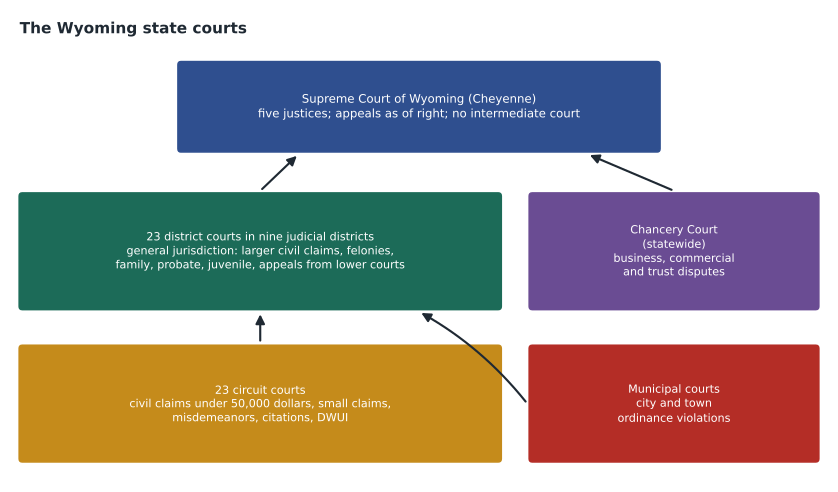
| Court | Number | Main jurisdiction |
|---|---|---|
| Supreme Court of Wyoming | One; five justices | Appeals as of right from district courts; rules and lawyer regulation |
| District courts | 23 courts in nine judicial districts | General jurisdiction: larger civil claims, felonies, family, probate, juvenile, appeals from lower courts and agencies |
| Chancery Court | Statewide | Certain business, commercial and trust disputes, without a jury |
| Circuit courts | 23 courts in the same nine districts | Civil claims under 50,000 dollars, small claims, misdemeanors, citations, DWUI |
| Municipal courts | In cities and towns | Ordinance violations |
How judges are selected
Wyoming uses a merit selection system for its supreme court and district court judges, and for circuit court judges. When a vacancy occurs, a judicial nominating commission reviews applicants and sends the governor a short list, from which the governor appoints. After serving for a period, the judge stands for a retention election in which voters decide whether to keep the judge, without an opposing candidate. Wyoming adopted this approach by constitutional amendment in the 1970s. Municipal judges are appointed locally.
For a new lawyer the practical point is that Wyoming judges are not partisan candidates, and the bench is small. A lawyer who practices in a county will appear before the same district and circuit judges again and again, which makes reputation and candor with the court especially valuable.
The Wyoming Rules of Civil Procedure
The Wyoming Rules of Civil Procedure are adopted by the Supreme Court and are closely modeled on the Federal Rules of Civil Procedure. The Court substantially revised them in 2017 to bring them into line with the federal rules as amended through that time, so a lawyer who learned federal procedure for the bar exam will recognize most of the Wyoming rules by number and content: pleadings, joinder, discovery, summary judgment and trial practice all follow the federal model. Wyoming has a separate set of rules for the circuit courts, and the Uniform Rules for District Courts supply local practice details.
The differences that matter in practice are state-specific. Wyoming's district courts have general jurisdiction, so the subject-matter questions that dominate federal procedure, such as diversity and federal question jurisdiction, do not arise in the same way. Venue is set by Wyoming statute and the rules, generally tying a case to the county where a defendant resides or where the claim arose. Service of process follows Rule 4, which allows personal service and other methods similar to the federal rule. Disclosure and discovery follow the federal model of initial disclosures and proportional discovery, with timing and scheduling set by local practice and court order.
Wyoming's long-arm statute allows its courts to exercise jurisdiction on any basis not inconsistent with the Wyoming or United States Constitution, which means personal jurisdiction questions in Wyoming come down to federal due process analysis. That is one point where bar exam learning on minimum contacts carries straight into practice.
Limitations periods
Wyoming's limitations periods are set mainly in Title 1 of the Wyoming Statutes. The general period for many injury claims not arising from contract is four years under W.S. 1-3-105. Other claims have their own periods: claims based on written contracts have a longer period, professional negligence claims including medical malpractice generally have shorter periods with discovery rules, and wrongful death claims have their own statute. Claims against governmental entities require a written notice of claim within two years under the Governmental Claims Act, a requirement explained in lesson 8. A careful lawyer checks the specific statute for each claim at intake rather than relying on a general rule.
Kenna's rancher's claim, arising from property damage in 2026, was well within the four-year period. Ardith still had her calendar the outside date in the file on the first day. 'Every file gets a limitations date on intake,' she said. 'Not because you plan to wait, but because you might not be the one who handles it next year.'
Appeals
Because Wyoming has no intermediate appellate court, an appeal from a final judgment of a district court goes directly to the Supreme Court of Wyoming. The Wyoming Rules of Appellate Procedure govern the process, which begins with a notice of appeal filed in the district court within a short period after entry of the judgment; the standard period is 30 days, and a lawyer should check the rules for exceptions and for the effect of post-trial motions. Appeals from circuit courts and municipal courts go first to the district court, which acts as an appellate court for those cases. Review of some orders that are not final, and of certain agency decisions, is available through petitions and other procedures set out in the appellate rules.
The Supreme Court's opinions are the main source of Wyoming case law. They are published in the Pacific Reporter and, since 2001, with a public domain citation in the form year WY number.
Federal court in Wyoming
The United States District Court for the District of Wyoming is the state's only federal district court, with courthouses in Cheyenne and Casper and other locations. Appeals go to the Tenth Circuit Court of Appeals in Denver. Federal practice is a large part of Wyoming law because so much of the state is federal land: national parks and forests, Bureau of Land Management lands, and mineral leases on federal property generate litigation under federal environmental, mining and public lands law. A new Wyoming lawyer who handles natural resources or ranching matters will meet federal agencies early.
Admission to the federal district court requires a separate application to that court, and lawyers admitted in Wyoming are generally eligible to apply.
Tribal courts and the Wind River Reservation
The Wind River Reservation in central Wyoming is home to the Eastern Shoshone and Northern Arapaho Tribes. The tribes have their own court, which hears civil and criminal matters arising within the reservation under tribal law and federal law. Jurisdiction in Indian country is divided among tribal, federal and state courts by a body of federal law that depends on where the events occurred, whether the parties are tribal members and the type of case. Federal courts have also had to decide disputed boundary questions; in 2017 the Tenth Circuit held that the city of Riverton is not within the reservation for purposes of federal environmental law.
A Wyoming lawyer whose client has a dispute with any connection to the reservation should start by identifying which court has jurisdiction, and should be prepared to research tribal codes and federal Indian law. The bar exam does not test this, but Wyoming practice can.
Worked problem
Choosing the court
A hypothetical client, Hartsell, was injured in Gillette when a contractor's truck backed into her parked car. Her medical bills and lost wages total 85,000 dollars. A second hypothetical client, Ferrell, is owed 12,000 dollars by a supplier in Sheridan.
Show solution
- Hartsell's claim exceeds the 50,000-dollar circuit court limit, so it belongs in the district court in Campbell County, where the accident occurred.
- Ferrell's claim is under 50,000 dollars, so it may be filed in circuit court; a very small claim might use small claims procedures.
- Each file needs a limitations date: for Hartsell, the four-year period in W.S. 1-3-105 for injury claims; for Ferrell, the period for the type of contract involved.
- An appeal from Hartsell's district court judgment would go directly to the Supreme Court of Wyoming; an appeal in Ferrell's circuit court case would go first to the district court.
Answer: Hartsell files in district court; Ferrell in circuit court; each file is calendared for limitations at intake.
Common mistakes
MistakeWyoming has an intermediate court of appeals.
InsteadThere is none; district court appeals go directly to the Supreme Court of Wyoming.
MistakeThe circuit courts hear civil claims of any size.
InsteadCircuit courts hear civil claims under 50,000 dollars; larger claims go to district court.
MistakeWyoming civil procedure is completely different from federal procedure.
InsteadThe Wyoming Rules of Civil Procedure are closely modeled on the federal rules.
MistakeWyoming judges run in partisan elections.
InsteadWyoming uses merit selection and retention elections.
MistakeState courts always have jurisdiction over events on the Wind River Reservation.
InsteadJurisdiction is divided among tribal, federal and state courts under federal Indian law.
Practice problems
Work each problem on paper first, then reveal the answer to check.
How many judicial districts does Wyoming have?
Show answer
Nine, containing 23 district courts and 23 circuit courts.
What is the circuit court civil limit?
Show answer
Claims under 50,000 dollars.
Where does an appeal from a district court judgment go?
Show answer
Directly to the Supreme Court of Wyoming.
What is the general limitations period for many injury claims?
Show answer
Four years under W.S. 1-3-105.
Which federal circuit covers Wyoming?
Show answer
The Tenth Circuit.
Pleading and discovery in practice
Ardith Duvall gave Kenna three pieces of practical advice for her first Wyoming filings. First, use the current forms and rules. The Wyoming Judicial Branch publishes the rules of civil procedure, the uniform rules for district courts and the circuit court rules, and the clerk's office in each county can answer questions about local practice, such as how hearings are set. Second, plead facts. Because the Wyoming rules follow the federal model, a complaint should state enough facts to show a plausible claim, not just conclusions, and a defense lawyer should expect motions testing the sufficiency of the pleadings. Third, take discovery planning seriously. Initial disclosures, proportional discovery and scheduling orders mean that a case's shape is often set in its first months.
In circuit court the pace is faster and the procedures simpler. Many small civil claims are resolved quickly, and some parties represent themselves. A new lawyer should still prepare as carefully as in district court, because circuit court judgments are enforceable in the same way and an appeal goes only to the district court.
Practice in a small bar
Wyoming's size shapes courtroom practice. In many counties there is one district judge, a few circuit judges and a small group of lawyers who see each other in every case. Courtesy, punctuality and candor travel quickly through a small bar, and so do lapses. Ardith's advice was to treat every opposing lawyer as someone she would face again next month, because she would.
Distance also matters. A lawyer in Casper may have hearings in Douglas, Lander and Gillette in the same week, and winter roads can close without warning. Many Wyoming courts allow remote appearances for some hearings, and lawyers should know the local practice and ask early when travel is uncertain. Missing a hearing because of a closed highway is understandable once; missing it because no one called the court is not.
Where to find Wyoming law
Wyoming statutes are published by the Legislative Service Office, the Supreme Court's opinions are available on the Judicial Branch website and in the Pacific Reporter, and the court rules are collected on the Judicial Branch website. The Wyoming State Bar's publications and CLE programs are the main sources of practical guidance on local practice. A new lawyer should bookmark all of them on the first day.
Summary and key terms
- The Supreme Court of Wyoming, with five justices, hears appeals as of right; there is no intermediate appellate court.
- District courts (23, in nine districts) have general jurisdiction; circuit courts handle civil claims under 50,000 dollars, small claims and misdemeanors.
- A statewide Chancery Court hears certain business, commercial and trust disputes without a jury.
- Judges are chosen by merit selection and retained by voters.
- The Wyoming Rules of Civil Procedure closely follow the federal rules; the long-arm statute reaches to constitutional limits.
- Limitations periods vary by claim; many injury claims have four years under W.S. 1-3-105.
- Circuit court
- A Wyoming trial court of limited jurisdiction for civil claims under 50,000 dollars, small claims and misdemeanors.
- District court
- A Wyoming trial court of general jurisdiction, one in each county.
- Chancery Court
- Wyoming's statewide court for certain business, commercial and trust disputes, without a jury.
- Retention election
- An election in which voters decide whether a sitting judge remains in office.
- Long-arm statute
- A statute permitting jurisdiction over out-of-state defendants, in Wyoming to the limits of due process.
Lesson quiz · 5 questions
Score 60% or more to complete this lesson.
Create a free account to save your progress, take quizzes and earn a certificate.