
BAR-251 · Lesson 4 of 12 · 20 min
The Wyoming bar exam: the UBE, scoring and the 270 passing score
▶ Video coming soon A video version of this lesson is on the way.
Kenna had been told two different things about the Wyoming exam. A classmate said it was 'just the UBE, nothing Wyoming about it.' A lawyer at her firm said 'Wyoming grades its own essays, so it is not quite the same as anywhere else.' Hollis said both were right, and that understanding why is the key to scoring well.
This lesson explains the structure of the Uniform Bar Examination as given in Wyoming, how it is graded and scaled, what the 270 passing score means, how scores are reported and reviewed, and how a candidate should translate the scoring rules into a study plan. February 2027 is the last time Wyoming will give this exam; lesson 5 covers the NextGen exam that replaces it.
The structure of the exam
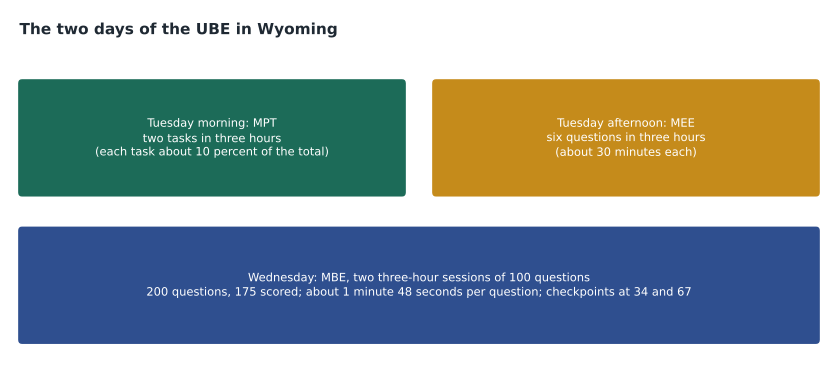
Wyoming gives the UBE over two days, on the last Tuesday and Wednesday of February and July. The first day is the written day. The morning session is the Multistate Performance Test, two tasks in three hours. The afternoon session is the Multistate Essay Examination, six essay questions in three hours. The second day is the Multistate Bar Examination, 200 multiple-choice questions in two sessions of three hours each. Of the 200 MBE questions, 175 are scored and 25 are unscored pretest questions that look exactly like the others.
All three components are written by NCBE. The MPT gives the examinee a File of facts and a Library of law and asks for a practical lawyering task such as an objective memo, a persuasive brief, a client letter or a demand letter. The MEE asks the examinee to identify and analyze issues in fact patterns drawn from a defined list of subjects. The MBE tests the same core subjects in multiple-choice form.
What the MEE covers from July 2026
NCBE narrowed the MEE beginning with the July 2026 exam to align it with the NextGen exam. Four subjects were removed: conflict of laws, family law, trusts and estates, and secured transactions. From July 2026 the MEE covers business associations (agency and partnership, corporations and limited liability companies), civil procedure, constitutional law, contracts including Article 2 of the UCC, criminal law and procedure, evidence, real property and torts. During the transition, family law and trusts and estates may still appear on the MPT, where the Library supplies the governing law.
Kenna's February 2027 exam follows the narrowed list. Hollis told her to check every practice set she used: older commercial MEE books still include essays on the removed subjects, and those essays are now wasted study time for the essay portion. The removed subjects are not wasted for Wyoming practice, though. Lesson 9 covers Wyoming family law and estates because a new Wyoming lawyer will meet them in the first month.
How the exam is weighted
The three components are weighted by NCBE's UBE formula, which Wyoming's Rule 211 repeats: the MBE counts for 50 percent of the total score, the MEE for 30 percent and the MPT for 20 percent. Because the MPT tasks are long and the MEE has six questions, a single MPT task carries more weight than a single MEE answer. Each MPT task is worth 10 percent of the total, while each MEE answer is worth 5 percent.
Who grades and how scores are scaled
NCBE scores the MBE centrally. Wyoming grades the written components itself: the admission rules require the Board of Law Examiners to meet at least twice a year to grade the MEE and MPT, using NCBE's grading materials and the calibration NCBE provides to graders. That is what Kenna's colleague meant when he said Wyoming grades its own essays. Graders compare answers to one another and assign relative grades, typically on a short scale, rather than measuring answers against a fixed checklist.
Raw written grades are then scaled to the MBE. Scaling places the written scores on the same scale as the MBE scores of the same group of examinees, so that an examinee's written score reflects how well the examinee did relative to the group, adjusted for the group's overall ability as measured by the MBE. Scaling is what makes a UBE score portable: a 270 earned in Wyoming means the same thing as a 270 earned in another UBE jurisdiction, even though each jurisdiction grades its own essays.
The total UBE score is reported on a 400-point scale, combining the scaled MBE score and the scaled written score according to the weights. Exams are graded anonymously until grading is complete; Rule 206 requires it.
The 270 passing score
Wyoming's passing score on the UBE is a total scaled score of 270 or more, earned in a single administration. That is one of the higher UBE passing scores; several jurisdictions pass at 260 or 266, and the highest UBE passing score in use is 270. Wyoming does not accept a transferred MBE score in place of sitting the MBE, and it does not combine components from different sittings.
The 270 standard has two practical effects. First, a Wyoming examinee needs a solid performance across all three components; there is little room to rely on a strong MBE to rescue weak written answers, or the reverse. Second, a Wyoming passing score transfers to every UBE jurisdiction, because no jurisdiction requires more than 270. A candidate who might move within a few years can treat a Wyoming pass as a portable credential.
| Item | Wyoming rule |
|---|---|
| Passing score | 270 total scaled score in a single administration |
| Weights | MBE 50 percent, MEE 30 percent, MPT 20 percent |
| Written grading | Board of Law Examiners, at least twice a year, using NCBE materials |
| Transferred MBE score | Not accepted |
| Laptop | Permitted for the MEE and MPT with registration and the prescribed software |
| Last legacy UBE | February 2027 |
Results and review
The Board releases results after grading and scaling are complete; the date varies with each administration, so candidates should check the Board's notices. A successful examinee whose MPRE score and character and fitness file are complete then moves toward certification and admission.
Under Rule 212, an applicant who fails may review the applicant's own answers and the exam analysis at the Wyoming State Bar office. Other review, such as a request to rescore the MBE, follows NCBE's policies. Hollis encouraged anyone who fails to use the review: reading one's own MEE answers next to the analysis is the fastest way to see whether the problem was knowledge, organization or time.
Exam day in Wyoming
The admission rules treat the exam seriously. By sitting the exam, an applicant is deemed to swear that the applicant has received no advance knowledge of the questions and no outside assistance. The Board appoints monitors to keep order and prevent cheating, and misconduct leads to disqualification and possible referral to the Character and Fitness Committee. The Board publishes rules on what may be brought into the room, and examinees should read the current notice rather than relying on what was permitted at another state's exam.
Pacing is the skill that matters most on the day. In the MPT session the two tasks share three hours, so a candidate who spends 110 minutes on the first task has 70 left for the second. In the MEE session six essays share three hours, which means 30 minutes each. On the MBE each three-hour session has 100 questions, or about one minute and 48 seconds per question. Hollis gave Kenna checkpoints to write on her scratch paper: question 34 by the end of the first hour and question 67 by the end of the second.
Kenna asked about travel. Many Wyoming examinees drive several hours to reach the exam site, and February roads can close for wind and snow. Hollis's advice was blunt: arrive the day before, book a room close to the site, check road conditions the night before and carry the admission materials and identification in a bag that never leaves the car until the morning of the exam.
Why 270 is not the target
Candidates sometimes treat the passing score as the goal. Hollis warned against that. A candidate whose practice performance sits right at 270 has roughly even odds on the day, because a hard essay set or a slow MPT can move the score several points. The real target is a practice level comfortably above 270. For Kenna, whose early practice scores suggested an MBE around 136 and written work in the high 130s, the plan was to push both components up a few points and to spend extra time on the MPT, where each task is worth twice as much as an essay.
Worked problem
Where do the points come from?
A hypothetical examinee, Burkhart, earns a scaled MBE score of 139 and a scaled written score of 129 on the 200-point scales that combine into the 400-point total. His written work was strong on the MEE but he ran out of time on the second MPT task.
Show solution
- On a 400-point scale, the MBE contributes half and the written components the other half, so his total is about 139 plus 129, or 268.
- He needed 270, so he failed by about two points.
- Because each MPT task is worth about 10 percent of the total, finishing the second task with a passable answer would likely have added more than the two points he needed.
Answer: Burkhart's best route to passing is time management on the MPT, not more MBE drills.
Common mistakes
MistakeWyoming writes its own essays.
InsteadNCBE writes the MEE and MPT; Wyoming's Board grades them using NCBE materials.
MistakeThe MEE still tests family law and trusts and estates.
InsteadThose subjects, along with conflict of laws and secured transactions, left the MEE in July 2026.
MistakeA strong MBE score can be carried over from another state.
InsteadWyoming does not accept transferred MBE scores; the whole UBE must be taken in one administration.
MistakeEach MEE answer counts as much as an MPT task.
InsteadEach MPT task is worth about twice as much as a single MEE answer.
MistakeA Wyoming 270 transfers only to states that pass at 270.
InsteadA 270 meets every UBE jurisdiction's passing score.
Practice problems
Work each problem on paper first, then reveal the answer to check.
What is Wyoming's UBE passing score?
Show answer
A total scaled score of 270 in a single administration.
How are the UBE components weighted?
Show answer
MBE 50 percent, MEE 30 percent, MPT 20 percent.
Who grades the MEE and MPT in Wyoming?
Show answer
The Board of Law Examiners, using NCBE grading materials.
Which four subjects left the MEE in July 2026?
Show answer
Conflict of laws, family law, trusts and estates, and secured transactions.
What review does Rule 212 allow after a failing result?
Show answer
Review of the applicant's own answers and the exam analysis at the Wyoming State Bar office.
Reading a score report
Hollis spent part of the session explaining how to read a UBE score report, because candidates who fail often misread theirs. A report shows the scaled MBE score, the scaled written score and the total. The scaled MBE and written scores are each on a 200-point scale, and the total is their combination on the 400-point scale. Because the MBE carries 50 percent and the written components together carry 50 percent, the total is simply the sum of the two scaled scores. An examinee with a scaled MBE of 136 and a scaled written score of 132 has a total of 268, two points short of Wyoming's 270.
Some jurisdictions also report raw written grades for each MEE and MPT answer. Raw grades show where points were lost relative to other examinees on the same administration, which is useful for planning a retake. A low grade on one MPT task matters more than a low grade on one MEE answer, because the MPT task carries twice the weight.
Using practice scores
Practice scores are rough guides, not predictions. A practice MBE score from a commercial course may be scaled differently from the real exam, and self-graded essays are notoriously generous. Hollis told Kenna to rely on three signals instead of any single number: her percentage correct on official NCBE practice questions, which is the closest match to real MBE difficulty; the grades a neutral reader gave her timed MEE and MPT answers; and whether she finished every timed set on time. A candidate who scores well in untimed practice but runs out of time in timed sets has a pacing problem, and pacing problems cost more points on the real exam than gaps in knowledge.
Kenna's early numbers suggested an MBE around 136 and written work in the high 130s, which put her near 270 but not safely above it. Her plan was to raise each by a few points through weekly timed sets and to protect her MPT score by practicing the first fifteen minutes of each task, the reading and outlining phase where most examinees lose time.
A word about the last legacy exam
Because February 2027 is the last UBE in Wyoming, commercial courses and older study materials will soon shift to NextGen. A February 2027 candidate must make sure every practice set is a legacy UBE set using the narrowed MEE subject list. NextGen practice questions test different formats and may leave out material the legacy exam still covers.
Summary and key terms
- Day one is the MPT (two tasks, three hours) and the MEE (six questions, three hours); day two is the MBE (200 questions, 175 scored).
- The weights are MBE 50, MEE 30 and MPT 20 percent; each MPT task is worth about twice an MEE answer.
- Wyoming's Board grades the written components; scores are scaled to the MBE and reported on a 400-point scale.
- Wyoming passes at 270 in a single administration and does not accept transferred MBE scores.
- From July 2026 the MEE no longer tests conflict of laws, family law, trusts and estates or secured transactions.
- February 2027 is Wyoming's last legacy UBE.
- UBE
- The Uniform Bar Examination, made up of the MBE, MEE and MPT and producing a portable score.
- Scaling
- Placing written scores on the MBE scale so that scores mean the same thing across administrations and jurisdictions.
- Pretest questions
- The 25 unscored MBE questions used to test future items.
- MPT
- The Multistate Performance Test, a practical task using a File and a Library.
- Legacy UBE
- The current UBE, which Wyoming gives for the last time in February 2027.
Lesson quiz · 5 questions
Score 60% or more to complete this lesson.
Create a free account to save your progress, take quizzes and earn a certificate.