
BAR-251 · Lesson 2 of 12 · 21 min
Eligibility, education, application deadlines and fees
▶ Video coming soon A video version of this lesson is on the way.
Kenna's first worry after filing was a small one. 'My dean's office says the certificate goes out in December,' she wrote to Hollis. 'My application went in on November 6. Is it complete?' Hollis's reply became the outline of this session: Wyoming's eligibility rules are short, but the filing rules are strict, and the difference between a complete and an incomplete application can cost a candidate an entire exam cycle.
This lesson covers who may sit the Wyoming exam, what education counts, the filing deadlines, the fees, the documents in the application packet, testing accommodations, retakes and the limit on attempts.
Who may sit the exam
The admission rules set two basic eligibility requirements for admission by examination. The applicant must be an adult, and the applicant must hold a Juris Doctor degree from a law school accredited by the American Bar Association. Wyoming statute repeats the education requirement. There is no alternative route for graduates of law schools that are not ABA-accredited, for graduates of foreign law schools, for law office study or for a degree earned online from an unaccredited program. NCBE's Wyoming chart confirms that foreign law graduates are not eligible to sit in Wyoming.
That rule is stricter than in some neighboring states, which allow foreign-educated lawyers to qualify through an LLM or years of practice. A lawyer educated abroad who wants a Wyoming license must first earn a JD from an ABA-accredited school. A graduate of a non-ABA school who passed the bar exam and practiced in another state is likewise not eligible, either by examination or on motion, because the motion rules also require the ABA-accredited JD.
A final-year student may apply before graduating. The dean's certificate must show the JD from an ABA-accredited school, and the dean sends it directly to the Admissions Director under separate cover rather than through the applicant. Kenna's degree was conferred in May 2026, so her dean's office simply needed to issue the certificate; the application packet itself was complete when she filed, because the dean's certificate travels separately. Hollis advised her to confirm by email with the Admissions Director in early December that it had arrived.
Filing deadlines
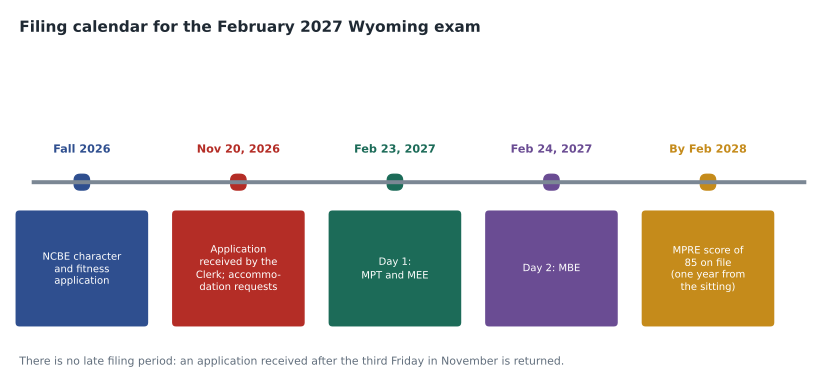
Wyoming gives the UBE twice a year, in February and July, on the last Tuesday and Wednesday of the month. The rules tie the filing deadlines to the calendar rather than to fixed dates. An application for a February exam must be received by the third Friday in November of the preceding year. An application for a July exam must be received by the third Friday in April. For the February 23-24, 2027 exam, the deadline was Friday, November 20, 2026.
The word that matters is received. The rules state that postmarks, faxes and emails are not accepted, and the filing instructions add that applications received after the deadline, regardless of postmark, will be returned. Wyoming does not have a late filing period with a late fee, which many other jurisdictions offer. A candidate who misses the deadline does not pay extra to get in; the candidate waits for the next exam.
Hollis suggested a working rule: treat the deadline as two weeks earlier than it is. Mail can be slow between smaller towns and Cheyenne, documents such as a certificate of good standing take time to obtain, and a filing that is returned as incomplete must be refiled before the deadline to count. Kenna mailed her packet with tracking from Casper and watched it arrive at the Clerk's office two days later.
| Exam | Exam days | Application must be received by |
|---|---|---|
| February 2027 | Tuesday February 23 and Wednesday February 24, 2027 | Friday November 20, 2026 (third Friday in November) |
| July 2027 (first NextGen) | Last Tuesday and Wednesday of July 2027 | Third Friday in April 2027 |
| Any exam | Last Tuesday and Wednesday of February or July | Third Friday in November (February) or April (July); no late period |
Fees
The Wyoming application fee for admission by examination is 600 dollars, paid by personal check or money order to the Clerk of the Wyoming Supreme Court. It is not refundable. The filing instructions warn that checks may take several weeks to clear, so a candidate should not close the account the check is drawn on. Separately, the applicant pays NCBE's background investigation fee directly to NCBE when submitting the NCBE character and fitness application; that fee is set by NCBE and changes from time to time. A candidate who types the written portions on a laptop also pays a fee to the exam software vendor shortly before the exam.
The 600-dollar Wyoming fee covers more than one sitting. The filing instructions say an applicant may register for two examinations without paying an additional Wyoming application fee. After that, the applicant must reapply with a new Wyoming fee and a supplemental NCBE application. The admission rules frame the same idea from the applicant's side: an applicant who fails may request to sit a second exam within one year without a new fee, filing the request by May 1 for a July exam or December 1 for a February exam.
The application packet
The filing instructions list the documents that must be in the packet when it reaches the Clerk. Missing items are the most common reason applications are returned. The packet includes the original Petition and Application for Admission by Examination; the original, notarized Wyoming Authorization and Release; a color photocopy of the front of the applicant's driver's license or passport; the 600-dollar check or money order; a copy of the completed NCBE Character and Fitness Application; and, for an applicant already admitted elsewhere, a certificate of good standing from the highest court of each state where the applicant currently practices, issued no more than 90 days before filing. The dean's certificate comes separately from the law school.
Two details trip people up. First, the certificate of good standing must come from the highest state court, not from a state bar association. A letter from a bar association describing discipline history is not a substitute, and a bar association letter is accepted only with prior approval from the Clerk. Second, the documents must be originals where the checklist says originals; photocopies of the petition or the release are returned.
| Item | Detail |
|---|---|
| Petition and Application | Original, signed; the rules in effect on filing govern |
| Authorization and Release | Original, notarized |
| Identification | Color copy of driver's license or passport |
| Fee | 600 dollars to the Clerk of the Wyoming Supreme Court; nonrefundable |
| NCBE character and fitness application | Copy in the packet; NCBE fee paid to NCBE |
| Certificate of good standing | Only if admitted elsewhere; from the highest court; issued within 90 days |
| Dean's certificate | Sent directly by the law school to the Admissions Director |
After filing, the application is a continuing one. An applicant must tell the Admissions Director about changes in name, residence, employment, contact information or status in other jurisdictions, using the Amendment to Application form. A new arrest, lawsuit or debt problem after filing must also be reported. Failing to update the application is itself a character and fitness concern.
Testing accommodations
An applicant with a disability may request reasonable testing accommodations. The request and supporting documentation are due by the application deadline, so a February examinee must have the request in by the third Friday in November. The rules allow emergency requests for conditions that arise after the deadline, but not fewer than seven days before the exam. An applicant whose request is denied may seek review by the Supreme Court within fifteen days. Hollis's advice was to gather documentation early: recent evaluations, a history of accommodations in law school and on the LSAT or MPRE, and a clear statement of the accommodation requested and why.
Using a laptop
Applicants may type the MEE and MPT on their own computers if they register, use the software the Board prescribes, meet the equipment requirements and accept the risks of technology failure. The MBE is answered on the answer sheet or in the format NCBE provides. Kenna registered for the laptop option. Hollis told her to install the software early, run the practice exam on the same machine and practice handwriting one MEE answer anyway, in case the laptop fails on the day.
Retakes and the attempt limit
Wyoming limits attempts. Under Rule 201, an applicant who has failed the UBE four times may not sit again in Wyoming unless the applicant makes a strong showing that the limit should be waived. The application form asks applicants who have already failed four or more times to explain, on a separate sheet, what they have done to improve their preparation. The limit counts failed attempts, so a candidate who withdraws before the exam has not used an attempt.
Hollis used the rule to make a broader point about planning. A candidate who fails in February 2027 will retake in July 2027 on the NextGen exam, not the UBE, because February 2027 is Wyoming's last legacy UBE. The fee rule allows the second sitting without a new Wyoming fee, but the content and format change. Lesson 5 describes what that means.
Worked problem
Is the packet complete?
A hypothetical applicant, Hollister, lives in Laramie and was admitted in Colorado in 2024. On November 18, 2026 he mails a petition, a photocopied authorization and release, a copy of his NCBE application, a 600-dollar check and a letter from the Colorado bar association describing his discipline history. His law school has not yet sent a dean's certificate.
Show solution
- The application must be received by November 20, 2026; mailing on November 18 is risky because only receipt counts.
- The authorization and release must be the original and notarized; a photocopy is returned.
- As a lawyer admitted elsewhere, he needs a certificate of good standing from the Colorado Supreme Court issued within 90 days; a bar association discipline letter does not substitute.
- The dean's certificate travels separately from the law school, so its absence from the packet is not by itself a defect, but it must arrive.
Answer: The packet is incomplete. Hollister should deliver it by hand or overnight service, include the notarized original release and the Colorado Supreme Court certificate, and confirm with his law school that the dean's certificate is on its way.
Common mistakes
MistakeA foreign lawyer with an LLM from a US school can sit in Wyoming.
InsteadWyoming requires a JD from an ABA-accredited school; an LLM does not qualify.
MistakeWyoming has a late filing period with a late fee.
InsteadThere is no late period; late applications are returned.
MistakeA state bar association's good standing letter is enough.
InsteadThe certificate must come from the highest state court and be issued within 90 days.
MistakeEvery retake requires a new Wyoming fee.
InsteadThe application covers two examinations; after that, reapplication with a new fee is required.
MistakeThere is no limit on attempts in Wyoming.
InsteadAfter four failed attempts, further sittings require a strong showing to waive the limit.
Practice problems
Work each problem on paper first, then reveal the answer to check.
When is the application due for a February exam?
Show answer
It must be received by the third Friday in November.
What is the Wyoming application fee?
Show answer
600 dollars, nonrefundable, payable to the Clerk of the Wyoming Supreme Court.
Who sends the dean's certificate?
Show answer
The law school dean sends it directly to the Admissions Director.
When are accommodation requests due?
Show answer
By the application deadline; emergency requests are not accepted fewer than seven days before the exam.
What happens after four failed attempts?
Show answer
The applicant may not sit again without a strong showing justifying a waiver.
Planning backward from the deadline
Hollis gave Kenna a simple method for any filing: start at the deadline and work backward. For the February 2027 exam the application had to be in the Clerk's hands by Friday, November 20, 2026. Allowing a week for mail and a cushion for a returned packet put the real target at November 6. The NCBE character and fitness application, which asks for every address, employer and school for many years and often takes weeks to complete, had to be submitted before that, because a copy of it goes into the Wyoming packet. Requests for documents from other offices, such as a certificate of good standing for an applicant already admitted elsewhere, had to go out early enough to arrive but late enough to fall within the 90-day window. And the notary appointment for the authorization and release had to be booked.
Working backward also reveals conflicts. A candidate taking the November MPRE should not plan to finish the NCBE application the same week. A candidate changing jobs in the fall should file the application after the move, or be ready to file an amendment right away. Kenna wrote her backward calendar on one page and taped it inside her study binder.
Common filing problems
Admissions staff in most jurisdictions see the same handful of problems, and Wyoming's filing instructions list several of them directly. The first is the missing highest-court certificate: an applicant admitted elsewhere sends a bar association letter instead. The second is an incomplete or missing NCBE character and fitness application. The third is photocopies where the checklist requires originals. The fourth is failing to use the checklist at all. Each of these causes the packet to be returned, and because Wyoming has no late period, a return close to the deadline can cost the applicant the exam.
Two quieter problems are inconsistency and silence. An application that lists different employment dates from the NCBE application invites questions. An applicant who moves, changes jobs or receives a citation after filing and does not file an amendment creates a candor issue. Hollis's rule was that every page of the Wyoming packet should match every page of the NCBE application, and that any change after filing should be reported the same week.
Summary and key terms
- Applicants must be adults with a JD from an ABA-accredited law school; foreign and non-ABA graduates are not eligible.
- Applications must be received by the third Friday in November (February exam) or April (July exam); there is no late period.
- The Wyoming fee is 600 dollars; NCBE's investigation fee is paid separately to NCBE.
- The packet must include originals, a notarized release, identification, the NCBE application copy and, if admitted elsewhere, a highest-court certificate issued within 90 days.
- Accommodation requests are due by the filing deadline.
- Four failed attempts bar further sittings unless the limit is waived on a strong showing.
- ABA-accredited JD
- A Juris Doctor degree from a law school accredited by the American Bar Association, required on every Wyoming route.
- Dean's certificate
- The law school's certification of the applicant's degree, sent directly to the Admissions Director.
- Certificate of good standing
- A certificate from the highest court of a state where the applicant is admitted, issued within 90 days of filing.
- Amendment to Application
- The form used to report changes to a pending application.
- Attempt limit
- The rule that four failed attempts bar further sittings absent a waiver.
Lesson quiz · 5 questions
Score 60% or more to complete this lesson.
Create a free account to save your progress, take quizzes and earn a certificate.