
BAR-251 · Lesson 10 of 12 · 21 min
Wyoming business entities, trusts, DAOs and the rules of professional conduct
▶ Video coming soon A video version of this lesson is on the way.
A software developer named Solveig Wexler called Duvall and Ostlund from Denver. She and a group of online collaborators wanted to form a Wyoming entity to hold the treasury of a project governed by token votes, and someone had told her Wyoming was the place to do it. The same week, a client's daughter asked whether her parents should move their family trust to Wyoming, and a car accident client asked what the firm would charge. 'Three questions,' Ardith said, 'and all three are about why lawyers from other states keep calling Wyoming.'
This lesson covers the Wyoming business and trust law that draws clients from elsewhere, including the LLC Act, DAO LLCs and DUNAs, Wyoming trusts and the Chancery Court, and then the Wyoming Rules of Professional Conduct, the contingent fee rules and lawyer discipline. The MEE tests business associations under general principles and the MPRE tests the ABA Model Rules; this lesson is for Wyoming practice.
The Wyoming LLC
Wyoming enacted the first limited liability company statute in the United States in 1977, and the LLC remains central to its business law. The current Wyoming Limited Liability Company Act, in chapter 29 of Title 17, is based largely on the revised uniform act. It allows member-managed and manager-managed LLCs, gives the operating agreement wide freedom to set governance and duties, and shields members and managers from personal liability for the company's obligations solely because of their status.
Wyoming LLCs are popular with out-of-state owners for several reasons: low filing and annual fees, no state corporate or personal income tax, privacy because the public filing need not list members, and creditor protection. Wyoming's act makes a charging order the exclusive remedy of a judgment creditor of a member against the member's interest, which means a creditor generally cannot seize the member's interest or force a sale. How far that protection reaches for a single-member LLC is a question a careful lawyer checks in the current statute and cases rather than assumes. Veil piercing remains available in appropriate cases, and the Wyoming Supreme Court has addressed when it applies to LLCs. A lawyer forming an LLC for a client should explain these features accurately rather than overselling them.
DAO LLCs
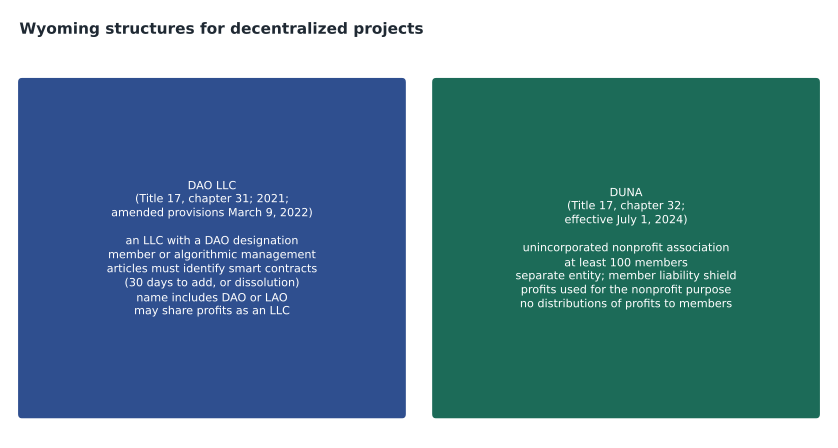
In 2021 Wyoming became the first state to provide a statutory framework for decentralized autonomous organizations. Wyoming's DAO supplement, in chapter 31 of Title 17, allows a DAO to organize as a Wyoming LLC with the additional designation of a decentralized autonomous organization. Amended provisions took effect March 9, 2022. The DAO supplement works alongside the LLC Act, so the LLC rules apply except where the supplement provides otherwise.
The supplement has distinctive features. A DAO may be managed by its members, algorithmically through smart contracts, or both, and its articles of organization must describe how members will manage it, including the extent to which management is algorithmic. The articles must include a publicly available identifier of any smart contract used to manage, facilitate or operate the DAO; if the identifier is omitted, the DAO has 30 days after filing to add it by amendment or it will be dissolved. The name must include DAO or LAO along with an LLC designation. The Secretary of State's guidance explains these filing requirements.
DUNAs
In 2024 Wyoming added a second structure, the decentralized unincorporated nonprofit association, or DUNA. The DUNA Act, in chapter 32 of Title 17, took effect July 1, 2024. It allows an association with at least 100 members to operate for a common nonprofit purpose with governance carried out partly or entirely through distributed ledger technology and smart contracts.
A DUNA is a separate legal entity for purposes of contracts and torts, and members and administrators are not personally liable for its contracts or torts merely because of their role. It may earn profits, but they must be used for or set aside for its nonprofit purpose; dividends and distributions of profits to members are prohibited, with exceptions such as reasonable compensation, benefits consistent with the purpose and distributions on winding up. If membership falls below 100, the association may face dissolution or convert to an ordinary unincorporated nonprofit association. Members owe no default fiduciary duty but are bound by the implied covenant of good faith and fair dealing.
For Wexler's project, Kenna outlined the choice. If the members wanted to share profits, a DAO LLC was the closer fit. If the project was a protocol run for a common purpose with many token holders and no profit distributions, a DUNA might fit. Either way, the firm would need to explain that Wyoming entity status does not settle questions of federal securities, tax or banking law.
Wyoming's interest in digital assets extends beyond entities. In 2019 the legislature authorized special purpose depository institutions, state-chartered banks focused on digital asset custody and related services, and it has passed several other digital asset statutes since. A new lawyer should treat this as a specialized field that changes often.
Wyoming trusts
The second caller's question reflects Wyoming's reputation as a trust jurisdiction. Wyoming has adopted a version of the Uniform Trust Code, in chapter 10 of Title 4, with several provisions designed to attract trust business. Wyoming allows trusts to last for up to 1,000 years, far longer than the traditional rule against perpetuities. It permits self-settled asset protection trusts, which Wyoming calls qualified spendthrift trusts, under which a settlor may be a beneficiary of a trust that is protected from many of the settlor's creditors if statutory conditions are met. It allows directed trusts, in which an advisor or committee directs the trustee on investments or distributions, and it authorizes private family trust companies. It has no state income tax.
These features do not make a Wyoming trust right for every family. A trust must have a real connection to Wyoming, usually a Wyoming trustee and administration in the state, and the law of the settlor's home state, federal tax law and fraudulent transfer rules all limit what a Wyoming trust can achieve. Kenna's advice to the caller's daughter was that moving a trust is a planning decision for the family's own lawyers, who should compare the terms of the existing trust, the home state's law and the cost of Wyoming administration.
The Chancery Court
Wyoming's Chancery Court, described in lesson 7, fits this picture. It was created to hear certain business, commercial and trust disputes without a jury, giving out-of-state businesses and trust companies a specialized forum. A Wyoming lawyer advising an entity or a trust should know whether a dispute could be filed there.
The Wyoming Rules of Professional Conduct
The Wyoming Rules of Professional Conduct for Attorneys at Law are adopted by the Supreme Court and follow the structure and numbering of the ABA Model Rules. Most of what a candidate learns for the MPRE applies in Wyoming: competence, diligence, communication, confidentiality, conflicts, safekeeping property, candor to the tribunal, fairness to opposing parties, communications with represented persons, advertising and misconduct. As in every state, the text differs from the Model Rules in places, and a Wyoming lawyer must read the Wyoming version of a rule before relying on it.
The most visible Wyoming difference is outside the numbered rules. Wyoming has a separate set of Rules Governing Contingent Fees for Members of the Wyoming State Bar, which apply alongside Rule 1.5 on fees.
The contingent fee rules
The contingent fee rules govern any agreement under which the lawyer's fee depends wholly or partly on the outcome. They forbid contingent fees in criminal matters and in divorce, annulment and legal separation, and in proceedings where a statute or regulation sets how fees are determined. Collection of commercial accounts and insurance subrogation claims made under usual practices are exempt from the writing and percentage rules.
Every other contingent fee agreement must be in writing, in duplicate, signed by the lawyer and each client, with a signed copy delivered to the client within a reasonable time. The lawyer keeps a signed copy and proof of delivery for three years after the matter ends. Agreements must contain the required provisions and be substantially in the form attached to the rules, the Representation Agreement, and the client must receive a copy of the rules with a full explanation when the agreement is signed. The form gives the client the right to rescind by written notice before the end of the third calendar day.
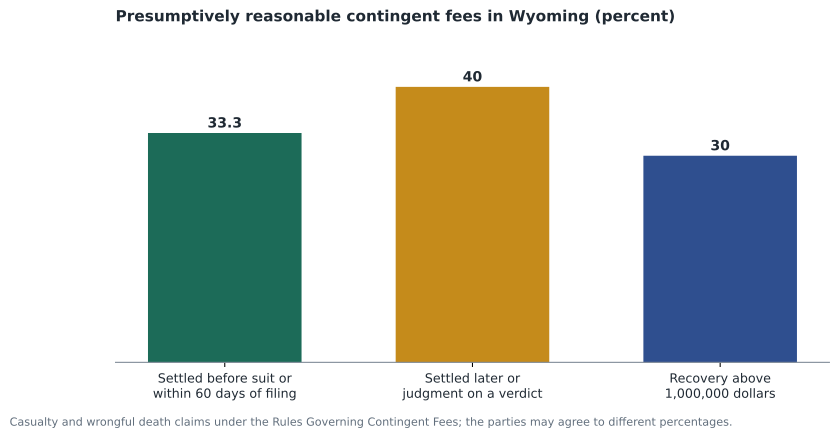
For casualty and wrongful death claims, the rules set presumptively reasonable percentages for total recoveries up to 1,000,000 dollars: one-third if the claim settles before suit or within 60 days after filing, and 40 percent if it settles more than 60 days after filing or goes to judgment on a verdict. For the part of a recovery above 1,000,000 dollars, 30 percent is presumed reasonable. Lawyers and clients may agree to different percentages, but the presumptions shape what is reasonable.
| Contingent fee rule | Requirement |
|---|---|
| Prohibited matters | Criminal matters; divorce, annulment and legal separation; matters where a statute sets fees |
| Writing | In writing, in duplicate, signed by lawyer and client; copy to the client; lawyer keeps a copy three years |
| Form | Substantially in the form of the Representation Agreement; client gets a copy of the rules, explained |
| Presumptive percentages (up to 1,000,000 dollars) | One-third before suit or within 60 days after filing; 40 percent after that or on a verdict |
| Above 1,000,000 dollars | 30 percent of the excess presumed reasonable |
| Fee sharing | Sharing lawyers liable as partners for malpractice; no fee merely for referral; terms disclosed in writing |
| Review | Fee dispute committee within 60 days after final distribution; district court review within 30 days of the decision |
The rules also address fee sharing. Lawyers who share a contingent fee are liable for each other's malpractice in the matter as if they were partners, only lawyers available to the client for consultation may share the fee, no one may receive a fee merely for referring a case, and the sharing terms must be disclosed to the client in writing. A client or lawyer may ask the bar's committee on fee disputes to review the reasonableness of a fee by applying within 60 days after final distribution of the proceeds, and either side may seek district court review of the committee's decision within 30 days.
Trust accounts and the integrated bar
Client money is handled under Rule 1.15 of the Wyoming rules and the state's trust account requirements, which include holding client funds in a separate trust account, keeping complete records and handling nominal or short-term funds through the IOLTA program. A new lawyer opening a practice should set up the trust account and record-keeping system before taking the first retainer.
Because the Wyoming State Bar is an integrated bar, membership, dues, CLE compliance and discipline all run through the Bar. Bar Counsel investigates complaints against lawyers and prosecutes discipline before the state's disciplinary board, with final decisions by the Supreme Court. Complaint volume has risen: the Bar's June 2026 board minutes reported 72 complaints already that year and an expectation of more than 150 for the year, compared with roughly 115 to 120 in prior years.
Worked problem
The car accident client's fee
Kenna's client, Shoshana Kittridge, was injured in a crash and wants to hire the firm on a contingent fee. She also asks whether the firm can handle her divorce on the same basis. Another lawyer referred her to the firm and asks for a share of the fee.
Show solution
- The injury claim may be handled on a contingent fee, but the agreement must be in writing in duplicate, signed by the lawyer and the client, substantially in the required form, with a copy of the rules given and explained.
- If the claim settles before suit or within 60 days after filing, one-third is presumptively reasonable; later settlement or a verdict, 40 percent; above 1,000,000 dollars, 30 percent of the excess.
- The divorce cannot be handled on a contingent fee.
- The referring lawyer cannot receive a fee merely for the referral; a lawyer who shares the fee must be available to the client for consultation, is liable for malpractice as a partner and the terms must be disclosed in writing.
Answer: The firm signs a compliant Representation Agreement for the injury claim, quotes an hourly or flat fee for the divorce and declines a pure referral fee.
Common mistakes
MistakeWyoming LLCs give members absolute protection from all creditors.
InsteadThe charging order is the exclusive remedy against a member's interest, but veil piercing and other limits remain.
MistakeA DAO LLC can file without identifying its smart contracts.
InsteadThe identifier must be added within 30 days of filing or the DAO will be dissolved.
MistakeA DUNA may distribute profits to its members.
InsteadDistributions of profits to members are prohibited, with narrow exceptions.
MistakeA Wyoming lawyer may take a divorce on a contingent fee if the client agrees.
InsteadContingent fees are prohibited in divorce, annulment and legal separation.
MistakeA lawyer may receive part of a contingent fee simply for referring a case.
InsteadNo one may receive a fee merely for referral; sharing lawyers must be available to the client and are liable as partners.
Practice problems
Work each problem on paper first, then reveal the answer to check.
When did Wyoming enact the first LLC statute in the United States?
Show answer
In 1977.
What must a DAO LLC's articles include?
Show answer
A description of member or algorithmic management and a public identifier of any smart contract used to operate it.
What is the minimum membership of a DUNA?
Show answer
One hundred members.
How long may a Wyoming trust last?
Show answer
Up to 1,000 years.
What contingent fee is presumptively reasonable after a verdict on a 500,000-dollar recovery?
Show answer
Forty percent.
Summary and key terms
- Wyoming enacted the first LLC statute in 1977; its LLC Act offers flexible governance and makes the charging order the exclusive remedy against a member's interest.
- DAO LLCs (2021, amended 2022) and DUNAs (effective July 1, 2024) give decentralized projects statutory structures.
- Wyoming trust law allows 1,000-year trusts, qualified spendthrift trusts, directed trusts and private trust companies.
- The Wyoming Rules of Professional Conduct follow the Model Rules, with Wyoming-specific text.
- Separate contingent fee rules require a written form agreement, ban contingent fees in criminal and divorce matters and set presumptive percentages.
- Bar Counsel investigates complaints; the Supreme Court has the final word on discipline.
- Charging order
- A court order giving a member's judgment creditor a right to distributions, the exclusive remedy under Wyoming's LLC Act.
- DAO LLC
- A Wyoming LLC designated as a decentralized autonomous organization under Title 17, chapter 31.
- DUNA
- A decentralized unincorporated nonprofit association under Wyoming's 2024 act.
- Qualified spendthrift trust
- Wyoming's self-settled asset protection trust.
- Representation Agreement
- The required form for Wyoming contingent fee agreements.
Lesson quiz · 5 questions
Score 60% or more to complete this lesson.
Create a free account to save your progress, take quizzes and earn a certificate.