
BAR-251 · Lesson 1 of 12 · 21 min
Becoming a lawyer in Wyoming
▶ Video coming soon A video version of this lesson is on the way.
Hollis Marchetti began the Wyoming session with a map rather than a rule book. On the shared screen was the outline of the state, nearly a perfect rectangle, with a handful of dots for its larger towns and long empty stretches between them. 'This is the least populous state in the country,' she said, 'and that fact explains a surprising amount about how its lawyers are admitted, how its courts work and what kind of practice a new lawyer walks into.'
The newest member of the study group was Kenna Delmont, who grew up on the edge of Sheridan, finished her JD at an ABA-approved law school in May 2026 and now works as a law clerk at Duvall and Ostlund, a small general practice firm in Casper. The firm's files are a cross-section of Wyoming practice: ranch boundary and water disputes, car and trucking accidents on the interstate, wills and small estates, a few business formations and the occasional claim against a county. Kenna filed her application on November 6, 2026 for the February 23-24, 2027 Wyoming bar exam. 'I know the exam is the UBE,' she said. 'What I do not know is who actually decides whether I become a lawyer, or what happens between passing and practicing.'
This lesson answers that question. It maps the bodies that run admission in Wyoming, the rules they apply, the three main routes into the profession and the steps from law school to the oath. Later lessons take each step in detail.
A small bar with a clear chain of authority
Wyoming's admission system is compact. There is one statewide supreme court, one board that examines applicants, one committee that reviews character and fitness and one integrated state bar whose office does the administrative work for both. A candidate who has prepared for admission in a large jurisdiction with separate regional committees will find Wyoming refreshingly simple. The cost of that simplicity is that the rules are strict about paper: incomplete applications are returned, deadlines are fixed by the calendar rather than by postmark, and the Board and the Court expect applicants to read the rules themselves.
The size of the bar also shapes practice after admission. Wyoming has a few thousand licensed lawyers, a good share of whom live outside the state and practice in Wyoming only occasionally. Many towns have only a handful of practicing attorneys, so a new lawyer often handles a wide range of matters from the first year. That is one reason the Wyoming material in this course reaches across courts and procedure, torts, water, family law, estates, business entities and professional conduct rather than a single specialty.
The bodies that run admission
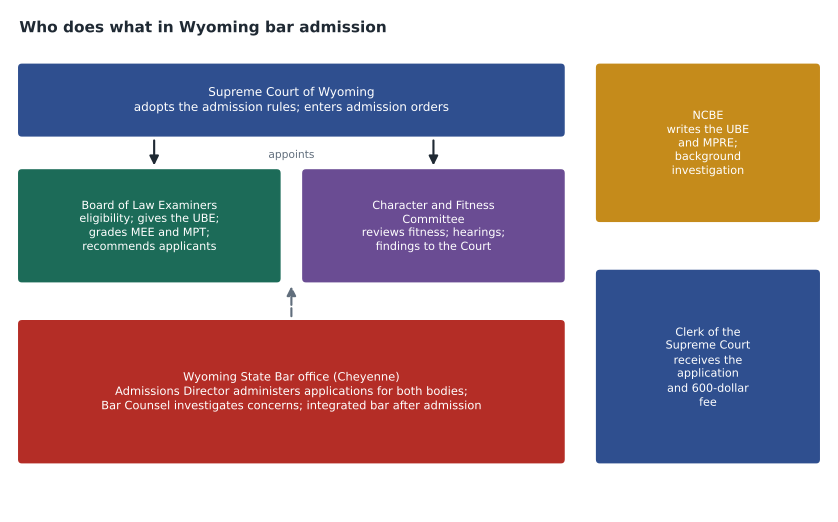
The Supreme Court of Wyoming is the state's highest court, and it is the final authority on admission to the practice of law. It adopts the Rules and Procedures Governing Admission to the Practice of Law, which lawyers cite as the Wyoming admission rules or W.Admission.R. The Court amends those rules by order, most recently with a set of amendments effective August 12, 2026 that prepare the state for the NextGen bar exam. When the Board and the Character and Fitness Committee have finished their work, they certify an applicant to the Court, and the Court enters the order admitting the applicant to practice.
The Board of Law Examiners is appointed by the Court. Under the admission rules it is made up of resident lawyers with years of active practice who serve staggered terms. The Board decides whether an applicant is eligible to sit the exam, administers the UBE in Wyoming twice a year, grades the written components that are graded locally, and recommends applicants for admission once they have met the examination requirements. It also handles applications for admission on motion and by transferred UBE score.
The Character and Fitness Committee is a separate body, also appointed by the Court, made up of resident lawyers and a small number of nonlawyer members. It reviews applications that raise questions about an applicant's honesty, judgment, financial responsibility or fitness, holds hearings when needed and sends written findings and a recommendation to the Court. Lesson 3 explains its procedure.
The Wyoming State Bar is the integrated bar: every lawyer licensed in Wyoming must be a member. Its office in Cheyenne houses the Admissions Director, who serves as the administrative office for both the Board and the Committee. In practice, most of an applicant's correspondence about forms, deadlines and missing documents runs through the Admissions Director, while the application itself is filed with the Clerk of the Wyoming Supreme Court. Bar Counsel, also part of the Bar's office, investigates character and fitness concerns when the Admissions Director refers them, and handles lawyer discipline after admission.
NCBE, the National Conference of Bar Examiners, is a national nonprofit rather than a Wyoming body. It writes the components of the Uniform Bar Examination and the MPRE, scores the MBE, keeps the score records that make transfers possible, and performs the background investigation for Wyoming applicants through its character and fitness application. Wyoming applicants pay NCBE's investigation fee directly to NCBE, separately from the Wyoming application fee.
Three ways into the Wyoming bar
The admission rules offer three main routes. The first is admission by examination: an applicant with a JD from an ABA-accredited law school applies by the deadline, sits the UBE in Wyoming, earns a total scaled score of at least 270, produces an MPRE scaled score of at least 85, clears character and fitness and takes the oath. Kenna is on this route, and most of this course describes it.
The second is admission by transferred UBE score. A lawyer or graduate who sat the UBE in another jurisdiction and earned a passing Wyoming score may apply to transfer it. A score less than three years old can qualify without further review of practice, and a score three to five years old can qualify if the applicant has practiced at least 300 hours a year in the two years before applying. Since July 2026, Wyoming also accepts transferred NextGen scores of 620 or more. The applicant never sits an exam in Wyoming, but still needs the MPRE and character and fitness clearance.
The third is admission on motion, sometimes called admission without examination. An experienced lawyer who was admitted elsewhere by written exam and has practiced actively for five of the last seven years may be admitted without sitting the Wyoming exam, if the other requirements of the rules are met. Wyoming has no formal reciprocity agreement with any state; eligibility depends on the applicant meeting the rule, not on where the applicant is from. Lesson 11 covers transfer and motion in detail, along with the separate rule for military spouse attorneys.
Wyoming does not offer a diploma privilege, an apprenticeship route in place of law school or a separate pathway for graduates of foreign or non-ABA law schools. The JD from an ABA-accredited school is required on every route, and Wyoming statute repeats the requirement.
The steps on the examination route
Hollis drew the examination route as six boxes on the screen. First, eligibility: an adult applicant with a JD from an ABA-accredited law school, or a final-year student who will graduate before the exam and whose dean will certify the degree. Second, the application: filed with the Clerk of the Wyoming Supreme Court by the third Friday in November for a February exam or the third Friday in April for a July exam, with the 600-dollar fee, a copy of the NCBE character and fitness application and the other required documents. Third, the exam itself: the two-day UBE, given on the last Tuesday and Wednesday of February and July. Fourth, the MPRE: a scaled score of 85 or more, with evidence filed within one year of the UBE sitting. Fifth, character and fitness review. Sixth, the Board and the Committee certify the applicant, the Court enters the admission order, and the applicant takes and files the oath.
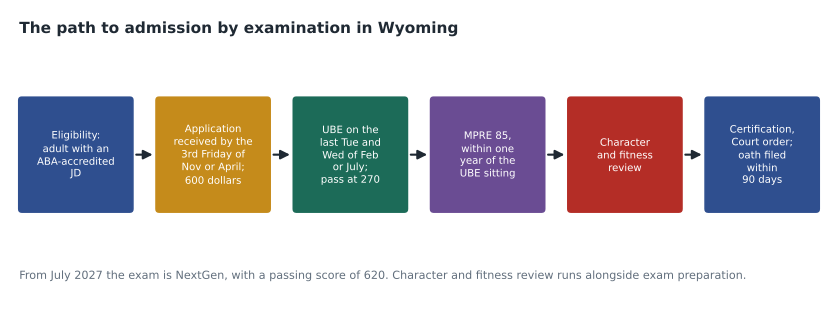
Some steps can move. The MPRE may be taken before or after the bar exam, though the Board warns that a missing MPRE score delays the recommendation for admission. The character and fitness review begins when the application is filed and runs alongside exam preparation. Other steps cannot move. The filing deadline is the date the application is received, not the date it is mailed, and an application that arrives late is returned. The oath must be filed within 90 days after the admission order, and an applicant who misses that window has only a narrow route to cure it before starting the whole process again.
Kenna's file shows how the steps fit together. She sat the MPRE in August 2026 and scored 97. She requested the NCBE character and fitness application in September, disclosed a college noise citation and a closed collection account from a medical bill, and mailed her Wyoming petition with the dean's certificate request on November 6, two weeks before the November 20 deadline. 'Once I pass,' she said, 'the Board and the Committee certify me, the Court signs the order, and I take the oath in Cheyenne.'
The law that governs admission
Three layers of law matter. The admission rules adopted by the Supreme Court set the substantive requirements: education, exam scores, the MPRE, character and fitness standards, transfer, motion, military spouse admission and the oath. Wyoming statutes in Title 33 add the basic qualification that an applicant hold a JD from an ABA-accredited school, among other matters. The Rules Governing the Wyoming State Bar and the Authorized Practice of Law then govern membership, dues, CLE and discipline after admission. On top of these, NCBE's own policies govern the MPRE, score reporting and the background investigation.
The rules change. The Court has amended the admission rules several times in recent years, including a 2024 amendment confirming that the Court may waive requirements in appropriate circumstances and the August 12, 2026 amendments that add NextGen scoring to the rules. A candidate should read the current rules on the Wyoming Judicial Branch website and the current filing instructions before relying on any summary, including this one. Each form carries a revision date in its footer; Kenna noticed hers read August 2026.
The oath and admission
Admission ends with the oath prescribed by statute. Under the rules, the applicant takes the oath after the Court's admission order and must file the original oath within 90 days. An applicant who fails to file in time may file an affidavit with the Board within twelve months explaining the delay; otherwise the applicant must reapply, pay the fees again and may have to sit the exam again. New lawyers then join the Wyoming State Bar, pay dues and become subject to the CLE rules described in lesson 11.
Kenna asked how long the gap is between passing and practicing. Hollis gave an honest answer: it depends on when results come out, whether the MPRE score is already on file and whether the character and fitness file raises questions that need a hearing. A clean file with the MPRE already done moves fastest. A file with an unresolved question, even a small one, can add months.
Worked problem
Sending a question to the right place
Three hypothetical applicants send Hollis questions. Rudd, a final-year student, wants to know whether his dean can certify his degree after he files. Ingalls, a lawyer licensed elsewhere for nine years, wants to know whether she can be admitted without sitting the exam. Arnett has a 2023 DUI and wants to know how it will be reviewed.
Show solution
- Eligibility to sit and the dean's certificate are part of the examination application filed with the Clerk and reviewed by the Board; the dean sends the certificate directly to the Admissions Director.
- Admission without examination is governed by the motion rules (Rules 302 and 303), and the Board reviews the application through the Bar office.
- A character and fitness concern is reviewed by the Admissions Director and, if substantial, by Bar Counsel and the Character and Fitness Committee.
Answer: Rudd files his petition and asks his dean to send the certificate under separate cover; Ingalls reads Rules 302 and 303 and files a motion application; Arnett discloses the DUI fully and prepares evidence of rehabilitation for the Committee.
Common mistakes
MistakeThe Board of Law Examiners admits lawyers in Wyoming.
InsteadThe Board and the Committee certify applicants; the Supreme Court of Wyoming enters the order admitting them.
MistakeAn application postmarked by the deadline is on time.
InsteadThe application must be received by the third Friday in November or April; postmarks, faxes and emails do not count.
MistakeWyoming has reciprocity agreements with neighboring states.
InsteadWyoming has no formal reciprocity agreement with any state; motion applicants must meet the rule.
MistakeA graduate of a non-ABA or foreign law school can qualify after practicing elsewhere.
InsteadEvery route requires a JD from an ABA-accredited law school.
MistakeJoining the state bar association is optional.
InsteadThe Wyoming State Bar is an integrated bar; every licensed Wyoming lawyer must be a member.
Practice problems
Work each problem on paper first, then reveal the answer to check.
Which body enters the order admitting a lawyer in Wyoming?
Show answer
The Supreme Court of Wyoming.
Where is the examination application filed?
Show answer
With the Clerk of the Wyoming Supreme Court in Cheyenne.
What role does the Admissions Director play?
Show answer
She administers applications for the Board and the Committee from the Wyoming State Bar office.
Name the three main routes to admission.
Show answer
Admission by examination, admission by transferred UBE or NextGen score, and admission on motion.
How long does a new admittee have to file the oath?
Show answer
Ninety days after the admission order.
Summary and key terms
- The Supreme Court of Wyoming adopts the admission rules and enters admission orders.
- The Board of Law Examiners decides eligibility, gives the UBE and recommends applicants; the Character and Fitness Committee reviews fitness.
- The Wyoming State Bar office, through the Admissions Director and Bar Counsel, administers both bodies.
- Every route requires a JD from an ABA-accredited law school; Wyoming has no formal reciprocity agreements.
- The routes are examination, transferred score and admission on motion, plus a separate rule for military spouses.
- The oath must be filed within 90 days after the admission order.
- W.Admission.R.
- The Rules and Procedures Governing Admission to the Practice of Law adopted by the Supreme Court of Wyoming.
- Board of Law Examiners
- The body appointed by the Court to examine applicants and recommend them for admission.
- Character and Fitness Committee
- The Court-appointed committee that reviews applicants' moral character and fitness and holds hearings.
- Admissions Director
- The Wyoming State Bar staff member who administers applications for the Board and the Committee.
- Integrated bar
- A state bar in which membership is mandatory for every licensed lawyer.
Lesson quiz · 5 questions
Score 60% or more to complete this lesson.
Create a free account to save your progress, take quizzes and earn a certificate.