
BAR-251 · Lesson 12 of 12 · 21 min
Capstone: Wyoming practice questions and an exam-day plan
▶ Video coming soon A video version of this lesson is on the way.
Hollis ended the Wyoming course with a working session on Tuesday, November 17, 2026, three days before the filing deadline Kenna had already met. The plan had three parts: ten short questions on Wyoming admission and law, an original practice memo problem set in a fictional Wyoming county, and a written plan for the last three months before the February 23-24, 2027 exam and the weeks after it. 'The exam tests general law,' Hollis said. 'This session tests whether you can be a Wyoming lawyer the week you are sworn in.'
All questions and the memo problem below are original. They are not released bar exam questions, and the people and places in the problem are fictional.
Part one: ten short questions
Kenna answered each question aloud in one or two sentences, then Hollis gave the model answer. The questions and answers are set out here so a reader can try them first.
Question 1. A graduate of a foreign law school with an LLM from an ABA-accredited US school asks whether she can sit the Wyoming bar exam. Answer: No. Wyoming requires a JD from an ABA-accredited law school on every route, and an LLM does not substitute for it.
Question 2. An application for the July 2027 exam is mailed on the third Friday in April and arrives the following Monday. Is it timely? Answer: No. The application must be received by the third Friday in April; postmarks do not count, and Wyoming has no late filing period.
Question 3. An examinee scores 268 on the February 2027 UBE. What is her next Wyoming exam, and what score must she earn? Answer: The July 2027 NextGen exam, on which Wyoming's passing score is 620. Her UBE score cannot be combined with a NextGen score.
Question 4. A candidate passed the MPRE in 2025 with an 82 for another state. Does that satisfy Wyoming? Answer: No. Wyoming requires 85, with evidence filed within one year of the UBE sitting.
Question 5. A plaintiff is 55 percent at fault in a car accident. What does she recover under Wyoming law? Answer: Nothing. Under W.S. 1-1-109 a claimant whose fault is more than 50 percent is barred.
Question 6. A plaintiff with 300,000 dollars in damages sues a city whose snowplow caused the crash. What is the most she can recover from the city? Answer: 250,000 dollars, the per-claimant limit in W.S. 1-39-118, assuming the claim fits a waiver and a proper notice of claim was presented within two years.
Question 7. A rancher wants to move his irrigation right to a different field. What principle controls? Answer: The change usually requires state approval, and it may not injure other appropriators, which often limits the changed right to historic consumptive use.
Question 8. A will is entirely in the testator's handwriting and signed, with no witnesses. Is it valid in Wyoming? Answer: Yes, as a holographic will under W.S. 2-6-113, subject to proof of the handwriting.
Question 9. A client asks a Wyoming lawyer to handle her divorce on a contingent fee. May the lawyer agree? Answer: No. Wyoming's contingent fee rules prohibit contingent fees in divorce, annulment and legal separation.
Question 10. A lawyer licensed in Utah for eight years by examination wants to practice in Wyoming without an exam. What route fits? Answer: Admission on motion under Rules 302 to 304, if she has practiced actively at least 300 hours a year for five of the last seven years and meets the other requirements.
Kenna answered nine of the ten correctly. She missed question 6, saying the cap had been raised to 1,000,000 dollars in 2026. Hollis reminded her that the 2026 bill to raise the caps was introduced but never enacted.
Part two: the Brennock County memo problem
Hollis then gave Kenna a practice memo problem modeled on the kind of assignment a new associate receives. Kenna had 60 minutes to outline an answer in IRAC form.
The facts. Brennock County is a fictional Wyoming county. On March 3, 2026, Tobin Kesterson, a ranch hand driving his employer Cal Wendover's pickup, ran a stop sign at a rural intersection and collided with a delivery van driven by Nell Abeyta. The stop sign was hidden by a ridge of packed snow left by a Brennock County snowplow operator two days earlier. Abeyta suffered a broken pelvis; her damages are 400,000 dollars. A witness says Abeyta was going 10 miles an hour over the speed limit. Kesterson has no personal assets, but Wendover's ranch has a liability policy covering the pickup. In September 2026 Abeyta's former lawyer sent the county a two-page letter describing the crash and asking it to 'make this right'; the letter was not itemized, named no amount and was signed only by the lawyer. Abeyta also asks two side questions: whether her late father's handwritten note, signed by him, leaving her his fishing cabin is a valid will, and how the firm will charge her.
Issue one: liability and apportionment. Under W.S. 1-1-109, the jury will determine Abeyta's total damages and the percentage of fault of each actor: Abeyta for speeding, Kesterson for running the sign, and the county for the snow ridge. Wendover is likely liable for Kesterson's negligence as his employer if Kesterson was acting within the scope of his employment, a question to investigate. If Abeyta's fault is not more than 50 percent, she recovers her damages reduced by her own percentage, and each defendant is liable only for its own share. Suppose the jury finds Abeyta 15 percent, Kesterson 55 percent and the county 30 percent at fault. Abeyta recovers 85 percent of 400,000 dollars, or 340,000 dollars in total: 220,000 dollars from the Kesterson and Wendover side, collected through the ranch's insurance, and 120,000 dollars from the county, if the county claim survives.
Issue two: the Governmental Claims Act. The county is immune unless the claim fits a waiver in the Act, such as the waivers for negligent operation of vehicles and equipment or other listed categories. That question must be researched first. Even if a waiver applies, Abeyta must present a written claim within two years of March 3, 2026, that states the time, place and circumstances, names the employees involved if known, demands a specific amount and is signed and certified under penalty of perjury as the Wyoming Constitution, article 16, section 7 requires. The September 2026 letter does not meet those requirements: it is not itemized, states no amount and lacks the certification. Because the two-year period runs to March 3, 2028, the firm can still present a proper claim. It should do so promptly, then calendar the deadline to sue. Any recovery from the county is capped at 250,000 dollars, so the 120,000-dollar share in the example is within the limit.
Issue three: the father's note. If the note is entirely in the father's handwriting and signed by him, it can be a valid holographic will under W.S. 2-6-113 without witnesses. If any part is typed or printed, it fails as holographic and would need two witnesses. The firm should also check whether the father left a surviving spouse, because a spouse could claim an elective share under W.S. 2-5-101, and should open a probate matter in the district court where the father lived.
Issue four: the fee. The firm may represent Abeyta in the injury claim on a contingent fee, but the agreement must comply with the Rules Governing Contingent Fees: in writing, in duplicate, signed by the lawyer and Abeyta, substantially in the form of the Representation Agreement, with a copy of the rules given to Abeyta and explained. If the claim settles before suit or within 60 days after filing, one-third is presumptively reasonable; later, or after a verdict, 40 percent. The firm should also confirm that her former lawyer has no claim to part of the fee, and if he does, that any fee sharing complies with the rules.
Conclusion. Abeyta has strong claims against Kesterson and Wendover and a possible claim against the county. The firm should immediately research the Governmental Claims Act waiver, prepare and present a compliant, certified notice of claim well before March 3, 2028, open a probate file for the cabin and sign a compliant contingent fee agreement for the injury claim.
Hollis graded Kenna's outline 5 out of 6. She had spotted every issue and done the arithmetic correctly, but she had said the former lawyer's letter was defective without explaining that a proper, certified claim must reach the county before the two-year period ends. 'Say why the date matters,' Hollis wrote in the margin. 'The two-year period is the reason to act now.'
Part three: the exam-day plan
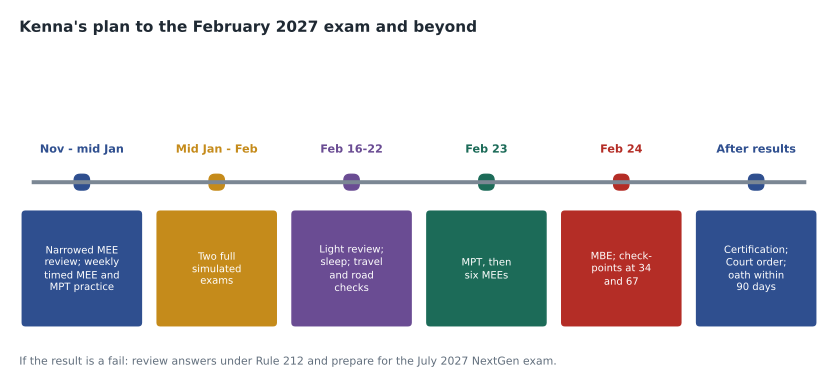
The rest of the session was planning. Kenna's plan ran from late November to her expected admission.
Late November to mid-January. Finish the MEE subject review on the post-July 2026 list only: business associations, civil procedure, constitutional law, contracts and sales, criminal law and procedure, evidence, real property and torts. Write two timed MEE answers and one timed MPT task each week, using the laptop software. Do a set of 33 MBE questions on three weekday mornings and a full 100-question session every Saturday.
Mid-January to mid-February. Take two full simulated exams under timed conditions, a week apart, and review each the following day. Keep Wyoming law out of the exam notebook. Confirm with the Admissions Director that the dean's certificate and the MPRE score are on file.
The week before. Light review only, fixed sleep and wake times, no new material. Check road conditions for the drive to the exam site, book a room for Monday night, February 22, and pack identification, admission materials, the laptop, its charger if permitted and the items the Board allows.
Tuesday, February 23. MPT in the morning: split the three hours evenly between the two tasks unless the instructions suggest otherwise, and finish both. MEE in the afternoon: 30 minutes per essay, with a short outline before writing. Wednesday, February 24. MBE: checkpoints at question 34 and question 67 in each session.
After the exam. Respond promptly to any request from the Admissions Director or Bar Counsel. When results come, if she has passed, watch for the certification and the Court's order, take the oath and file it within 90 days, then join the Wyoming State Bar and calendar CLE beginning the year after admission. If she has not passed, review her answers under Rule 212 in March, file for the July 2027 NextGen exam by the deadline the rules set for a second sitting and switch to NextGen practice materials.
Kenna added one line at the bottom of the plan, which Hollis said every Wyoming candidate should copy: 'Keep two notebooks. Study the exam's law until February 24. Study Wyoming's law the next morning.'
Worked problem
Scoring the memo
A hypothetical second student, Brisbin, answered the Brennock County problem by saying Abeyta could recover all 340,000 dollars from the ranch's insurer because joint and several liability applies, that the September letter was a sufficient notice of claim, and that the father's note was invalid because it had no witnesses.
Show solution
- Brisbin applied joint and several liability; Wyoming uses several liability, so each defendant pays only its own share.
- The September letter was not itemized, stated no amount and was not signed and certified by the claimant under penalty of perjury, so it does not satisfy the Act.
- A handwritten, signed note can be a valid holographic will in Wyoming without witnesses.
Answer: Brisbin's answer would score poorly. Each error comes from applying a general or exam rule where the problem called for Wyoming law, the reverse of the trap in lesson 6.
Common mistakes
MistakeOn a Wyoming practice memo, the general exam rule is the safe answer.
InsteadA Wyoming practice problem calls for Wyoming law: several liability, the Governmental Claims Act, holographic wills and the contingent fee rules.
MistakeAn informal letter to a county preserves a claim.
InsteadThe claim must be itemized, state an amount and be signed and certified under penalty of perjury within two years.
MistakeThe last month before the exam is the time for new material.
InsteadThe final weeks are for simulated exams and review, not new subjects.
MistakeAfter passing, the oath can be filed whenever convenient.
InsteadThe oath must be filed within 90 days of the admission order.
MistakeA failed February 2027 examinee should keep studying the UBE.
InsteadWyoming's next exam is NextGen in July 2027; switch to NextGen materials.
Practice problems
Work each problem on paper first, then reveal the answer to check.
What does Wyoming require of an MPRE score for exam applicants?
Show answer
A scaled score of 85, filed within one year of the UBE sitting.
In the memo problem, how much does Abeyta recover from the county if the county is 30 percent at fault?
Show answer
120,000 dollars, within the 250,000-dollar cap, if the claim fits a waiver and a proper notice is presented.
By what date must Abeyta present a proper notice of claim?
Show answer
By March 3, 2028, two years after the crash.
What makes the father's note a valid will?
Show answer
It must be entirely in his handwriting and signed by him.
What is the pacing plan for the MEE?
Show answer
Thirty minutes per essay, with a short outline before writing.
A final checklist
Hollis ended with a checklist Kenna could keep on her desk until results came out: the NCBE character and fitness application submitted and matching the Wyoming petition; the Wyoming packet received by the Clerk by November 20, 2026, with the notarized release and the 600-dollar fee; the dean's certificate confirmed with the Admissions Director; the MPRE score of 97 sent by NCBE; the laptop registered and the exam software practice run completed; a room booked near the exam site for February 22, 2027; and an amendment form ready in case anything in the application changed. 'If every line is checked,' Hollis said, 'the only thing left is the exam.'
Summary and key terms
- The ten short questions review eligibility, deadlines, scores, the MPRE, fault, governmental claims, water, wills, fees and motion.
- A strong memo answer applies W.S. 1-1-109 with several liability and works the numbers.
- Claims against a county require a waiver, a certified itemized claim within two years and are capped at 250,000 dollars per claimant.
- A handwritten, signed will can be valid in Wyoming without witnesses; check the elective share.
- Contingent fee agreements must follow Wyoming's form and percentage rules.
- The exam-day plan moves from narrowed MEE review to simulated exams, then to certification, the oath and CLE.
- IRAC
- Issue, rule, application and conclusion, the standard structure for a legal analysis.
- Checkpoint
- A planned question number to reach by a set time during an MBE session.
- Simulated exam
- A full-length practice exam taken under timed conditions.
- Written notice of claim
- The written, itemized, certified claim required before suing a Wyoming governmental entity.
- Exam notebook
- A candidate's notes of the general rules the bar exam tests, kept separate from state-law notes.
Lesson quiz · 5 questions
Score 60% or more to complete this lesson.
Create a free account to save your progress, take quizzes and earn a certificate.