
BAR-246 · Lesson 9 of 12 · 19 min
Vermont family law, wills and estates
▶ Video coming soon A video version of this lesson is on the way.
A general practitioner in a small Vermont town spends a large part of every week on family and estate matters. In Quimby's office, Hattie drafted wills for dairy farmers who wanted to keep the farm in the family, helped a widow through a probate estate, and sat in on Family Division hearings about parental rights and child support. 'Half of the law in this office is about who gets the farm,' Quimby told her. 'The other half is about who gets the kids.'
Family law and trusts and estates were removed from the MEE starting in July 2026, and they are not foundational concepts on the first NextGen exams. Vermont's rules in these areas therefore matter mostly for practice and for the first-year CLE requirement. This lesson covers Vermont's role in the history of marriage equality, divorce grounds and residency, property division, maintenance, parental rights and child support, parentage, and wills, intestacy and probate.
Vermont and marriage equality
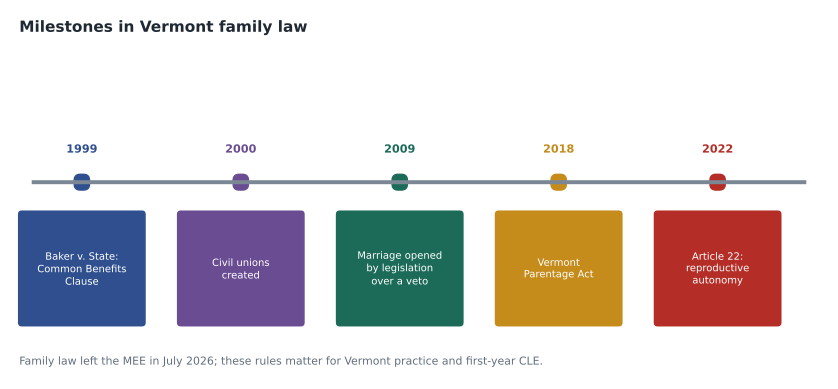
Vermont occupies a special place in the history of family law. In Baker v. State (1999), the Vermont Supreme Court held that the Common Benefits Clause of the Vermont Constitution required the State to extend to same-sex couples the common benefits and protections that flow from marriage under Vermont law. The Court left it to the legislature to decide how. In 2000, the legislature responded by creating civil unions, the first legal status of its kind in the United States, giving same-sex couples the rights and responsibilities of marriage under state law.
In 2009, the legislature went further and opened marriage itself to same-sex couples, overriding the Governor's veto. Vermont was the first state to recognize same-sex marriage by legislation rather than by court order. Couples who entered civil unions before the change may remain in them, and the Family Division handles the dissolution of civil unions under the same rules that apply to divorce.
Vermont added another provision to its constitution in 2022. Article 22, approved by voters in November 2022, protects an individual's right to personal reproductive autonomy and provides that the right may not be denied or infringed unless justified by a compelling State interest achieved by the least restrictive means. Article 22 shapes Vermont law on reproductive health care and is a reference point in parentage and family planning matters.
Grounds for divorce
Vermont's divorce statute, 15 V.S.A. section 551, lists seven grounds. A divorce may be granted for adultery; for a sentence of confinement in prison for life or for three years or more, if the spouse is actually confined when the complaint is filed; for intolerable severity; for willful desertion, or when a spouse has been absent for seven years without being heard from; for a spouse's persistent refusal or neglect, without cause, to provide suitable support when able to do so; for permanent incapacity due to a mental condition or psychiatric disability, under a separate procedure; and when the spouses have lived apart for six consecutive months and the court finds that resumption of marital relations is not reasonably probable.
In practice, the last ground, living separate and apart for six consecutive months, is the one used in the great majority of cases. It operates as Vermont's no-fault ground. Because the parties can live apart for six months while the case is pending, the six-month period often runs during the litigation itself.
Residency rules also apply. Vermont law generally requires that one spouse have lived in Vermont for at least six months before filing and for one year before the final hearing. A couple who moves to Vermont shortly before a separation must account for those periods.
| Ground (15 V.S.A. section 551) | Key element |
|---|---|
| Adultery | Either spouse |
| Imprisonment | Sentence of life or three years or more; actually confined at filing |
| Intolerable severity | Conduct making the marriage intolerable |
| Desertion or absence | Willful desertion, or absence for seven years without word |
| Nonsupport | Persistent refusal or neglect to support when able |
| Mental incapacity | Permanent incapacity under the statute's separate procedure |
| Living apart | Six consecutive months; resumption not reasonably probable |
Property division
Vermont is an equitable distribution state with a broad definition of the marital estate. Under 15 V.S.A. section 751, all property owned by either or both of the parties, however and whenever acquired, is subject to the court's jurisdiction for equitable division. Vermont does not limit division to property acquired during the marriage, as some states do. Property one spouse owned before the marriage or inherited during it is part of the estate the court may divide, although the source of the property is one of the factors the court considers in deciding how to divide it.
The statute lists factors for the court to weigh, including the length of the marriage; the age and health of the parties; their occupations, sources and amounts of income, vocational skills and employability; the contribution of each spouse to the education, training or increased earning power of the other; the value of each spouse's property interests, liabilities and needs; whether the property was acquired by gift or inheritance; the contribution of each spouse in acquiring, preserving and depreciating or appreciating the property, including the contribution of a homemaker; the party through whom the property was acquired; and the respective merits of the parties. The last factor allows the court to consider fault in dividing property, although courts are cautioned against using property division to punish.
For a farm family, the breadth of the marital estate is a central planning issue. A farm one spouse inherited from a parent may be divided at divorce, and the inheritance factor is only one consideration among many. Prenuptial agreements are therefore common among Vermont farm families, and Quimby drafted several in which the couple agreed that an inherited farm would remain the property of the spouse who inherited it.
Maintenance
Vermont calls spousal support maintenance. Under 15 V.S.A. section 752, the court may order rehabilitative or permanent maintenance to a spouse who lacks sufficient income or property to provide for reasonable needs and who cannot support himself or herself at the standard of living established during the marriage. Since the legislature's maintenance reform of 2018, Vermont has used statutory guidelines that tie the amount and duration of maintenance to the length of the marriage and the difference between the parties' incomes, while allowing the court to deviate when the guideline result would be unfair or inequitable. Maintenance is separate from property division, and the two are often negotiated together.
Parental rights and responsibilities
Vermont uses the term parental rights and responsibilities instead of custody. Under 15 V.S.A. section 665, the court allocates legal and physical responsibility for a child according to the child's best interests, and it considers statutory factors, including the relationship of the child with each parent, each parent's ability to provide love, guidance and a safe home, the child's adjustment to home, school and community, the ability and disposition of each parent to foster a positive relationship with the other parent, the quality of the child's relationship with the primary care provider, and any evidence of abuse. When parents agree on shared rights and responsibilities, the court generally accepts their agreement if it serves the child's best interests.
The parent who does not have primary physical responsibility usually has parent-child contact, Vermont's term for visitation. Relief from abuse proceedings under 15 V.S.A. chapter 21, heard in the Family Division, can affect both the allocation of responsibilities and the terms of contact.
Child support
Vermont calculates child support under statutory guidelines based on an income-shares model: the combined income of both parents determines the total support amount, which is divided between them in proportion to their incomes. The guidelines include worksheets and tables, and deviations are permitted when application of the guidelines would be unfair to the child or a parent. The Office of Child Support assists with establishment and enforcement.
Parentage
The Vermont Parentage Act, enacted in 2018 and codified in Title 15C, modernized Vermont's parentage law. It provides for establishing parentage through birth, presumption, voluntary acknowledgment, adjudication, adoption, assisted reproduction and gestational carrier agreements, and it applies equally to parents regardless of gender or marital status. The Act also recognizes de facto parentage in defined circumstances, allowing a person who has acted as a parent with the consent of the existing parent to seek a judgment of parentage.
Wills
Vermont's will execution statute, 14 V.S.A. section 5, requires that a will be in writing and signed by the testator, or by another person in the testator's presence and at the testator's direction, in the presence of at least two credible witnesses. The witnesses must attest and sign the will in the presence of the testator and in each other's presence. A temporary provision that allowed remote witnessing during the COVID-19 emergency expired in 2023.
Vermont's statute contains no exception for an unwitnessed handwritten will, so a handwritten will that is not executed with two witnesses generally will not be admitted to probate. Careful practitioners also have the witnesses sign an affidavit about the execution, which makes it easier to prove the will without calling the witnesses later.
Intestacy and probate
When a Vermont resident dies without a will, the intestacy statute in Title 14 decides who inherits. In general terms, a surviving spouse takes the entire intestate estate when there are no descendants or when all of the decedent's descendants are also descendants of the surviving spouse, and shares the estate with the decedent's other descendants when there are children from another relationship. When there is no spouse, the estate passes to descendants, then to parents and then to more remote relatives in the order set out in the statute. A new lawyer should read the current statute for the exact shares before advising a family.
Estates are administered in the Probate Division of the Superior Court in the county where the decedent lived. The process typically involves filing the will and a petition, appointing an executor or administrator, notifying heirs and creditors, inventorying and managing assets, paying debts and taxes, and distributing what remains. Vermont also has its own estate tax, separate from the federal estate tax, with a much lower exclusion amount than the federal one, so even a moderately valuable farm may need estate tax planning at the state level.
Trusts are governed by the Vermont Trust Code, Title 14A, which is based on the Uniform Trust Code. Many Vermont families use revocable trusts to avoid probate and to plan for the transfer of farmland and camps across generations.
Worked problem
Dividing an inherited farm
Nettie Gilfeather inherited a 200-acre dairy farm from her father in 2010, five years after marrying Sumner Tierney. Both worked the farm for the next fifteen years, and Sumner rebuilt the barns. They separated in March 2026 and have lived apart since. In October 2026, Sumner files for divorce. Is the farm part of the property the court may divide?
Show solution
- Grounds: living apart for six consecutive months, from March to October 2026, supports a divorce if the court finds resumption is not reasonably probable.
- Marital estate: under 15 V.S.A. section 751, all property owned by either party, however and whenever acquired, is subject to equitable division, including inherited property.
- Factors: inheritance favors Nettie, but the length of the marriage, Sumner's contribution in preserving and improving the farm and the parties' needs and incomes also matter.
- Agreement: absent a valid prenuptial or postnuptial agreement, the court will weigh the factors rather than set the farm aside automatically.
Answer: The farm is part of the divisible estate. The court may award most or all of it to Nettie because she inherited it, but it may also award Sumner a share or an offsetting payment, reflecting his contributions over fifteen years.
Common mistakes
MistakeVermont divides only property acquired during the marriage.
InsteadSection 751 reaches all property owned by either party, however and whenever acquired, including inherited property.
MistakeVermont requires one year of separation for a no-fault divorce.
InsteadThe living-apart ground requires six consecutive months.
MistakeVermont uses the word custody in its statutes.
InsteadVermont speaks of parental rights and responsibilities and parent-child contact.
MistakeA handwritten will is valid in Vermont without witnesses.
InsteadSection 5 requires at least two witnesses, with no exception for handwritten wills.
MistakeFamily law and estates are still tested on the February 2027 MEE.
InsteadBoth subjects left the MEE starting July 2026.
Summary and key terms
- Baker v. State (1999) led to civil unions in 2000; marriage opened to same-sex couples by legislation in 2009; Article 22 (2022) protects reproductive autonomy.
- Section 551 lists seven grounds; living apart six consecutive months is the common no-fault ground.
- Section 751 makes all property of either spouse divisible; inheritance and the respective merits of the parties are factors.
- Maintenance under section 752 follows guidelines adopted after the 2018 reform.
- Parental rights and responsibilities are allocated by the child's best interests under section 665.
- Wills require two witnesses under 14 V.S.A. section 5; estates go through the Probate Division; trusts follow the Vermont Trust Code.
- 0
- Common Benefits Clause
- 1
- civil union
- 2
- Article 22
- 3
- living separate and apart
- 4
- equitable distribution
- 5
- maintenance
- 6
- parental rights and responsibilities
- 7
- parent-child contact
- 8
- Vermont Parentage Act
- 9
- Probate Division
Practice problems
Work each problem on paper first, then reveal the answer to check.
What did Baker v. State (1999) hold?
Show answer
The Common Benefits Clause required Vermont to extend the benefits and protections of marriage to same-sex couples, leaving the method to the legislature.
What is Vermont's no-fault divorce ground?
Show answer
Living apart for six consecutive months when resumption of marital relations is not reasonably probable.
Is property one spouse inherited subject to division in a Vermont divorce?
Show answer
Yes. Section 751 reaches all property, though inheritance is a factor in the division.
How many witnesses does a Vermont will require?
Show answer
At least two credible witnesses, who sign in the testator's presence and each other's presence.
Lesson quiz · 5 questions
Score 60% or more to complete this lesson.
Create a free account to save your progress, take quizzes and earn a certificate.