
BAR-246 · Lesson 7 of 12 · 19 min
Vermont courts and civil procedure, including the Environmental Division and Act 250
▶ Video coming soon A video version of this lesson is on the way.
Abner Quimby keeps a hand-drawn chart of the Vermont courts taped inside his office closet door. He drew it in 2010, when the legislature reorganized the trial courts, and he has updated it in pencil ever since. On Hattie's first day in 2022, he walked her through it. 'There is one trial court with divisions, one appellate court, and one statewide land use system that will take up more of your life than either,' he said. Four years later, she could draw the chart from memory.
None of this is tested on the UBE. But it is the first thing a new Vermont lawyer needs, and it is a large part of the 15 hours of Vermont practice and procedure CLE that new admittees must complete. This lesson covers the court system, Vermont civil procedure basics, limitations periods and the medical malpractice certificate of merit, and Vermont's distinctive land use system under Act 250.
The Vermont Supreme Court
Vermont has a single appellate court, the Vermont Supreme Court, which sits in Montpelier. It has five justices: a Chief Justice and four Associate Justices. Vermont has no intermediate court of appeals, so appeals from the trial courts go directly to the Supreme Court. Most appeals are heard as of right, and the Court decides a large share of cases by full opinion, entry order or three-justice panel.
Vermont's method of selecting and retaining judges is unusual. When a vacancy occurs, the Judicial Nominating Board screens candidates and sends names to the Governor, who appoints from the list, subject to confirmation by the Vermont Senate. Justices and judges serve six-year terms. At the end of each term, a judge who wishes to continue is retained by a vote of the General Assembly, the state's legislature, rather than by a popular retention election. Retention is usually routine, but the legislative vote gives Vermont's judges a form of accountability that most states provide through elections.
The Superior Court and its divisions
Vermont's trial courts were reorganized by legislation in 2010 into a single Vermont Superior Court. The Superior Court has a unit in each of the state's fourteen counties, and each unit has divisions that handle different kinds of cases.
The Civil Division hears civil actions, including contract and tort cases, landlord-tenant matters, small claims and appeals from certain municipal and administrative decisions. The Criminal Division hears criminal cases. The Family Division hears divorce and civil union dissolution, parentage, child support, parental rights and responsibilities, juvenile matters and relief from abuse proceedings. The Probate Division hears estates, guardianships, adoptions and trusts. The Environmental Division is a statewide division that hears appeals from municipal zoning and land use decisions and many state environmental permit matters, and its judges travel to hold hearings where the land is.
Alongside the Superior Court is the Judicial Bureau, which hears civil violations such as traffic tickets, fish and wildlife violations and many municipal ordinance violations. Vermont counties also elect assistant judges, a distinctive Vermont office with a long history, who have administrative duties and hear certain matters in their counties.
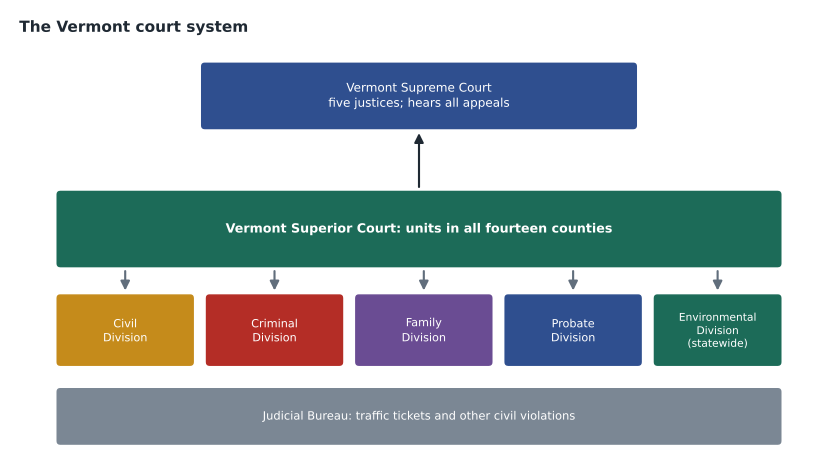
| Court or division | What it hears |
|---|---|
| Vermont Supreme Court | All appeals from the trial courts; attorney admission and discipline; rules |
| Superior Court, Civil Division | Contract, tort, property and landlord-tenant cases; small claims |
| Superior Court, Criminal Division | Felonies and misdemeanors |
| Superior Court, Family Division | Divorce, parentage, support, juvenile and relief from abuse cases |
| Superior Court, Probate Division | Estates, guardianships, adoptions, trusts |
| Environmental Division (statewide) | Municipal zoning appeals and many environmental permit matters |
| Judicial Bureau | Traffic tickets and other civil violations |
The federal court
Vermont's federal trial court is the United States District Court for the District of Vermont, which holds court mainly in Burlington and Rutland. Appeals go to the Second Circuit in New York. Vermont lawyers regularly appear in both systems, and a new lawyer quickly learns that the same dispute can look very different depending on which court hears it.
Vermont Rules of Civil Procedure
Civil cases in the Superior Court are governed by the Vermont Rules of Civil Procedure, adopted by the Supreme Court. The Vermont rules were modeled on the Federal Rules of Civil Procedure, and many provisions are similar or identical in substance. Vermont courts often look to federal decisions interpreting the parallel federal rule, but they are not bound by them.
The most important departure for a new litigator is the pleading standard. In Colby v. Umbrella, Inc. (2008), the Vermont Supreme Court declined to adopt the plausibility standard of Bell Atlantic Corp. v. Twombly. It reaffirmed Vermont's long-standing notice-pleading approach, under which a motion to dismiss for failure to state a claim is disfavored and should be granted only if it is beyond doubt that there exist no facts or circumstances that would entitle the plaintiff to relief. A complaint that might not survive a federal Rule 12(b)(6) motion may survive in Vermont state court.
Other differences tend to be matters of detail: timing rules, the mechanics of service and the treatment of particular motions. Quimby's advice to Hattie was to never assume that a Vermont rule says exactly what its federal twin says. 'Read the Vermont rule and the Reporter's Notes,' he told her. 'The notes tell you when Vermont meant to be different.'
Limitations periods
Vermont's general limitations period for civil actions is six years. Actions for personal injuries, damage to personal property, assault and battery, false imprisonment, and slander and libel have a three-year period under 12 V.S.A. section 512. For personal injuries, the statute provides that the claim accrues on the date the injury is discovered, a statutory discovery rule. Medical malpractice claims are governed by a separate provision with its own discovery and outside time limits, and new lawyers should read it carefully before calendaring a malpractice deadline.
The medical malpractice certificate of merit
Vermont requires a certificate of merit in most medical negligence cases. Under 12 V.S.A. section 1042, for injuries or deaths occurring on or after February 1, 2013 and alleged to result from a health care provider's negligence, the plaintiff's attorney, or a self-represented plaintiff, must file a certificate with the complaint. The certificate states that the attorney or plaintiff consulted a qualified health care provider who described the applicable standard of care and indicated a reasonable likelihood that the plaintiff can show that the defendant failed to meet that standard and that the failure caused the injury. A separate certificate is required for each defendant.
The statute gives a plaintiff who needs time to complete the consultation a way to preserve the claim. Filing a petition with the clerk of the court where the action will be filed automatically extends the limitations period by 90 days. A complaint filed without a required certificate is dismissed without prejudice, except in rare cases where expert testimony is not needed to prove the claim. The requirement does not apply if the only claim against a provider is failure to obtain informed consent.
Act 250
Vermont's most distinctive body of law for a general practitioner is Act 250, the state's land use and development law, codified at 10 V.S.A. chapter 151. The legislature enacted it in 1970 in response to rapid second-home and ski-area development, and it has shaped the Vermont landscape ever since. Act 250 requires a state land use permit for many kinds of development and subdivision, in addition to any local zoning permit.
Act 250 jurisdiction depends on the type, size and location of a project. Over the decades, the triggers have covered commercial and industrial construction on more than a threshold acreage, larger housing projects, subdivisions above a threshold number of lots, and construction above a set elevation. The thresholds have been adjusted many times, most recently by housing legislation in 2023 and by Act 181 of 2024, so lawyers check the current statute rather than relying on memory.
Applications are heard by District Environmental Commissions, panels of local citizens appointed for each district. A commission issues a permit only if it finds that the project satisfies the statutory criteria in 10 V.S.A. section 6086(a). The criteria address air and water pollution, water supply, soil erosion, traffic, the burden on schools and municipal services, scenic and natural beauty, historic sites and rare and irreplaceable natural areas, necessary wildlife habitat and endangered species, and conformance with local and regional plans, among others. Aesthetics review has long used the so-called Quechee test, a two-part analysis of whether a project would have an adverse effect and, if so, whether that effect would be undue.
Permits usually come with conditions, such as limits on hours of operation, landscaping requirements, stormwater controls or restrictions on future expansion. Those conditions run with the land, and a buyer of property subject to an Act 250 permit takes it subject to the permit's conditions. Checking for Act 250 permits and their conditions is a standard part of a Vermont title search and real estate closing.
| Act 250 element | What it involves |
|---|---|
| Statute | 10 V.S.A. chapter 151, enacted 1970 |
| Jurisdiction | Development and subdivision above statutory thresholds, which vary by type and location |
| Decision maker | District Environmental Commissions |
| Criteria | 10 V.S.A. section 6086(a): environment, infrastructure, aesthetics, habitat, planning |
| Permit conditions | Run with the land; checked in real estate transactions |
| Oversight | Land Use Review Board (formerly the Natural Resources Board) under Act 181 |
Act 181 of 2024 and the 2026 changes
In 2024, the legislature passed Act 181, the largest overhaul of Act 250 in decades, with effective dates beginning June 17, 2024. Act 181 renamed and restructured the Natural Resources Board as the Land Use Review Board, with five full-time members chosen through a nominating process. It created temporary exemptions from Act 250 for certain housing development while a longer-term system took shape. The long-term system is location-based: areas planned for growth, designated as Tier 1, would have reduced Act 250 review for housing; most of the state would remain in Tier 2; and critical natural resource areas would form Tier 3, with additional review. Act 181 also added a new criterion for forest blocks and habitat connectors and a new jurisdictional trigger for road construction, often called the road rule. Act 181 also provides for appeals of Act 250 permit decisions to move from the Environmental Division to the new Board on a schedule set by the act, so a new lawyer should confirm the current appeal route before filing.
Implementation proved contentious. In June 2026, Governor Phil Scott signed S.325, a partial rollback of Act 181. Among other things, the new law repealed the road rule, which would have required review of longer private roads in much of the state, and repealed provisions that would have required stricter state review of development near designated habitat connectors and headwater streams. The Land Use Review Board continues to work with regional planning commissions on Tier 1 maps.
For a new lawyer, the lesson is that Act 250 is a moving target. Quimby keeps a folder labeled 'Act 250 this year' and replaces its contents every summer after the legislative session ends.
Worked problem
Spotting an Act 250 issue
Hiram Bourdeau owns 40 acres outside Middlebury with a 1998 Act 250 permit that allowed a small sawmill and limited its hours to 7 a.m. to 5 p.m. He sells the parcel to Elsie Bessette, who plans to run the mill until 9 p.m. and add a retail lumber store. What should Elsie's lawyer check?
Show solution
- Existing permit: the 1998 permit's conditions, including the hours limit, run with the land and bind Elsie.
- Material change: extending hours and adding retail use may be a material change that requires a permit amendment.
- Local zoning: the town's zoning bylaw may also require a permit for the new use.
- Current law: check whether Act 181 and the 2026 amendments changed jurisdiction or procedure for the project's location.
Answer: Elsie's lawyer should review the existing permit, advise her that she is bound by its conditions, and seek a jurisdictional opinion or permit amendment from the District Commission before she extends hours or opens a store, while also checking local zoning.
Common mistakes
MistakeVermont has an intermediate court of appeals.
InsteadAppeals go directly from the Superior Court to the Vermont Supreme Court.
MistakeVermont judges face popular retention elections.
InsteadThe General Assembly votes on retention at the end of each six-year term.
MistakeVermont state courts apply Twombly.
InsteadColby v. Umbrella (2008) kept notice pleading in Vermont state court.
MistakeA medical negligence complaint can be filed now and the certificate of merit supplied later.
InsteadThe certificate must be filed with the complaint; a petition to the clerk extends the limitations period by 90 days.
MistakeAct 250 permit conditions expire when the land is sold.
InsteadConditions run with the land and bind later owners.
Summary and key terms
- The Vermont Supreme Court has five justices and hears all appeals; there is no intermediate appellate court.
- Judges are appointed from a Judicial Nominating Board list, confirmed by the Senate, and retained by the General Assembly every six years.
- The Superior Court has units in fourteen counties with Civil, Criminal, Family and Probate Divisions, and a statewide Environmental Division.
- Colby v. Umbrella (2008) kept notice pleading; personal injury claims have three years under section 512, with discovery accrual.
- Section 1042 requires a certificate of merit with most medical negligence complaints; a petition extends the limitations period by 90 days.
- Act 250 requires state land use permits for development above thresholds; Act 181 (2024) restructured it and S.325 (2026) rolled parts back.
- 0
- Vermont Supreme Court
- 1
- Judicial Nominating Board
- 2
- Superior Court
- 3
- Environmental Division
- 4
- Judicial Bureau
- 5
- notice pleading
- 6
- certificate of merit
- 7
- Act 250
- 8
- District Environmental Commission
- 9
- Land Use Review Board
Practice problems
Work each problem on paper first, then reveal the answer to check.
How many justices sit on the Vermont Supreme Court?
Show answer
Five: a Chief Justice and four Associate Justices.
Who decides whether a Vermont judge is retained?
Show answer
The General Assembly, by vote at the end of each six-year term.
What is the limitations period for a personal injury claim in Vermont?
Show answer
Three years under 12 V.S.A. section 512, accruing on discovery of the injury.
What did Act 181 of 2024 do to the Natural Resources Board?
Show answer
Renamed and restructured it as the Land Use Review Board.
Lesson quiz · 5 questions
Score 60% or more to complete this lesson.
Create a free account to save your progress, take quizzes and earn a certificate.