
BAR-246 · Lesson 2 of 12 · 19 min
Eligibility, education, the Law Office Study Program, deadlines and fees
▶ Video coming soon A video version of this lesson is on the way.
Hattie's file at the Office of Attorney Licensing is thicker than most. It contains her registration for the Law Office Study Program from the fall of 2022, eight six-month reports describing what she studied and did in Abner Quimby's office, Quimby's certifications as her supervisor, and finally her application to sit for the February 2027 exam. Every one of those documents had a deadline, and every one had to be filed correctly. 'The exam is hard,' Quimby told her when she started, 'but the paperwork is where the Board finds out whether you read instructions.'
This lesson covers the study-of-law requirement, including the Law Office Study Program, the rules for graduates of non-approved and foreign law schools, the early exam option for current students, filing deadlines and fees.
The study-of-law requirement
Rule 6 of the Rules of Admission requires every applicant for admission by examination to have completed the study of law before admission. An applicant can satisfy the rule in one of several ways. The most common is graduation with a Juris Doctor from a law school accredited by the American Bar Association or approved by the Vermont Supreme Court. The second is completion of the Law Office Study Program under Rule 7. The third, under Rule 8, applies to graduates of law schools in the United States that were not approved: they may qualify if the school was seeking ABA approval during their enrollment and has not since been denied. The fourth applies to graduates of foreign law schools who obtain an equivalency determination.
The same educational requirements apply to admission by transferred UBE score. They do not apply to admission without examination, which under Rule 14 has no educational prerequisites because the applicant's years of practice take their place.
| Route to meeting the education requirement | Key condition |
|---|---|
| ABA-accredited or Court-approved law school | J.D. conferred (or the early exam option, below) |
| Law Office Study Program (Rule 7) | Four years of supervised study under a Vermont judge or attorney |
| Non-approved U.S. law school (Rule 8) | School was seeking ABA approval during enrollment and has not been denied |
| Foreign law school | Equivalency determination, common-law training, admission abroad in good standing |
The early exam option
Vermont lets some law students sit for the bar exam before they graduate. A student at an ABA-accredited law school may take the exam after completing five semesters of full-time study, as long as the student graduates within seven months after sitting. The option is useful for students who want to take the February exam in their final year and begin practice soon after graduation. It also carries risk: a student who passes but then does not graduate within the window cannot be admitted on that score.
Marchetti tells students who ask about the early option to consider their final-year course load carefully. 'You are studying for the bar and taking a full semester at the same time. Some people thrive on that. Others end up doing neither well.'
The Law Office Study Program
The Law Office Study Program, often called LOS, is Vermont's modern version of reading the law. Rule 7 sets out its requirements, and the Board of Bar Examiners publishes guidance for participants.
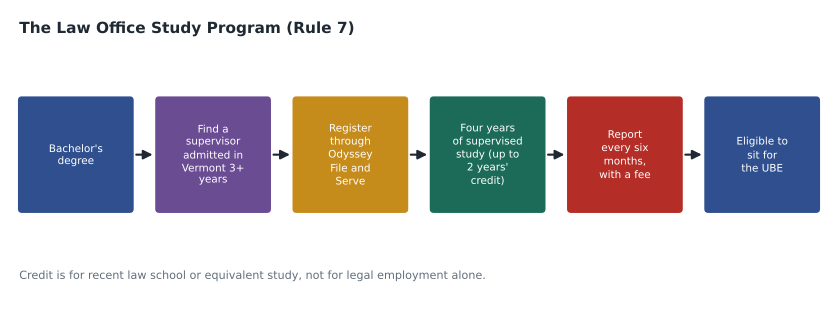
To enter the program, a participant must hold a bachelor's degree from an institution whose accreditor is approved by the United States Department of Education, or a foreign undergraduate degree shown to be equivalent. The participant must find a supervisor: a judge or attorney who practices in Vermont and has been admitted to the Vermont bar for at least three years before the apprenticeship starts. The Office of Attorney Licensing keeps a list of judges and lawyers who have said they are willing to supervise, which helps participants who do not already have a connection to a law office.
The apprenticeship lasts four years. During that time, the participant follows a systematic course of study arranged with the supervisor and designed to prepare the participant for general practice. The course must include, at a minimum, the subjects tested on the UBE and related Vermont law. In practice, participants combine reading from treatises and casebooks, written assignments reviewed by the supervisor, observation of hearings and client meetings, and supervised work on real files.
Every six months, the participant files a report with the Board through Odyssey File and Serve, together with a fee. Each report must state the number of weeks the participant studied during the past six months, describe in detail the areas studied, tasks performed and other relevant study or work, and outline the study plan for the next six months. The reports are how the Board monitors the program and confirms that the participant's four years are real study, not simply employment.
A participant may ask the Board for credit of up to two years for prior study. The prior study must be recent and must take the form of law school coursework or an equivalent program. Prior legal employment, such as working as a paralegal, does not count unless it was part of a law-office study program. The Board decides whether to award credit and how much.
Hattie's reports show how a well-run program works. In her first year, she read the standard first-year subjects, from contracts and torts to civil procedure, and wrote a short memorandum each week that Quimby marked up in red. In her second and third years, she drafted wills, deeds and pleadings under his review, sat in on town zoning hearings and an Environmental Division hearing on an Act 250 permit, and attended criminal arraignments. In her fourth year, she concentrated on the UBE subjects she had covered least in the office, including federal civil procedure and evidence, and began a commercial bar review course in the fall of 2026.
LOS candidates have historically passed the bar at lower rates than law school graduates, and Marchetti does not hide that. 'You have advantages,' she told Hattie. 'You have actually drafted a deed and argued with a zoning administrator. But you did not have three years of law school exams teaching you how to write a fast, organized answer to a hypothetical. That is what we will work on.'
Graduates of foreign law schools
A graduate of a law school outside the United States can sit for the Vermont exam after obtaining a determination that the foreign legal education is equivalent. The applicant must show training in a common-law system and admission to a bar of general jurisdiction abroad, in good standing; the Board may waive the good-standing requirement for good cause. The foreign equivalency application carries a fee of 50 dollars, and if the Board needs an expert foreign equivalency report, there is an additional charge of 250 dollars.
Timing matters. Foreign equivalency applications for admission by examination must be filed by December 1 for the following July exam or by August 1 for the following February exam, well before the regular application deadlines. Graduates of certain Canadian law schools listed by the Board do not need an equivalency report, although they must still file the application. For a Canadian-trained lawyer in Quebec or Ontario who wants to practice across the border in Vermont, that exemption makes the process simpler.
Filing deadlines
Vermont has one deadline per exam, with no late filing period. For the February 2027 exam, the application had to be received by November 15, 2026. For the July 2027 exam, the first NextGen administration, the application must be received by April 15, 2027. NCBE's jurisdiction listing confirms that Vermont has no late filing deadline for either administration.
The word received is important. A candidate who mails or uploads an application on the evening of the deadline and assumes it will be counted as timely is taking an avoidable risk. Hattie filed her application on November 6, 2026, nine days early, and then called the Office of Attorney Licensing the following week to confirm that the file was complete.
| Exam | Application must be received by | Foreign equivalency filed by |
|---|---|---|
| February 2027 (legacy UBE) | November 15, 2026 | August 1, 2026 |
| July 2027 (first NextGen) | April 15, 2027 | December 1, 2026 |
Fees
Under Rule 26, applicants must pay the required fees by their due dates. The rule itself no longer lists dollar amounts. Instead, the Court Administrator sets the fees, and the Judiciary publishes them on its website, where they may change. The Board's notes explain that the amounts were removed from the rule for that reason. Candidates should check the current published fee schedule when they file rather than relying on figures from a study guide or a classmate.
Application fees are generally nonrefundable. An applicant who withdraws may ask the Board in writing for a refund, and the Board may grant one in its discretion only on a showing of extraordinary circumstances. Even then, the refund excludes a nonrefundable administrative fee. Law Office Study Program participants also pay a fee with each six-month report.
Accommodations
Rule 28 provides for reasonable accommodations for applicants with disabilities. A candidate who needs extra time, a separate room, assistive technology or another accommodation should request it early, with the supporting documentation the Board requires. Accommodation requests take time to review, and a candidate who waits until the filing deadline may find that the review cannot be completed before the exam.
What can go wrong
The most common problems in Vermont applications are the same as in other states. Candidates miss the deadline because they confuse it with another state's. Candidates submit incomplete applications and assume the Office will contact them. LOS participants miss a six-month report, which can call into question whether a period of study counts. Foreign-trained candidates start the equivalency process too late. Each of these can cost a candidate an entire exam cycle, because Vermont gives the exam only twice a year and has no late filing period.
Worked problem
Checking LOS eligibility
Prudence Rowell, a paralegal for six years in a Rutland firm, registered for the Law Office Study Program in October 2024 with a supervising attorney admitted in Vermont in 2019. She asks the Board for two years of credit for her paralegal work. She has never attended law school. When can she sit for the bar exam?
Show solution
- Supervisor: admitted in 2019, more than three years before October 2024, so the supervisor qualifies.
- Credit: prior legal employment does not count unless it was part of an LOS-type program; paralegal work alone does not qualify for prior-study credit.
- Length: without credit, she must complete four years of supervised study, ending in October 2028.
- Reports: she must file a report every six months, with a fee, throughout the four years.
Answer: Prudence is unlikely to receive credit for her paralegal years and should plan on completing four years of study in October 2028, which would make the February 2029 exam her first realistic sitting.
Common mistakes
MistakeVermont has a late filing period for a higher fee.
InsteadVermont has one deadline per exam and no late filing period.
MistakeAny experienced paralegal can get credit toward the Law Office Study Program.
InsteadCredit of up to two years is for recent law school coursework or an equivalent program; legal employment alone does not count.
MistakeAn LOS supervisor can be any lawyer licensed anywhere.
InsteadThe supervisor must be a Vermont judge or practicing attorney admitted in Vermont for at least three years before the apprenticeship starts.
MistakeFees are listed in Rule 26.
InsteadRule 26 refers to fees set by the Court Administrator and published on the Judiciary website.
MistakeStudents can sit for the exam any time before graduating.
InsteadStudents at ABA-accredited schools may sit after five semesters of full-time study and must graduate within seven months.
A filing checklist
Marchetti gives every candidate the same short checklist for the weeks before the filing deadline. Confirm the correct exam and the correct deadline. Gather the documents the application requires, including the law school certificate or, for LOS participants, proof of completion of the program and the supervisor's certifications. Confirm the current fee on the Judiciary's published schedule. Submit through Odyssey File and Serve as the instructions require, and keep a copy of the filing confirmation. Then, a week later, contact the Office of Attorney Licensing to confirm that the file is complete. Candidates who follow the checklist rarely lose an exam cycle to paperwork.
Hattie added one item for LOS candidates: make sure every six-month report has been filed and accepted before applying, because the Board relies on those reports to confirm that the four years of study are complete. Her last report, filed in September 2026, described her final six months of study and confirmed that her four years were done.
Summary and key terms
- Rule 6 requires the study of law through an ABA-accredited or Court-approved school, the Law Office Study Program, a qualifying non-approved U.S. school or an approved foreign education.
- The Law Office Study Program requires a bachelor's degree, four years of supervised study under a Vermont judge or attorney admitted at least three years, and reports every six months.
- Up to two years of credit may be given for recent law school or equivalent study, not for employment alone.
- Students at ABA schools may sit after five semesters of full-time study if they graduate within seven months.
- Deadlines: November 15 for February and April 15 for July, with no late period; foreign equivalency by August 1 or December 1.
- Fees are set by the Court Administrator and published on the Judiciary website; refunds only for extraordinary circumstances.
- 0
- study of law
- 1
- Law Office Study Program
- 2
- supervising attorney
- 3
- six-month report
- 4
- prior-study credit
- 5
- early exam option
- 6
- foreign equivalency
- 7
- Odyssey File and Serve
- 8
- Rule 26
Practice problems
Work each problem on paper first, then reveal the answer to check.
How long is the Law Office Study Program?
Show answer
Four years of supervised study, with possible credit of up to two years for recent prior law study.
Who can supervise an LOS participant?
Show answer
A Vermont judge or attorney practicing in Vermont who has been admitted to the Vermont bar for at least three years before the apprenticeship starts.
What is the filing deadline for the July 2027 Vermont exam?
Show answer
The application must be received by April 15, 2027.
Does Vermont require an equivalency report for graduates of Canadian law schools?
Show answer
Not for the Canadian schools the Board lists, although those graduates must still file the application.
Lesson quiz · 5 questions
Score 60% or more to complete this lesson.
Create a free account to save your progress, take quizzes and earn a certificate.