
BAR-246 · Lesson 5 of 12 · 19 min
Exam changes ahead: Vermont and the NextGen bar exam in July 2027
▶ Video coming soon A video version of this lesson is on the way.
At the group's November session, Marchetti put a slide on the screen with two dates: February 2027 and July 2027. 'Hattie, you are on the left side of this line,' she said. 'If you pass in February, the NextGen exam is just something you read about. If you do not, your retake in July will be a different exam.' Hattie did not enjoy hearing it, but she understood the point. Vermont is one of the first states to give the NextGen bar exam, and a candidate deciding when to sit has to understand the change.
This lesson covers the Vermont Supreme Court's decision to adopt the NextGen bar exam, the transition dates, the 620 passing score, how the new exam differs from the legacy UBE, and what the transition means for score transfer and for candidates who might retake.
The decision
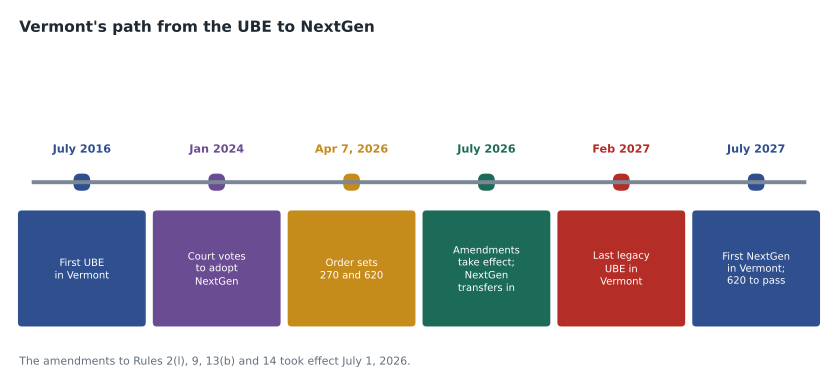
The Vermont Supreme Court voted at its January 2024 administrative meeting to adopt the NextGen bar exam, and NCBE announced Vermont's decision on January 17, 2024. Vermont's first NextGen administration will be in July 2027. February 2027 is Vermont's final legacy UBE.
NextGen is NCBE's replacement for the current UBE components. NCBE designed it after a multi-year study of what newly licensed lawyers actually do, and it aims to test a narrower set of legal knowledge together with a broader set of lawyering skills. NCBE first offered the NextGen exam in July 2026 in a small group of jurisdictions, and more jurisdictions are scheduled to join in 2027 and 2028, with the legacy UBE ending after February 2028.
The rule amendments
The Court prepared its rules for the transition in an order dated April 7, 2026, effective July 1, 2026. The order amended four parts of the Rules of Admission.
First, it amended the definition of the Uniform Bar Examination in Rule 2(l) to include both the legacy UBE and the NextGen UBE. Second, it amended Rule 9(b)(2) to set the passing score at 270 for the legacy UBE and 620 for the NextGen UBE. The Board's notes explain that 620 maps directly from 270 and keeps the standard stable during the transition. Third, it amended Rule 13(b) so that Vermont can accept transferred NextGen scores earned elsewhere even before Vermont gives its own first NextGen exam in July 2027. Fourth, it amended Rule 14 so that NextGen scores earned before July 2027 count properly toward the five-year limitation on admission without examination. A related amendment to Rule 9(c)(7)(B) incorporates the NextGen exam into the requirement to re-file after a failed attempt.
| Rule | Change in the April 7, 2026 order |
|---|---|
| Rule 2(l) | UBE defined to include the legacy UBE and the NextGen UBE |
| Rule 9(b)(2) | Passing score 270 (legacy) and 620 (NextGen) |
| Rule 9(c)(7)(B) | Re-filing rule covers NextGen failures |
| Rule 13(b) | Transferred NextGen scores accepted before July 2027 |
| Rule 14 | NextGen scores before July 2027 count toward the five-year limit |
NCBE's own jurisdiction listings have not always kept pace with Vermont's rules. One NCBE help page still listed Vermont's NextGen passing score and first score acceptance date as to be announced in late 2026, while the Vermont Judiciary's admission page and the amended Rule 9(b)(2) state 620. When an NCBE summary and Vermont's own rules disagree, the Vermont rule controls.
What NextGen tests
The NextGen exam is organized around two kinds of content. The first is foundational concepts and principles: a narrower set of legal doctrine than the legacy MBE and MEE, covering civil procedure, contract law, evidence, torts, business associations, constitutional law, criminal law and constitutional protections, real property, and, from later administrations, limited family law. The second is foundational lawyering skills: legal research, legal writing, issue spotting and analysis, investigation and evaluation, client counseling and advising, negotiation and dispute resolution, and client relationship and management.
The exam does not test those skills in separate sections. Instead, NextGen integrates knowledge and skills across question types. Some questions are standalone multiple-choice questions much like MBE items. Others come in sets built around a common fact pattern, mixing multiple-choice and short written answers. Integrated question sets ask applicants to work through a realistic client matter, using legal resources provided with the questions, in a way that resembles the MPT.
The format in Vermont
The Vermont Judiciary describes the NextGen exam as entirely computer-based. It consists of three three-hour sessions. Each session includes two integrated question sets and about 40 multiple-choice questions. Applicants complete it over a day and a half rather than two full days, and they take it on their own laptops using exam software rather than on paper answer sheets.
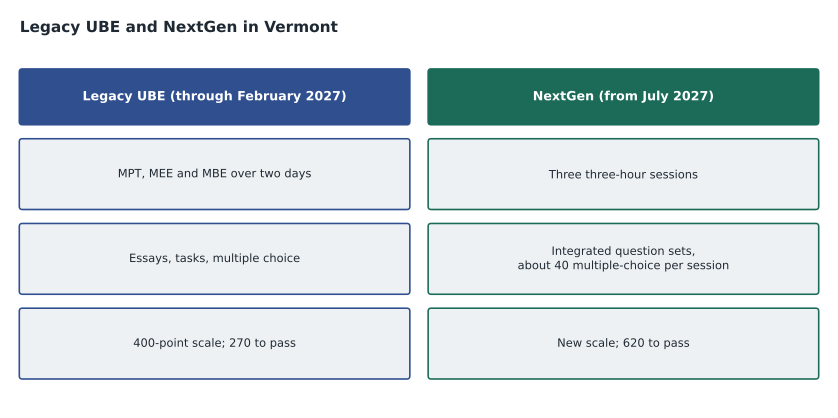
| Feature | Legacy UBE (through February 2027) | NextGen (from July 2027) |
|---|---|---|
| Delivery | Paper MBE; laptops for written components | Entirely computer-based |
| Structure | MPT, MEE, MBE over two days | Three three-hour sessions |
| Question types | Essays, performance tasks, multiple choice | Integrated question sets, standalone multiple choice, short answers |
| Content | Seven MBE subjects plus MEE subjects | Foundational concepts and lawyering skills |
| Vermont passing score | 270 | 620 |
The new score scale
NextGen scores are reported on a new scale rather than the 400-point UBE scale, and NCBE's guidance tied NextGen passing standards to the legacy standards jurisdictions already used. A jurisdiction with a 260 legacy standard would set 610; one with a 270 standard would set 620. Vermont's choice of 620 follows that guidance directly. Because the two scales are different, a candidate cannot combine a legacy score and a NextGen score or carry part of one exam into the other.
Score transfer during the transition
Vermont accepts both legacy UBE scores and NextGen UBE scores from other jurisdictions, as long as the score meets Vermont's standard for that exam and is no more than five years old when the application is filed. A candidate who took NextGen in July 2026 in one of the first jurisdictions to give it, and scored at least 620, can transfer that score to Vermont now, even though Vermont itself has not yet given the new exam. That is what the April 2026 amendment to Rule 13(b) was designed to allow.
Legacy UBE scores remain transferable for their full five-year life. Hattie's February 2027 score, if she passes, will be usable for transfer to other UBE jurisdictions according to each jurisdiction's own rules, and NextGen jurisdictions have said they will continue to accept legacy scores during the transition.
What the change means for candidates
For a candidate deciding when to sit, the most important consequence is that a failed February 2027 exam cannot be retaken in the same format in Vermont. A February candidate who fails will retake in July 2027 on NextGen, with different preparation materials and a different structure. Commercial bar review companies have built NextGen courses, but there is far less official practice material than for the legacy exam, which has decades of released MEE and MPT questions.
Candidates should also watch the subjects. NextGen tests a narrower body of doctrine than the legacy MBE and MEE, with some subjects, such as conflict of laws and secured transactions, not tested as foundational concepts. A candidate who prepared for February and must retake in July should not assume that every subject they studied will appear, or that every skill tested in July was practiced in February.
Worked problem
Choosing between February and July
Emmeline Cady graduates from an ABA-accredited law school in May 2027. She wonders whether she could have taken the February 2027 exam under the early exam option and whether she should, given the change to NextGen. She completed five semesters of full-time study by December 2026.
Show solution
- Early option: a student at an ABA-accredited school may sit after five semesters of full-time study, if she graduates within seven months of sitting.
- Timing: February 2027 to May 2027 graduation is within seven months, so she would have been eligible if she had filed by November 15, 2026.
- Risk: if she fails in February, her retake would be NextGen in July 2027, a different exam.
- Alternative: sitting for the first time in July 2027 means one preparation, on NextGen, after graduation.
Answer: Emmeline's choice is between a February legacy sitting with abundant practice material and a NextGen retake risk, or a single July NextGen sitting after graduation. Either is permitted; the decision turns on her course load, her readiness and how she weighs a format change on a retake.
Why Vermont moved early
Vermont is a small jurisdiction with a small number of applicants each year, and its Court chose to join the first group of jurisdictions rather than wait. Moving early also aligns Vermont with neighbors and with other jurisdictions in the first group, which makes score transfer easier for northern New England lawyers. The cost is that early candidates face an exam with a short track record. Marchetti put it to the group simply. 'Every new exam has a first class. Vermont's July 2027 candidates will be one of them.'
Common mistakes
MistakeVermont gives its first NextGen exam in February 2027.
InsteadFebruary 2027 is the last legacy UBE; the first NextGen exam in Vermont is July 2027.
MistakeVermont's NextGen passing score has not been set.
InsteadThe April 7, 2026 order set 620, effective July 1, 2026.
MistakeVermont cannot accept NextGen scores until it gives the exam itself.
InsteadAmended Rule 13(b) allows transfer of NextGen scores before July 2027.
MistakeA legacy and a NextGen score can be combined.
InsteadThe scales differ; scores cannot be combined.
MistakeNextGen keeps separate essay and performance test sections.
InsteadIt uses integrated question sets and standalone questions in three three-hour sessions.
Preparing for NextGen
Candidates who will sit for Vermont's July 2027 exam, whether for the first time or as a retake, should adjust their preparation. NCBE publishes a content scope outline and sample questions for NextGen, and commercial bar review companies offer NextGen courses. Because NextGen emphasizes skills such as legal research with provided resources, client counseling and negotiation, candidates should practice reading and applying unfamiliar legal materials under time pressure, much as the MPT requires. The integrated question sets reward careful reading of a client file and the ability to switch between short written answers and multiple-choice questions on the same facts.
Computer-based delivery also matters. NextGen is taken entirely on a laptop, so candidates should practice on screen rather than on paper, get used to reading long passages and legal resources on a monitor, and learn the exam software's tools for highlighting and navigation. Candidates who prepared for the legacy exam with printed practice materials will need time to adapt.
Advice for a February 2027 candidate
Marchetti's advice to Hattie and the other February candidates was practical. Prepare fully for February as though there will be no second chance, because the second chance is a different exam. Use the large body of released legacy materials, especially MEE questions with analyses and past MPTs. If the February result is a fail, take a short break and then begin NextGen preparation from the content outline rather than simply repeating the legacy course. A February candidate's legacy knowledge will still help in July, because the foundational concepts overlap heavily with the MBE subjects, but the format and skills emphasis will be new.
Watching for further changes
Transition rules can change, and NCBE and the Vermont Board publish updates as jurisdictions move to NextGen. Candidates should check the Vermont Judiciary's admission page and the Board's notices before filing, before the exam and after receiving results. Hattie set a reminder to check the page on the first day of each month until her admission.
What NextGen means for Vermont law offices
The transition also affects supervising lawyers and employers. A Vermont firm hiring a new graduate in 2027 or 2028 may have associates who passed different exams, with different skills emphasized. NCBE's research for NextGen identified tasks new lawyers perform most often, such as researching a legal issue, drafting a client communication and evaluating facts, and the exam is built around those tasks. Quimby, who has supervised two LOS participants and several summer interns, sees the change as a closer match to what a small Vermont office actually asks of a new lawyer. 'The legacy exam asked whether you knew the rule against perpetuities,' he said. 'The new one asks whether you can read a statute you have never seen and tell a client what it means. I need the second skill every day.'
For Law Office Study Program participants, the change may be especially relevant. The program's emphasis on supervised practical work lines up with NextGen's emphasis on lawyering skills, and LOS participants who sit in July 2027 or later will be tested in a format closer to the work they have been doing in the office. The program's course of study still must include the subjects tested on the UBE, and participants and supervisors should adjust their study plans to the NextGen content scope outline as Vermont's first NextGen administration approaches.
Summary and key terms
- The Vermont Supreme Court voted in January 2024 to adopt NextGen; the first Vermont administration is July 2027.
- February 2027 is Vermont's last legacy UBE.
- An April 7, 2026 order, effective July 1, 2026, set passing scores of 270 (legacy) and 620 (NextGen).
- Vermont accepts transferred NextGen scores before July 2027 under amended Rule 13(b).
- NextGen is computer-based, with three three-hour sessions of integrated question sets and about 40 multiple-choice questions each.
- A February 2027 candidate who fails will retake on NextGen in July 2027.
- 0
- NextGen bar exam
- 1
- foundational concepts and principles
- 2
- foundational lawyering skills
- 3
- integrated question set
- 4
- 620 passing score
- 5
- score transfer
- 6
- legacy UBE
- 7
- transition
Practice problems
Work each problem on paper first, then reveal the answer to check.
When will Vermont first give the NextGen bar exam?
Show answer
July 2027.
What passing score did Vermont set for NextGen?
Show answer
620, which maps from the 270 legacy standard.
Can a candidate who scored 625 on NextGen in another state in July 2026 transfer that score to Vermont now?
Show answer
Yes, if it is no more than five years old at filing and the other requirements are met; amended Rule 13(b) allows it.
How is the NextGen exam structured in Vermont?
Show answer
Three three-hour computer-based sessions, each with two integrated question sets and about 40 multiple-choice questions.
Lesson quiz · 5 questions
Score 60% or more to complete this lesson.
Create a free account to save your progress, take quizzes and earn a certificate.