
BAR-246 · Lesson 1 of 12 · 17 min
Becoming a lawyer in Vermont
▶ Video coming soon A video version of this lesson is on the way.
Hattie Lafountain joined Hollis Marchetti's Tuesday study group in the fall of 2026 with a story none of the other candidates could match. She grew up on her family's dairy farm outside St. Albans, finished a bachelor's degree at a Vermont college, and then, instead of going to law school, spent four years reading law in a Montpelier law office under the supervision of Abner Quimby, a general practitioner who has handled wills, land deals, town disputes and the occasional criminal case for three decades. Hattie is one of a small number of people in the country who will sit for the bar exam without a law degree. Vermont is one of the few states where that is still possible.
Marchetti asked her to describe the path in one sentence at her first session. 'The Vermont Supreme Court decides who becomes a lawyer, the Board of Bar Examiners runs the exam, the Character and Fitness Committee decides whether I am fit to practice, and I have to pass the UBE with a 270, score 80 on the MPRE, and then finish fifteen hours of Vermont CLE and a mentorship in my first year.' Marchetti smiled. 'That is most of the course. The rest is detail, and in bar admission the detail is where people get hurt.'
This lesson maps the institutions that regulate Vermont lawyers, the routes into Vermont practice and the shape of the process from first filing to the oath. Later lessons go deeper into each step.
Who controls admission
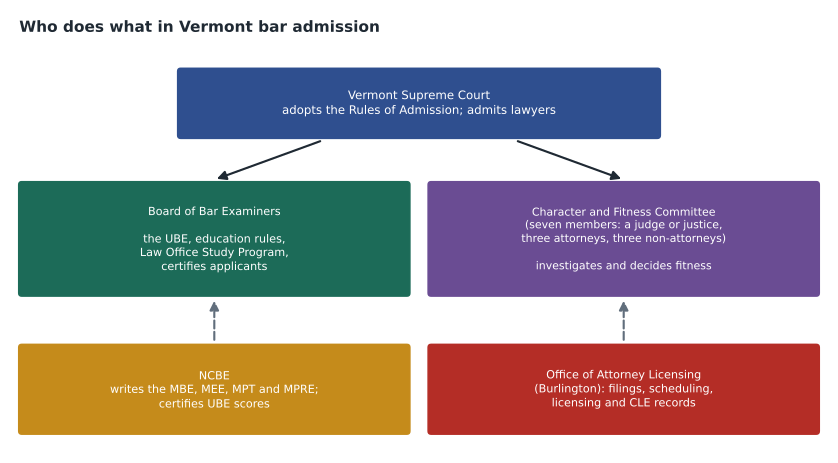
In Vermont, as in nearly every state, the power to decide who may practice law belongs to the state's highest court. The Vermont Supreme Court regulates the practice of law, adopts the Rules of Admission to the Bar of the Vermont Supreme Court, and makes the final decision on every admission. The Rules of Admission are the governing text for everything in Lessons 1 through 5 and Lesson 11. The current rules are posted by the Judiciary in an unofficial compiled version dated as of July 1, 2026, which includes the Court's April 2026 amendments for the NextGen bar exam.
Rule 1 of the Rules of Admission establishes two bodies that do the work. The Board of Bar Examiners, governed by Rule 3, administers the bar examination, evaluates applicants' educational qualifications, oversees the Law Office Study Program and certifies applicants who meet the requirements. The Character and Fitness Committee, governed by Rule 4, decides whether each applicant has the character and fitness to practice law. The Committee has seven members: one retired justice or an active or retired judge, three attorneys and three members of the public who are not attorneys. That mix of lawyers and non-lawyers reflects the idea that fitness to practice is a question in which the public has a direct stake.
Both bodies are supported by the Office of Attorney Licensing, which is part of the Vermont Judiciary and sits in the Costello Courthouse on Cherry Street in Burlington. The Office of Attorney Licensing is the place a candidate actually deals with: it receives applications, answers questions, schedules the exam and later handles annual licensing and continuing legal education records. Vermont files are submitted electronically through the Judiciary's electronic filing system, Odyssey File and Serve, which Hattie had already used for her six-month study reports.
The role of NCBE
The National Conference of Bar Examiners is not a Vermont body, but it touches almost every Vermont applicant. NCBE writes the components of the Uniform Bar Examination that Vermont gives: the Multistate Bar Examination, the Multistate Essay Examination and the Multistate Performance Test. It also writes and administers the Multistate Professional Responsibility Examination, which Vermont requires. Under Rule 10, the Board grades the UBE together with NCBE under NCBE's procedures, and NCBE certifies each applicant's score. NCBE's public listing for Vermont also notes that NCBE conducts character and fitness investigations for some types of applications.
What NCBE does not do is decide who is admitted. It produces scores and reports; the Board certifies, the Committee decides fitness and the Supreme Court admits.
| Body | What it does |
|---|---|
| Vermont Supreme Court | Adopts the Rules of Admission; admits applicants; hears appeals from character and fitness decisions |
| Board of Bar Examiners | Runs the bar exam; evaluates education; oversees the Law Office Study Program; certifies applicants |
| Character and Fitness Committee | Seven members (a judge or justice, three attorneys, three non-attorneys); investigates and decides fitness |
| Office of Attorney Licensing | Receives filings, schedules the exam, handles licensing and CLE records |
| NCBE | Writes the MBE, MEE, MPT and MPRE; certifies UBE scores; conducts some character investigations |
Three ways in
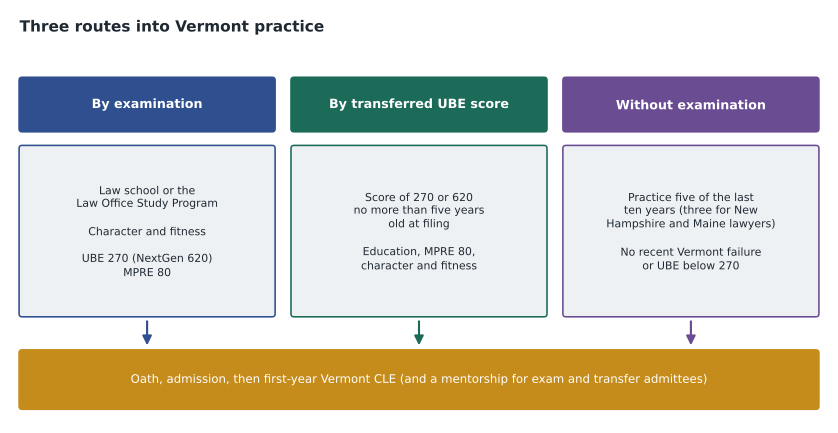
There are three basic routes to a Vermont law license. Lesson 2 and Lesson 11 cover each in detail.
The first and most common route is admission by examination. An applicant meets the education requirements, passes character and fitness review, achieves a passing UBE score in Vermont and an MPRE score of at least 80, and then completes Vermont's post-admission requirements. The education requirement can be met through a law degree from an ABA-accredited or Court-approved law school or through the Law Office Study Program, the four-year apprenticeship Hattie completed.
The second route is admission by transferred UBE score. Vermont accepts UBE scores earned in other jurisdictions if the score meets Vermont's passing standard, the score is no more than five years old when the application is filed, and the applicant meets Vermont's education, MPRE and character requirements. A candidate who sits for the UBE in New Hampshire, for example, can transfer the score to Vermont rather than sit again.
The third route is admission without examination, sometimes called admission on motion. An experienced lawyer licensed in another United States jurisdiction can be admitted without taking an exam if the lawyer has actively practiced for a required period, generally five of the preceding ten years, with a shorter three-year period for lawyers admitted in New Hampshire or Maine. Lesson 11 covers the details and conditions.
Who can apply
Rule 5 sets the general requirements every applicant must satisfy. An applicant must be at least 18 years old and must be a United States citizen or a lawfully present alien. Every applicant must establish good moral character and fitness to practice under the process in Rules 16 through 19. Applicants for admission by examination or by transferred score must also meet the study-of-law requirements in Rule 6, through law school or the Law Office Study Program, and must achieve the required MPRE score under Rule 11.
Vermont does not require an applicant to live in Vermont, and it does not require a Vermont office. Hattie's group includes a candidate from New Hampshire who expects to transfer his UBE score to Vermont later because his firm handles cases on both sides of the Connecticut River. That kind of cross-border practice is common in northern New England, and the three states' admission rules reflect it.
A timeline from start to oath
For an applicant taking the February 2027 exam, the main stages look like this. The application must be received by November 15, 2026. Character and fitness review begins as soon as the application is filed and runs alongside exam preparation. The exam is given in late February at a hotel in South Burlington. Results follow some weeks later. Once the applicant has a passing UBE score, a qualifying MPRE score and character and fitness certification, the Board certifies the applicant to the Supreme Court, the applicant takes the oaths required by statute and the state and federal constitutions, and the Court admits the applicant.
Admission is not the end of the process. Under Rule 12, a new lawyer admitted by examination or by transferred score must complete at least 15 hours of continuing legal education on Vermont practice and procedure and a mentorship with an experienced Vermont lawyer, and must certify completion within one year after admission. Failure to certify changes the lawyer's license to inactive status. Lesson 11 covers these first-year requirements, which surprise many candidates who assume that passing the exam is the last hurdle.
The oath
Rule 20 governs the final step. An applicant who has been certified for admission takes the oaths required by Vermont law, including the attorney's oath under 12 V.S.A. section 5812 and the oath under section 5851, along with oaths to support the constitutions of Vermont and the United States. The oaths may be administered by specified judicial officers, and the rule allows them to be given remotely by audio-visual communication. Many new Vermont lawyers still choose a ceremony in a courtroom with family present, but remote administration means that a candidate living out of state does not have to travel to Vermont simply to be sworn in.
Why Vermont is different
Vermont is a small bar. The state has a population of well under a million people, a single law school in South Royalton, and a lawyer population that is small enough for many practitioners to know one another. Several features of its admission system follow from that size and history.
First, Vermont keeps a law office study route. Most states abolished reading the law during the twentieth century. Vermont, along with a handful of others, never did, and its program is structured with a supervising lawyer, a four-year commitment and reports every six months. Lesson 2 covers the program.
Second, Vermont adds a structured first year. The combination of Vermont-specific CLE and a mentorship is designed to make sure that a new lawyer who passed a national exam learns how Vermont actually works: its unified courts, its land use system, its town government and its procedural habits.
Third, Vermont keeps pace with national change. Vermont has given the UBE since July 2016, and the Vermont Supreme Court voted in January 2024 to adopt the NextGen bar exam, with the first administration in July 2027. Vermont will therefore be among the first states to give the new exam. Lesson 5 covers what that means for a candidate deciding when to sit.
Fourth, Vermont cooperates closely with its neighbors. Its admission-without-examination rule gives special treatment to lawyers admitted in New Hampshire and Maine, and both of those states treat Vermont lawyers in a similar way. For a lawyer in the Upper Valley or the Northeast Kingdom, a two-state or three-state practice is a realistic plan.
How to use this course
Lessons 2 through 6 follow the admission process: eligibility and education, character and fitness and the MPRE, the exam itself, the NextGen transition, and the relationship between what the UBE tests and what Vermont law says. Lessons 7 through 10 cover Vermont law that matters to a new Vermont lawyer even though the UBE does not test it directly: the courts and civil procedure, torts and claims against government, family law and estates, and the professional conduct rules. Lesson 11 covers score transfer, admission without examination and the first year of practice. Lesson 12 brings everything together in practice questions and an exam-day plan.
Marchetti's advice to Hattie was the same advice she gives every candidate. 'Know the rules of your own admission as well as you know the rule against perpetuities. More people lose months to a missed form than to a missed MBE question.'
Common mistakes
MistakeThe Board of Bar Examiners admits lawyers in Vermont.
InsteadThe Vermont Supreme Court admits lawyers; the Board certifies applicants who meet the requirements.
MistakeCharacter and fitness is decided by the Board of Bar Examiners.
InsteadA separate seven-member Character and Fitness Committee, including three non-attorneys, decides fitness.
MistakeVermont requires a law degree from an ABA-approved school.
InsteadA Court-approved school or the four-year Law Office Study Program also satisfies the education requirement.
MistakePassing the exam completes the process.
InsteadNew lawyers must complete 15 hours of Vermont CLE and a mentorship and certify within one year after admission.
MistakeNCBE decides who passes in Vermont.
InsteadNCBE certifies scores, but the Board certifies applicants and the Court admits them.
Summary and key terms
- The Vermont Supreme Court regulates admission through the Rules of Admission to the Bar, compiled as of July 1, 2026.
- The Board of Bar Examiners runs the exam and certifies applicants; the seven-member Character and Fitness Committee decides fitness.
- The Office of Attorney Licensing in Burlington handles filings, which are made through Odyssey File and Serve.
- Three routes: examination, transferred UBE score, and admission without examination.
- Applicants must be at least 18 and a citizen or lawfully present; no residency requirement.
- New admittees complete Vermont CLE and a mentorship within one year after admission.
- Vermont has given the UBE since July 2016 and gives its first NextGen exam in July 2027.
- 0
- Vermont Supreme Court
- 1
- Board of Bar Examiners
- 2
- Character and Fitness Committee
- 3
- Office of Attorney Licensing
- 4
- Rules of Admission
- 5
- NCBE
- 6
- Law Office Study Program
- 7
- admission without examination
- 8
- transferred UBE score
Practice problems
Work each problem on paper first, then reveal the answer to check.
Which body decides whether an applicant has the character and fitness to practice in Vermont?
Show answer
The Character and Fitness Committee, a seven-member body with a judge or justice, three attorneys and three non-attorneys.
What are the three routes into Vermont practice?
Show answer
Admission by examination, admission by transferred UBE score, and admission without examination for experienced lawyers.
What must a new Vermont lawyer do in the first year after admission?
Show answer
Complete at least 15 hours of CLE on Vermont practice and procedure and, if admitted by exam or transferred score, a mentorship, and certify completion within one year.
Can the attorney's oath be administered remotely in Vermont?
Show answer
Yes. Rule 20 allows the oaths to be administered by audio-visual communication.
Lesson quiz · 5 questions
Score 60% or more to complete this lesson.
Create a free account to save your progress, take quizzes and earn a certificate.