
BAR-246 · Lesson 8 of 12 · 19 min
Vermont torts: comparative negligence, the Tort Claims Act and claims against towns
▶ Video coming soon A video version of this lesson is on the way.
In her third LOS year, Hattie worked on a file that taught her more tort law than any casebook. A client, a school bus driver named Asa Shatney, had swerved to avoid a town plow truck on an icy road in Washington County, slid into a ditch and broke his leg. The plow driver had been driving in the center of the road. Asa had been going a little faster than the conditions allowed. The questions came quickly: Who could Asa sue? Did his own speed bar recovery? Could the plow driver be sued personally? Did it matter that the truck belonged to a town rather than the state? Quimby made her answer each one in writing before he would let her draft the complaint.
This lesson covers the Vermont tort rules a new lawyer meets most often: comparative negligence under 12 V.S.A. section 1036, Vermont's duty-to-assist statute, damages, claims against the State under the Vermont Tort Claims Act, and claims against towns and their employees.
Comparative negligence
Vermont abandoned the common law rule of contributory negligence by statute. Under 12 V.S.A. section 1036, contributory negligence does not bar recovery in an action for death, personal injury or property damage caused by negligence, as long as the plaintiff's negligence was not greater than the causal total negligence of the defendant or defendants. When the plaintiff can recover, the damages are diminished in proportion to the plaintiff's share of the fault.
Vermont's rule is therefore a modified comparative negligence rule of the 'not greater than' type, sometimes called the 51 percent rule. A plaintiff who is 50 percent at fault recovers half of the damages; a plaintiff who is 51 percent at fault recovers nothing. The comparison is between the plaintiff's negligence and the total negligence of all the defendants, not each defendant separately. A plaintiff who is 40 percent at fault can recover against two defendants who are 30 percent at fault each, even though the plaintiff is more at fault than either one alone.
The statute also addresses how liability is divided among defendants. When recovery is allowed against more than one defendant, each defendant is liable for the proportion of the total damages that matches the ratio of that defendant's causal negligence to the total causal negligence of all defendants against whom recovery is allowed. The reach of that apportionment rule, including how it interacts with joint and several liability where the plaintiff is not at fault, has been the subject of Vermont case law, and a new lawyer should research the current case law before advising a client about collecting a judgment from multiple defendants.
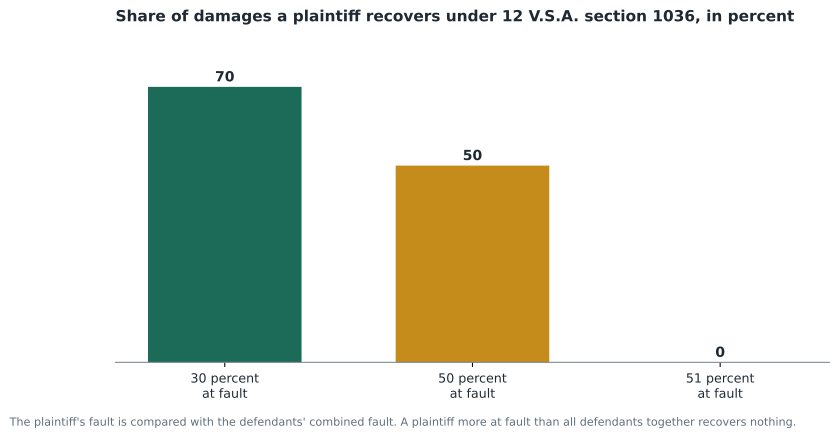
| Plaintiff's fault | Defendants' combined fault | Result under section 1036 |
|---|---|---|
| 20 percent | 80 percent | Recovers 80 percent of damages |
| 50 percent | 50 percent | Recovers 50 percent of damages |
| 40 percent | 60 percent (30 and 30) | Recovers 60 percent, apportioned between the two defendants |
| 51 percent | 49 percent | Recovers nothing |
The duty to assist
Vermont is one of the few states with a statutory duty to assist strangers. Under 12 V.S.A. section 519, a person who knows that another is exposed to grave physical harm must, to the extent that it can be done without danger or peril to themselves or without interference with important duties owed to others, give reasonable assistance to the exposed person, unless that assistance is being provided by others. A person who willfully violates the duty can be fined. The statute also protects people who give reasonable assistance in good faith from civil liability unless their acts constitute gross negligence or they receive compensation.
The duty-to-assist statute is a contrast with the general common law rule, tested on the UBE, that there is no affirmative duty to rescue a stranger absent a special relationship or the defendant's own creation of the peril. On the exam, the general no-duty rule applies. In Vermont practice, section 519 is a distinctive feature, though prosecutions under it are rare and its main practical effect is the good-faith immunity it provides.
Damages
Vermont has not enacted a general statutory cap on compensatory damages in personal injury cases, and juries decide damages under the usual common law principles. Punitive damages are available in Vermont, but the plaintiff must show that the defendant acted with malice, which Vermont courts describe in terms of conduct manifesting personal ill will, evil motive or a reckless or wanton disregard of the plaintiff's rights. Punitive damages are not available for ordinary negligence. The State's liability under the Tort Claims Act is capped, as discussed below.
Claims against the State: the Vermont Tort Claims Act
At common law, the State of Vermont, like other states, was immune from suit. The Vermont Tort Claims Act, 12 V.S.A. chapter 189, waives that immunity in part. Under section 5601(a), the State is liable for injury to persons or property or loss of life caused by the negligent or wrongful act or omission of a State employee acting within the scope of employment, under the same circumstances, in the same manner and to the same extent as a private person would be liable. Claimants cannot levy execution against State property to collect a judgment, and the Superior Courts have exclusive jurisdiction over these actions.
Section 5601(b) caps the State's liability. Effective July 1, 2011, the maximum liability of the State is 500,000 dollars to any one person and 2,000,000 dollars in the aggregate to all persons arising out of each occurrence. In a serious injury case, the cap can be the most important number in the file.
Section 5601(e) lists exceptions to the waiver. The Act does not apply to claims based on the exercise or performance of a discretionary function, even if the discretion was abused; to claims based on an employee's execution of a statute or regulation with due care; to certain tax and customs matters, quarantines and fiscal operations; to certain National Guard activities; to claims arising from intentional torts such as assault, battery, false imprisonment and fraud; to claims for which a statutory remedy is already provided; and to certain highway design decisions. Under section 5601(f), however, the exceptions do not apply to the extent that a liability insurance policy purchased by the Secretary of Administration provides coverage. Section 5601(g) makes clear that the Act does not waive the State's Eleventh Amendment immunity from suit in federal court.
The Act also makes the action against the State the exclusive remedy for most claims based on a State employee's conduct within the scope of employment. The employee generally cannot be sued personally for that conduct, although the statute preserves claims against employees in certain cases of gross negligence or willful misconduct.
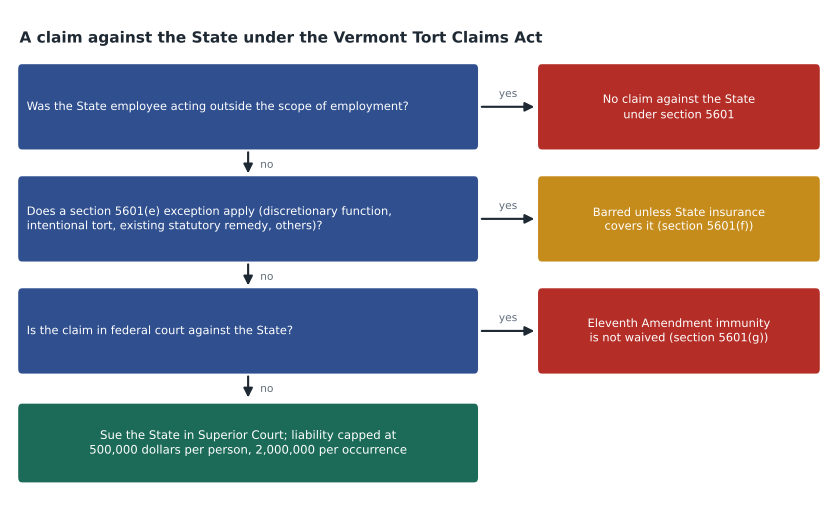
| Feature | Vermont Tort Claims Act |
|---|---|
| Waiver | State liable like a private person for employees acting within the scope of employment (section 5601(a)) |
| Court | Superior Court has exclusive jurisdiction |
| Cap | 500,000 dollars per person; 2,000,000 dollars per occurrence (section 5601(b), effective July 1, 2011) |
| Exceptions | Discretionary functions, intentional torts, existing statutory remedies and others (section 5601(e)) |
| Insurance | Exceptions do not apply to the extent State insurance covers the claim (section 5601(f)) |
| Federal court | No waiver of Eleventh Amendment immunity (section 5601(g)) |
Claims against towns
Claims against Vermont's cities, towns and villages are governed by a different framework. Vermont common law has traditionally distinguished between a municipality's governmental functions, for which it enjoyed immunity, and its proprietary functions, such as operating a utility, for which it could be liable like a private business. Vermont law also provides that a municipality that purchases liability insurance waives its immunity to the extent of the coverage. The result is that the insurance policy, and the line between governmental and proprietary activity, often decide whether a town can be held liable.
Claims against municipal employees are channeled to the municipality by 24 V.S.A. section 901a. When a municipal employee's act or omission within the scope of employment causes property damage, injury or death, the exclusive right of action is against the municipality, and the employee or the employee's estate cannot be sued for that conduct. The statute defines municipal employees broadly to include paid employees and certain volunteers whose services were requested by the legislative body, a municipal officer or an employee acting within their authority, which covers many volunteer firefighters and similar roles.
When the municipality stands in the employee's place, it may raise any defense the employee could have raised, but it must give up any defense the employee could not have used, including municipal sovereign immunity. The rule therefore does more than shift the defendant: in a case covered by section 901a, the town cannot hide behind its own immunity for conduct that the employee would have answered for personally. Section 901a does not apply to acts or omissions that were willful, intentional or outside the scope of the employee's authority, and the statute provides for the municipality to defend and indemnify employees in specified situations.
Municipal liability has been a recurring subject at the Statehouse. In the 2025 and 2026 sessions, the Vermont League of Cities and Towns presented testimony asking the legislature to consider monetary caps on municipal liability. A lawyer handling a claim against a town should check whether any change has been enacted since this course was written.
Worked problem
Asa Shatney and the town plow
Asa, 30 percent at fault for driving too fast for the icy conditions, was injured when he swerved to avoid a town plow truck driven by a town employee who was 70 percent at fault for driving in the center of the road. Asa's damages are 200,000 dollars. Whom should he sue, and what can he recover?
Show solution
- Defendant: under 24 V.S.A. section 901a, the plow driver acted within the scope of employment, so the exclusive right of action is against the town, not the driver.
- Immunity: in the substituted action, the town must give up municipal sovereign immunity, because the driver could not have raised it.
- Comparative negligence: Asa's 30 percent fault is not greater than the defendant's 70 percent, so he can recover under section 1036.
- Damages: 200,000 dollars reduced by his 30 percent share leaves 140,000 dollars.
Answer: Asa should sue the town, not the driver, and he can recover about 140,000 dollars, subject to proof of damages and any coverage or other defenses the town can raise in the driver's place.
The State's employees and the town's employees compared
The two regimes look similar but differ in important details. A claim against the State proceeds under the Tort Claims Act, with a statutory waiver, defined exceptions and a cap. A claim against a town proceeds under the common law of municipal liability, the insurance waiver and section 901a, with no statewide cap under current law. In both, the employee generally drops out of the case and the public entity becomes the defendant. A new lawyer who identifies early which regime applies avoids suing the wrong defendant and missing the real limits on recovery.
Common mistakes
MistakeA Vermont plaintiff who is partly at fault recovers nothing.
InsteadUnder section 1036, a plaintiff recovers reduced damages if the plaintiff's fault is not greater than the defendants' combined fault.
MistakeThe plaintiff's fault is compared with each defendant separately.
InsteadIt is compared with the total causal negligence of all defendants.
MistakeThe State's liability under the Tort Claims Act is unlimited.
InsteadIt is capped at 500,000 dollars per person and 2,000,000 dollars per occurrence.
MistakeA town employee can be sued personally for negligent driving on the job.
InsteadUnder 24 V.S.A. section 901a, the exclusive right of action is against the municipality.
MistakeOn the UBE, a bystander has a duty to rescue because of Vermont's statute.
InsteadThe UBE tests the general no-duty rule; section 519 is a Vermont-specific statute.
Summary and key terms
- Section 1036: modified comparative negligence; a plaintiff recovers reduced damages if not more at fault than the defendants combined.
- Section 1036 apportions damages among defendants by their share of fault; research how it interacts with joint and several liability.
- Section 519 imposes a limited duty to assist and grants good-faith immunity to rescuers.
- Punitive damages require malice; there is no general cap on compensatory damages.
- The Vermont Tort Claims Act waives State immunity subject to exceptions and a cap of 500,000 dollars per person and 2,000,000 per occurrence.
- Under 24 V.S.A. section 901a, claims for municipal employees' conduct within the scope of employment go against the municipality, which cannot raise sovereign immunity in that action.
- 0
- comparative negligence
- 1
- modified comparative negligence
- 2
- duty to assist
- 3
- malice
- 4
- Vermont Tort Claims Act
- 5
- discretionary function
- 6
- municipal immunity
- 7
- governmental function
- 8
- proprietary function
- 9
- section 901a
Practice problems
Work each problem on paper first, then reveal the answer to check.
A plaintiff is 45 percent at fault and the two defendants are 30 and 25 percent at fault. Can the plaintiff recover?
Show answer
Yes. The plaintiff's 45 percent is not greater than the defendants' combined 55 percent; damages are reduced by 45 percent.
What is the State's maximum liability to one person under the Vermont Tort Claims Act?
Show answer
500,000 dollars, with a 2,000,000 dollar aggregate per occurrence.
Does the Tort Claims Act cover intentional torts such as assault?
Show answer
No. Section 5601(e) excludes them, unless State insurance coverage applies under section 5601(f).
Can a town raise sovereign immunity when it is substituted for its employee under section 901a?
Show answer
No. It must give up any defense the employee could not have used, including municipal sovereign immunity.
Lesson quiz · 5 questions
Score 60% or more to complete this lesson.
Create a free account to save your progress, take quizzes and earn a certificate.