
BAR-243 · Lesson 7 of 12 · 20 min
Tennessee courts and civil procedure
▶ Video coming soon A video version of this lesson is on the way.
Henrietta Ozment handed Beckett two new files on the same Monday in October. The first was a contract dispute over a sawmill's unpaid invoices, which she wanted filed in chancery court. The second was a health care claim against a walk-in clinic in Cookeville for a missed fracture, which she said could not be filed for at least two months. 'Why chancery for one, and why can't we file the other one now?' Beckett asked. Ozment pointed to his Tennessee notebook. 'Those two questions are half of Tennessee civil practice,' she said. 'Write the answers down.'
This lesson covers the structure of the Tennessee courts and how judges are chosen, the Tennessee Rules of Civil Procedure and the ways they differ from federal practice, limitations and the savings statute, the special pre-suit rules for health care liability claims, and the basic routes of appeal. None of this is tested on the UBE. All of it is part of the Tennessee Law Course's subject matter and of a new Tennessee lawyer's first year.
The structure of the courts
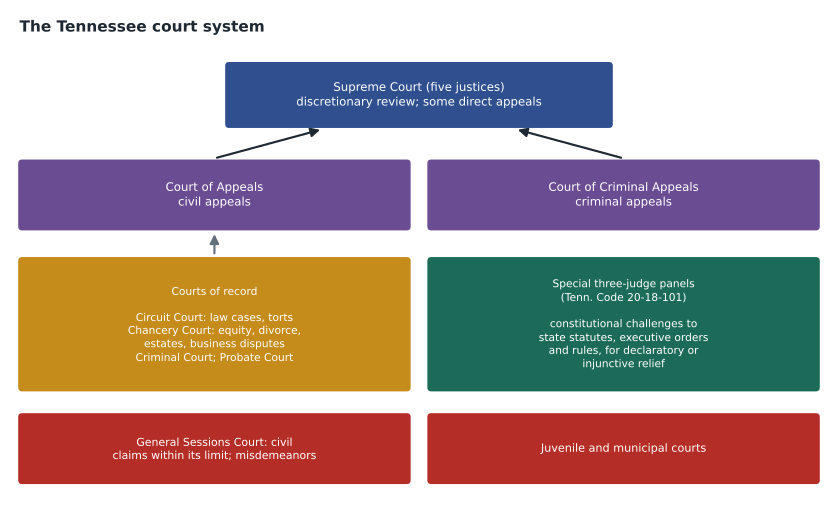
At the top is the Supreme Court of Tennessee, with five justices. It hears most cases by permission, on applications for permission to appeal, and it has the final word on Tennessee law. It also regulates the practice of law through its rules, including Rules 7, 8, 9 and 21.
Below it are two intermediate appellate courts. The Court of Appeals hears civil appeals. The Court of Criminal Appeals hears criminal appeals and related matters. Both sit in panels and hear cases across Tennessee's three grand divisions: East, Middle and West Tennessee.
Tennessee's trial courts of record include circuit courts, chancery courts, criminal courts and, in some counties, probate courts. Circuit courts are courts of general jurisdiction and handle most tort cases. Chancery courts are courts of equity; they handle injunctions, trusts, estates, contract disputes and many business cases, and they share jurisdiction over many civil matters, including divorce, with circuit courts. In many districts the same judge sits in more than one court. Below the courts of record are general sessions courts, which hear civil claims up to a statutory dollar limit, landlord-tenant cases, preliminary criminal matters and misdemeanors, and juvenile and municipal courts.
Henrietta's choice of chancery for the sawmill case followed from those rules. The claim was for an unpaid account, which either court could hear, but the client also wanted an accounting of the buyer's sales and an order freezing certain funds, both equitable remedies. Chancery was the natural forum.
Special three-judge panels
Since 2021, Tennessee has had a distinctive procedure for constitutional challenges to state law. Under Tennessee Code section 20-18-101, a civil action that challenges a state statute, an executive order or an administrative rule on constitutional grounds, seeks a declaratory judgment or an injunction, and is brought against the state, a state agency or a state official in an official capacity must be heard by a three-judge panel. The Supreme Court adds two trial judges to the judge originally assigned, one from each of the other two grand divisions, so that the panel represents the whole state. The Supreme Court designates a chief judge, and the majority decides. The Court's Rule 54 sets out the procedure.
How judges are chosen
Appellate judges in Tennessee, including Supreme Court justices, are chosen under a system approved by voters in a 2014 constitutional amendment. The governor appoints, the General Assembly confirms or rejects the appointment, and the judge then stands in retention elections, in which voters decide whether to keep the judge for a new eight-year term. Trial judges are elected by the voters of their judicial districts for eight-year terms. Vacancies between elections are filled by appointment.
The Tennessee Rules of Civil Procedure
The Tennessee Rules of Civil Procedure, adopted by the Supreme Court with the approval of the General Assembly, are modeled on the Federal Rules of Civil Procedure. The numbering is mostly the same, so a lawyer who knows the federal rules can usually find the corresponding Tennessee rule. But Tennessee has departed from federal practice in several important ways.
Pleading. In Webb v. Nashville Area Habitat for Humanity (2011), the Supreme Court of Tennessee declined to adopt the plausibility standard of Bell Atlantic v. Twombly and Ashcroft v. Iqbal. A motion to dismiss for failure to state a claim under Tennessee Rule 12.02(6) tests only the legal sufficiency of the complaint, taking the factual allegations as true. Tennessee is a notice pleading state.
Summary judgment. Tennessee once had a summary judgment standard, from Hannan v. Alltel Publishing (2008), that made it unusually hard for a moving party to win. The General Assembly responded with Tennessee Code section 20-16-101, effective for cases filed on or after July 1, 2011, and in Rye v. Women's Care Center of Memphis (2015), the Supreme Court overruled Hannan and adopted a standard consistent with the federal approach under Celotex. A moving party that does not bear the burden of proof at trial can win by negating an essential element of the nonmoving party's claim or by showing that the nonmoving party's evidence is insufficient to establish an essential element.
Comparative fault and new parties. Because Tennessee juries allocate fault among everyone who caused an injury, including nonparties, defendants often answer by blaming someone the plaintiff has not sued. Tennessee Code section 20-1-119 gives the plaintiff a remedy. If a defendant's answer alleges that a person not a party caused or contributed to the injury, the plaintiff has 90 days after the answer is filed to amend the complaint to add that person, or to file a separate action against that person, even if the limitation period would otherwise have expired. The statute does not extend a statute of repose.
| Issue | Federal practice | Tennessee practice |
|---|---|---|
| Pleading standard | Plausibility (Twombly, Iqbal) | Traditional notice pleading (Webb, 2011) |
| Summary judgment | Celotex | Rye (2015) and section 20-16-101: similar to Celotex |
| Adding a party blamed in the answer | Relation-back rules of Rule 15(c) | 90 days after the answer under section 20-1-119 |
| Constitutional challenges to state law | Ordinary single-judge court | Three-judge panel under section 20-18-101 |
| Appeal from final judgment | Appeal filed within 30 days (most civil cases) | Appeal filed within 30 days (Tenn. R. App. P. 4) |
Limitations and the savings statute
Tennessee's limitation periods are short, and they catch out lawyers trained elsewhere. The general period for personal injuries is one year from accrual under Tennessee Code section 28-3-104, with a discovery rule. The Board's supplemental torts outline notes that the period is two years when the defendant was criminally charged and prosecuted for the conduct within the one-year period. Injury to real or personal property has three years under section 28-3-105. Claims against local governments under the Governmental Tort Liability Act have twelve months under section 29-20-305(b). Product liability claims have the one-year personal injury period plus a statute of repose under section 29-28-103.
The savings statute, section 28-1-105, softens the effect of a dismissal. If a timely action is dismissed on a ground that does not conclude the plaintiff's right of action, the plaintiff may refile within one year after the dismissal, even if the limitation period has expired. It can be used once. The Board's torts outline notes that it does not apply to claims under the Governmental Tort Liability Act.
Health care liability claims
The walk-in clinic file was governed by the Tennessee Health Care Liability Act, Tennessee Code section 29-26-101 and following, which applies to any claim against a health care provider for injury related to the provision of health care services. Its procedure is strict.
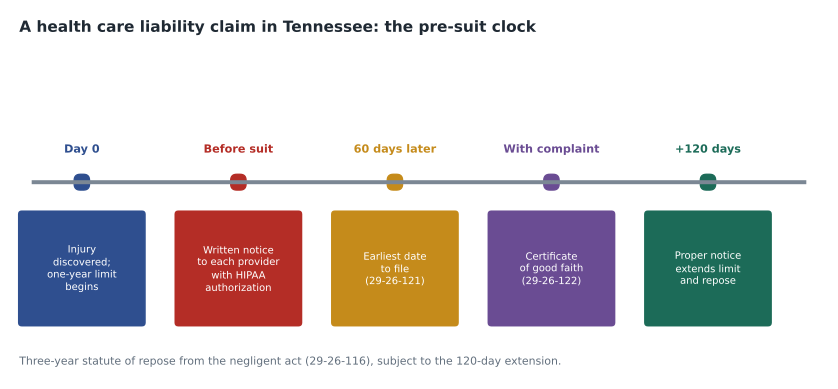
First, pre-suit notice. Under section 29-26-121, the claimant must give written notice of the potential claim to each health care provider who will be a defendant at least 60 days before filing the complaint. The notice must include a HIPAA-compliant authorization allowing the provider to obtain the claimant's medical records from the other providers being sent notice. Tennessee courts require substantial compliance with these content requirements.
Second, the extension. If notice is properly given, the limitation period and the statute of repose are extended by 120 days. That extension is why lawyers send notice well before the one-year limitation period runs.
Third, the certificate of good faith. Under section 29-26-122, in any case in which expert testimony is required, the plaintiff must file with the complaint a certificate stating that the plaintiff or counsel has consulted with a qualified expert who believes there is a good faith basis for the claim. Failure to file the certificate generally results in dismissal.
Fourth, time limits and experts. Section 29-26-116 sets a one-year limitation period from discovery and a three-year statute of repose from the negligent act, subject to narrow exceptions and the 120-day extension. Expert witnesses on the standard of care must generally be licensed in Tennessee or a contiguous state and have practiced in the relevant specialty in the year before the injury, under section 29-26-115(b).
Worked problem
Planning the clinic case
The client was misdiagnosed at the clinic on April 20, 2026 and learned of the missed fracture on May 4, 2026, when a specialist read a new X-ray. Henrietta wants to know the latest safe dates. Assume the discovery rule starts the clock on May 4, 2026.
Show solution
- The one-year limitation period under section 29-26-116 would expire on May 4, 2027.
- If proper pre-suit notice is given to each provider before May 4, 2027, the period is extended by 120 days, to early September 2027.
- Suit cannot be filed until at least 60 days after notice. Sending notice in early December 2026 allows filing in February 2027, well within both periods.
- The complaint must be accompanied by a certificate of good faith based on consultation with a qualified expert, so the firm needs an expert review before filing.
- The three-year repose period from April 20, 2026 is not an issue on these dates.
Answer: Send compliant notice with HIPAA authorizations to each provider by early December 2026, line up the expert consultation, and file with the certificate of good faith after the 60 days have run.
Appeals
An appeal as of right from a final judgment in a civil case is taken under Tennessee Rule of Appellate Procedure 3, by filing a notice of appeal within 30 days after entry of the judgment under Rule 4. Interlocutory appeals are limited: Rule 9 allows one with the permission of both the trial court and the appellate court, and Rule 10 allows an extraordinary appeal by permission of the appellate court alone in narrow circumstances. A party who loses in the Court of Appeals or the Court of Criminal Appeals can seek review in the Supreme Court by filing an application for permission to appeal under Rule 11, generally within 60 days after the intermediate court's judgment.
Practical points for a new lawyer
Ozment's checklist for every new civil file has four lines. Calendar the limitation period on day one, using the shortest period that could apply. Check whether any special statute governs the claim, such as the Health Care Liability Act or the Governmental Tort Liability Act, because each has its own notice rules. Choose the court, circuit or chancery, by the remedies the client wants. And when a defendant's answer blames a nonparty, calendar the 90-day deadline under section 20-1-119 immediately.
Common mistakes
MistakeTennessee follows federal plausibility pleading.
InsteadWebb (2011) kept notice pleading.
MistakeTennessee still applies the Hannan summary judgment standard.
InsteadRye (2015) overruled Hannan; section 20-16-101 also applies.
MistakeA health care claim can be filed the day the lawyer is retained.
InsteadWritten notice must be given at least 60 days before filing, and a certificate of good faith filed with the complaint.
MistakeThe savings statute applies to every claim.
InsteadIt does not apply to claims under the Governmental Tort Liability Act.
MistakeConstitutional challenges to state statutes go to a single chancellor.
InsteadSection 20-18-101 requires a three-judge panel for covered actions against the state.
Discovery and motion practice in brief
Because the Tennessee Rules of Civil Procedure follow the federal rules closely, discovery in Tennessee state court will feel familiar: interrogatories, requests for production, requests for admission and depositions are governed by rules numbered as in federal practice. The differences are mostly local. Many judicial districts have local rules on scheduling, motion hearings and the form of proposed orders, and some chancery and circuit courts set motion dockets on particular days. A new lawyer should read the local rules of each court before filing anything there and should ask the clerk's office how motions are set.
A first-month calendar habit
Ozment requires every new associate to keep a deadline calendar with two independent entries for each critical date, one in the firm's case management system and one on a paper or separate electronic calendar checked weekly. For Tennessee litigation, the critical dates include the limitation period, the GTLA twelve-month period, health care liability notice and filing dates, the 90-day section 20-1-119 window, the 30-day notice of appeal deadline and response deadlines for motions. 'Most malpractice claims against young lawyers are calendar claims,' she told Beckett. 'Not law claims.'
Summary and key terms
- Tennessee has a five-justice Supreme Court, a Court of Appeals, a Court of Criminal Appeals, and circuit, chancery, criminal, probate, general sessions, juvenile and municipal courts.
- Appellate judges are appointed, confirmed and retained by voters; trial judges are elected for eight-year terms.
- Covered constitutional challenges to state law go to three-judge panels under section 20-18-101.
- Tennessee keeps notice pleading (Webb) and uses a Celotex-like summary judgment standard (Rye; section 20-16-101).
- Personal injury has one year (28-3-104); property three years (28-3-105); the savings statute gives one year to refile.
- Health care liability claims require 60-day pre-suit notice, carry a 120-day extension and need a certificate of good faith.
- 0
- circuit court
- 1
- chancery court
- 2
- grand divisions
- 3
- retention election
- 4
- three-judge panel
- 5
- notice pleading
- 6
- savings statute
- 7
- certificate of good faith
Practice problems
Work each problem on paper first, then reveal the answer to check.
Which court is the natural forum for a claim seeking an accounting and an injunction?
Show answer
Chancery court.
How long before filing must health care liability notice be given?
Show answer
At least 60 days.
What does section 20-1-119 allow?
Show answer
Adding a nonparty blamed in the answer within 90 days after the answer.
How long does a party have to file a notice of appeal from a final civil judgment?
Show answer
30 days.
Lesson quiz · 5 questions
Score 60% or more to complete this lesson.
Create a free account to save your progress, take quizzes and earn a certificate.