
BAR-243 · Lesson 1 of 12 · 19 min
Becoming a lawyer in Tennessee
▶ Video coming soon A video version of this lesson is on the way.
Beckett Tisdale joined Hollis Marchetti's Tuesday evening study group with a folder of printouts and a question he had been carrying since graduation. 'Everyone keeps telling me I just need to pass the bar,' he said. 'But the Board's website has a list of steps longer than my grocery list. What actually stands between me and a Tennessee license?' Beckett grew up in Cookeville, in Putnam County, finished his J.D. in May 2026 at an ABA-approved law school in Tennessee, and has clerked since June at Ozment & Hargis, a four-lawyer general practice firm a few blocks from the Putnam County courthouse. He is registered for the February 23 and 24, 2027 exam in Nashville.
Marchetti smiled. 'That list is the right place to start,' she said. 'Passing the exam is one requirement out of several. Candidates who treat the others as paperwork are the ones who end up waiting months for a license after they pass. Tonight we map the whole route, so you know who decides each step and what each step needs from you.'
This lesson introduces the people and bodies that control admission in Tennessee, the sequence of steps from law school to the oath, the main routes into Tennessee practice, and the vocabulary the rest of the course uses. Later lessons take each step in detail.
The Supreme Court controls admission
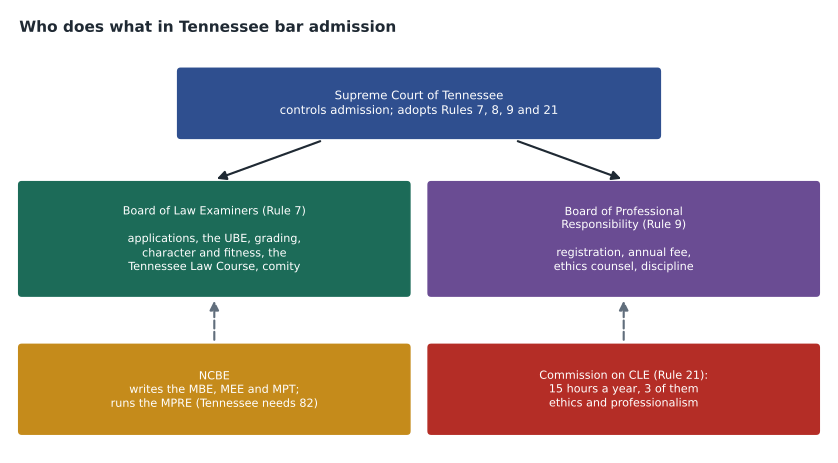
In Tennessee, as in most states, the power to decide who may practice law belongs to the highest court. The preface to Tennessee Supreme Court Rule 7, the Rules for Licensing of Attorneys, says it plainly: the Supreme Court controls admission to the practice of law. The Court adopts and amends the licensing rules, appoints the members of the Board of Law Examiners, approves the Board's policies on matters such as the passing score and the MPRE score, and has the final word on any contested application. It also adopts the Rules of Professional Conduct (Rule 8), the disciplinary rules (Rule 9) and the continuing legal education rules (Rule 21) that govern lawyers once they are licensed.
The Court amends Rule 7 regularly. Its most recent amendment before this course was an order filed and effective October 2, 2026, which the Board announced on its website with a reminder that applicants should review the amended rule and the Board's revised Policies and Procedures. Marchetti's first piece of advice follows from that: read the current version of Rule 7 and the Board's policies, not a summary from a commercial course or a classmate who sat two years ago.
The Board of Law Examiners
The Tennessee Board of Law Examiners administers admission day to day. It is a body of the Supreme Court, with a professional staff in Nashville. The Board receives and processes applications through its online portal, called Synergy. It administers the bar exam, grades the written answers under NCBE's grading process and releases results. It reviews character and fitness, arranges the character and fitness interview, runs the Tennessee Law Course, and decides applications for admission by transferred UBE score and by comity.
Most candidates deal with the Board through Synergy and email. The Board posts announcements on its website, including application opening dates, exam logistics, results dates and rule changes. For the February 2027 exam, for example, the Board announced that applications would open on October 5, 2026 rather than October 1, to finish technical updates to the application system. Candidates who check the announcements page regularly see changes like that in time.
NCBE
The National Conference of Bar Examiners is a national nonprofit, not a Tennessee body. It writes the three parts of the Uniform Bar Examination: the Multistate Bar Examination, the Multistate Essay Examination and the Multistate Performance Test. It also writes and administers the Multistate Professional Responsibility Examination, which Tennessee requires with a scaled score of at least 82.
NCBE plays a second role in Tennessee that surprises some candidates. The character and fitness application is completed on NCBE's system, and NCBE conducts the background investigation and sends a report to the Board. The Board, not NCBE, decides whether an applicant has the required character. A candidate therefore needs two accounts: an NCBE account for the character and fitness application and the MPRE, and a Synergy account for the Tennessee application itself. The Board's instructions stress that the two are separate and that both submissions are needed for a complete application.
The Board of Professional Responsibility
Once a candidate is approved for licensing, the next body is the Board of Professional Responsibility, usually called the BPR. The BPR is the Supreme Court's agency for lawyer registration and discipline under Rule 9. New lawyers register with the BPR and pay one combined fee that covers the law license, BPR registration and enrollment with the appellate court clerk. After admission, lawyers pay an annual registration fee, keep their contact and trust account information current with the BPR, and are subject to its disciplinary process. The BPR also has ethics counsel who answer lawyers' questions about the Rules of Professional Conduct.
The Commission on Continuing Legal Education
The Commission on Continuing Legal Education, created under Rule 21, tracks the CLE that Tennessee lawyers must complete. The annual requirement is 15 hours, at least 3 of them in ethics and professionalism. Lesson 11 covers the details, including when a newly admitted lawyer's first compliance year begins.
Voluntary bar associations and support
Tennessee does not have a mandatory, or integrated, state bar. A licensed lawyer must register with the BPR and pay its fees, but membership in the Tennessee Bar Association or a local bar association is voluntary. Many new lawyers join anyway, for practice sections, mentoring and CLE programs. The Tennessee Lawyers Assistance Program offers confidential help to lawyers, judges and law students dealing with stress, substance use and mental health concerns. Marchetti mentions it at the first session of every Tennessee group. 'The months before the bar are some of the hardest in a career,' she said. 'Knowing where to get help is part of the preparation.'
| Body | Main role for a candidate | Where it appears in this course |
|---|---|---|
| Supreme Court of Tennessee | Adopts Rule 7 and the policies; final authority on admission | Lessons 1, 5 and 11 |
| Board of Law Examiners | Applications, the UBE, grading, character and fitness, the Tennessee Law Course | Lessons 2 to 6 and 11 |
| NCBE | Writes the UBE and MPRE; runs the character and fitness application and investigation | Lessons 3 to 5 |
| Board of Professional Responsibility | Registration, fees, ethics counsel and discipline after licensing | Lessons 10 and 11 |
| Commission on CLE | Tracks the 15-hour annual CLE requirement | Lesson 11 |
The route from law school to the oath
For a candidate admitted by examination, the route has a clear order, although some steps overlap. Marchetti draws it as a line of ten boxes on the whiteboard of the video call.
First, education. The candidate needs an undergraduate degree and a J.D. from a law school that meets Rule 7's standards, usually an ABA-accredited school or one approved by the Board. Lesson 2 covers the other routes, including foreign education.
Second, the MPRE. Tennessee requires a scaled score of 82. The score must be earned no more than two years before the bar exam that produces the candidate's qualifying score. Many candidates take the MPRE during law school; Beckett took it in March 2026 and scored 88.
Third, the application. The candidate files the Tennessee exam application in Synergy and completes the NCBE character and fitness application, by the Board's deadline for that exam. For February 2027 the Board's final deadline is December 1, 2026.
Fourth, character and fitness. NCBE investigates, the Board reviews, and every applicant has a character and fitness interview. Lesson 3 explains what the Board looks for.
Fifth, the exam itself. Tennessee gives the UBE and requires a total scaled score of 270. February 2027 is the last time Tennessee gives the legacy UBE; from July 2027 it gives the NextGen bar exam. Lessons 4 and 5 cover both.
Sixth, the Tennessee Law Course. This is Tennessee's jurisdiction-specific requirement: a mandatory online course on Tennessee law of about seven and a half hours. Exam applicants get access within ten days after the exam. Lesson 6 covers it.
Seventh, results. The Board posts a pass list and emails results. For the July 2026 exam, scoring delays moved the release from the expected October 1 to October 6, 2026. Results are final; the Board does not regrade.
Eighth, approval for licensing. Once the exam score, the MPRE, the Tennessee Law Course and the character and fitness interview are all complete and approved, the Board approves the applicant for licensing.
Ninth, BPR registration. The new lawyer receives a welcome email from the BPR, registers and pays the combined fee. A Certificate of Eligibility follows, which the Board's page describes as valid for 90 days.
Tenth, the oath. The oath of admission must be taken within two years of the date the exam grades were released, either at an admission ceremony or by affidavit. Only then is the candidate a licensed Tennessee lawyer.
Worked problem
Putting Beckett's steps in order
Beckett graduated in May 2026, took the MPRE in March 2026 and scored 88, filed his Tennessee application on October 12, 2026, and will sit the February 23 and 24, 2027 exam. Which requirements are complete, and which remain?
Show solution
- Education: complete. His J.D. is from an ABA-approved law school, and his undergraduate degree is from a regionally accredited college.
- MPRE: complete. 88 is above Tennessee's 82, and March 2026 is less than two years before February 2027.
- Application and character and fitness: filed. The NCBE investigation and the Board's review are under way, and the interview is still ahead.
- Exam: ahead, on February 23 and 24, 2027. He needs 270.
- Tennessee Law Course: ahead. He gets access within ten days after the exam.
- BPR registration, Certificate of Eligibility and oath: after approval.
Answer: Two requirements are complete and one is under way. The exam, the Tennessee Law Course, the interview and the licensing steps remain.
Other routes into Tennessee practice
Not every Tennessee lawyer passes the bar exam in Tennessee. Rule 7 provides several routes, each with its own requirements.
A lawyer who earned a UBE score in another jurisdiction can apply for admission by transferred UBE score. Tennessee accepts a legacy UBE score of 270 or more, or a NextGen score of 620 or more from July 2026 onward, as long as the score is still valid under Rule 7. Transfer applicants still complete character and fitness and the Tennessee Law Course.
An experienced lawyer licensed elsewhere may qualify for admission without examination, which Tennessee calls admission by comity, under Article V of Rule 7. The Board's current comity page requires that the applicant have been primarily engaged in the active practice of law for a set number of recent years and hold a J.D. from an ABA-accredited or Tennessee-approved law school.
Lawyers who work in-house for a single employer in Tennessee can register as in-house counsel. Lawyers who need to appear in a single Tennessee case can seek admission pro hac vice. Military spouses have their own route. Lesson 11 covers each of these.
Who may apply
Rule 7 also contains requirements that are easy to overlook. An applicant must be a United States citizen or a qualified alien as defined in Tennessee Code section 4-58-102. Applicants upload proof with the application. Applicants must also be at least of legal age and must meet the education rules. A candidate unsure whether an unusual background qualifies should ask the Board early, in writing, before the filing deadline.
How to use this course
This course follows the order of the steps. Lessons 2 and 3 cover the application and character and fitness. Lessons 4 and 5 cover the exam and the change to NextGen. Lesson 6 covers the Tennessee Law Course and the difference between the general law the UBE tests and Tennessee law. Lessons 7 to 10 cover the Tennessee law that matters most in early practice and in the Tennessee Law Course: courts and civil procedure, torts, family law and estates, and the Rules of Professional Conduct. Lesson 11 covers score transfer, comity and the obligations that start after admission. Lesson 12 puts it together with practice questions and an exam-day plan.
Beckett copied Marchetti's ten boxes into his notebook and added a date to each one he could predict. 'Four of these have deadlines I did not know about,' he said. 'That is why we start here,' Marchetti answered.
Common mistakes
MistakeThe Tennessee Bar Association admits lawyers.
InsteadThe Supreme Court controls admission. The Board of Law Examiners administers it; the Tennessee Bar Association is a voluntary organization.
MistakeNCBE decides character and fitness.
InsteadNCBE investigates and reports. The Board reviews the report, interviews the applicant and decides.
MistakePassing the exam is the last step.
InsteadThe Tennessee Law Course, the interview, BPR registration and the oath all follow.
MistakeAny MPRE score counts, however old.
InsteadThe score must be at least 82 and earned no more than two years before the qualifying bar exam, with a narrow exception for lawyers licensed elsewhere.
MistakeThe oath can be taken whenever convenient.
InsteadIt must be taken within two years of the grade release date.
Summary and key terms
- The Supreme Court of Tennessee controls admission and adopts Rules 7, 8, 9 and 21.
- The Board of Law Examiners runs applications, the UBE, character and fitness and the Tennessee Law Course through its Synergy portal.
- NCBE writes the UBE and MPRE and conducts the character and fitness investigation; the Board decides.
- Licensed lawyers register with the Board of Professional Responsibility and meet CLE rules set by the Commission on CLE.
- The exam route runs from education and the MPRE through the application, the exam (270 to pass), the Tennessee Law Course and the interview to BPR registration and the oath.
- Other routes include transferred UBE scores, comity, in-house registration and pro hac vice.
- 0
- Board of Law Examiners
- 1
- Rule 7
- 2
- Synergy
- 3
- NCBE
- 4
- Board of Professional Responsibility
- 5
- Tennessee Law Course
- 6
- comity
- 7
- Certificate of Eligibility
Practice problems
Work each problem on paper first, then reveal the answer to check.
Which body controls admission to practice in Tennessee?
Show answer
The Supreme Court of Tennessee, through Rule 7.
What MPRE score does Tennessee require?
Show answer
A scaled score of 82.
What is Tennessee's jurisdiction-specific requirement?
Show answer
The Tennessee Law Course, an online course of about seven and a half hours.
Within what time must the oath be taken?
Show answer
Within two years of the grade release date.
Lesson quiz · 5 questions
Score 60% or more to complete this lesson.
Create a free account to save your progress, take quizzes and earn a certificate.