
BAR-243 · Lesson 12 of 12 · 17 min
Capstone: Tennessee practice questions and an exam-day plan
▶ Video coming soon A video version of this lesson is on the way.
At the Tuesday session on November 17, 2026, Marchetti gave Beckett a two-part assignment. 'First, a Tennessee file of the kind your firm will hand you in your first month,' she said. 'Write it up as a memo, using Tennessee law. Second, ten short questions that mix admission rules and Tennessee law. Then we build your exam-day plan, and that plan uses none of the Tennessee law at all.' This lesson reproduces the assignment, Beckett's answers and the plan. The file is an original hypothetical; it is not a released bar exam question.
Part one: ten short questions
Marchetti read the questions aloud and gave the group a minute for each. Try them before reading the answers.
Question 1. A candidate scored 84 on the MPRE in November 2024 and sits the Tennessee UBE in February 2027. She has never been licensed. Does her MPRE score count?
Question 2. A candidate fails the February 2027 Tennessee exam and wants to retake in Tennessee in July 2027. Which exam will he take?
Question 3. A lawyer earned a 268 on the July 2026 UBE in a jurisdiction with a 266 passing score. Can she transfer that score to Tennessee?
Question 4. A Tennessee plaintiff is found 50 percent at fault, and the only defendant 50 percent at fault. What does she recover?
Question 5. A client injured in a car crash on November 1, 2025 calls the firm on November 10, 2026. What is the first issue?
Question 6. A jury awards a woman 1,500,000 dollars in noneconomic damages for a broken leg and her husband 300,000 dollars for loss of consortium. No exception applies. What is the maximum combined noneconomic recovery?
Question 7. A couple married eight years has no will. The husband dies leaving his wife and two children. What share does the wife take?
Question 8. A client tells a Tennessee lawyer he will kill a coworker tomorrow. What must the lawyer do?
Question 9. A newly admitted lawyer is sworn in on May 12, 2027. How many CLE hours must she complete for 2027?
Question 10. A candidate writes an MEE answer on a federal complaint's sufficiency using Tennessee's notice pleading standard. What is wrong?
| Question | Answer | Source |
|---|---|---|
| 1 | No. November 2024 is more than two years before February 2027, and she is not licensed elsewhere; she must retake and score 82 | Rule 7 section 4.07(e) and (f) |
| 2 | NextGen; February 2027 is Tennessee's last legacy UBE | April 22, 2024 announcement |
| 3 | No. Tennessee requires 270 for a transferred legacy score | Rule 7 section 3.05; Board transfer page |
| 4 | Nothing; her fault is not less than the defendant's | McIntyre v. Balentine |
| 5 | The one-year limitation period has almost certainly run | Tennessee Code section 28-3-104 |
| 6 | 750,000 dollars combined | Section 29-39-102; Yebuah (2021) |
| 7 | One-third of the intestate estate | Section 31-2-104 |
| 8 | Reveal information to the extent reasonably necessary to prevent the death | RPC 1.6(c)(1) |
| 9 | 15 hours, because she was sworn in before September 1 | Rule 21; Commission FAQ |
| 10 | The MEE tests federal law: Twombly and Iqbal plausibility | UBE scope; Webb applies only in Tennessee courts |
Beckett got nine of ten. He missed question 6, answering 1,050,000 dollars by applying a separate cap to the husband's claim. 'That is exactly why Yebuah matters,' Marchetti said. 'The consortium claim shares the injured spouse's cap.'
Part two: the community center file
The facts. On June 30, 2026, the firm's client, Eulalia Barnhart, slipped on a wet stairway at a community center owned and run by a small city in Putnam County. A cleaning company under contract with the city had mopped the stairs twenty minutes earlier and left no warning sign. City staff had received two complaints that morning about water on the stairs. Ms. Barnhart was reading a text message as she started down. She broke her right wrist. At a walk-in clinic that afternoon, the provider read the X-ray as normal and sent her home with a splint. A specialist diagnosed a displaced fracture on July 9, 2026, and she needed surgery. Her husband, Cornelius, has helped care for her since. She retained the firm on November 16, 2026. She asks two more things: whether the firm can lend her money for rent while the case is pending, and how much she can expect to recover.
Marchetti's instructions: write a memo to Henrietta Ozment covering claims, deadlines, procedure, fault, damages and the ethics question. Use Tennessee law.
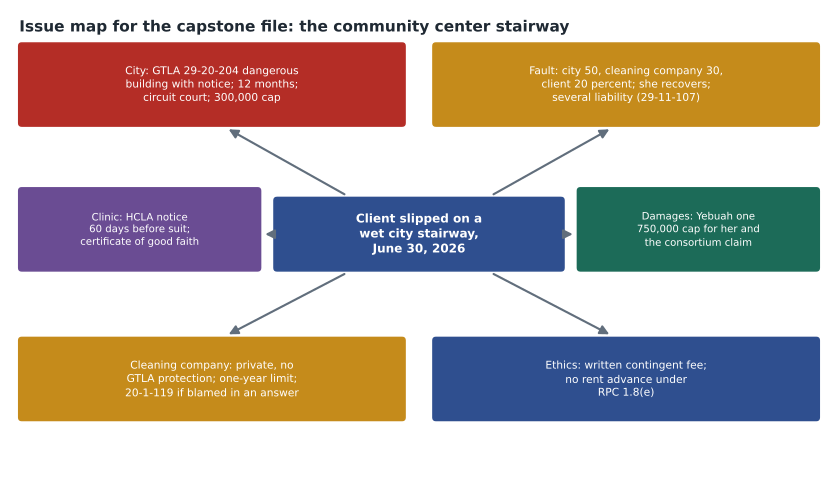
Beckett's memo
Question presented. What claims does Ms. Barnhart have against the city, the cleaning company and the clinic, what must the firm do and by when, and how are fault and damages likely to be allocated?
Short answer. She has a claim against the city under the Governmental Tort Liability Act for a dangerous condition in a public building, a negligence claim against the cleaning company, and a health care liability claim against the clinic. The GTLA claim must be filed within twelve months of June 30, 2026. The health care claim requires pre-suit notice at least 60 days before filing and a certificate of good faith. Her own inattention will reduce her recovery but will not bar it unless a jury finds her at least as much at fault as the defendants combined. Several liability applies, the GTLA caps limit the city's exposure, and her husband's consortium claim shares her noneconomic cap. The firm cannot lend her rent money.
The claim against the city. Local governments are immune unless the GTLA removes immunity (section 29-20-201). Section 29-20-204 removes immunity for injuries caused by a dangerous or defective condition in a public building owned and controlled by the entity, if the entity had actual or constructive notice of the condition. Two complaints that morning likely give actual notice. Section 29-20-205 may also apply to staff negligence in failing to warn or close the stairs, subject to its exceptions; none appears to apply. The suit must be filed in circuit court within twelve months, by June 30, 2027 (section 29-20-305(b)), and the savings statute will not extend that period. The city's liability for bodily injury is limited to 300,000 dollars for Ms. Barnhart (section 29-20-403).
The claim against the cleaning company. The cleaning company is a private contractor, not a governmental entity, so the GTLA does not protect it. Its employees mopped and left no warning. The one-year personal injury limitation period of section 28-3-104 runs from June 30, 2026, so the firm should sue the company by June 30, 2027. If the firm sues only the city and the city's answer blames the cleaning company, section 20-1-119 gives 90 days after the answer to add the company even if the year has run, but the firm should not rely on that window when the company is already known.
The claim against the clinic. The misread X-ray is a health care liability claim under section 29-26-101 and following. The claim was discovered on July 9, 2026, so the one-year limitation period runs to about July 9, 2027, extended by 120 days if proper pre-suit notice is given (section 29-26-121(c)). The firm must give written notice with a HIPAA-compliant authorization to the clinic and each provider at least 60 days before filing and must file a certificate of good faith with the complaint after consulting a qualified expert (section 29-26-122). The expert must meet the competency rules of section 29-26-115(b).
Fault. A jury will allocate fault among everyone who caused the injury. A plausible allocation is city 50 percent, cleaning company 30 percent and Ms. Barnhart 20 percent for reading her phone. Under McIntyre she recovers because 20 percent is less than the defendants' combined 80 percent, and her damages are reduced by 20 percent. Liability is several (section 29-11-107): the city and the company each pay their own shares. The clinic's liability is for the separate harm caused by the delayed diagnosis.
Damages. Suppose total damages from the fall are 600,000 dollars, of which 200,000 are economic and 400,000 noneconomic, and the husband's consortium award is 100,000 dollars. After the 20 percent reduction, the city's 50 percent share of her damages is 300,000 dollars and the company's 30 percent is 180,000 dollars. The city's share happens to equal the GTLA cap of 300,000 dollars for her. The noneconomic total of 400,000 plus the husband's 100,000 is 500,000 dollars, below the 750,000-dollar cap, which under Yebuah covers both claims together. Punitive damages are unlikely on these facts.
The rent loan. Tennessee RPC 1.8(e) allows a lawyer to advance court costs and the expenses of litigation, but prohibits giving a client financial assistance in connection with pending litigation beyond what the rule allows. Rent money is general living expense, not a litigation expense. The firm should decline and, if appropriate, refer her to community resources. Any contingent fee agreement must be in writing and signed by the client, and statutory limits on fees in health care liability cases must be checked (section 29-26-120).
Next steps. Calendar June 30, 2027 for the city and the cleaning company and about July 9, 2027 for the clinic before any extension; send health care notice by early January 2027 at the latest; obtain an expert review; gather the two morning complaints and the cleaning contract; prepare a written fee agreement.
Marchetti's comments. She gave the memo a high mark and added three notes. First, it correctly separated the city from the private contractor. Second, it would be stronger with a sentence on whether the community center stairs were within the city's control at the time, which section 29-20-204 requires. Third, the next-steps paragraph should list the earliest deadline first, not the claim it belongs to. 'In practice, the calendar is the memo,' she wrote.
Part three: the exam-day plan
Then Marchetti turned to the exam, and the Tennessee law disappeared. 'Everything you just wrote stays in your Tennessee notebook,' she said. 'On February 23 and 24 you answer under the general law and the federal rules. Here is the plan.'
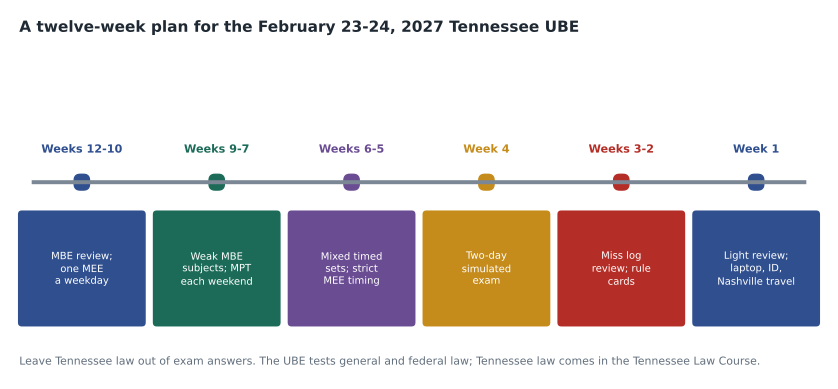
Weeks twelve to ten, from early December: MBE review subject by subject, 34 timed questions every weekday morning, one timed MEE question every weekday evening, and a miss log recording why each wrong answer was wrong.
Weeks nine to seven: shift MBE time toward the two weakest subjects, which for Beckett are Evidence and Real Property, and add one full MPT each weekend on the 15, 25 and 50 minute budget.
Weeks six and five: mixed timed MBE sets of 100 questions, strict 30-minute MEE timing, and a second weekend MPT.
Week four: a full two-day simulated exam on the Tuesday and Wednesday, timed exactly as the real exam, followed by a day of review.
Weeks three and two: review the miss log, make short rule cards for repeat errors, and do one more mixed set of 100 MBE questions.
Week one: light review only. Confirm the ExamSoft mock exam has been uploaded, check the laptop and charger, print the admission ticket, pack the permitted items, confirm identification and drive to Nashville on February 22.
Exam-day checklists
Day one. Arrive early at the Fairgrounds Exposition Center with the admission ticket, identification, laptop, power cord and permitted items. Spend the first 15 minutes of each MPT on the task memo and file. Watch the clock during the MEE and leave time to write a conclusion for every question. Eat lunch, walk, and do not discuss the morning's tasks.
Day two. Bring pencils and permitted items for the paper MBE. Answer every question; there is no penalty for wrong answers. Mark hard questions and return to them. Use any remaining time to check that the answer sheet matches the booklet.
After the exam. Register for the Tennessee Law Course in Synergy, pay the 15-dollar fee, and complete the course when access arrives within ten days. Keep the character and fitness application current. Check the Board's announcements for the results date.
Common mistakes
MistakeBring Tennessee rules into MEE answers to show local knowledge.
InsteadThe UBE tests general law and federal rules; Tennessee law belongs in the Tennessee Law Course and practice.
MistakeThe GTLA claim can be refiled under the savings statute.
InsteadThe savings statute does not apply to GTLA claims; file within twelve months.
MistakeA contractor working for a city shares its GTLA immunity.
InsteadPrivate contractors are not governmental entities under the GTLA.
MistakeA spouse's consortium claim has its own cap.
InsteadYebuah: one 750,000-dollar cap covers both claims.
MistakeRent advances are a normal litigation expense.
InsteadRPC 1.8(e) permits advancing litigation costs and expenses, not living expenses.
What the group learned
At the end of the session Marchetti asked each member to name one Tennessee rule and one exam habit they would carry forward. Beckett chose the GTLA's twelve-month limit, because the capstone showed him how little time a city case allows, and the MPT time budget, because it turned his unfinished first memo into a finished fourth one. 'Both are about the clock,' Marchetti said. 'In practice and on the exam, that is usually the point.'
Summary and key terms
- The MPRE must be 82 or higher and earned within two years before the qualifying UBE, with an exception for lawyers licensed elsewhere.
- February 2027 is Tennessee's last legacy UBE; a July 2027 retake is NextGen.
- In Tennessee practice, calendar the shortest limitation period first: twelve months for the GTLA, one year for personal injury and health care claims.
- McIntyre, several liability, the GTLA caps and Yebuah together determine recovery in multi-defendant cases.
- Health care claims need 60-day pre-suit notice and a certificate of good faith.
- On exam day, use only the general law and federal rules the UBE tests, and follow a timed plan.
- 0
- issue map
- 1
- pre-suit notice
- 2
- removal of immunity
- 3
- several liability
- 4
- derivative claim
- 5
- miss log
- 6
- simulated exam
- 7
- admission ticket
Practice problems
Work each problem on paper first, then reveal the answer to check.
When must the GTLA claim against the city be filed?
Show answer
Within twelve months of June 30, 2026, by June 30, 2027.
Does the GTLA protect the private cleaning company?
Show answer
No; it is not a governmental entity.
Can the firm advance Ms. Barnhart's rent?
Show answer
No; RPC 1.8(e) permits advancing litigation costs and expenses, not living expenses.
Which body of law applies on the MEE?
Show answer
General principles and federal rules, not Tennessee law.
Lesson quiz · 5 questions
Score 60% or more to complete this lesson.
Create a free account to save your progress, take quizzes and earn a certificate.