
BAR-243 · Lesson 3 of 12 · 21 min
Character and fitness and the MPRE
▶ Video coming soon A video version of this lesson is on the way.
Two items on Beckett's NCBE character and fitness application had kept him up at night. In 2022, during his first year of law school, he was cited for driving with an expired registration on Interstate 40 and paid the fine by mail. In 2023, a hospital bill from an emergency room visit went to a collection agency while he was waiting for an insurance appeal; he paid it in full in early 2024 once the appeal was decided. 'Neither of these is a big deal,' he told Marchetti. 'But I keep wondering whether writing them down makes them a big deal.'
'Writing them down is what makes them small,' Marchetti said. 'Leaving them off is what makes them big. Tonight we talk about what the Board is actually looking for, how the process runs, and how to write explanations that answer the Board's questions before it asks them. Then we cover the MPRE, which is the other half of Tennessee's professional responsibility requirement.'
Why character and fitness exists
Every jurisdiction requires bar applicants to show that they have the character and fitness to practice law. The purpose is protection of the public and the courts. Clients trust lawyers with money, secrets and legal rights they cannot protect themselves. Courts depend on lawyers' honesty. The admission process asks whether there is reason to doubt that an applicant will meet those obligations.
Under Rule 7, the applicant bears the burden of proving good moral character and fitness. That point matters. The Board does not have to prove that an applicant lacks character; the applicant has to show that he or she has it. An incomplete or evasive application leaves the burden unmet.
How the process runs in Tennessee
Tennessee uses NCBE for the investigation. The applicant completes the NCBE character and fitness application online and saves a copy as a PDF, which is also uploaded to the Tennessee application in Synergy. The application asks about residence and employment history, education, academic discipline, criminal matters including traffic citations, civil litigation, financial matters such as defaults and collections, prior bar applications, licenses and, within the limits the law allows, conditions that currently affect the ability to practice.
NCBE verifies the answers. It contacts employers, schools and references, checks court and credit records, and compiles a report for the Board. The Board reviews the report alongside the application and may ask the applicant for more information or documents. Every applicant then has a character and fitness interview; the Board's transfer instructions, for example, ask applicants to choose an interview location when they apply. The Board's approval of the interview is required before the applicant moves on to the licensing steps.
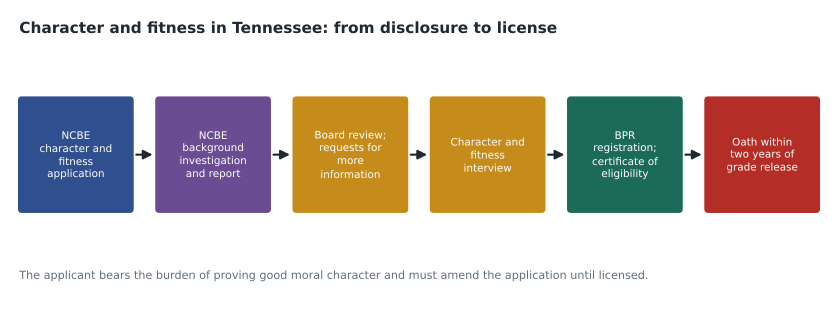
If the Board has concerns that the interview does not resolve, Rule 7 provides procedures for further review, including a hearing, and the applicant can ultimately seek review by the Supreme Court. Those procedures are rare. The great majority of files with disclosures are approved after the applicant explains the matter candidly and shows how it was resolved.
What the Board looks for
Boards across the country look at the same broad categories of conduct, and Tennessee is no different. The most serious concern is dishonesty: false statements, fraud, academic dishonesty and, above all, lack of candor in the application itself. Other concerns include criminal conduct, especially conduct involving violence, dishonesty or drugs; neglect of financial responsibilities, such as unpaid judgments or debts handled irresponsibly; violations of court orders; and conduct showing disregard for the rights of others.
The Board considers factors that put conduct in context: the applicant's age at the time, how recent the conduct was, how serious it was, whether it was a single incident or part of a pattern, the applicant's candor in discussing it, and evidence of rehabilitation. A 2022 registration citation paid promptly is a minor traffic matter. A medical bill that went to collections during an insurance dispute and was paid once the dispute ended is an ordinary financial event. Neither shows dishonesty or irresponsibility, as long as the applicant discloses and explains them.
| Category | Examples | What helps |
|---|---|---|
| Candor | Omissions or false answers on the application | Full disclosure; prompt amendment |
| Criminal and traffic | Arrests, citations, convictions, diversion | Court records; proof of completion |
| Financial | Collections, judgments, defaults, bankruptcy | Payment records; explanation of circumstances |
| Academic | Discipline, honor code findings | School records; what changed afterward |
| Court orders | Missed support payments, ignored subpoenas | Proof of compliance; explanation |
Writing a good explanation
Marchetti teaches a four-part formula for each yes answer. First, state the facts plainly: what happened, when and where. Second, state the outcome: the fine, the dismissal, the payment, the court order. Third, attach the documents that prove it. Fourth, if relevant, say briefly what the applicant learned or changed. The explanation should be short, factual and free of excuses. It should never minimize or blame others.
Beckett's registration citation took two sentences and a copy of the receipt. His collection account took five sentences: the emergency room visit in 2023, the insurance denial and appeal, the referral to collections while the appeal was pending, the payment in full in early 2024 after the appeal was resolved, and a statement that he had no other accounts in collection. He attached the collection agency's paid-in-full letter. 'The Board reads hundreds of these,' Marchetti said. 'It wants facts and proof. You gave it both.'
The duty to amend
The application speaks as of the day it is filed, but the duty of candor continues until licensing. If a new matter arises after filing, the applicant must amend the application promptly: a new traffic citation, a lawsuit, a new debt problem, a change of address or employment. An applicant who amends voluntarily shows exactly the candor the Board wants to see. An applicant who stays silent risks the most serious finding of all, a lack of candor, which can be far worse than the underlying event.
Exam score validity and timing
Character and fitness review runs alongside exam preparation. It can take months, and a candidate who passes the exam cannot be licensed until it is complete. The timing matters because a Tennessee exam score is valid for licensing only for three years after grades are released, under Rule 7 section 4.07(c). The licensing process must be finished before the score expires. In practice, candidates who file complete applications and answer the Board's requests quickly finish long before that limit.
The MPRE
The Multistate Professional Responsibility Examination is a separate exam written and administered by NCBE. It tests the rules governing lawyers' conduct, based mainly on the ABA Model Rules of Professional Conduct and the Model Code of Judicial Conduct, along with generally accepted principles of the law governing lawyers. It is not based on Tennessee's Rules of Professional Conduct, which differ from the Model Rules in several respects covered in Lesson 10.
The MPRE has 60 multiple-choice questions, of which 50 are scored and 10 are unscored pretest questions. Candidates have two hours. Scores are reported on a scale from 50 to 150. NCBE offers the MPRE several times a year, generally in March, August and November, at testing centers and, for some candidates, by remote proctoring. Candidates register through their NCBE account.
Tennessee's MPRE requirement
Tennessee requires a scaled MPRE score of at least 82. That is higher than many jurisdictions, several of which accept 75 or 80. The minimum is set by a policy approved by the Supreme Court.
Rule 7 section 4.07(e) adds a timing rule. An applicant admitted by examination or by transferred UBE score must have earned the qualifying MPRE score no more than two years before the bar exam that produced the qualifying UBE score. The applicant is responsible for making sure NCBE sends the MPRE score report to the Board.
Section 4.07(f) creates an exception for experienced lawyers. An applicant whose qualifying MPRE score is more than two years old can still satisfy the requirement if he or she holds an active license in good standing, obtained by examination, in another United States jurisdiction, provides certificates of admission and good standing from each jurisdiction of admission, and submits the NCBE score report with the application.
NCBE's chart for Tennessee also notes that there are no MPRE time limits for comity applicants. Lesson 11 covers comity.
Worked problem
Does the MPRE score count?
Three members of Marchetti's group want to use their MPRE scores in Tennessee. Beckett scored 88 in March 2026 and sits the February 2027 exam. Ulric Hazlett scored 84 in August 2023 and sits the February 2027 exam; he has never been licensed. Isadora Petree scored 86 in 2017, passed the Georgia exam in 2018 and has practiced in Georgia since; she plans to transfer nothing and sit the February 2027 Tennessee exam. Whose score counts?
Show solution
- Beckett: 88 exceeds 82, and March 2026 is within two years before February 2027. His score counts.
- Ulric: 84 exceeds 82, but August 2023 is more than two years before February 2027. He is not licensed elsewhere, so the 4.07(f) exception does not apply. He must retake the MPRE and score 82 or more.
- Isadora: her 2017 score is more than two years old, but she holds an active Georgia license obtained by examination. If she provides certificates of admission and good standing and the NCBE score report, the exception in section 4.07(f) applies.
Answer: Beckett's and Isadora's scores can be used. Ulric must retake the MPRE.
Preparing for the MPRE
Most candidates prepare for the MPRE in three to five weeks of part-time study. The topics with the most questions are conflicts of interest, the client-lawyer relationship, confidentiality, litigation and other forms of advocacy, the regulation of the legal profession, and the lawyer's duties to the public and the legal system. Candidates should practice with released NCBE questions and learn the Model Rules, not Tennessee's variations, for the exam. After the exam, they should learn Tennessee's differences for practice.
Marchetti's advice for Tennessee candidates is to aim well above 82. 'Do not study to pass a 75 jurisdiction,' she said. 'Eighty-two is a real score. Give yourself a margin.'
Character after admission
The values tested in character and fitness do not end at admission. Lawyers in Tennessee answer to the Board of Professional Responsibility under Rule 9, and the Rules of Professional Conduct treat dishonesty, misuse of client money and lack of candor to courts very seriously. The candor an applicant shows on the NCBE application is the same candor a lawyer owes to clients, courts and the BPR throughout a career.
By mid-November 2026 the Board had asked Beckett for nothing further. 'That is what a good file looks like,' Marchetti said. 'Not a perfect history. A complete one.'
Common mistakes
MistakeMinor traffic citations do not need to be disclosed.
InsteadAnswer every question exactly as asked; if the form asks about citations, list them.
MistakeThe Board must prove an applicant lacks character.
InsteadThe applicant bears the burden of proving good moral character and fitness.
MistakeOnce the application is filed, nothing more is required.
InsteadThe applicant must amend promptly until licensed.
MistakeTennessee accepts an MPRE score of 75.
InsteadTennessee requires 82.
MistakeAny MPRE score works regardless of age.
InsteadIt must be earned within two years before the qualifying UBE, unless the 4.07(f) exception for lawyers licensed elsewhere applies.
A character and fitness checklist
Before filing, Marchetti asks each Tennessee candidate to work through a short checklist. Does every address in the residence history connect to the next with no gaps? Does every job, including summer, part-time and volunteer legal work, appear with accurate dates and a supervisor who can be reached? Has the candidate pulled a personal credit report and compared it with the financial answers? Has the candidate listed every traffic citation, court matter, academic discipline and prior bar application the form asks about, including matters that were dismissed or expunged if the question covers them? Is there an explanation, labeled by question number, with supporting documents for every yes answer?
She also asks candidates to read the completed application aloud, start to finish, a day after they think it is done. Errors that slip past a tired reader at midnight are obvious in daylight. Beckett found two that way: a transposed year in his employment history and a former landlord's address listed for the wrong apartment. Both went into an amendment the same evening.
Preparing for the interview
Every Tennessee applicant has a character and fitness interview, and many candidates find the prospect more stressful than it needs to be. The interview is not a cross-examination. It is a chance for the Board to confirm the application and to hear the applicant explain any disclosures in person. Marchetti's preparation advice is simple. Re-read the application and every attachment the night before. Be ready to describe each disclosed matter in two or three sentences, the same way it was written. Bring copies of key documents. Answer questions directly and do not volunteer speculation. If you do not remember a detail, say so and offer to follow up in writing.
Beckett practiced with Marchetti on a video call. She asked him about the collection account, and he answered in four sentences without looking at his notes: the emergency visit, the insurance appeal, the referral to collections while the appeal was pending, and payment in full once it was decided. 'That is the whole interview for that item,' she said. 'Facts, outcome, proof. You do not need to apologize for having been sick.'
Disclosures that worry candidates most
Three kinds of disclosure come up again and again in Marchetti's groups. The first is academic: a warning or finding in college or law school. The Board looks at what happened, how the school resolved it and whether the applicant was candid about it on the law school application as well as the bar application; inconsistent answers between the two are a much bigger problem than the original incident. The second is financial: student loans in default, collection accounts or a bankruptcy. Debt itself is not disqualifying; irresponsible handling of it can be, and a payment plan or a documented resolution answers most concerns. The third is health: questions about conditions that currently affect the ability to practice. Those questions are narrow, and candidates should answer exactly what is asked and seek confidential advice, including from the Tennessee Lawyers Assistance Program, if they are unsure.
Summary and key terms
- Applicants bear the burden of proving good moral character and fitness under Rule 7.
- NCBE investigates and reports; the Board reviews, interviews every applicant and decides.
- Candor is the most important factor; disclose fully, document outcomes and amend promptly.
- Tennessee exam scores are valid for licensing for three years after grade release (section 4.07(c)).
- Tennessee requires an MPRE score of 82, earned no more than two years before the qualifying UBE (section 4.07(e)).
- Section 4.07(f) excuses an older MPRE score for applicants licensed by examination elsewhere and in good standing.
- 0
- character and fitness
- 1
- burden of proof
- 2
- candor
- 3
- duty to amend
- 4
- MPRE
- 5
- scaled score
- 6
- pretest questions
- 7
- rehabilitation
Practice problems
Work each problem on paper first, then reveal the answer to check.
Who bears the burden of proof in character and fitness?
Show answer
The applicant.
What MPRE score does Tennessee require?
Show answer
82.
How old may a qualifying MPRE score be for a first-time applicant?
Show answer
No more than two years before the bar exam that produced the qualifying UBE score.
What is the most damaging problem in a character and fitness file?
Show answer
Lack of candor, such as omitting or misstating information.
Lesson quiz · 5 questions
Score 60% or more to complete this lesson.
Create a free account to save your progress, take quizzes and earn a certificate.