
BAR-243 · Lesson 4 of 12 · 20 min
The Tennessee bar exam: UBE format, scoring and the 270 passing score
▶ Video coming soon A video version of this lesson is on the way.
Beckett's first full practice MPT came back with a note from Marchetti in the margin: 'Good law, no conclusion.' He had spent fifty minutes reading the file and library, thirty minutes outlining and ten minutes writing, and the memo stopped halfway through the second issue. 'I knew exactly what to say,' he told the group. 'I just ran out of clock.' Marchetti was not alarmed. 'That is the most common first MPT there is,' she said. 'The exam rewards people who understand its structure and spend their time on purpose. Tonight we take the structure apart: what happens each day, how each part is graded, how the parts are combined and what 270 really means in Tennessee.'
Tennessee has given the Uniform Bar Examination since February 2019. The UBE is prepared by NCBE and is the same exam in every UBE jurisdiction. Each jurisdiction grades its own written answers using NCBE's grading materials and sets its own passing score. Tennessee's is 270 on the 400-point UBE scale, which puts it among the higher UBE passing scores. February 2027 is the last time Tennessee will give this exam; Lesson 5 explains what replaces it.
When and where
The February 2027 exam is on Tuesday and Wednesday, February 23 and 24, 2027. The Board's exam page lists one site for February: the Fairgrounds Exposition Center in Nashville. Candidates approved for non-standard testing accommodations test in Nashville, at the same site or another location the Board designates. For July 2027, the Board lists three sites: the Knoxville Convention Center, the Great Hall and Conference Center in Memphis, and the Fairgrounds Exposition Center in Nashville.
Beckett lives about eighty miles east of Nashville on Interstate 40. He booked a hotel room near the fairgrounds for both nights in early November. 'Nothing about traffic on the morning of day one should be a variable,' Marchetti told him.
The two days
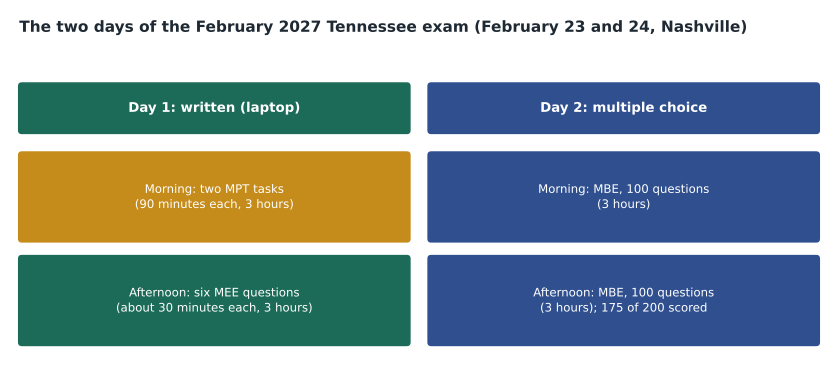
Day one is the written day. The morning session is the Multistate Performance Test: two 90-minute tasks, three hours in total. The afternoon session is the Multistate Essay Examination: six questions, with about 30 minutes suggested for each, three hours in total. Day two is the Multistate Bar Examination: 200 multiple-choice questions, 100 in a three-hour morning session and 100 in a three-hour afternoon session.
| Session | Component | Content | Time |
|---|---|---|---|
| Day 1 morning | MPT | Two performance tasks, each with a file and a library | Three hours (90 minutes each suggested) |
| Day 1 afternoon | MEE | Six essay questions | Three hours (about 30 minutes each) |
| Day 2 morning | MBE | 100 multiple-choice questions | Three hours |
| Day 2 afternoon | MBE | 100 multiple-choice questions | Three hours |
Laptops and ExamSoft
In Tennessee, laptops are used only for the written portions on day one, the MPT and the MEE. The MBE on day two is answered on paper. Candidates who use a laptop must register with ExamSoft during the open registration period and pay ExamSoft's non-refundable license fee, confirm that the laptop meets the minimum system requirements, uninstall older versions of the software, install the current Examplify software on the laptop they will bring, agree to the terms and conditions in Board Policy Appendix C-1, and complete and upload the mock exam by the deadline. Tablets and iPads are not permitted.
ExamSoft notices come directly from ExamSoft, not from the Board. The Board's page advises candidates to add the ExamSoft and Turnitin email domains to their trusted senders so that deadline reminders do not land in a spam folder. Beckett did that the night he registered and set a phone reminder for the mock exam deadline.
The Multistate Bar Examination
The MBE has 200 questions, but only 175 count. The other 25 are unscored pretest questions that NCBE is testing for future exams, mixed in so candidates cannot identify them. The scored questions cover seven subjects: Civil Procedure, Constitutional Law, Contracts (including sales under Article 2 of the Uniform Commercial Code), Criminal Law and Procedure, Evidence, Real Property and Torts. NCBE's subject matter outlines define what can be tested.
The MBE tests generally accepted principles of law, not Tennessee law. Civil Procedure questions are based on the Federal Rules of Civil Procedure and federal jurisdiction statutes, and Evidence questions on the Federal Rules of Evidence. A candidate who answers a torts question by applying Tennessee's 49 percent comparative fault rule, or a civil procedure question by applying the Tennessee Rules of Civil Procedure, may choose the wrong answer. Lesson 6 develops this point.
Raw MBE scores are converted to scaled scores through a statistical process called equating, which adjusts for small differences in difficulty between administrations. Equating means a given scaled MBE score represents the same level of performance on any exam. There is no fixed number of correct answers that guarantees a particular scaled score.
The Multistate Essay Examination
The MEE has six questions. Each is built around a fact pattern that may raise issues from more than one subject. Beginning with the July 2026 exam, NCBE removed four subjects from the MEE: Conflict of Laws, Family Law, Trusts and Estates and Secured Transactions. For February 2027, MEE questions may therefore come from Business Associations (agency and partnership, corporations and limited liability companies), Civil Procedure, Constitutional Law, Contracts and Sales, Criminal Law and Procedure, Evidence, Real Property and Torts.
Older study materials, including some outlines still in circulation, list the removed subjects. A February 2027 candidate can skip MEE practice questions on those subjects. They may still appear in an MPT, where the needed law is supplied in the library.
MEE answers are graded on a relative scale. Graders trained with NCBE's materials compare answers to each other and to the model analysis and assign grades that reflect how an answer ranks among all the answers to that question in Tennessee. A strong answer identifies the issues, states the rules accurately, applies them to the facts and reaches a conclusion. Organization matters, because graders read many answers quickly.
The Multistate Performance Test
Each MPT task gives the candidate a file, containing the facts in memos, letters, transcripts and documents, and a library, containing the law in cases, statutes and rules. The candidate must complete a lawyering task, such as an objective memo, a persuasive brief, a client letter, a contract provision or a discovery plan, using only those materials. The library may contain the law of a fictional jurisdiction. The MPT does not test memorized law. It tests whether a candidate can read, organize and apply legal materials under time pressure and follow the supervising attorney's instructions exactly.
Marchetti teaches a time budget for each 90-minute task: about 15 minutes reading the task memo and the file, about 25 minutes reading the library and building an outline, and about 50 minutes writing. After two more practice tasks on that budget, Beckett finished with five minutes to spare.
How the parts are combined
The UBE total score combines the three components with fixed weights: the MBE counts for 50 percent, the MEE for 30 percent and the MPT for 20 percent. Because the written components are graded on a relative scale, their raw scores are converted, or scaled, to the MBE score scale. That makes written scores comparable from one administration to the next. The scaled MBE and scaled written scores are then combined into a total on a scale that runs to 400.
What 270 means
Tennessee's passing score is 270 on the 400-point scale, the equivalent of 135 on the 200-point scale some jurisdictions use. UBE jurisdictions set their own passing scores: some require 260, others 266, others 270 or more. A score of 270 passes in Tennessee and in every UBE jurisdiction with the same or a lower minimum. A score of 268 earned in Tennessee fails in Tennessee even though it would pass in a 266 jurisdiction, and the candidate could try to transfer it there if that jurisdiction's other rules are met.
There is no separate minimum for any component. A candidate with a weaker MBE can pass with a stronger written score, and the other way round. Every point counts, and no part of the exam can be written off.
Worked problem
Is Beckett on track for 270?
On a full-length practice exam in mid-November 2026, Beckett's estimated scaled MBE score was 131 and his estimated written score, scaled to the MBE, was 141. Using the simplified approach that weights the two halves equally and doubles the result to reach the 400-point scale, is he on track for 270, and where should he focus?
Show solution
- The MBE counts for 50 percent; the MEE and MPT together count for the other 50 percent.
- Weighted average on the 200-point scale: 0.5 times 131 plus 0.5 times 141 equals 136.
- On the 400-point scale: 136 times 2 equals 272, just above 270.
- The margin is only two points. His MBE is the weaker half and the half most responsive to drilling, so he should add timed MBE sets in his weakest subjects, which his miss log shows are Evidence and Real Property.
Answer: Beckett is narrowly on track at about 272. Four or five more scaled MBE points would give him a much safer margin.
Practice scores are estimates
Commercial courses and NCBE's practice products give estimated scores, but they are only estimates. The real scaled score depends on equating and on how a candidate's written answers rank against every other answer in Tennessee on the same day. Marchetti tells Tennessee candidates to aim for practice totals of at least 280. 'In a 270 jurisdiction, a 272 practice score is a coin flip,' she said. 'Build a cushion.'
Exam-day rules
The Board publishes instructions for each administration covering admission tickets, identification, permitted and prohibited items, laptop use and conduct. Candidates acknowledge those instructions in the General Instructions Acknowledgment they upload before the deadline. Bringing a prohibited item, such as a phone, into the testing room can lead to serious consequences under the Board's instructions, including dismissal from the exam. Read the instructions for the specific administration, not last year's version.
Results
The Board emails results and posts a pass list on its website. For July 2026, the Board announced that scoring delays moved the release from the anticipated October 1, 2026 to October 6, 2026, between 5 and 6 p.m. Central time. A candidate whose name does not appear either did not earn the required score or has a score held for another reason. Results are final: the Board does not regrade or reconsider scores. Passing candidates move on to the Tennessee Law Course, the character and fitness interview and licensing. A candidate who does not pass files a re-examination application.
Using the format to plan study
Knowing the format shapes how to study. The MBE is half the score and rewards repeated timed practice with real-style questions and careful review of every error. The MEE rewards precise rule statements and a structure graders can follow quickly. The MPT rewards a disciplined time budget and practice with several task types. A sensible plan spends about half of study time on MBE subjects and practice, about a third on MEE practice and the rest on MPT tasks, adjusted for the candidate's strengths.
Beckett's plan looked like that: MBE sets before work on weekdays, one timed MEE question each weekday evening and two MPTs every weekend. Ozment & Hargis agreed to let him drop to half-time hours from January.
Common mistakes
MistakeThe MEE tests Tennessee law.
InsteadThe MEE tests generally accepted principles. Tennessee writes no questions of its own for the UBE.
MistakeFamily law and trusts and estates are still MEE subjects.
InsteadNCBE removed them, along with conflict of laws and secured transactions, beginning in July 2026. They may appear in an MPT with the law supplied.
MistakeAll 200 MBE questions are scored.
Instead175 are scored; 25 are unscored pretest questions.
MistakeLaptops are used for the whole exam.
InsteadIn Tennessee, laptops are used only for the MPT and MEE on day one.
MistakeA low score can be regraded on request.
InsteadTennessee results are final; the Board does not regrade.
Reading an MEE call
Many weak MEE answers are not wrong on the law. They answer a question the examiners did not ask. Each MEE question ends with one or more numbered calls, and the graders' analysis is organized around those calls. Marchetti teaches candidates to read the calls first, before the facts, and to write each call as a heading in the answer. Then, reading the facts, the candidate marks the facts that bear on each call. That habit prevents the two commonest failures: spending ten minutes on an issue the question never raised, and missing a call entirely because it was buried at the end of a long paragraph.
For each call, a good answer states the conclusion, the rule, the application of the rule to the specific facts and the conclusion again. The rule statement should be precise but short. The application is where most points are earned: graders look for the candidate to use the facts the examiners deliberately put in the question, not general statements that would fit any set of facts.
Building an MBE miss log
The fastest way to raise an MBE score is to learn from wrong answers. After every timed set, Beckett records each miss in a spreadsheet with four columns: the subject and subtopic, the answer he chose, the correct answer and the reason he missed it. He sorts the reasons into four groups: did not know the rule, knew the rule but misread the facts, misread the call, and changed a correct answer. After a month, the pattern was clear. Most of his Evidence misses were hearsay exceptions he did not know cold, while most of his Real Property misses came from misreading which party held which interest. The cure for the first was memorization; the cure for the second was slowing down and diagramming the conveyance.
Summary and key terms
- Tennessee has given the UBE since February 2019; February 2027 (February 23 and 24, in Nashville) is its last legacy UBE.
- Day one: two 90-minute MPT tasks and six MEE questions on laptop. Day two: the 200-question MBE, with 175 scored.
- From July 2026 the MEE no longer covers conflict of laws, family law, trusts and estates or secured transactions.
- Weights: MBE 50 percent, MEE 30 percent, MPT 20 percent; written scores are scaled to the MBE.
- Tennessee requires a total scaled score of 270 on the 400-point scale, with no component minimums.
- Results are final, and practice scores are only estimates; aim for a cushion of about ten points.
- 0
- Uniform Bar Examination
- 1
- MBE
- 2
- MEE
- 3
- MPT
- 4
- equating
- 5
- scaling
- 6
- Examplify
- 7
- passing score
Practice problems
Work each problem on paper first, then reveal the answer to check.
What is Tennessee's UBE passing score?
Show answer
270 on the 400-point scale.
On which day are laptops used in Tennessee?
Show answer
Day one, for the MPT and MEE only.
How many MBE questions are scored?
Show answer
175 of the 200.
Where is the February 2027 Tennessee exam given?
Show answer
At the Fairgrounds Exposition Center in Nashville.
Lesson quiz · 5 questions
Score 60% or more to complete this lesson.
Create a free account to save your progress, take quizzes and earn a certificate.