
BAR-243 · Lesson 2 of 12 · 20 min
Eligibility, education, deadlines and fees
▶ Video coming soon A video version of this lesson is on the way.
Beckett filed his Tennessee application on October 12, 2026, one week after Synergy opened. He was proud of that until a classmate from law school texted him in November: she had just discovered that her undergraduate college's accreditation might need a waiver and was not sure she could get the paperwork in before the deadline. 'How do I know my file is actually complete?' Beckett asked Marchetti the following Tuesday. 'I uploaded what the checklist said. Is there anything the checklist does not say?'
'There is always something the checklist does not say,' Marchetti answered. 'It tells you what to upload. It does not tell you what happens if your school, your degree or your dates do not fit the usual pattern. Tonight we go through eligibility, the education rules, the calendar and the fees, and we look for the places where files usually go wrong.'
This lesson covers who may sit for the Tennessee exam, the education requirements and their alternatives, the filing calendar for the February 2027 exam, the fees, accommodations and withdrawal. The figures come from the Board's published instructions and NCBE's jurisdiction charts as of fall 2026. Fees and dates change, and Marchetti's rule is that the Board's current instructions control whenever they differ from anything in a course, including this one.
The basic eligibility requirements
Rule 7 sets the requirements for admission by examination. An applicant must have the required education, must be a United States citizen or a qualified alien as defined in Tennessee Code section 4-58-102, must file a complete application by the deadline and must pay the required fees. Character and fitness and the MPRE are covered in Lesson 3. Proof of citizenship or qualified-alien status is uploaded with the application.
Undergraduate education
Tennessee expects applicants to hold a bachelor's degree from a regionally accredited college or university. The Board's instructions describe accreditation by the Southern Association of Colleges and Schools or an equivalent regional accreditor. An applicant whose undergraduate degree comes from an unaccredited or foreign institution must request a waiver under Rule 7 section 2.01(c), showing that the education is substantially equivalent. The Board's policies describe what that request must contain. A waiver takes time, so an applicant who needs one should file early in the application window.
Official transcripts must be sent directly from each school that awarded a degree. A transcript the applicant forwards personally does not count. That is one of the most common reasons a file sits incomplete.
Law school education
The usual requirement is a J.D. from a law school accredited by the American Bar Association or approved by the Tennessee Board of Law Examiners. Tennessee is one of the states that approves some law schools that are not ABA-accredited, so graduates of a Board-approved Tennessee school are eligible to sit for the exam. NCBE's chart for Tennessee also notes that graduates of other non-ABA-approved schools can qualify only with additional requirements, including admission in another state and a specified period of practice. For every law school attended, the applicant submits a Law Degree Verification form, which the school completes.
A candidate who is about to graduate can apply before graduation, as long as the degree is conferred before the exam and the school certifies it. Beckett's school sent its verification in October.
Foreign legal education
Rule 7 Article VII gives applicants educated outside the United States three paths, each listed on the Board's exam page. An applicant using any path must file a Foreign-Education Option Election form with the application.
Under section 7.01(a), the applicant shows that the foreign education is substantially equivalent to a United States bachelor's degree and J.D. That requires a credential evaluation from a member of the National Association of Credential Evaluation Services.
Under section 7.01(b)(1), the applicant holds a law degree from an accredited foreign law school, is licensed in a United States or foreign jurisdiction, and has practiced for five of the last eight years. The applicant submits an Affidavit of Past Practice.
Under section 7.01(b)(2), the applicant has a qualifying LL.M. from an ABA-accredited or Tennessee-approved law school. The Board's page says the LL.M. must be a traditional or American-law program, taught in English and completed in person, not by distance learning, and the American school must send a verification form directly to the Board. NCBE's chart notes that a foreign graduate needs more than an LL.M. alone and that an educational equivalency determination is part of the process, so a candidate on this path should read the rule itself carefully and confirm the other conditions with the Board.
Applicants licensed outside the United States also submit certified copies of their licenses, three good-standing letters and certified translations where documents are not in English.
| Path | Main requirements | Key documents |
|---|---|---|
| 7.01(a) equivalency | Foreign education substantially equivalent to a bachelor's degree and J.D. | NACES credential evaluation |
| 7.01(b)(1) practice | Accredited foreign law degree, a license, practice in five of the last eight years | Affidavit of Past Practice; license copies |
| 7.01(b)(2) LL.M. | Qualifying in-person LL.M. in English from an ABA-accredited or Tennessee-approved school | School verification form sent to the Board |
The filing calendar for February 2027
For the February 23 and 24, 2027 exam, applications opened in Synergy on October 5, 2026. The Board had planned to open them on October 1 but delayed the opening to finish technical updates. The Board's exam page lists December 1 as the final filing deadline for the February exam, the same date as the deadline for accommodation requests and for uploading the signed General Instructions Acknowledgment.
NCBE's chart for Tennessee lists a first filing deadline of December 1 and a late filing deadline of December 20 for February 2027. The Board's own exam page, by contrast, treats December 1 as the final deadline and does not describe a late period for February 2027. When the two sources differ, the Board's current instructions control. Marchetti's advice is simpler still: file in October or November, and treat December 1 as a hard wall.
For the July 27 and 28, 2027 exam, the Board's page lists May 1 as the final deadline for accommodation requests and the General Instructions Acknowledgment. NCBE's chart for the July 2026 exam showed a first deadline of May 1 and a late deadline of May 20. Candidates planning for July 2027 should check the Board's announcement when that application window opens.
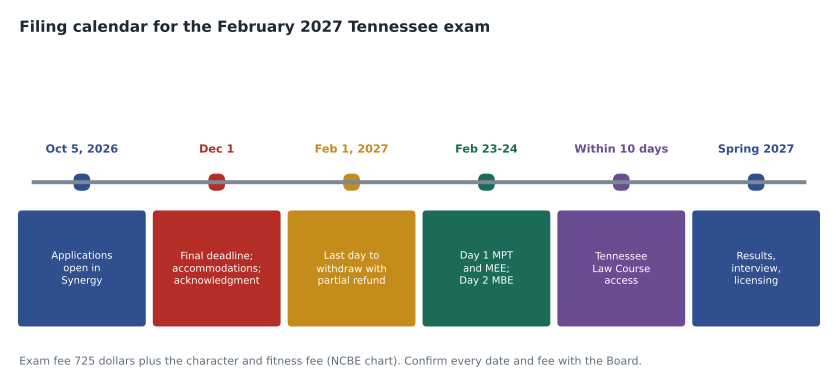
The General Instructions Acknowledgment
Every applicant must sign and upload the Board's General Instructions Acknowledgment by the final deadline: December 1 for February and May 1 for July. The Board's page is blunt that an applicant who does not upload it cannot sit for the exam. The document confirms that the applicant has read the Board's instructions on exam-day conduct, permitted items, laptop use and related rules. It is one page, and it is easy to forget because it is not part of the main application form.
Fees
NCBE's chart for Tennessee, updated in October 2026, lists the bar exam application fee as 725 dollars plus a character and fitness fee, for first-time takers, attorney applicants and repeaters alike. It lists a laptop fee of 100 dollars where laptops are used. The ExamSoft software license is paid separately and directly to ExamSoft; it is non-refundable, and a new license is needed for each exam. The Tennessee Law Course has its own registration fee, which the Board's FAQ lists as 15 dollars. After licensing, the new lawyer pays one combined fee to the BPR covering the license, BPR registration and appellate court enrollment.
For other routes, NCBE's chart lists 675 dollars plus the character and fitness fee for admission by transferred UBE score, and 1,400 dollars plus the character and fitness fee for admission on motion, which Tennessee calls comity.
Fees can be paid online by credit card through a third-party vendor, which charges its own service fee, or by check or money order payable to the Tennessee Board of Law Examiners. Checks must show the applicant's full name and NCBE number. The Board does not accept cash.
| Item | Amount (fall 2026) | Source and notes |
|---|---|---|
| Exam application | 725 dollars plus character and fitness fee | NCBE chart; same for first-time, attorney and repeat applicants |
| Laptop | 100 dollars | NCBE chart; the ExamSoft license is paid separately to ExamSoft |
| Tennessee Law Course | 15 dollars | Board FAQ |
| Transferred UBE score | 675 dollars plus character and fitness fee | NCBE chart |
| Comity | 1,400 dollars plus character and fitness fee | NCBE chart |
| Withdrawal before the refund deadline | Partial refund of 150 dollars | Board FAQ; February 1 for February 2027 |
Withdrawing and changing plans
Plans change. A candidate who withdraws from the February 2027 exam by February 1, 2027, the Board's announced deadline, receives a partial refund, which the Board's FAQ describes as 150 dollars. After that date, no refund is available. A candidate who withdraws and wants to sit later files a new application for the later exam.
For February 2027 candidates, a decision to withdraw has a second consequence that Lesson 5 explains in detail. February 2027 is the last legacy UBE Tennessee will give. A candidate who withdraws and sits in July 2027 will take the NextGen bar exam instead, with a different format and different preparation.
Accommodations
Tennessee offers two kinds of testing accommodations. Non-standard testing accommodations change the standard conditions, for example extra time, a separate room or assistive technology. Courtesy accommodations allow a needed item or practice without changing the administration, for example large-print materials or more frequent restroom breaks.
There is no fee for an accommodation request, but the Board will not review a request until the applicant has submitted a paid exam application. The request is filed in Synergy by the final deadline, December 1 for February and May 1 for July, as one application listing every accommodation requested. All supporting documentation must arrive by the same deadline. Form 2 is required for every request, with additional forms by type of disability, and supporting forms must come directly from the professional or institution, not from the applicant and not by email. The Board typically sends decision letters by January 20 for February exams and June 20 for July exams. A new request with current documentation is required for every exam; an approval for one administration does not carry over. Emergency requests are possible when a disability arises after the deadline and could not have been diagnosed in time.
The documentation standards are specific. A learning disability evaluation should generally be adult-normed and completed within five years and after age 18. An ADHD evaluation should typically be within three years and after age 18. A psychological disability evaluation should generally be within twelve months. A physical disability evaluation should come from a medical doctor who specializes in the condition. Candidates who need accommodations should start gathering documentation as soon as they decide which exam to take.
Worked problem
Checking a file for gaps
Beckett's classmate Winnifred Stamey graduated in May 2026 from a Board-approved Tennessee law school that is not ABA-accredited. Her bachelor's degree is from a college whose accreditation lapsed two years before she graduated. She wants to sit in February 2027 and has not yet opened her application on November 20, 2026. What should she do?
Show solution
- Law school: a Board-approved Tennessee school satisfies the law school requirement for the exam.
- Undergraduate degree: because the college was not regionally accredited when she graduated, she needs a waiver request under Rule 7 section 2.01(c) showing substantial equivalence.
- Timing: the final deadline is December 1. She should open the application immediately, pay the fee, upload the waiver request with supporting documents, and ask her schools to send transcripts and the Law Degree Verification form directly.
- Acknowledgment: she must sign and upload the General Instructions Acknowledgment by December 1.
- Fallback: if the waiver cannot be decided in time, she should ask the Board about her options. A later exam would be NextGen in July 2027.
Answer: Winnifred is eligible in principle, but her undergraduate waiver is the risk. She should file everything at once, well before December 1, and ask the Board early.
Repeat takers
NCBE's chart reports that Tennessee does not limit the number of attempts to earn a passing UBE score. A candidate who does not pass files a re-examination application under Rule 7 for a later exam. Tennessee scores do not carry over between administrations; each attempt must produce a total of at least 270 in a single administration. For candidates who failed in July 2026 and plan to retake in February 2027, the timing is tight but workable, and February 2027 is their last chance at the legacy format in Tennessee.
Keeping the application current
The application is a continuing statement. If an address, job, or any answer changes before licensing, the applicant must amend it in Synergy. Lesson 3 explains why prompt amendment matters for character and fitness. For eligibility, the most common amendment is a change in graduation date or degree status, which the law school must also confirm.
Beckett checked his own file that night. His transcripts and verification were in, his acknowledgment was uploaded and his laptop was registered with ExamSoft. The one gap was an old summer job he had listed with the wrong end date. He amended it before he went to bed.
Common mistakes
MistakeOnly ABA-accredited law school graduates may sit in Tennessee.
InsteadGraduates of Board-approved Tennessee law schools are also eligible, and other routes exist for some non-ABA and foreign graduates.
MistakeA transcript I forward myself is fine.
InsteadTranscripts must come directly from the school.
MistakeNCBE's late deadline for February 2027 is December 20.
InsteadNCBE lists December 20, but the Board's exam page treats December 1 as the final deadline. Follow the Board.
MistakeThe General Instructions Acknowledgment can be signed on exam day.
InsteadIt must be uploaded by the final deadline, or the applicant cannot sit.
MistakeAccommodations approved last time carry over.
InsteadA new request with current documentation is needed for each exam.
Summary and key terms
- Applicants need an undergraduate degree, a J.D. from an ABA-accredited or Board-approved law school, and United States citizenship or qualified-alien status.
- Unaccredited or foreign undergraduate degrees require a waiver; foreign legal education has three paths under Rule 7 Article VII.
- February 2027 applications opened October 5, 2026; the Board lists December 1 as the final deadline, including for accommodations and the acknowledgment.
- The exam fee is 725 dollars plus the character and fitness fee; the laptop fee is 100 dollars and the Tennessee Law Course fee is 15 dollars.
- Withdrawal by February 1, 2027 earns a partial refund of 150 dollars; February 2027 is the last legacy UBE in Tennessee.
- Tennessee does not limit UBE attempts, but each passing score must be earned in a single administration.
- 0
- regional accreditation
- 1
- waiver request
- 2
- Law Degree Verification
- 3
- Foreign-Education Option Election
- 4
- General Instructions Acknowledgment
- 5
- non-standard testing accommodation
- 6
- courtesy accommodation
Practice problems
Work each problem on paper first, then reveal the answer to check.
What is the Board's final filing deadline for the February 2027 exam?
Show answer
December 1, 2026.
Which document must be uploaded by the final deadline or the applicant cannot sit?
Show answer
The General Instructions Acknowledgment.
How many paths does Rule 7 provide for foreign-educated applicants?
Show answer
Three: section 7.01(a), 7.01(b)(1) and 7.01(b)(2).
What refund does a candidate receive for withdrawing before the deadline?
Show answer
A partial refund of 150 dollars.
Lesson quiz · 5 questions
Score 60% or more to complete this lesson.
Create a free account to save your progress, take quizzes and earn a certificate.