
BAR-234 · Lesson 8 of 12 · 21 min
North Carolina torts: contributory negligence, damages limits and claims against the state
▶ Video coming soon A video version of this lesson is on the way.
Grady's rear-end collision file was the case that had first taught him North Carolina was different. The client, a home health aide whose name Grady kept to himself, had been stopped at a green light in Greenville, looking at her phone, when a delivery van hit her from behind. The van's driver said she had stopped for no reason. 'In law school I would have said comparative fault, reduce her damages by ten or twenty percent,' Grady said. 'Ruthanne says that if a jury finds she was negligent at all, she gets nothing.' Hollis said that was the rule, and that the rest of the lesson was about the doctrines that keep it from being as harsh as it sounds.
This lesson covers the North Carolina tort rules a new lawyer meets first: contributory negligence and its exceptions, joint and several liability, punitive damages, the medical malpractice cap, the State Tort Claims Act, governmental immunity of counties and cities, the public duty doctrine, and direct claims under the state constitution.
Contributory negligence
North Carolina is one of a small group of jurisdictions, with Alabama, Maryland, Virginia and the District of Columbia, that still apply the common-law rule of contributory negligence. If the plaintiff's own negligence was a proximate cause of the plaintiff's injury, the plaintiff recovers nothing from a merely negligent defendant, however small the plaintiff's share of fault. The Supreme Court of North Carolina has declined invitations to adopt comparative fault judicially, and the General Assembly has not changed the rule.
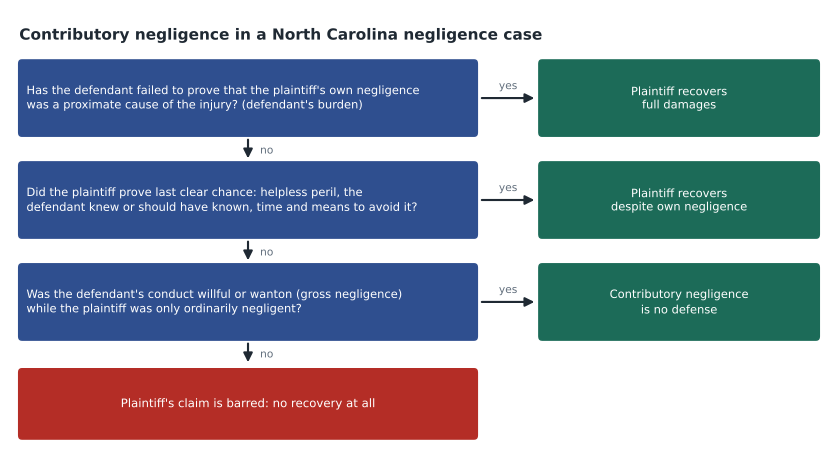
Contributory negligence is an affirmative defense. By statute the defendant must plead it and bears the burden of proving it at trial. The defendant must show that the plaintiff failed to use ordinary care for her own safety and that the failure was a proximate cause of her injury. Contributory negligence is ordinarily a question for the jury, and summary judgment on it is appropriate only when the evidence establishes the plaintiff's negligence so clearly that no other reasonable conclusion is possible.
Children receive special treatment. A child under seven is conclusively presumed incapable of contributory negligence. A child between seven and fourteen is presumed incapable, but the presumption can be rebutted by evidence of the child's capacity. A child over fourteen is presumed capable, and is held to the standard of a reasonable child of similar age, capacity, discretion, knowledge and experience.
Last clear chance
The most important exception is the doctrine of last clear chance. A contributorily negligent plaintiff may still recover if she proves that she, by her own negligence, placed herself in a position of helpless peril, or a position of peril from which she could not escape by the exercise of reasonable care; that the defendant knew, or by the exercise of reasonable care should have discovered, her position and her incapacity to escape; that the defendant had the time and the means to avoid the injury by the exercise of reasonable care; that the defendant negligently failed to use the available time and means; and that the injury resulted. The plaintiff bears the burden of proving the doctrine's elements.
The doctrine does not apply when the plaintiff's negligence continues up to the moment of injury and she could have avoided the harm at any time by paying attention. That is why it often fails in two-moving-vehicle cases: both drivers had the chance to avoid the collision until the end. In Grady's case, the client was stopped, but she could have moved forward at any moment if she had looked up. Whether she was in helpless peril, or merely inattentive, was a jury question.
Gross negligence and other limits
Contributory negligence is a defense only to negligence. It is not a defense to intentional torts. And ordinary contributory negligence does not bar recovery when the defendant's conduct was willful or wanton, sometimes described as gross negligence: conduct done with a wicked purpose or with reckless indifference to the rights of others. A plaintiff who was only ordinarily negligent can recover against a defendant whose conduct rose to that level, although the plaintiff's own gross negligence would again bar recovery. Pleading gross negligence in the alternative is therefore common in North Carolina injury complaints where the facts support it, such as a defendant driving while impaired or at extreme speed.
Contributory negligence also does not apply in the same way in workers' compensation, which is a no-fault system. And the defense must be proved by evidence of the plaintiff's conduct, not by the mere fact of injury.
Joint and several liability and contribution
North Carolina retains joint and several liability. When two or more defendants' negligence combines to cause an indivisible injury, each is liable for the whole of the plaintiff's damages, and the plaintiff may collect the full judgment from any of them. North Carolina's Uniform Contribution Among Tort-Feasors Act allows a defendant who pays more than its pro rata share to seek contribution from the others. A release of one tortfeasor does not discharge the others unless its terms so provide, but it reduces the claim against them by the amount paid.
Grady said that seemed to cut against the harshness of contributory negligence. Hollis agreed: in North Carolina the plaintiff either recovers everything, from any liable defendant, or recovers nothing. The trial is all or nothing on fault, which shapes settlement value in ways a lawyer from a comparative fault state may not expect.
Punitive damages
Chapter 1D of the General Statutes governs punitive damages. A claimant must prove by clear and convincing evidence that the defendant is liable for compensatory damages and that one of three aggravating factors was present and related to the injury: fraud, malice, or willful or wanton conduct. Punitive damages may not be awarded against a person solely on the basis of vicarious liability for the acts of another, and a corporation is liable only if its officers, directors or managers participated in or condoned the conduct.
The statute caps punitive damages at the greater of three times compensatory damages or 250,000 dollars. The cap does not apply to claims based on injury or harm arising from the defendant's operation of a motor vehicle while impaired, in violation of the impaired driving statute. The trier of fact is not told about the cap; the court reduces an excessive award.
Medical malpractice
In 2011 the General Assembly capped noneconomic damages in medical malpractice actions at 500,000 dollars, with the cap adjusted for inflation every three years, and with an exception allowing a jury to award more when the plaintiff suffered disfigurement, loss of use of part of the body, permanent injury or death and the defendant's conduct was reckless, grossly negligent, fraudulent, intentional or with malice. Economic damages are not capped. The same legislation raised the standard of proof for malpractice claims arising from emergency medical care. Combined with Rule 9(j), described in Lesson 7, these rules make medical malpractice a specialized area in North Carolina.
Claims against the State: the State Tort Claims Act
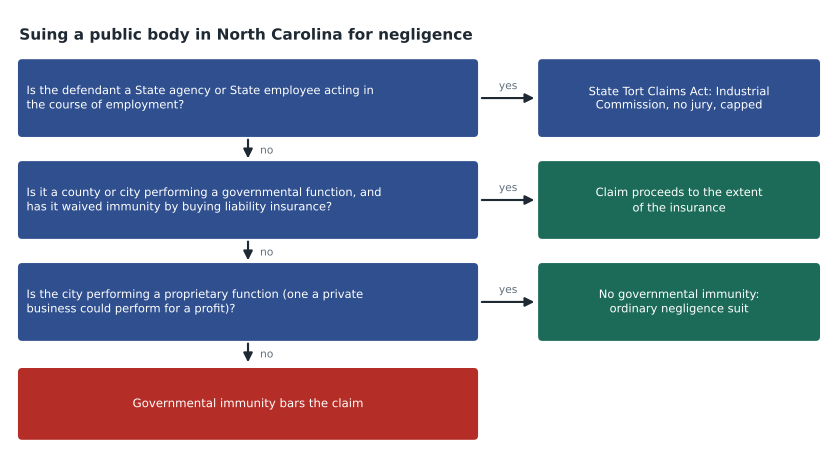
The State of North Carolina and its agencies are immune from suit in tort except as the General Assembly has consented. The State Tort Claims Act, Article 31 of Chapter 143 of the General Statutes, is the principal consent. It gives the North Carolina Industrial Commission jurisdiction over negligence claims against State departments, institutions and agencies, arising from the negligence of an officer, employee, involuntary servant or agent of the State acting within the scope of his or her office, employment, service, agency or authority.
The Act has distinctive features. Claims are filed with the Industrial Commission, not with a court. A deputy commissioner hears the claim without a jury, and an appeal goes to the full Commission and then to the Court of Appeals. The claim must be filed within three years after it accrues. The Act applies negligence principles as they would apply to a private person, so contributory negligence is a defense, and the claimant may rely on last clear chance. Recovery is capped, cumulatively, at 1,000,000 dollars for any one person, reduced by other insurance or recoveries as the Act provides, and punitive damages are not available. The Act covers negligence only, not intentional acts.
The public duty doctrine also limits State liability. Under that doctrine, a governmental entity that acts for the benefit of the public generally, such as by inspecting workplaces or enforcing safety laws, owes no duty to particular individuals harmed when it fails to do so, unless a special relationship or a special duty exists. The Supreme Court of North Carolina applied the doctrine to a State Tort Claims Act claim in Stone v. North Carolina Department of Labor, 347 N.C. 473 (1998), arising from the Hamlet poultry plant fire of 1991. As to local governments, the Court has limited the doctrine largely to law enforcement's failure to protect people from the criminal acts of others.
Claims against counties and cities: governmental immunity
Counties and cities are protected by governmental immunity when they perform governmental functions, those that are discretionary, political, legislative or public in nature and performed for the public good, such as police and fire protection. They are not immune when they perform proprietary functions, those commercial or chiefly for the private advantage of the community, which a private business could perform. The Supreme Court of North Carolina set out a framework for drawing the line in Estate of Williams v. Pasquotank County Parks and Recreation Department, 366 N.C. 195 (2012), starting with whether the legislature has designated the activity as governmental or proprietary and then considering whether the activity is traditionally provided by government, whether a fee is charged and whether the fee does more than cover operating costs.
Counties and cities can waive governmental immunity by purchasing liability insurance, under statutes that provide that immunity is waived to the extent of the insurance coverage. A plaintiff suing a city for a governmental function must therefore plead and prove the waiver, and the first discovery request in such a case usually seeks the city's insurance policies and any risk pool agreements, whose terms may preserve immunity for certain claims.
Direct constitutional claims
When no adequate state remedy exists, North Carolina recognizes a direct claim for violation of rights guaranteed by the state constitution's Declaration of Rights, against the State or its officials in their official capacities. The Supreme Court of North Carolina recognized the claim in Corum v. University of North Carolina, 330 N.C. 761 (1992). Sovereign immunity does not bar a Corum claim, but the claim is available only when no adequate alternative remedy exists, and the existence of a remedy under the State Tort Claims Act or a waiver of immunity can defeat it.
Workers' compensation
The Industrial Commission also administers the Workers' Compensation Act. Workers' compensation is generally the exclusive remedy for an employee injured by accident arising out of and in the course of employment, barring a negligence suit against the employer. The Supreme Court of North Carolina recognized a narrow exception in Woodson v. Rowland, 329 N.C. 330 (1991), allowing a civil action when the employer intentionally engages in misconduct knowing it is substantially certain to cause serious injury or death. Claims against third parties, such as the manufacturer of a defective machine, remain available, subject to the employer's lien.
Worked problem
Contributory negligence and last clear chance
Clyde Pender, a hypothetical pedestrian, crosses a rural road in Pitt County at night in dark clothing outside a crosswalk and trips, falling in the travel lane. A driver, Ivey Tolson, rounding a curve 300 feet away, sees him lying in the road but, while adjusting her radio, does not brake until too late and strikes him. Can Clyde recover?
Show solution
- Ivey will prove contributory negligence: crossing at night in dark clothing outside a crosswalk was a failure to use ordinary care and a proximate cause of the injury.
- Clyde invokes last clear chance: after he fell he was in a position of peril from which he could not escape by reasonable care.
- Ivey saw him with 300 feet to stop, so she knew of his peril and had the time and means to avoid him.
- She negligently failed to use that time and means, and the injury resulted.
Answer: Clyde can likely recover all of his damages under last clear chance, despite his own negligence. Without that doctrine, his contributory negligence would bar any recovery.
Common mistakes
MistakeNorth Carolina reduces a negligent plaintiff's damages by her share of fault.
InsteadContributory negligence bars recovery entirely, subject to last clear chance and gross negligence exceptions.
MistakeThe plaintiff must disprove her own negligence.
InsteadContributory negligence is an affirmative defense the defendant must plead and prove.
MistakeNorth Carolina limits joint and several liability.
InsteadNorth Carolina retains joint and several liability, with contribution among tortfeasors.
MistakeState Tort Claims Act cases go to a jury in superior court.
InsteadThey are heard by the Industrial Commission without a jury, with a 1,000,000 dollar cap.
MistakeCities are always immune from negligence suits.
InsteadImmunity covers governmental functions only and is waived to the extent of liability insurance.
Practice problems
Work each problem on paper first, then reveal the answer to check.
Who bears the burden of proving contributory negligence?
Show answer
The defendant.
At what age is a child conclusively presumed incapable of contributory negligence?
Show answer
Under seven.
What is the punitive damages cap?
Show answer
The greater of three times compensatory damages or 250,000 dollars, with an impaired driving exception.
Who hears State Tort Claims Act claims?
Show answer
The North Carolina Industrial Commission.
Which case recognized direct claims under the North Carolina Constitution?
Show answer
Corum v. University of North Carolina, 330 N.C. 761 (1992).
Summary and key terms
- Contributory negligence bars a negligent plaintiff's recovery; the defendant must plead and prove it.
- Last clear chance and the defendant's willful or wanton conduct allow recovery despite the plaintiff's ordinary negligence.
- Joint and several liability remains; punitive damages need clear and convincing proof of fraud, malice or willful or wanton conduct and are capped.
- The State Tort Claims Act sends negligence claims against the State to the Industrial Commission, without a jury, with a 1,000,000 dollar cap.
- Counties and cities are immune for governmental functions unless they waive immunity by insurance; Corum claims fill gaps in state remedies.
- contributory negligence
- A plaintiff's negligence that proximately caused her injury and bars recovery.
- last clear chance
- A doctrine allowing a negligent plaintiff to recover when the defendant had the last opportunity to avoid harm.
- governmental function
- An activity performed for the public good, protected by governmental immunity.
- public duty doctrine
- The rule that a government owes no duty to individuals for failure to perform general public duties.
- Corum claim
- A direct claim under the North Carolina Constitution when no adequate state remedy exists.
Lesson quiz · 5 questions
Score 60% or more to complete this lesson.
Create a free account to save your progress, take quizzes and earn a certificate.