
BAR-234 · Lesson 3 of 12 · 21 min
Character and fitness and the MPRE
▶ Video coming soon A video version of this lesson is on the way.
Grady arrived at the third session with a problem he had been turning over for a week. In his second year of college he had been cited for having an open container of beer in a car parked outside a football game. He had paid the fine and forgotten about it. Filling out his bar application, he found the question that asked about every citation and charge, however minor, and remembered the citation in the parking lot. He had disclosed it, but he could not find the paperwork, and the Board had written asking for the court record. 'It was a fifty-dollar ticket eight years ago,' he said. 'Is this going to keep me out?' Hollis said almost certainly not, as long as he handled it the way the Board expected: promptly, completely and without minimizing it.
This lesson covers the two parts of the admission process that test character rather than knowledge: North Carolina's character and fitness review and the Multistate Professional Responsibility Examination.
The standard
North Carolina admits only applicants who show that they possess the good moral character and fitness required of a lawyer. The burden of proof rests on the applicant, not on the Board. That allocation matters. The Board does not have to prove that an applicant is unfit; the applicant has to prove fitness. An applicant who leaves gaps, gives vague answers or fails to produce requested records has not carried the burden, even if nothing in the record is actually bad.
The purpose of the review is protective. A license tells the public, the courts and other lawyers that this person can be trusted with clients' money, confidences and causes. The review looks for conduct that suggests a risk to those interests: dishonesty, disregard of legal obligations, financial irresponsibility, neglect of duties, and violence. It also asks whether past problems have been addressed, because rehabilitation is part of the picture.
How the review works
North Carolina runs its own character and fitness investigation. It does not use NCBE's investigation service, so applicants follow the Board's own forms and instructions. Board staff review the application, collect records, contact references and employers, and check court and credit records. Where questions arise, the Board may ask for more information, an explanation in writing, or additional documents.
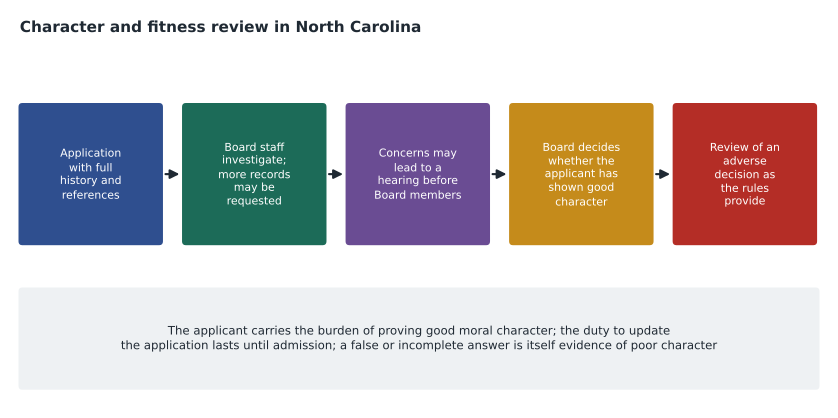
If concerns remain after the written stage, the Board may set the matter for a hearing before members of the Board. At a hearing the applicant may present evidence, call witnesses, be represented by counsel and explain the conduct in question. The Board then decides whether the applicant has carried the burden. The rules provide for review of an adverse decision, and an applicant facing a hearing should read the procedural rules carefully and consider retaining counsel experienced in admission matters.
Most files never reach a hearing. Many applicants have something to disclose: a citation, a debt, an academic warning, a dispute with a former landlord. The Board's question is not whether the applicant has a perfect record, but whether the applicant's record and conduct in the admission process show the honesty and judgment the profession requires.
Candor above all
The single most important rule in character review is candor. An applicant who discloses a problem and explains it is in a far better position than one who leaves it out and is found out. Failing to disclose is often treated as more serious than the underlying conduct, because it is fresh evidence of dishonesty, given under oath, in the very process designed to test honesty. A minor college citation disclosed fully is usually a non-event. The same citation omitted becomes a question about whether the applicant can be trusted to tell a court the truth.
Hollis gave Grady three rules for his own file. First, when in doubt, disclose. If a question could reasonably be read to cover a matter, answer as if it does and explain. Second, do not characterize; document. Instead of writing that the citation was minor, attach the record that shows what it was and what happened. Third, answer the question asked. If the question asks about every citation, list every citation, not just the ones that seem significant.
Grady had already disclosed the open container citation. The Board's letter asked for the court record, and he did not have it. Hollis told him to call the clerk of court in the county where the citation was issued that week, request a certified copy of the record or a certified statement that no record remains, and send whatever he received to the Board with a short cover letter. If the record had been destroyed under the court's retention schedule, the clerk's statement saying so would answer the Board's question.
What the Board looks at
The Board considers the whole applicant, but certain kinds of conduct come up again and again.
Criminal history. Arrests, charges, citations and convictions must be disclosed as the questions require, including matters that were dismissed, deferred or expunged if the question reaches them. The Board considers the nature of the offense, the applicant's age, how long ago it happened, and what the applicant has done since.
Financial responsibility. Unpaid debts, defaulted student loans, collections, judgments and bankruptcies are relevant. Debt itself is not disqualifying. What matters is whether the applicant has dealt with obligations honestly, for example by making payment arrangements and keeping them.
Academic and employment discipline. Honor code violations, plagiarism findings and terminations for cause are relevant because they speak to honesty and reliability. Law school records are reviewed, and a law school's certification may disclose discipline.
Candor in other proceedings. Inconsistent statements in loan applications, court filings or earlier bar applications draw close attention.
Conduct in the admission process itself. Late responses, incomplete answers and failure to update the application are all evidence the Board can weigh.
Rehabilitation
When an applicant has past misconduct, the question becomes rehabilitation. Factors commonly considered include the applicant's age at the time of the conduct, how recent it was, its seriousness, the cumulative effect of several incidents, whether the applicant has made restitution, the applicant's candor about it, positive social contributions since, and evidence of changed behavior, such as treatment completed or a long record of responsible employment. An applicant with serious past conduct should gather evidence of rehabilitation before filing: letters from employers and others who know the applicant now, records of completed programs, and proof of restitution.
Mental health and substance use
Applicants sometimes worry about questions concerning mental health or substance use. Many jurisdictions have narrowed such questions in recent years to focus on conduct rather than diagnosis or treatment, and the Americans with Disabilities Act limits how they may be used. An applicant should answer whatever the current application actually asks, read it carefully, and know that seeking treatment is generally viewed as responsible, not as a mark against fitness. North Carolina has a lawyer assistance program that offers confidential help to lawyers and law students, and its existence reflects the profession's view that getting help is a sign of good judgment.
The MPRE
The second test of the professional side of admission is the Multistate Professional Responsibility Examination. North Carolina requires a scaled score of 80. NCBE writes and administers the MPRE. It is a two-hour multiple-choice exam of 60 questions, 50 of which are scored, testing the ABA Model Rules of Professional Conduct, the ABA Model Code of Judicial Conduct, and generally accepted principles of law governing lawyers, including the law of malpractice and the attorney-client privilege. It is given several times a year, and candidates schedule it separately from the bar exam.
Scores are reported on a scale from 50 to 150. A score of 80 is in the lower middle of the range among jurisdictions; some require 85 or 86, and a few require 75. Because the MPRE tests the ABA Model Rules, not North Carolina's version, a candidate preparing for it should study the Model Rules and keep North Carolina's differences, covered in Lesson 10, for practice.
When the MPRE must be passed
The Board's rules set a time window for general applicants. Under section .0501, the applicant must have passed the MPRE within the 24 months before the first day of the bar exam the applicant passed, or within the 12 months after it. Servicemembers may receive an extension under the rules. NCBE's guide notes that there is no MPRE time limit for comity applicants, and the transfer-applicant rule requires a passing MPRE score without the same window.
For Grady, sitting the bar exam on February 23 and 24, 2027, the window ran from February 2025 to February 2028. He had taken the MPRE in November 2025 during his third year of law school and scored 96, well inside the window. A candidate who has not yet taken the MPRE can take it after the bar exam, within the 12-month window, but Hollis advised against waiting. A candidate who passes the bar exam but has no MPRE score cannot be admitted until the score arrives.
| Applicant type | MPRE score | Timing rule |
|---|---|---|
| General applicant (exam) | 80 | Within 24 months before the first day of the passed exam or 12 months after |
| Transferred UBE score | 80 | Passing score required; no separate window in the rule |
| Comity | 80 | No time limit (NCBE guide) |
| Servicemembers | 80 | Extensions available under the rules |
Preparing for the MPRE
Most candidates prepare for the MPRE in three to five weeks of part-time study, using NCBE's published subject outline and practice materials. The heaviest-tested areas are conflicts of interest, the client-lawyer relationship, confidentiality, and litigation and other forms of advocacy. Two habits help. First, read each question for the word that controls it: must, may, should, subject to discipline. Second, remember that the answer is the Model Rules answer, even if a North Carolina rule would differ.
A character question worked through
Hollis walked Grady through the kind of file that does reach a hearing, using an invented applicant. Suppose an applicant was placed on academic probation in law school after copying part of a classmate's memo, did not disclose the matter on a scholarship renewal form, and then disclosed it fully on the bar application with the school's records attached. The Board would see three things: the original dishonesty, the later nondisclosure on another form, and the full disclosure now.
The applicant's best course would be to address all three directly. A short statement would explain what happened, accept responsibility without excuses, explain why the scholarship form was answered as it was and acknowledge that it should not have been, and describe what has changed since. Supporting letters from a dean, a professor or an employer who knows about the matter and can speak to the applicant's conduct since would carry weight. So would evidence of a consistent record of honest work in the years after.
Grady asked whether an applicant in that position should hire a lawyer. Hollis said that for a matter likely to lead to a hearing, yes: a lawyer experienced in admission matters knows how the Board approaches such cases, can help the applicant prepare, and can present the evidence of rehabilitation in an organized way. For a minor citation or a paid debt, a careful applicant can usually handle the matter alone.
Keeping the MPRE and the bar exam on separate tracks
A final point about timing. Candidates who take the MPRE in the same season as the bar exam often find the two compete for study time. The MPRE is usually easier to schedule early: many students take it during the second or third year of law school, while professional responsibility is fresh from the required course. A candidate who has already passed it can give the last months before the bar exam entirely to the UBE.
Worked problem
A late disclosure
Ivey Tolson, a hypothetical applicant, filed her North Carolina application in early October 2026. In December she remembers a civil judgment entered against her in 2023 for unpaid rent on an apartment in another state. She paid it in full in 2024. Her application did not mention it. What should she do?
Show solution
- The duty to update and the duty of candor both require her to correct the application now.
- She should file an amendment disclosing the judgment, attach the court record and proof of payment, and explain briefly why it was omitted.
- Prompt voluntary correction is far better than discovery by the Board, which could treat the omission as evidence of poor character.
- The underlying debt, paid in full, is unlikely to be serious by itself.
Answer: Ivey should amend her application immediately, with documents. Voluntary correction protects her; silence would put her candor in question.
Common mistakes
MistakeThe Board must prove an applicant is unfit to deny admission.
InsteadThe applicant bears the burden of proving good moral character.
MistakeMinor or expunged matters never need to be disclosed.
InsteadDisclose whatever the question reaches; when in doubt, disclose.
MistakeNorth Carolina requires an MPRE score of 85.
InsteadNorth Carolina requires 80.
MistakeThe MPRE tests the North Carolina Rules of Professional Conduct.
InsteadIt tests the ABA Model Rules and general law governing lawyers.
MistakeAn applicant may take the MPRE at any time before admission.
InsteadGeneral applicants must pass within 24 months before the first exam day or 12 months after.
Practice problems
Work each problem on paper first, then reveal the answer to check.
Who bears the burden of proof in North Carolina character review?
Show answer
The applicant.
What MPRE score does North Carolina require?
Show answer
A scaled score of 80.
What is the MPRE window for a general applicant?
Show answer
Within 24 months before the first day of the passed exam or within 12 months after.
Does North Carolina use NCBE's character and fitness service?
Show answer
No; it runs its own investigation.
Name three factors relevant to rehabilitation.
Show answer
Any three of: age at the time, recency, seriousness, restitution, candor, positive contributions since, evidence of changed behavior.
Summary and key terms
- The applicant must prove good moral character and fitness; gaps and vague answers fail that burden.
- Candor is decisive: nondisclosure is often worse than the conduct itself.
- The Board looks at criminal, financial, academic and employment history and at conduct in the admission process.
- Rehabilitation is weighed by age, recency, seriousness, restitution, candor and changed behavior.
- North Carolina requires an MPRE score of 80, passed within 24 months before or 12 months after the first day of the passed exam.
- good moral character
- The honesty, trustworthiness and judgment an applicant must prove to be admitted.
- burden of proof
- The obligation to establish a fact; in character review it rests on the applicant.
- rehabilitation
- Evidence that an applicant has overcome past misconduct.
- MPRE
- The Multistate Professional Responsibility Examination, NCBE's ethics test.
- scaled score
- A score adjusted so results are comparable across administrations.
Lesson quiz · 5 questions
Score 60% or more to complete this lesson.
Create a free account to save your progress, take quizzes and earn a certificate.