
BAR-234 · Lesson 7 of 12 · 20 min
North Carolina courts and civil procedure
▶ Video coming soon A video version of this lesson is on the way.
The car-wreck file Ruthanne had given Grady in his first week had grown into a lawsuit, and he came to the seventh session with a list of procedural questions. Which court should the complaint go in? What happens if the firm needs to dismiss and refile? Why had Ruthanne told him that the medical expenses claim would be argued under a rule of evidence he had never heard of? Hollis said the answers were all North Carolina-specific, and that most of them were about the structure of the courts and the North Carolina Rules of Civil Procedure.
This lesson describes the North Carolina court system and the procedural rules a new litigator uses most: which court hears what, how judges are chosen, the Business Court, pleading under the North Carolina Rules, voluntary dismissal and the one-year refiling rule, the medical malpractice certification in Rule 9(j), limitations periods, mediated settlement conferences, and interlocutory appeals.
The structure of the courts
North Carolina has a unified state court system, the General Court of Justice, administered by the Administrative Office of the Courts. It has an appellate division and a trial division.
At the top of the appellate division is the Supreme Court of North Carolina, with a chief justice and six associate justices. Below it is the Court of Appeals, with fifteen judges who sit in panels of three. Most appeals from the trial courts go first to the Court of Appeals. Some go directly to the Supreme Court, including appeals from final judgments of the Business Court in cases designated as mandatory complex business cases, and certain other categories set by statute. The Supreme Court also reviews Court of Appeals decisions on discretionary review.
The trial division has two levels. The superior court is the court of general jurisdiction. It hears felony criminal cases, civil cases above the district court's amount in controversy, and appeals from the clerk of superior court in estate and special proceedings. The district court hears misdemeanors, infractions, juvenile matters, most family cases, including divorce, custody, support and equitable distribution, and civil cases where the amount in controversy is 25,000 dollars or less. Within the district court, magistrates hear small claims up to a statutory limit, and small claims judgments can be appealed to district court for a new trial.
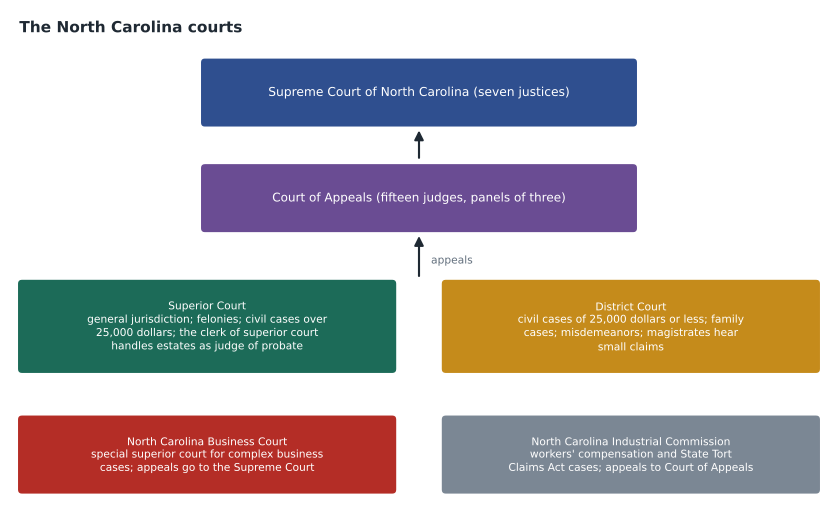
The amount in controversy rule divides civil cases between the trial courts, but it is not a strict limit on jurisdiction in the federal sense. The two courts share original jurisdiction over civil matters, and the statute assigns cases to the proper division. A case filed in the wrong division can be transferred. In Grady's car-wreck case, the client's medical bills alone exceeded 25,000 dollars, so the complaint belonged in superior court.
The clerk of superior court, an elected official in each county, has judicial functions as well as administrative ones. As Lesson 6 explained, the clerk is the judge of probate. The clerk also hears special proceedings, such as partitions of real property, foreclosures under a power of sale, adoptions and incompetency proceedings, with appeals to the superior court.
How judges are chosen
North Carolina elects its judges. Justices of the Supreme Court, judges of the Court of Appeals, superior court judges and district court judges are chosen in partisan elections for eight-year terms at the appellate and superior court levels and four-year terms at the district court level. Vacancies between elections are filled by appointment by the governor. Superior court judges rotate among the districts within a division, a North Carolina tradition intended to prevent too close a tie between a judge and the local bar.
The Business Court
The North Carolina Business Court is a special superior court that hears complex business disputes. A case may be designated as a mandatory complex business case if it involves certain subjects defined by statute, such as disputes about the law governing corporations, partnerships and limited liability companies, securities, antitrust, trade secrets and certain contract disputes above a threshold, and a party files a timely notice of designation. Other complex cases can be assigned to the Business Court by the Chief Justice. Business Court judges issue written opinions that are published and widely cited, and they have built up a substantial body of North Carolina business law. Appeals from final judgments in mandatory complex business cases go directly to the Supreme Court.
The North Carolina Rules of Civil Procedure
The North Carolina Rules of Civil Procedure, found in section 1A-1 of the General Statutes, are modeled on the Federal Rules of Civil Procedure, and most numbers line up: Rule 4 for service, Rule 8 for pleading, Rule 12 for defenses and motions, Rule 26 for discovery, Rule 56 for summary judgment. The North Carolina courts often look to federal decisions interpreting a parallel rule. But there are differences, and some of them are traps.
Pleading. North Carolina follows notice pleading. A complaint must give a short and plain statement of the claim sufficiently particular to give the court and the parties notice of the transactions and occurrences intended to be proved and showing that the pleader is entitled to relief. The Supreme Court of North Carolina adopted the notice theory of pleading in Sutton v. Duke, 277 N.C. 94 (1970). North Carolina has not adopted the federal plausibility standard, so a motion to dismiss under Rule 12(b)(6) tests whether the complaint, treated as true, states a claim on any theory, a standard generally friendlier to plaintiffs than the federal one.
Damages in the complaint. In negligence actions and other actions where the matter in controversy exceeds 25,000 dollars, the complaint generally should not state the dollar amount demanded; it states that the relief demanded is for damages in excess of 25,000 dollars. Punitive damages claims must be pleaded with specificity about the aggravating factor.
Voluntary dismissal and the one-year rule
Rule 41(a)(1) allows a plaintiff to dismiss an action without prejudice by filing a notice of dismissal at any time before the plaintiff rests its case, or by stipulation. The rule then provides that a new action based on the same claim may be commenced within one year after the dismissal. If the original action was filed within the limitations period, the new action is treated as timely even if the limitations period has otherwise run in the meantime.
This is a powerful tool. A plaintiff whose case is going badly at trial, or who discovers a gap in the evidence, can dismiss before resting and refile within a year. The limits matter just as much. The one-year rule saves only a claim that was timely when first filed. A second notice of dismissal of the same claim operates as an adjudication on the merits. And a voluntary dismissal does not revive a claim that a statute of repose has extinguished.
Medical malpractice: Rule 9(j)
Rule 9(j) is a North Carolina requirement with no federal counterpart. A complaint alleging medical malpractice by a health care provider must specifically assert that the medical care and all medical records pertaining to the alleged negligence that are available to the plaintiff after reasonable inquiry have been reviewed by a person who is reasonably expected to qualify as an expert witness under the Rules of Evidence and who is willing to testify that the care did not comply with the applicable standard of care, unless the complaint pleads facts establishing negligence under the common-law doctrine of res ipsa loquitur. A superior court judge may extend the limitations period by up to 120 days to allow the review. A complaint that fails to comply with Rule 9(j) is subject to dismissal, and the failure often cannot be cured by amendment after the limitations period has run.
Ruthanne's firm did not handle malpractice cases, but she had told Grady that every North Carolina litigator should know Rule 9(j), because injury cases can turn out to involve a provider's negligence, and the certification must be in the original complaint.
Limitations and repose
The general limitations period for personal injury, property damage and contract claims in North Carolina is three years. Medical malpractice claims are subject to a three-year period with special discovery and repose provisions. Wrongful death claims generally must be brought within two years of death. Statutes of repose cut off certain claims regardless of when injury is discovered, including claims arising from improvements to real property and product liability claims, the latter subject to a twelve-year repose period measured from the initial purchase for use or consumption. Because statutes of repose are substantive limits, the Rule 41 refiling rule and other tolling doctrines do not extend them.
Evidence of medical expenses
The North Carolina Rules of Evidence largely follow the federal rules, with additions. Rule 414, adopted in 2011, governs evidence of medical expenses in personal injury cases: evidence offered to prove past medical expenses is limited to evidence of the amounts actually paid to satisfy the bills, regardless of the source of payment, and evidence of the amounts actually necessary to satisfy the bills that have been incurred but not yet satisfied. This was the rule Ruthanne had mentioned. It can sharply reduce the medical expense figures a jury hears, because providers often accept much less than the billed amount from insurers.
Mediated settlement conferences
North Carolina requires mediated settlement conferences in most civil actions in superior court, under rules adopted by the Supreme Court. The parties select a certified mediator or the court appoints one, and attendance by the parties and their insurers is required. Similar programs exist in district court for family financial cases and in the clerk's estate matters. A large share of North Carolina civil cases settle at mediation, so preparing a client for the conference is a core skill for a new litigator.
Interlocutory appeals and the substantial right doctrine
As a general rule, a party may appeal only from a final judgment. North Carolina statutes allow an immediate appeal from an interlocutory order that affects a substantial right that would be lost absent immediate review, and from orders certified under Rule 54(b). The substantial right doctrine generates a great deal of litigation. Orders denying a claim of governmental or sovereign immunity are commonly held immediately appealable, as are orders that create a risk of inconsistent verdicts in some circumstances. A lawyer who wants to appeal an interlocutory order must show the court why it fits one of these categories, and a lawyer who does not appeal a qualifying order immediately may in some cases lose the right later.
Discovery and summary judgment
Discovery under the North Carolina Rules follows the federal pattern of interrogatories, requests for production, requests for admission and depositions, with limits on the number of interrogatories set by rule. Unlike the federal rules, North Carolina does not impose the same mandatory initial disclosures in ordinary cases, although local rules and case management orders can require early exchanges. Summary judgment under Rule 56 is available when there is no genuine issue of material fact, and the North Carolina courts apply it with the same caution as the federal courts in negligence cases, where questions of reasonableness are usually for the jury.
Worked problem
Saving a claim with Rule 41
Ivey Tolson, a hypothetical plaintiff, was injured in a car crash in Wilmington on March 1, 2023. Her lawyer filed suit in superior court on February 15, 2026. On the second day of trial in October 2026, before resting, he realizes a key witness cannot be located. What can he do, and by when must a new action be filed?
Show solution
- The three-year limitations period ran on March 1, 2026, but the original complaint was filed in time.
- Before resting, the plaintiff may take a voluntary dismissal without prejudice by notice under Rule 41(a)(1).
- A new action on the same claim may be filed within one year after the dismissal and is treated as timely.
- A second voluntary dismissal of the same claim would operate as an adjudication on the merits.
Answer: He can dismiss without prejudice before resting and refile within one year of the dismissal, so the new complaint must be filed by October 2027. He should use the time to locate the witness, because a second dismissal will not be available.
Common mistakes
MistakeNorth Carolina follows the federal plausibility standard.
InsteadNorth Carolina uses notice pleading under Sutton v. Duke.
MistakeRule 41 lets a plaintiff refile at any time.
InsteadThe new action must be filed within one year, and only once.
MistakeA medical malpractice complaint can add the Rule 9(j) certification later.
InsteadThe certification must be in the complaint, and late cures often fail.
MistakeJuries see the full billed medical expenses.
InsteadRule 414 limits evidence to amounts actually paid or necessary to satisfy the bills.
MistakeBusiness Court appeals go to the Court of Appeals.
InsteadAppeals from final judgments in mandatory complex business cases go directly to the Supreme Court.
Practice problems
Work each problem on paper first, then reveal the answer to check.
Which trial court hears civil cases above 25,000 dollars?
Show answer
The superior court.
How many judges sit on the Court of Appeals?
Show answer
Fifteen, in panels of three.
Which case adopted notice pleading in North Carolina?
Show answer
Sutton v. Duke, 277 N.C. 94 (1970).
What does Rule 9(j) require?
Show answer
A specific assertion that a reasonably qualified expert willing to testify reviewed the care and records.
What is the general limitations period for personal injury?
Show answer
Three years.
Summary and key terms
- The Supreme Court has seven justices; the Court of Appeals fifteen judges; superior court has general jurisdiction; district court hears family cases and civil cases of 25,000 dollars or less.
- North Carolina elects its judges; superior court judges rotate within divisions.
- The Business Court hears designated complex business cases, with appeals directly to the Supreme Court.
- North Carolina's notice pleading (Sutton v. Duke), Rule 41's one-year refiling rule, Rule 9(j) certification and Rule 414 on medical expenses are distinctive.
- Three-year limitations for most injury claims, two years for wrongful death, and statutes of repose that tolling cannot extend.
- General Court of Justice
- North Carolina's unified state court system.
- mandatory complex business case
- A case designated to the Business Court under the statute.
- notice pleading
- Pleading that gives notice of the claim without detailed facts.
- voluntary dismissal
- A plaintiff's dismissal without prejudice under Rule 41(a)(1).
- substantial right
- The doctrine allowing immediate appeal of certain interlocutory orders.
Lesson quiz · 5 questions
Score 60% or more to complete this lesson.
Create a free account to save your progress, take quizzes and earn a certificate.