
BAR-234 · Lesson 12 of 12 · 19 min
Capstone: North Carolina practice questions and an exam-day plan
▶ Video coming soon A video version of this lesson is on the way.
The last session before the holidays was a working session. Hollis gave Grady three original problems built on the North Carolina law from Lessons 6 through 10, the kind of questions a supervising lawyer might hand a new associate, or that the State-Specific Component and early practice would demand. He had thirty minutes for each, and then they compared his answers with hers. After that they turned to the February exam: what to do in the last week, on each exam day, and after.
The problems below are original hypotheticals, not released bar exam questions. Each is followed by a model answer in IRAC form: issue, rule, application, conclusion. The goal is not to memorize the answers but to practice the habit of stating the North Carolina rule precisely and applying it to the facts.
Problem 1: a collision and a city truck
Clyde Pender, a hypothetical resident of Wilson, was driving home at dusk when his car was struck by a city of Wilson garbage truck that ran a stop sign. Clyde had been driving 10 miles per hour over the speed limit. The truck's driver, a city employee on his route, admitted he had been looking at his route sheet. Clyde suffered a broken leg and has 60,000 dollars in medical bills, of which his insurer paid 31,000 dollars in full satisfaction. The city has a liability insurance policy with a 1,000,000 dollar limit. Advise Clyde on the main issues.
Issue one: does Clyde's speeding bar his claim? North Carolina applies contributory negligence. If the city proves that Clyde's negligence was a proximate cause of the collision, he recovers nothing, unless an exception applies. Speeding is negligence if it violates the statute, but the city must also prove proximate cause: that the collision would not have happened, or would have been less severe, had Clyde been driving at the limit. The truck ran a stop sign; if Clyde could not have avoided it at any lawful speed, his speeding was not a proximate cause. Contributory negligence is the city's burden and ordinarily a jury question. Last clear chance is unlikely to help Clyde, because both vehicles were moving and the driver did not see him in a position of helpless peril in time to avoid him. If the evidence showed the truck driver's conduct was willful or wanton, ordinary contributory negligence would not bar recovery, but looking at a route sheet is ordinary negligence.
Issue two: is the city immune? Garbage collection by a city has been treated in North Carolina cases as a governmental function, but the analysis under Estate of Williams starts with any legislative designation and considers whether a fee is charged and whether it exceeds operating costs. Even if the function is governmental, the city has waived immunity to the extent of its liability insurance under the waiver statute. The policy limit of 1,000,000 dollars covers Clyde's likely damages, subject to the policy's terms. The State Tort Claims Act does not apply, because the city is not a State agency.
Issue three: what medical expenses can Clyde prove? Under Rule 414 of the North Carolina Rules of Evidence, evidence of past medical expenses is limited to the amounts actually paid to satisfy the bills, here 31,000 dollars, and amounts necessary to satisfy bills incurred but not yet satisfied. He cannot put the full 60,000 dollars of billed charges before the jury.
Conclusion: Clyde has a viable negligence claim against the city, and immunity is waived to the extent of the insurance. The decisive issue is whether the city can prove that his speeding was a proximate cause of the collision; if it can, contributory negligence bars recovery entirely. His provable past medical expenses are 31,000 dollars. The case should be filed in superior court within three years of the collision, and the complaint should not state a dollar demand beyond saying that damages exceed 25,000 dollars.
Problem 2: a handwritten will and a short marriage
Ivey Tolson, a hypothetical widow from Kinston with two adult children from her first marriage, married Odell Beasley in 2022. In 2025 she wrote out, entirely in her own handwriting, a page leaving her house to her daughter and everything else to her two children equally, and signed it. She put it in her fireproof box with her deed, her insurance policy and her car title. She died in October 2026. Her estate is worth 600,000 dollars, all in her name, and Odell receives nothing under the paper. Odell wants to know his rights.
Issue one: is the paper a valid will? North Carolina recognizes holographic wills that are entirely in the testator's handwriting, subscribed by the testator, and found after death among the testator's valuable papers or effects, in a safe-deposit box or other safe place where the testator deposited it, or in the possession of a person with whom it was deposited. The paper is in Ivey's handwriting, signed, and found in her fireproof box with her deed and other valuable papers. It is very likely a valid holographic will, and it can be probated before the clerk of superior court, who is the judge of probate, on proof of the handwriting by witnesses familiar with it.
Issue two: does the will's failure to provide for Odell affect it? Marriage after a will does not revoke it, and the will was made after the marriage anyway. Odell is not a pretermitted child. The will stands.
Issue three: what can Odell claim? He may petition for an elective share. The elective share is a percentage of Ivey's total net assets that depends on the length of the marriage. Married in 2022 and widowed in October 2026, the spouses were married less than five years, so Odell's elective share is 15 percent of total net assets, reduced by the value of any property passing to him from Ivey by other means. On a 600,000 dollar estate with no other transfers to Odell, that is about 90,000 dollars, before adjustments for debts and expenses in computing total net assets. He must file within the statutory period after letters are issued. He may also claim the spousal year's allowance from personal property, a fixed statutory amount.
Issue four: could the children challenge the will? Only through a caveat, filed with the clerk and tried in superior court, on grounds such as lack of capacity or undue influence. Nothing in the facts suggests either. Odell has no reason to caveat; the will's validity does not change his elective share rights.
Conclusion: The will is likely valid and passes the estate to the children, but Odell can elect a 15 percent share of total net assets and claim the year's allowance. His lawyer should calendar the elective share deadline from the date letters are issued.
Problem 3: a separation, a business and a third party
Darrell and Maxine Lowery, hypothetical spouses in Greenville, married in 2007 and separated on April 1, 2026, when Maxine moved out. During the marriage Darrell built a heating and air business, using 40,000 dollars he inherited from his grandmother in 2008 as start-up capital, which he deposited directly in the business account. The business is now worth 500,000 dollars. Maxine earns much less than Darrell and stayed home with their children for ten years. She has learned that Darrell began a relationship with his office manager, Tamara, in 2025. Maxine asks what claims she has and when she can divorce.
Issue one: when can Maxine obtain an absolute divorce? After one year of living separate and apart, so no earlier than April 2027, and she or Darrell must have resided in North Carolina for six months before filing.
Issue two: how will the business be divided? Under section 50-20, property acquired during the marriage and before separation is presumed marital. The business was founded during the marriage, so it is presumptively marital. Darrell will argue that the 40,000 dollars of inherited start-up capital was separate property and that he can trace it into the business. If he proves the tracing, that portion of the value is separate; the increase in value caused by both spouses' contributions of effort during the marriage is marital. The court values marital property as of the date of separation, April 1, 2026. The statute presumes an equal division of the net marital estate, but Maxine can argue for an unequal division in her favor using the section 50-20(c) factors, including her lower income, the duration of the marriage, and her contributions as a homemaker and parent that supported Darrell's work. Darrell's affair is not a distributional factor unless it affected the marital estate.
Issue three: alimony. Maxine appears to be a dependent spouse and Darrell the supporting spouse. Darrell's relationship with Tamara began in 2025, during the marriage and before separation. If the court finds that it was illicit sexual behavior by the supporting spouse during the marriage and before separation, the statute requires the court to award alimony to Maxine. The amount and duration depend on the statutory factors. She should seek postseparation support now.
Issue four: claims against Tamara. Maxine may sue Tamara for alienation of affection if she proves a marriage with genuine love and affection, its alienation and destruction, and Tamara's wrongful and malicious acts as a controlling cause. She may sue for criminal conversation if she proves sexual intercourse between Tamara and Darrell during the marriage. Under section 52-13, only acts before the April 1, 2026 separation can give rise to either claim, the claim must be brought within three years of Tamara's last such act, and it lies only against Tamara as a natural person, not against the business.
Issue five: timing. Maxine must file her equitable distribution and alimony claims before any judgment of absolute divorce is entered, or they will be lost. Her lawyer should file them now, in district court, with a claim for postseparation support.
Conclusion: Maxine can divorce no earlier than April 2027. She should file now for equitable distribution, in which the business is largely marital subject to Darrell's tracing claim, and for postseparation support and alimony, which the court must award if Darrell's pre-separation affair is proved. She has potential claims against Tamara for acts before separation, to be filed within three years.
How to grade your own answers
Hollis gave Grady a checklist for comparing his answers with the models. Did he state each North Carolina rule precisely, with its elements, before applying it? Did he identify the burden of proof where it mattered, as in contributory negligence? Did he apply the rule to each important fact, rather than repeating the facts? Did he reach a conclusion on each issue, even a qualified one? And did he notice the deadlines, the elective share filing period, the bar on post-divorce property claims, the three-year limits, because missing a deadline is the most common way new lawyers hurt clients.
The last week before the February exam
For the February 23 and 24, 2027 exam, Hollis set out a plan. The North Carolina law in this course is not on the UBE, so the last week belongs to the multistate subjects.
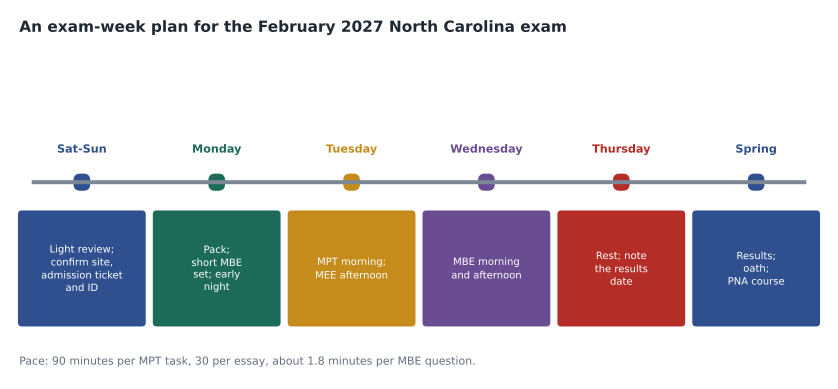
In the last week, review rather than learn. Go through the error log from MBE practice and the rule statements for the eight MEE subjects. Do one timed MPT, one set of three essays and two short MBE sets, then stop heavy study by Sunday.
Confirm logistics. Read every notice from the Board about the exam site, arrival time, permitted items, identification and laptop rules. Plan the route, parking and a backup. Pack the night before: admission materials, identification, permitted items, a watch if allowed, and simple food for the break.
On the first day, the MPT comes in the morning. Read the task memo first, then the File, then the Library, and outline before writing. Spend about 90 minutes on each task. In the afternoon, the six MEE questions get 30 minutes each. Read the call of the question first, outline briefly, lead with a conclusion and the rule, and move on when time is up. A partial answer on every question beats a perfect answer on five.
On the second day, the MBE: 100 questions in the morning and 100 in the afternoon. Keep to about 1.8 minutes per question, mark and skip a question that is taking too long, and answer every question, since there is no penalty for guessing. Do not discuss the exam with other candidates during the breaks.
After the exam
Rest for a few days. Keep the application current, since the duty to update continues until admission. Make sure the MPRE score is on file within the rule's window. Note when results will be released and plan for both outcomes. A candidate who passes moves to the oath and the first year's steps from Lesson 11. A candidate who does not pass should request the score report, decide promptly whether to retake in July 2027, and file the supplemental application before the January deadline.
Grady wrote his exam-week plan on an index card and taped it above his desk in the firm's back office, next to the trust account checklist she had given him.
Common mistakes
MistakeOn a North Carolina negligence problem, apply comparative fault.
InsteadApply contributory negligence, with last clear chance and gross negligence exceptions.
MistakeA handwritten will is valid wherever it is found.
InsteadA holographic will must be found in a qualifying place.
MistakeFile equitable distribution after the divorce is final.
InsteadFile before the absolute divorce judgment, or the claim is lost.
MistakeSpend the last week before the exam on North Carolina law.
InsteadThe legacy UBE tests general law; review the multistate subjects.
Practice problems
Work each problem on paper first, then reveal the answer to check.
What is the elective share for a marriage of less than five years?
Show answer
15 percent of total net assets, less property passing to the spouse.
What evidence of past medical expenses does Rule 414 allow?
Show answer
Amounts actually paid or necessary to satisfy the bills.
When can spouses separated on April 1, 2026 obtain an absolute divorce?
Show answer
No earlier than April 2027.
How long should a candidate spend on each MEE question?
Show answer
About 30 minutes.
What must a candidate who fails do to retake in July?
Show answer
File a supplemental application by the January deadline.
Summary and key terms
- Answer North Carolina problems in IRAC form, stating each rule with its elements before applying it.
- Contributory negligence, immunity waiver by insurance and Rule 414 decide many injury cases.
- Holographic wills, the elective share by length of marriage and the year's allowance decide many estate questions.
- Equitable distribution, mandatory alimony for pre-separation misconduct and section 52-13 decide many family cases.
- The last week before the UBE belongs to the multistate subjects and logistics; deadlines matter after the exam too.
- IRAC
- Issue, rule, application, conclusion: the standard structure for a legal analysis.
- proximate cause
- A cause that, in natural sequence, produces the injury and without which it would not have occurred.
- tracing
- Following separate property into a new form to keep it separate in equitable distribution.
- total net assets
- The base for the elective share, including some nonprobate property.
- supplemental application
- The application a repeat candidate files to sit again.
Lesson quiz · 5 questions
Score 60% or more to complete this lesson.
Create a free account to save your progress, take quizzes and earn a certificate.