
BAR-234 · Lesson 5 of 12 · 20 min
Exam changes: the move to NextGen in July 2028
▶ Video coming soon A video version of this lesson is on the way.
Grady had a friend from law school, now clerking in Missouri, who had sat the very first NextGen bar exam in July 2026. 'She says it is a completely different test,' Grady told Hollis. 'Do I need to worry about that?' Hollis said that for his February 2027 exam the answer was no, but that every North Carolina candidate should understand the transition, for two reasons: a candidate who does not pass on the first try needs to know which exam is waiting, and every North Carolina lawyer will work alongside colleagues licensed under the new system.
This lesson explains North Carolina's timetable for the NextGen Uniform Bar Examination, the rule amendments that carry it out, what NextGen looks like, and how the change affects first-time takers, repeaters and lawyers transferring scores.
The timetable
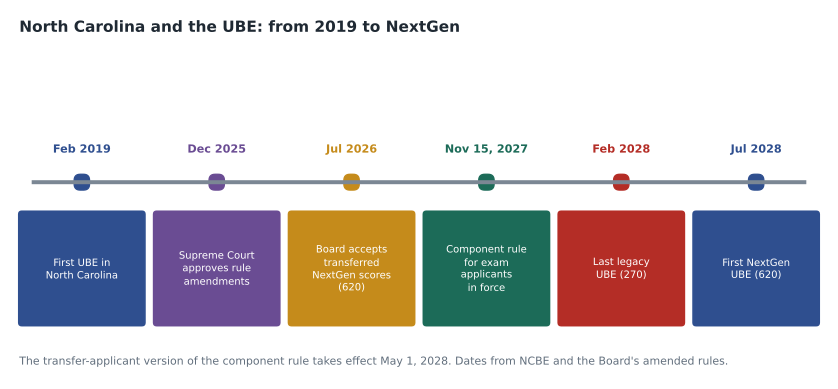
NCBE reports that North Carolina will give its last legacy UBE in February 2028 and its first NextGen UBE in July 2028. NCBE announced North Carolina's date in January 2026. North Carolina was not among the first group of jurisdictions that moved in July 2026; it chose a later start, as did several other states.
NCBE's guide also records two other dates. From July 2026, North Carolina accepts transferred NextGen scores from other jurisdictions, with a minimum of 620. And the NextGen passing score for North Carolina's own administrations, beginning in July 2028, is 620.
The rule amendments
The Supreme Court of North Carolina approved amendments to the Rules Governing Admission to the Practice of Law in December 2025, and the Board transmitted them for publication in the North Carolina Administrative Code. Several of the amendments implement the NextGen transition.
The definitions rule, section .0101, now provides that the Uniform Bar Examination includes the NextGen UBE. That single change lets the rest of the rules, which speak of the UBE, apply to both versions without separate wording.
The transfer rule, section .0504, as amended effective May 1, 2028, provides that a transfer applicant must have taken the UBE within three years before filing and achieved at least the Board's minimum passing score, and it specifies that the minimum is the passing score set as of the UBE administration immediately before the application is filed. That language is designed for a period in which North Carolina has two passing scores, 270 for legacy scores and 620 for NextGen scores.
The fee rule, section .0404, sets new fees beginning with the July 2028 examination, as noted in Lesson 2. And the rule on transferred Multistate Bar Examination scores, section .1002, was repealed effective January 1, 2026, consistent with NCBE's guide, which states that North Carolina does not accept transferred MBE scores.
The amendments also add the State-Specific Component on decedents' estates and trusts, with an effective date of November 15, 2027 for general applicants and May 1, 2028 for transfer applicants. Lesson 6 covers it.
What NextGen looks like
The NextGen bar exam is a different test, not a reformatted one. NCBE designed it to test a smaller set of legal subjects in less depth and to put more weight on lawyering skills. Its main features, as NCBE describes them, are these.
It is given in three sessions over one and a half days, on the same days as the legacy exam in jurisdictions that use it.
It produces a single score on a scale from 500 to 750, rather than separate MBE and written scores added together. Jurisdictions set their own passing scores on that scale; North Carolina's is 620.
It uses three kinds of questions. Standalone multiple-choice questions, some with one right answer and some asking the candidate to select more than one, make up about 49 percent of the score. Integrated question sets, which present a common fact pattern followed by several questions mixing multiple choice and short written answers, make up about 21 percent. Performance tasks, longer lawyering assignments similar in spirit to the MPT, make up about 30 percent.
It tests foundational concepts and principles in a defined list of subjects: Business Associations, Civil Procedure, Constitutional Law, Contracts, Criminal Law, Evidence, Real Property and Torts, with Family Law added for administrations from July 2028. It also tests foundational skills, including legal research, legal writing, issue spotting and analysis, investigation and evaluation, client counseling and advising, negotiation and dispute resolution, and client relationship and management.
The exam is delivered on computers at test sites, with the testing software provided by NCBE. Candidates should use NCBE's tutorial and sample questions to become familiar with the interface well before the exam.
| Feature | Legacy UBE (through February 2028) | NextGen UBE (from July 2028) |
|---|---|---|
| Days | Two days | One and a half days |
| Score | MBE plus scaled written score, out of 400 | Single score from 500 to 750 |
| North Carolina passing score | 270 | 620 |
| Question types | 200 MBE questions, six MEE essays, two MPT tasks | Standalone multiple choice, integrated sets, performance tasks |
| Skills emphasis | MPT only | Throughout, about half the score |
| Transferred scores accepted | Legacy scores of 270 within three years | NextGen scores of 620, accepted since July 2026 |
What the change means for a February 2027 candidate
For a first-time taker in February 2027, nothing about the exam itself changes. Grady will sit the legacy UBE, and he needs 270. His preparation should be built entirely around the legacy format: MBE, MEE and MPT.
The change matters only if he has to retake. A candidate who does not pass in February 2027 can sit the legacy exam in July 2027 and February 2028. A candidate who has still not passed by then meets NextGen in July 2028. Hollis told Grady that the right response to that fact is not anxiety but focus: the best protection against having to learn a new exam is passing this one.
What it means for repeaters
Repeaters face a strategic question in 2027. A candidate who fails in February 2027 by a small margin, especially on the MBE, should usually retake in July 2027, while the material is fresh and the format is familiar. A candidate who fails by a larger margin may still prefer to retake on the legacy format in July 2027 or February 2028 rather than wait for NextGen, because a full year of preparation for a different exam is a long time. Each case depends on the score report, work obligations and finances.
A candidate who expects to take NextGen in July 2028 should begin with NCBE's content scope outlines and sample questions, because NextGen tests some topics differently from the MBE and adds skills that the legacy exam tests only through the MPT.
What it means for score transfers
From July 2026, North Carolina accepts transferred NextGen scores of 620 or more. That means a lawyer who passed the NextGen exam in a July 2026 jurisdiction, such as Missouri or Connecticut, can apply to transfer that score to North Carolina, subject to the three-year age limit, character and fitness and the other transfer requirements. Legacy scores remain transferable at 270, within the same time limit. The amended rule's reference to the passing score for the administration immediately before filing is the mechanism that will govern which minimum applies once North Carolina gives NextGen itself.
Hollis pointed out that this works in both directions. A North Carolina legacy score of 270 or more earned in February 2027 is portable to other UBE jurisdictions that accept legacy scores, subject to their own minimums and age limits. Many jurisdictions have said they will continue to accept legacy scores for a period after their own switch, but each sets its own policy, and a candidate who plans to move should check the receiving jurisdiction's current rule.
What it means for practice
Even for lawyers who will never take NextGen, the change has practical consequences. Law schools are adjusting their curricula toward the NextGen subjects and skills. Supervising lawyers will hire new associates whose exam emphasized counseling, drafting and research. And North Carolina's decision to add a component on estates and trusts reflects a view that some North Carolina law should be tested directly, whatever the general exam covers.
How the change came about
NCBE developed the NextGen exam over several years after a testing task force recommended a new exam that would place more weight on the skills newly licensed lawyers actually use. NCBE announced the first administration for July 2026 and invited jurisdictions to adopt it on their own timetables. Jurisdictions considered the costs of transition, the readiness of law schools and candidates, and the effect on score portability. Some moved in July 2026; others, including North Carolina, chose later dates. North Carolina's choice of July 2028 gives the Board, the state's law schools and candidates time to prepare, and lets the Board observe the early administrations elsewhere.
The decision to add a State-Specific Component at about the same time reflects a separate judgment. The legacy UBE, after the July 2026 removal of Trusts and Estates from the MEE, and the NextGen exam both test estates law only lightly, if at all. By making estates and trusts a required component, North Carolina ensures that every lawyer it admits from late 2027 onward has been tested on the state's own rules in that area.
Preparing for NextGen if you need to
A candidate who expects to sit NextGen in North Carolina in July 2028 or later should prepare differently from a legacy candidate. NCBE's content scope outlines define the topics in each subject and mark the topics that may be tested in greater depth. The skills, especially legal research using a supplied library and client counseling, need practice of their own. NCBE's sample questions and tutorial show the question formats and the software. A candidate moving from legacy preparation to NextGen should not assume that strong MBE performance will carry over automatically: the multiple-select format, the integrated sets and the short written answers reward different habits, such as reading every option carefully and writing short, precise answers.
The NextGen subject list also matters for North Carolina candidates in particular. Family Law joins the tested subjects from July 2028, the month North Carolina begins, so every NextGen candidate in North Carolina will be tested on the family law concepts in NCBE's outline. Those are general principles, not North Carolina's equitable distribution or alimony statutes, and Lesson 9's North Carolina rules should be kept separate from the exam answer.
A practical rule of thumb follows. A candidate who has a realistic chance of passing the legacy exam by February 2028 should give it full effort rather than splitting attention between two formats. A candidate who expects to sit in July 2028 or later should switch materials completely and early, because habits built on the legacy MBE, such as reading only for the single best answer, can cost points on multiple-select questions.
Questions to ask the Board
Because the transition involves rules with different effective dates, candidates with unusual situations should ask the Board directly and in writing. Examples include a candidate who passes the legacy exam in February 2028 but is admitted after the component rule takes effect, a candidate who wants to transfer a legacy score earned elsewhere after North Carolina switches to NextGen, and a servicemember whose deployment affects the timing of the MPRE or the component. The Board's written answer, kept in the candidate's file, is the safest guide.
Worked problem
Planning a retake
Ivey Tolson, a hypothetical candidate, sits the North Carolina exam in February 2027 and receives a total of 262, with a scaled MBE of 128 and a scaled written score of 134. She works full time and can study only in the evenings. What should she consider?
Show solution
- She missed 270 by 8 points; her MBE is well below the 135 average and her written score is close to it.
- The July 2027 and February 2028 exams in North Carolina are still the legacy UBE, so her preparation carries over.
- Raising her MBE by about 8 scaled points would likely be enough, because the written score is scaled to the MBE.
- If she waits past February 2028, she will face the NextGen exam with a different format and a 620 passing score.
Answer: Ivey should plan to retake the legacy exam in July 2027 or February 2028, with an MBE-centered plan, rather than waiting for NextGen.
Common mistakes
MistakeNorth Carolina switched to NextGen in July 2026.
InsteadNorth Carolina's first NextGen exam is July 2028; it began accepting transferred NextGen scores in July 2026.
MistakeNextGen scores are on the same 400-point scale.
InsteadNextGen produces a single score from 500 to 750; North Carolina's passing score is 620.
MistakeNorth Carolina accepts transferred MBE scores.
InsteadIt does not; the MBE transfer rule was repealed effective January 1, 2026.
MistakeA February 2027 candidate should prepare for NextGen.
InsteadA February 2027 candidate sits the legacy UBE and should prepare for it.
Practice problems
Work each problem on paper first, then reveal the answer to check.
When is North Carolina's first NextGen exam?
Show answer
July 2028.
What is North Carolina's NextGen passing score?
Show answer
620.
Since when has North Carolina accepted transferred NextGen scores?
Show answer
July 2026.
What does amended section .0101 say about the UBE?
Show answer
That the UBE includes the NextGen UBE.
About what share of the NextGen score comes from performance tasks?
Show answer
About 30 percent.
Summary and key terms
- North Carolina's last legacy UBE is February 2028 and its first NextGen UBE is July 2028.
- North Carolina accepts transferred NextGen scores of 620 from July 2026 and will use 620 as its own NextGen passing score.
- The December 2025 rule amendments define the UBE to include NextGen, revise the transfer rule, set new fees and add the State-Specific Component.
- NextGen gives a single 500 to 750 score from standalone questions, integrated sets and performance tasks.
- A February 2027 candidate sits the legacy exam; repeaters should weigh retaking before the switch.
- NextGen UBE
- NCBE's new bar exam, first given in North Carolina in July 2028.
- integrated question set
- A NextGen fact pattern followed by several related questions.
- performance task
- A NextGen lawyering assignment using a supplied file and library.
- foundational skills
- The lawyering skills NextGen tests, such as research, writing and counseling.
- transferred score
- A UBE score earned in one jurisdiction and used for admission in another.
Lesson quiz · 5 questions
Score 60% or more to complete this lesson.
Create a free account to save your progress, take quizzes and earn a certificate.