
BAR-234 · Lesson 2 of 12 · 21 min
Eligibility, education, application deadlines and fees
▶ Video coming soon A video version of this lesson is on the way.
At the second session Grady brought a printout of his filing confirmation. He had submitted his application for the February 2027 exam a few days before the first deadline in early October 2026, after a late night assembling addresses for every apartment he had rented since college. 'I was proud of filing on time,' he said, 'until a friend from law school told me she missed the deadline by two days and is now paying a late fee and wondering whether her file will be complete in time.' Hollis said that North Carolina's calendar catches people every cycle, and that the best protection is to understand it well before it matters.
This lesson covers who may apply as a general applicant, the education rules, the two filing deadlines for each exam, the fees, and the practical steps that keep an application moving. The details come from the Board's rules and NCBE's jurisdiction guide for North Carolina; the Board publishes exact dates for each administration, and those published dates control.
General applicants and attorney applicants
The Board's rules distinguish general applicants from other categories. A general applicant is a person applying for admission by examination. Within that group, the rules and the fee schedule treat applicants differently depending on whether they are already licensed in another jurisdiction. A recent law graduate who has never been licensed pays the first-time applicant fee. A lawyer licensed elsewhere who chooses, or needs, to sit the North Carolina exam pays the higher attorney applicant fee, which reflects the added investigation of the lawyer's practice history and discipline record.
Other categories have their own rules: applicants by transferred UBE score under section .0504 and applicants by comity under the comity rules. Those routes are the subject of Lesson 11. This lesson concentrates on the general applicant who will sit the exam.
The education requirement
North Carolina's education rule is built around graduation from a law school approved by the American Bar Association. A candidate with a JD from an ABA-approved law school meets the requirement. NCBE's guide records that North Carolina does not limit eligibility only to ABA graduates, but the exceptions are narrow. A graduate of a law school outside North Carolina that is not ABA-approved may sit only if the graduate is already admitted to practice in another state. A graduate of a foreign law school may sit only if the graduate is also admitted in another United States jurisdiction. An LLM from an ABA-approved school does not by itself make a foreign-educated lawyer eligible.
That last point surprises some foreign-trained lawyers, because several states, including New York, allow an LLM to qualify a foreign lawyer to sit. In North Carolina the usual path for such a lawyer is to be admitted first in a jurisdiction that accepts the LLM route, and then to apply in North Carolina, either by sitting the exam as an attorney applicant or, after the required years of practice, by comity if reciprocity is available.
The rules also include prelegal education requirements and other formal conditions, and an applicant should read section .0501 of the Board's rules for the complete list. For a typical candidate with a bachelor's degree and a JD from an ABA-approved school, the education requirement is met once the law school certifies graduation.
The filing calendar
North Carolina has two filing deadlines for each exam: a first deadline and a later deadline that carries a late fee. NCBE's guide gives the dates for the current cycle. For the February 2027 exam, the first deadline was October 6, 2026 and the late deadline was November 3, 2026. For the July 2026 exam, the first deadline was January 6, 2026 and the late deadline was March 3, 2026. The pattern is consistent: early October and early November for a February exam, early January and early March for a July exam.
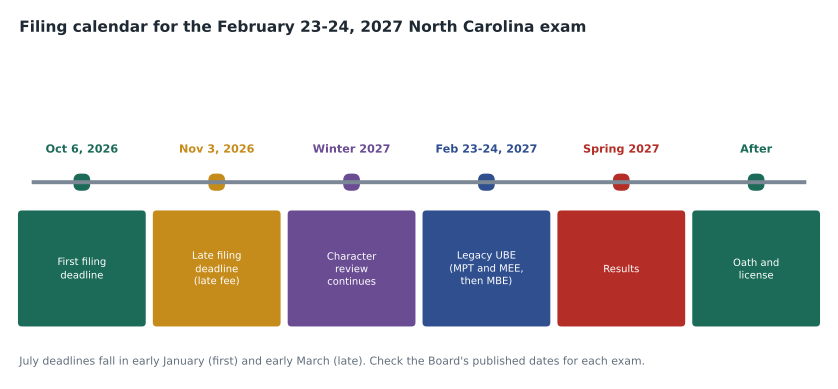
The early dates are deliberate. North Carolina's character and fitness review takes time, and the Board wants files open long enough for its staff to collect records, check references and resolve questions before the exam. A candidate who files at the first deadline gives the Board about four and a half months before a February exam; a candidate who files at the late deadline gives it about three and a half.
For the July exam, the January deadline means that most candidates file during their final semester of law school, before they graduate. The law school then certifies the degree after commencement. Hollis told Grady that she advises July candidates to treat the winter break of their third year as filing season: gather transcripts, court records and address histories in December, and file in the first week of January.
Fees
NCBE's guide lists the following fees for the North Carolina bar exam under the current schedule: 850 dollars for a first-time applicant who is not an attorney, 1,650 dollars for an attorney applicant, 400 dollars for a repeat applicant, and 125 dollars for the laptop option. The Board's amended rules keep the late filing fee at 250 dollars. Fees change from time to time, and the amendments approved by the Supreme Court of North Carolina in December 2025 set new amounts beginning with the July 2028 exam: 1,025 dollars for applicants not licensed elsewhere, 1,825 dollars for applicants licensed elsewhere, and 575 dollars for a supplemental application.
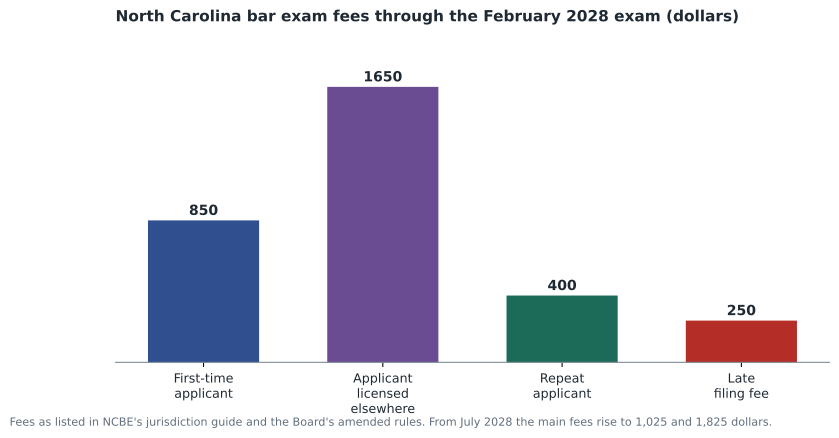
A repeat applicant does not start over. The rules use a supplemental application for applicants who have applied before, which updates the earlier file instead of rebuilding it. That is why the repeat fee is lower: much of the investigation is already done. A repeater must still update every answer that has changed, including new addresses, jobs, citations and any change in financial circumstances.
| Item | Current amount | From the July 2028 exam |
|---|---|---|
| First-time applicant (not licensed elsewhere) | 850 dollars | 1,025 dollars |
| Applicant licensed elsewhere | 1,650 dollars | 1,825 dollars |
| Repeat or supplemental application | 400 dollars | 575 dollars |
| Late filing fee | 250 dollars | 250 dollars |
| Laptop option | 125 dollars | Check the Board's notice |
What a complete application looks like
A complete North Carolina application is long. It asks for every residence and employer, all schools attended, every civil and criminal matter in which the applicant has been involved, financial history, bar admissions elsewhere, and references. It requires supporting documents, including transcripts, certificates and court records, and some of these must come directly from the issuing institution. North Carolina does not use NCBE's character and fitness investigation service; applicants file with the Board under the Board's own instructions.
Hollis gave Grady the list she gives every North Carolina candidate of the things that most often slow a file.
Court records. Any charge, citation or civil case, including matters that were dismissed or expunged, must be disclosed if the question calls for it, and the applicant often has to obtain the court file. A speeding ticket from college that was paid by mail can still require a certified record from the clerk of court in the county where it was issued. This takes weeks, not days.
Address and employment histories. The Board checks what an applicant reports against what references and records show. A missing summer job or a wrong month for a lease is not a character problem, but it starts a round of letters that delays the file.
Financial matters. Defaulted loans, collections and judgments must be disclosed and explained. The Board is not looking for debt-free applicants; it is looking for applicants who handle their obligations responsibly and candidly.
References. The application asks for people who can speak to the applicant's character. A reference who does not respond is the applicant's problem to solve. Hollis told Grady to tell each reference in advance that the Board would be in touch, and to choose people who answer mail.
Duty to update
The application is not a snapshot. An applicant has a continuing duty to update it until admission. A new job, a new address, a traffic citation, a lawsuit, or any change that would alter an answer must be reported promptly. Grady asked whether his move from his parents' house in Rocky Mount to an apartment in Greenville in August counted. It did, and he had already reported it, but he had not yet reported that his firm had promoted him from part-time intern to full-time law clerk in September. He sent the update that evening.
Testing accommodations
Applicants with disabilities may request testing accommodations. The request is separate from the application, has its own documentation requirements and deadlines, and should be filed as early as possible because supporting documentation takes time to assemble. The MPRE has its own accommodations process through NCBE.
February or July
Most new graduates sit in July, right after law school. February is common for December graduates, for candidates who need more time, and for repeaters. NCBE equates scores across administrations, so a 270 means the same thing in February as in July. February pass rates are lower in many jurisdictions, but that reflects the larger share of repeat takers, not a harder exam. The choice should turn on readiness and on how much uninterrupted study time a candidate can protect.
Grady had chosen February because his clerkship began in September and Ruthanne had agreed to cut his hours from January onward. Hollis said that was a sound plan, provided he started serious MBE work in November and did not let the firm's files crowd out study time in December.
A filing checklist
Hollis gave Grady the checklist she uses with every North Carolina candidate, organized by when each step should happen.
Three months before the first deadline: order transcripts from every college and law school attended, including summer programs at other schools; request certified court records for any citation, charge or civil case; pull a credit report and resolve or document any errors; and collect every address since age eighteen, with dates, from leases, utility bills and old tax returns.
Six weeks before the first deadline: ask references whether they are willing to serve and confirm their current contact details; draft explanations for anything that will need one, attaching documents rather than characterizing them; and start the online application so that the system's questions shape the records still needed.
Two weeks before the first deadline: review every answer against the documents; have someone else read the address and employment sections for gaps; and pay the fee with enough time for any payment problem to be fixed.
After filing: calendar the dates by which the Board may ask for more information, keep copies of everything submitted, and set a reminder to review the application monthly for changes that must be reported.
Grady said the checklist would have saved him the late night before he filed. Hollis said that was its purpose, and that the same habits, gathering documents early, checking them against each other and keeping a calendar, are the habits of a careful lawyer.
Withdrawal and changing exams
Plans change. A candidate who has filed for February may find that work, health or family obligations make the date impossible. The Board's rules and notices govern whether an application can be carried forward to a later exam, what part of the fee, if any, can be applied, and what deadlines apply to the request. A candidate in that position should contact the Board as soon as the problem is clear, in writing, rather than simply not appearing.
Worked problem
Missing the first deadline
Odell Beasley, a hypothetical May 2026 graduate of an ABA-approved law school, decides in mid-October 2026 to sit the February 2027 North Carolina exam. The first deadline has passed. What are his options?
Show solution
- The first filing deadline for February 2027 was October 6, 2026; it has passed.
- The late filing deadline was November 3, 2026; an application filed by then is accepted with the late fee of 250 dollars in addition to the filing fee.
- Filing late leaves less time for character and fitness review, so Odell should file a complete application with all supporting records as quickly as possible.
- If he cannot file by the late deadline, he must wait for the July 2027 exam, whose first deadline falls in early January 2027.
Answer: Odell can still sit in February 2027 if he files by November 3, 2026 and pays the late fee; otherwise he should plan for July 2027.
Common mistakes
MistakeAny foreign-trained lawyer with an ABA-approved LLM may sit the North Carolina exam.
InsteadA foreign law graduate must also be admitted in another U.S. jurisdiction; the LLM alone does not qualify.
MistakeThe July deadline falls in the spring after graduation.
InsteadThe first July deadline falls in early January, during the last semester of law school.
MistakeA repeat applicant files a brand-new application.
InsteadRepeaters file a supplemental application that updates the existing file, at a lower fee.
MistakeOnce filed, the application is final.
InsteadApplicants must update it promptly until admission.
MistakeNorth Carolina uses NCBE's character and fitness service.
InsteadNorth Carolina runs its own character and fitness process; applicants follow the Board's instructions.
Practice problems
Work each problem on paper first, then reveal the answer to check.
What were the first and late filing deadlines for the February 2027 exam?
Show answer
October 6, 2026 and November 3, 2026.
What is the first-time applicant fee under the current schedule?
Show answer
850 dollars.
What is the late filing fee?
Show answer
250 dollars, in addition to the filing fee.
May a graduate of a non-ABA law school outside North Carolina sit the exam?
Show answer
Only if admitted to practice in another state.
What fees apply from the July 2028 exam?
Show answer
1,025 dollars (not licensed elsewhere), 1,825 dollars (licensed elsewhere), 575 dollars for a supplemental application.
Summary and key terms
- General applicants sit the exam; the fee depends on whether the applicant is licensed elsewhere.
- A JD from an ABA-approved school meets the education requirement; non-ABA and foreign graduates must be admitted elsewhere first.
- February deadlines fall in early October and early November; July deadlines in early January and early March.
- Current fees: 850, 1,650, 400 for repeaters, 250 late; new fees from July 2028.
- A complete application needs court records, histories, financial disclosures and responsive references, and it must be kept current.
- general applicant
- A person applying for admission by examination.
- supplemental application
- The update filed by an applicant who has applied before.
- late filing deadline
- The second deadline, which requires a late fee.
- attorney applicant
- A general applicant already licensed in another jurisdiction, who pays a higher fee.
- duty to update
- The continuing obligation to report changes in an application until admission.
Lesson quiz · 5 questions
Score 60% or more to complete this lesson.
Create a free account to save your progress, take quizzes and earn a certificate.