
BAR-230 · Lesson 9 of 12 · 23 min
New Hampshire family law, wills and estates
▶ Video coming soon A video version of this lesson is on the way.
Joan Thayer, the third lawyer at Caswell and Thayer, handles the firm's divorces and estate plans, and in October she gave Ezra two files on the same afternoon. The first was a divorce: a couple married fourteen years, with two children, a house in Bow, a retirement account and a camp on Newfound Lake that the husband had inherited from his grandmother before the marriage. The second was an estate plan for a widow in Hopkinton with three adult children, one of whom she had not spoken to in a decade. 'Two files, two New Hampshire rules that surprise lawyers from other states,' Thayer told him. 'In the divorce, the camp is on the table. In the will, the estranged son had better be named.'
Family law and trusts and estates were removed from the MEE in July 2026, and the New Hampshire rules were never tested on the UBE in any case. But these are among the most common kinds of work for a new lawyer in a small New Hampshire firm. This lesson covers divorce, property division, alimony, parenting and child support, then turns to wills, the pretermitted heir rule, intestacy, the surviving spouse's rights and probate practice.
Where family cases are heard
Divorce, legal separation, parenting, child support and domestic violence cases are heard in the Family Division of the Circuit Court, described in Lesson 7. The divorce statute is RSA chapter 458, the parenting statute is RSA chapter 461-A and the child support guidelines are in RSA chapter 458-C. Many family cases involve self-represented parties, and the Family Division has standard forms and procedures designed for them, including required parenting education programs and financial affidavits.
Grounds for divorce
New Hampshire allows both no-fault and fault divorce. The no-fault ground in RSA 458:7-a is irreconcilable differences that have caused the irremediable breakdown of the marriage. Most New Hampshire divorces are granted on that ground, often on a joint petition.
RSA 458:7 lists fault grounds, some of which date to the nineteenth century: adultery, impotency, extreme cruelty, conviction of a serious crime followed by imprisonment, conduct that seriously injures health or endangers reason, habitual drunkenness for a period set in the statute, and abandonment or refusal to cohabit for a period set in the statute, among others. Fault grounds are less common than they once were, but they matter for two reasons. They may affect the division of property, because the property statute allows the court to consider fault in some circumstances, and some clients want the record to reflect what happened.
The court must also have jurisdiction. In general, New Hampshire's divorce jurisdiction statute requires that both parties be domiciled in the state, or that the plaintiff be domiciled in the state and the defendant be served in the state, or that one party have been domiciled in the state for a period set in the statute, usually a year, before the filing. A new lawyer should check the jurisdictional facts before filing, especially for clients who recently moved from Massachusetts, Maine or Vermont.
Property division: everything is on the table
New Hampshire's property division statute, RSA 458:16-a, is one of the broadest in the country. It defines the property to be divided as all tangible and intangible property and assets belonging to either or both parties, whether title is held individually or jointly. There is no category of separate property that is automatically excluded. Property owned before the marriage, property inherited during the marriage and gifts from third parties all fall within the pool to be divided.
The statute then directs the court to presume that an equal division is an equitable distribution. The court may depart from equal division when it decides that an equal division would not be appropriate or equitable after considering a list of factors. The factors include the length of the marriage, the ages and health of the parties, their earning capacities and needs, their contributions to the marriage, including contributions as homemaker and parent, the value of property brought into the marriage or acquired by gift or inheritance, and, in some circumstances, the fault of a party and its economic consequences.
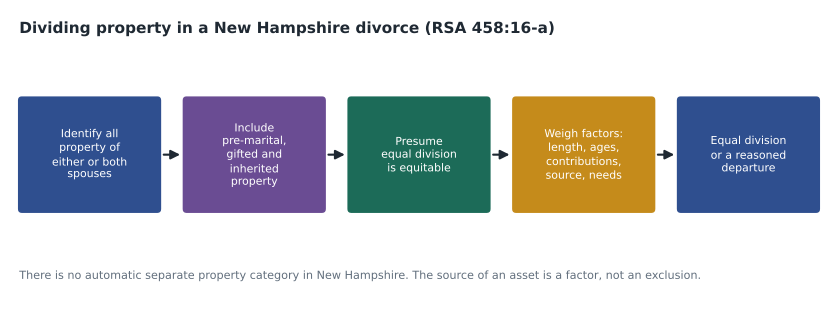
The camp on Newfound Lake shows how the statute works. In many states, a cottage inherited before the marriage would be the husband's separate property, outside the divorce. In New Hampshire, it is part of the marital pool. Its source is not ignored: the court may consider that it was inherited before the marriage and was the husband's family's for three generations in deciding whether to depart from equal division. But the starting point is that it is property to be divided, and the husband carries the burden of persuading the court that an unequal division is equitable.
Worked problem
Dividing the Bow divorce estate
The couple's property: the house in Bow (equity 300,000 dollars), the wife's retirement account (200,000 dollars), and the camp (worth 400,000 dollars), inherited by the husband before the fourteen-year marriage. No other significant assets or debts.
Show solution
- Identify the pool: under RSA 458:16-a all three assets are property to be divided, a total of 900,000 dollars.
- Start from the presumption: equal division would give each spouse 450,000 dollars.
- Consider the factors: the camp's source as a pre-marital inheritance, the length of the marriage and each spouse's contributions, including whether marital funds were used to maintain the camp.
- Possible outcomes: the court could divide all assets equally, or award the husband the camp and a larger overall share if it finds an equal division inequitable, explaining its reasons.
Answer: All three assets are divisible; equal division is presumed, and the camp's inherited source is a factor the court may weigh in departing from it.
Alimony
New Hampshire reformed its alimony statute, RSA 458:19, with changes that took effect in 2019. The statute now provides a framework for term alimony that ties the amount to a guideline calculated from the difference between the parties' incomes, subject to the payee's reasonable need and the payor's ability to pay, and limits the duration of term alimony in relation to the length of the marriage. The court may deviate from the guideline for reasons set out in the statute. The statute also addresses reimbursement alimony and the modification and termination of awards.
A new lawyer advising a divorcing client should run the statutory calculation early, because it frames settlement negotiations, and should read the current statute for the details of the formula, the duration limits and the deviation criteria.
Parental rights and responsibilities
In 2005 New Hampshire replaced the language of custody and visitation with the Parental Rights and Responsibilities Act, RSA chapter 461-A. The statute divides parenting into two concepts. Decision-making responsibility covers major decisions about a child, such as education, nonemergency health care and religious upbringing. Residential responsibility covers where the child lives and the schedule of parenting time. Every parenting case results in a parenting plan, and parents are encouraged to agree on one.
The statute creates a presumption that joint decision-making responsibility is in the child's best interests, except in cases involving abuse, where the presumption does not apply. Residential responsibility is allocated according to the child's best interests, considering factors listed in RSA 461-A:6, such as the relationship of the child with each parent, each parent's ability to provide for the child's needs, the child's developmental needs, the support of each parent for the child's relationship with the other parent, any history of abuse, and the child's preferences, given weight according to the child's maturity.
| Concept | What it covers | Default rule |
|---|---|---|
| Decision-making responsibility | Major decisions: education, nonemergency health care, religion | Presumption of joint decision-making, except in abuse cases |
| Residential responsibility | Where the child lives and the parenting schedule | Allocated by the child's best interests under RSA 461-A:6 |
| Parenting plan | The written arrangement for both kinds of responsibility | Required in every parenting case |
| Child support | Financial support of the child | Guidelines in RSA 458-C based on the parents' combined income and the number of children |
Child support
Child support is calculated under the guidelines in RSA chapter 458-C. The guidelines apply a percentage, which rises with the number of children, to the parents' combined adjusted income, and then divide the resulting obligation between the parents in proportion to their incomes. The court may deviate from the guideline amount for reasons listed in the statute, such as special needs of a child or substantially equal parenting schedules. The guidelines are reviewed periodically, and the Family Division provides worksheets that lawyers and self-represented parties use to calculate support.
Making a valid will
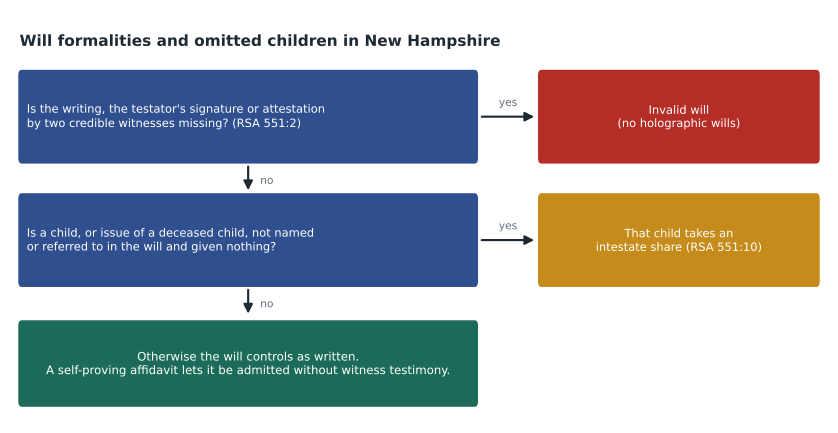
Turning to estates, New Hampshire's formalities for wills are set by RSA chapter 551. A person who is at least eighteen and of sane mind may make a will. The will must be in writing, signed by the testator or by someone else in the testator's presence and at the testator's direction, and signed by two or more credible witnesses who attest it. New Hampshire does not recognize holographic wills, meaning an unwitnessed handwritten will is not valid simply because it is in the testator's handwriting. A will may be made self-proved by an affidavit signed by the testator and witnesses before a notary or other official, which allows it to be admitted to probate without testimony from the witnesses.
The pretermitted heir rule: name every child
The rule Joan Thayer warned Ezra about is New Hampshire's pretermitted heir statute, RSA 551:10. Under that statute, a child of the testator, or the issue of a deceased child, who is not named or referred to in the will and who is not a beneficiary under it, is entitled to the same share of the estate as if the testator had died without a will. The statute protects children who were overlooked, but it applies whether the omission was accidental or deliberate. A parent who intends to leave nothing to a child must still name or refer to the child in the will.
New Hampshire's statute is broader than the omitted-child statutes in many states, which protect only children born or adopted after the will was made. In New Hampshire, a child who was alive when the will was signed, but who is not mentioned, can claim an intestate share. For that reason, careful New Hampshire wills include a clause listing all of the testator's children by name, and wills that disinherit a child say so expressly.
Worked problem
Drafting the Hopkinton widow's will
The widow wants to leave her estate equally to two of her three children and nothing to her son Daniel, with whom she has not spoken in ten years.
Show solution
- Formalities: the will must be signed and attested by two credible witnesses; Thayer prepares it with a self-proving affidavit.
- Pretermitted heir risk: if the will simply leaves everything to the two daughters and does not mention Daniel, he can claim an intestate share under RSA 551:10.
- Drafting solution: the will names all three children and states that she intentionally makes no provision for Daniel.
- Practice note: the firm keeps a record of the client's instructions in case of a later contest.
Answer: Naming Daniel and stating the intentional omission prevents a pretermitted heir claim.
Intestacy and the surviving spouse
When a person dies without a valid will, RSA chapter 561 determines who inherits. New Hampshire's intestacy statute follows the general pattern of the modern Uniform Probate Code. A surviving spouse receives the entire estate in the simplest case, where there are no descendants or parents or where all the decedent's descendants are also descendants of the surviving spouse and the spouse has no other descendants. In other situations, such as when the decedent has children from another relationship, the spouse receives a fixed dollar amount plus a fraction of the rest, with the remainder passing to the descendants. Without a spouse, the estate passes to descendants, then parents, then siblings and their descendants and more distant relatives in the order the statute sets.
A surviving spouse who is unhappy with the will may waive its provisions and take a statutory share instead. The amount of the statutory share depends on whether the decedent left descendants or other relatives, and the waiver must be filed in the Probate Division within a set time. Because the rules produce different results depending on the family's composition, a new lawyer should calculate the shares from the current statute in every case rather than relying on a rule of thumb.
Probate practice and trusts
Estates are administered in the Probate Division of the Circuit Court. A person named in the will, or an interested person if there is no will, petitions for appointment as administrator. New Hampshire probate forms generally use the term administrator, rather than executor, for the fiduciary of both testate and intestate estates. Small estates may qualify for simplified procedures under RSA chapter 553, and the Probate Division provides forms for inventories, accounts and closing documents.
Trusts are governed by the New Hampshire Trust Code, RSA chapter 564-B, based on the Uniform Trust Code. New Hampshire has worked to make itself a favorable place for trusts, adopting modern provisions on matters such as directed trusts, trust protectors, decanting and the duration of trusts. Trust work is a significant part of practice in Concord and the Seacoast, and a new lawyer in an estates practice will spend much of the first year learning it.
Common mistakes
MistakeInherited property is separate property and stays out of a New Hampshire divorce.
InsteadRSA 458:16-a includes all property of either spouse, whatever its source; source is only a factor in departing from equal division.
MistakeA handwritten, signed will is valid in New Hampshire.
InsteadNew Hampshire does not recognize holographic wills; two credible witnesses are required.
MistakeLeaving a child out of the will is enough to disinherit the child.
InsteadUnder RSA 551:10, an unnamed child takes an intestate share. Name the child and state the intentional omission.
MistakeCustody and visitation are the terms the court uses.
InsteadRSA 461-A uses decision-making and residential responsibility in a parenting plan.
MistakeThe surviving spouse always takes the whole estate when there is no will.
InsteadThe spouse's share depends on the family's composition under RSA 561.
Summary and key terms
- Family cases are heard in the Family Division; most divorces are granted for irreconcilable differences under RSA 458:7-a.
- RSA 458:16-a divides all property of either spouse, including pre-marital and inherited property, with a presumption of equal division.
- Alimony under RSA 458:19 follows a guideline framework with duration limits tied to the length of the marriage.
- RSA 461-A divides parenting into decision-making and residential responsibility, with a presumption of joint decision-making except in abuse cases.
- A valid will needs writing, the testator's signature and two credible witnesses; holographic wills are not recognized.
- RSA 551:10 gives an intestate share to any child not named or referred to in the will, so careful wills name every child.
- 0
- irreconcilable differences
- 1
- equitable distribution
- 2
- presumption of equal division
- 3
- decision-making responsibility
- 4
- residential responsibility
- 5
- parenting plan
- 6
- pretermitted heir
- 7
- self-proved will
Practice problems
Work each problem on paper first, then reveal the answer to check.
Is a camp inherited by one spouse before the marriage divisible in a New Hampshire divorce?
Show answer
Yes. RSA 458:16-a includes all property of either spouse; the inheritance is a factor the court may weigh in departing from equal division.
What does RSA 551:10 provide?
Show answer
A child, or issue of a deceased child, who is not named or referred to in the will and takes nothing under it receives an intestate share.
Does New Hampshire recognize holographic wills?
Show answer
No. A will must be attested by two credible witnesses.
What presumption applies to decision-making responsibility for a child?
Show answer
A presumption of joint decision-making responsibility, except in cases of abuse.
Lesson quiz · 5 questions
Score 60% or more to complete this lesson.
Create a free account to save your progress, take quizzes and earn a certificate.